
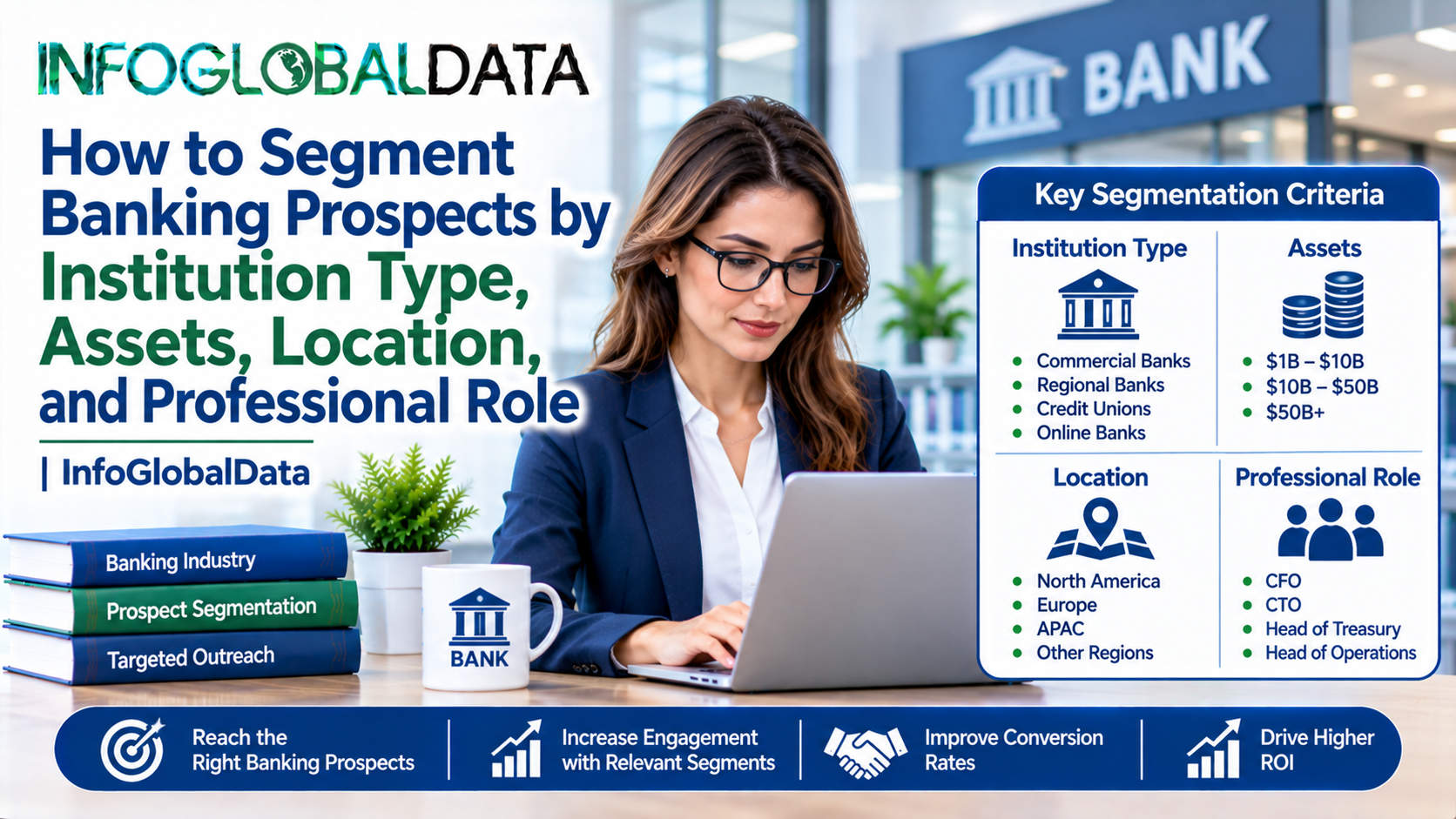
How to Segment Banking Prospects by Institution Type, Assets, Location, and Professional Role | InfoGlobalData

Introduction
Effective banking-sector outreach starts with understanding how financial institutions differ. A community bank with several hundred million dollars in assets does not have the same operating structure, technology budget, or purchasing priorities as a regional bank or a multinational institution. According to the Federal Reserve's December 2025 Supervision and Regulation Report, its supervisory framework distinguishes community banking organizations with less than $10 billion in assets, regional organizations with $10 billion to $100 billion, and large organizations with $100 billion or more. These distinctions provide a useful foundation for B2B prospect segmentation. A well-structured Banking Email List should therefore go beyond institution names and contact details. By combining institution type, asset size, geography, and professional role, marketers can develop more relevant campaigns and prioritize prospects according to their likely business needs.
1. Segment prospects by financial institution type
The first step is to classify prospects according to the type of institution they represent. Banks operate under different business models, serve different customer segments, and often have different purchasing structures.
Common categories include:
-
Community banks: Often focus on local markets, small businesses, relationship banking, and regional lending.
-
Regional banks: Typically operate across multiple markets and may have more complex lending, technology, and compliance requirements.
-
National and large banks: Often have specialized departments, centralized procurement, and enterprise-level technology requirements.
-
Foreign banking organizations: May operate through U.S. branches, agencies, or other regulated structures.
-
Savings institutions: Can have different operating and customer focuses from commercial banks.
The Federal Reserve's December 2025 report illustrates the scale differences. As of June 30, 2025, its supervisory portfolio included 3,367 community banking organizations with less than $10 billion in assets, 100 regional banking organizations with $10 billion to $100 billion, and 173 large and foreign banking organizations under its LFBO program. The last category includes foreign banking organizations operating in the United States, regardless of asset size, so it should not be treated as a simple domestic-bank size category.
Why this matters: A technology provider targeting community banks may emphasize affordable modernization, operational efficiency, or local customer engagement. A supplier approaching a large bank may need to address enterprise integration, cybersecurity, governance, or procurement requirements.
For marketers using a Banking Mailing list, institution type is a useful first filter before narrowing the audience by asset size or professional responsibility.
2. Use asset size to estimate organizational scale and potential needs
Institutional assets provide another useful segmentation dimension. A bank's balance sheet can indicate its operating scale, lending capacity, and organizational complexity. However, asset size should be treated as a targeting indicator—not as a direct measure of technology spending, purchasing authority, or budget availability.
The St. Louis Federal Reserve reported in May 2026 that the number of U.S. banks declined by 13% between 2020 and 2025, reaching 4,336, while average assets per institution increased by 33% to $5.8 billion. The analysis attributes the trend partly to consolidation and limited new bank formation.
This changing structure makes asset-based segmentation particularly useful. One practical framework for organizing prospects is:
|
Asset category |
Possible prospect profile |
Potential outreach focus |
|---|---|---|
|
Under $1 billion |
Smaller community institutions |
Operational efficiency, local lending, cost-effective services |
|
$1 billion–$10 billion |
Larger community banks |
Technology modernization, data management, commercial growth |
|
$10 billion–$100 billion |
Regional institutions |
Integration, risk management, analytics, scalable services |
|
$100 billion and above |
Large banking organizations |
Enterprise systems, cybersecurity, governance, complex procurement |
These are practical marketing bands, not universal regulatory classifications. The Federal Reserve uses the $10 billion and $100 billion thresholds in its supervisory framework, while the smaller subdivisions help marketers create more focused campaign segments.
The 2026 CSI Banking Priorities report provides further evidence that priorities can vary by asset size. Among its community financial institution respondents, technology modernization was a strategic priority for 31% of institutions in the $100 million–$250 million category, compared with 59% in the $5 billion–$10 billion category. The survey included 252 banking professionals and credit union respondents, so these figures should be interpreted within that sample rather than applied to every U.S. bank.
A Banking Email List segmented by asset range can help marketers tailor their messaging to different organizational scales instead of sending identical offers to every institution.
3. Add geographic segmentation to identify relevant banking markets
Location matters because banks operate within local, regional, national, and international markets. A financial institution's headquarters, branch footprint, and deposit-market presence can all help marketers determine whether it fits a campaign's geographic objectives.
The FDIC's September 2026 Summary of Deposits release provides a useful resource for this analysis. Its annual survey, based on June 30, 2026 data, covers more than 75,000 domestic offices operated by over 4,200 FDIC-insured institutions. The data can be used to examine branch-level deposits and compare institutional market share by state, county, and metropolitan statistical area.
Marketers can use geographic information in several ways:
-
State-level targeting: Identify banks operating in selected states or territories.
-
County and metropolitan targeting: Focus on institutions with a presence in specific local business markets.
-
Regional segmentation: Group banks across neighboring states when a product or service has a regional focus.
-
Branch-footprint analysis: Distinguish institutions with concentrated local networks from those with broader geographic coverage.
One important qualification is that a bank's headquarters location does not necessarily represent its entire operating market. A bank headquartered in one state may maintain branches and business relationships across several others. Similarly, branch deposits are not a complete measure of every institution's customer relationships or commercial reach.
For this reason, marketers should combine location data with institution-level information. An accurately organized Banking Email Database should distinguish headquarters, branch locations, and broader operating regions wherever reliable data is available.
4. Segment by professional role and business responsibility
Once institutions are classified by type, asset size, and location, the next step is to identify the people most relevant to the campaign.
Banking purchasing decisions frequently involve multiple departments. A technology purchase, for example, may require input from IT, cybersecurity, operations, finance, compliance, and executive leadership. Targeting only a bank's CEO may overlook the professionals who evaluate solutions or manage implementation.
The 2026 CSI Banking Priorities survey offers insight into the responsibilities represented in community financial institutions. Its 252 respondents included C-level executives (28%), directors (25%), managers (31%), senior vice presidents (9%), and vice presidents (7%). This distribution demonstrates the range of seniority involved in discussing banking priorities, although it does not establish the decision-making authority of every role.
Useful professional-role segments include:
|
Professional role |
Potential business interest |
|---|---|
|
CEO / President |
Growth strategy, profitability, institutional priorities |
|
CFO / Finance Director |
Financial performance, cost control, budgeting |
|
CIO / CTO |
Technology modernization, infrastructure, digital systems |
|
CISO / Security Director |
Cybersecurity, fraud prevention, risk controls |
|
Chief Risk Officer |
Enterprise risk, regulatory exposure, credit risk |
|
Chief Compliance Officer |
Regulatory processes, compliance management |
|
Head of Operations / COO |
Process efficiency, workflow improvement |
|
Head of Lending / Credit |
Loan origination, portfolio management, credit analysis |
|
Marketing Director |
Customer acquisition, retention, campaign performance |
The survey also identifies why these distinctions matter. Among its community financial institution respondents, 44% named technology modernization as a strategic priority for 2026, 38% selected strengthening cybersecurity, and 37% selected increasing operational efficiency. These priorities suggest different messaging opportunities for technology leaders, security professionals, and operations executives.
A role-based approach helps marketers move beyond generic banking messages. For example, a cybersecurity provider can prioritize security and risk leaders, while a lending technology company may focus on lending executives, operations managers, and technology decision-makers.
5. Combine segmentation dimensions for more relevant campaigns
The strongest prospecting strategy combines the four dimensions rather than using each independently.
Consider a campaign promoting commercial lending technology. A broad audience of all banking professionals may include people with little involvement in lending operations. A more focused segment could include:
-
Community and regional banks with defined asset ranges.
-
Institutions operating in selected states or metropolitan areas.
-
Heads of commercial lending, credit, and loan operations.
-
CIOs or technology leaders responsible for lending platforms.
A different campaign promoting cybersecurity services might prioritize larger institutions, C-level technology executives, CISOs, and risk leaders.
KPMG's 2025 Banking Technology Survey, based on responses from 200 executives across departments ranging from strategy to IT, examined technology maturity and investment priorities across digital transformation, core modernization, generative AI, data modernization, cybersecurity, and payments modernization. The breadth of these topics reinforces why a single job-title segment is unlikely to represent every banking technology opportunity.
For teams developing a Banking Mailing list, combining institution and contact attributes can make campaign planning more precise. InfoGlobalData may serve as a resource for researching and organizing banking-sector business contacts. Before using a Banking Email Database, marketers should assess its institution coverage, geographic scope, asset classifications, contact-role accuracy, and record freshness. They should also independently confirm that their intended outreach complies with applicable privacy and email-marketing requirements.
Practical takeaways for banking-sector marketers
-
Start with institution classification. Separate community, regional, national, savings, and foreign banking organizations before selecting individual contacts.
-
Use asset ranges thoughtfully. Create practical size bands, but avoid treating assets as a guarantee of purchasing power or technology budgets.
-
Verify geographic relevance. Use branch and market information alongside headquarters data to identify institutions operating in the intended territory.
-
Prioritize relevant professional roles. Match job functions to the product or service being promoted, and account for multi-department buying processes.
-
Review contact-data quality regularly. Check for outdated job titles, duplicate records, institution mergers, and changes in organizational structure before launching campaigns.
Conclusion
Banking prospect segmentation is most effective when it reflects how financial institutions are structured and how their purchasing priorities differ. Institution type establishes the business context, asset size provides an indication of organizational scale, geography identifies market relevance, and professional role helps connect campaigns with people responsible for specific business functions. Recent Federal Reserve, FDIC, and industry survey findings show why these dimensions matter in a changing banking environment shaped by consolidation, technology modernization, cybersecurity, and operational efficiency. For B2B marketers, a carefully organized Banking Email List is more useful when its records support meaningful segmentation than when it simply maximizes contact volume. Combining reliable institution and professional data can help create more relevant outreach and stronger opportunities for business engagement.
Frequently Asked Questions
1. What is a Banking Email List?
A Banking Email List is a collection of business contact records associated with banks and banking professionals. Depending on its coverage, it may include institution details, professional roles, business email addresses, and geographic information.
2. How should marketers segment banking prospects?
Marketers can segment banking prospects by institution type, asset size, location, and professional role. Combining these attributes helps align outreach with an institution's operating scale and the recipient's business responsibilities.
3. Why is bank asset size important for prospect segmentation?
Asset size can provide an indication of an institution's scale and organizational complexity. It can help marketers create relevant prospect groups, but it should not be treated as a direct measure of purchasing authority or available budget.
4. Which banking professionals should B2B marketers target?
The appropriate contacts depend on the product or service. Technology providers may focus on CIOs and CTOs, cybersecurity companies on CISOs and risk leaders, and lending solution providers on commercial lending and credit executives.
5. How can location improve banking prospect targeting?
Geographic segmentation helps marketers identify institutions operating in specific states, counties, and metropolitan markets. FDIC Summary of Deposits data can support this analysis through branch-level and market-share information.
6. What is the difference between a Banking Mailing List and a Banking Email Database?
The terms are often used interchangeably in B2B marketing. A Banking Email Database may emphasize organized records and searchable attributes, while a Banking Mailing List may refer more broadly to contacts selected for a particular campaign.
7. How often should banking contact data be reviewed?
Contact data should be reviewed before campaigns and refreshed according to the provider's update practices and the importance of the target segment. Bank mergers, employee turnover, role changes, and branch closures can make older records less relevant.