
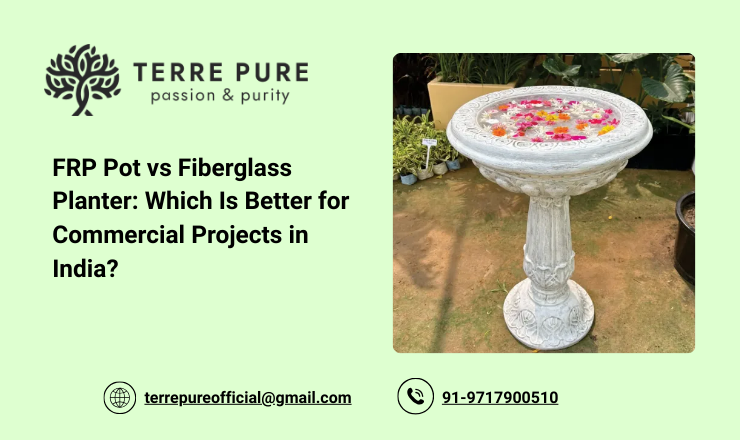
FRP Pot vs Fiberglass Planter: Which Is Better for Commercial Projects in India?

In modern commercial landscaping, choosing the right planter is more than a decorative decision—it directly impacts durability, maintenance costs, and overall project aesthetics. Whether it’s a corporate office, hotel, shopping mall, or luxury residential complex, the debate between an FRP Pot and a fiberglass planter is common among architects and procurement managers.
At first glance, both may look similar. However, when it comes to structural strength, finish quality, customization, and long-term performance in Indian climate conditions, understanding the technical differences becomes essential. This detailed guide will help you make an informed, practical decision backed by industry experience.
Understanding the Core Material
Fiber Reinforced Plastic (FRP) is a composite material made from fine glass fibers combined with resin. The result is a lightweight yet highly durable structure that resists corrosion, moisture damage, and extreme temperature fluctuations.
Fiberglass planters are generally a premium segment within FRP manufacturing. The base material remains similar, but the grade, thickness, reinforcement, and finish quality may differ depending on the manufacturer and intended application.
When Should You Choose an FRP Pot?
Standard FRP pots are ideal for:
- Residential balconies
- Indoor office décor
- Lightweight landscaping projects
- Decorative planters for moderate plant loads
They are cost-effective, easy to move, and available in multiple finishes. For small to mid-sized projects, they offer excellent value without compromising durability.
However, for larger projects with higher structural demands, a stronger and thicker build may be required.
Commercial-Grade Strength and Applications
For malls, hotels, airports, IT parks, and large corporate spaces, durability and uniform design consistency are non-negotiable. This is where a Large FRP Planter becomes the preferred choice.
These planters are specifically designed for:
- High footfall areas
- Outdoor exposure to UV rays and heavy rainfall
- Large plant root systems
- Long-term installations without frequent replacement
Their structural reinforcement ensures better load-bearing capacity, making them suitable for trees and heavy soil volumes.
Design Versatility for Modern Architecture
Today’s architectural trends favor clean lines and structured landscaping layouts. For such projects, a FRP Rectangular Planter is widely used.
Rectangular designs allow:
- Space optimization in corridors and entrances
- Partition-style landscaping
- Symmetrical arrangements in corporate lobbies
- Alignment with contemporary building geometry
These designs offer both functional and visual advantages, making them a common choice in commercial planning.
Aesthetic Appeal & Finish Quality
Premium projects often demand a sophisticated finish that complements modern interiors. A Fiberglass Planter in matte or textured finish offers:
- Scratch resistance
- Elegant non-reflective appearance
- Better dust camouflage in outdoor environments
- Long-lasting surface color retention
High-quality finishes not only enhance visual appeal but also reduce maintenance frequency, which is crucial for large commercial installations.
Product Specifications & Technical Highlights
When evaluating planters for commercial use, consider the following specifications:
- Material Thickness: Typically 3mm to 8mm depending on size
- UV Stabilization: Essential for outdoor exposure
- Reinforced Base: For heavy plant support
- Drainage Options: Pre-installed holes or custom placements
- Finish Options: Matte, glossy, or textured
- Customization: Size, color, and branding flexibility
A well-manufactured planter should balance weight efficiency with structural strength.
Advantages for Commercial Projects
- Lightweight Construction – Easier transportation and installation
- Weather Resistance – Suitable for Indian heat and monsoon
- Corrosion-Free – Ideal for coastal and humid areas
- Long Lifespan – Reduced replacement frequency
- Design Flexibility – Custom shapes and colors available
These advantages make fiberglass and FRP planters a strategic investment rather than a short-term decorative solution.
Why Quality Manufacturing Matters
Not all FRP or fiberglass planters are manufactured to the same standard. Commercial projects require:
- Uniform thickness
- Proper resin curing
- Smooth finishing
- Load-tested structure
- Reliable after-sales support
Choosing an experienced manufacturer ensures that the product performs as expected under real-world conditions.
Conclusion
Both FRP pots and fiberglass planters use similar base materials, but their performance depends heavily on manufacturing quality, reinforcement, and intended application. For small decorative use, standard options are sufficient. For large-scale commercial projects requiring durability, aesthetics, and long-term value, selecting high-grade Premium FRP Planters is a smart and future-proof investment.
If you are planning a commercial landscaping project, focus on structural strength, finish quality, and customization capabilities to ensure lasting results.
FAQs
Q1: Are FRP pots suitable for outdoor use?
Yes, if UV-coated and manufactured with proper thickness, they perform well outdoors.
Q2: What is the lifespan of a commercial fiberglass planter?
High-quality planters can last 8–12 years with minimal maintenance.
Q3: Which shape is best for commercial spaces?
Rectangular and large round designs are most commonly used due to space efficiency and visual impact.
Q4: Are fiberglass planters heavy?
No, they are significantly lighter than concrete or stone alternatives.
Q5: Can planters be customized for branding?
Yes, size, finish, and color customization are widely available for commercial projects.


