
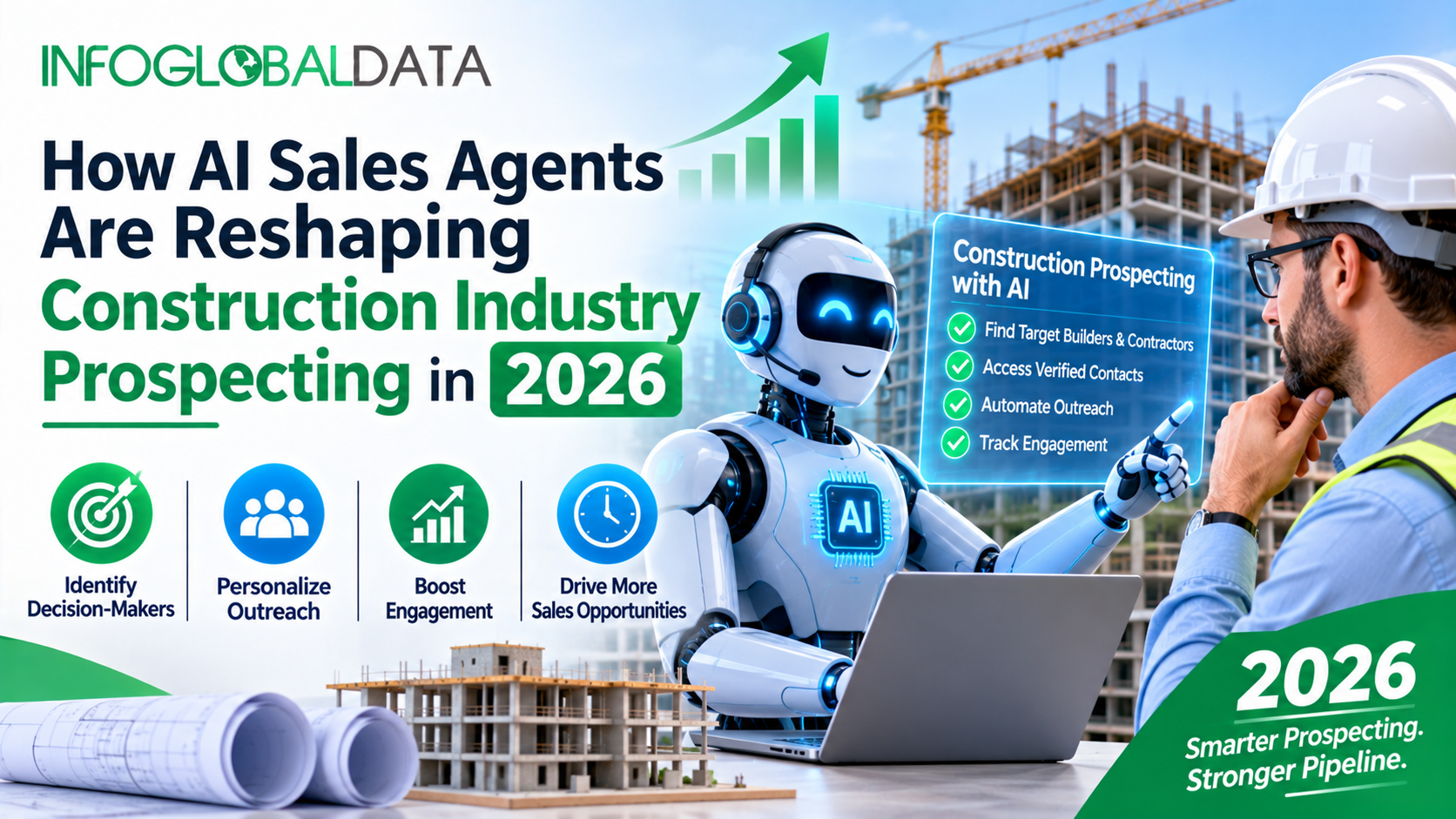
How AI Sales Agents Are Reshaping Construction Industry Prospecting in 2026 | InfoGlobalData

AI sales agents are changing how B2B companies identify prospects, research accounts, and manage outreach. For construction suppliers, equipment manufacturers, software providers, and service companies, the opportunity is particularly relevant: finding the right contractor often requires understanding trade specialization, project activity, location, company size, and purchasing responsibilities. According to Salesforce’s 2026 State of Sales research, 55% of sales professionals already use AI for prospecting, while another 38% plan to do so. At the same time, construction firms are increasing their own investment in AI. This article examines how AI agents are influencing construction prospecting, where they can improve sales workflows, and why accurate contact data remains essential to their performance.
1. Why Construction Prospecting Is Becoming More Data-Driven
Construction prospecting is more complex than collecting company names and sending introductory emails. Suppliers and service providers must identify contractors that match specific requirements, such as trade, project type, service territory, and purchasing needs.
The market itself is also changing. The Associated General Contractors of America (AGC) and Sage's 2026 Construction Hiring and Business Outlook found that 61% of surveyed firms use AI or plan to increase investment in it, compared with 44% in the previous year's survey. The report identified office and administrative functions as the leading area of AI use, followed by estimating and design or preconstruction.
These developments create an opportunity for sales teams serving construction businesses. AI agents can help them process larger volumes of market information, identify potentially relevant companies, and prioritize outreach based on defined criteria.
For example, a building-material supplier could use an AI-assisted workflow to identify commercial contractors in selected regions, classify them by specialty, and prepare a shortlist for sales representatives. The technology does not eliminate the need for prospect research; it changes how quickly that research can be performed.
2. How AI Sales Agents Differ from Traditional Sales Automation
Traditional sales automation generally follows predefined rules. It might send an email after a form submission, schedule a follow-up, or update a CRM field.
AI sales agents can perform more connected tasks. Depending on their configuration and data access, they may:
-
Research companies and summarize relevant information.
-
Classify prospects by trade, location, or business profile.
-
Identify potential decision-makers.
-
Compare prospects against an ideal customer profile (ICP).
-
Draft personalized outreach messages.
-
Recommend follow-up actions based on engagement.
-
Update CRM records or flag incomplete information for review.
The distinction is important: an AI writing assistant produces content when prompted, whereas an agent can potentially coordinate multiple steps toward a defined objective.
Salesforce's 2026 research, based on 4,050 sales professionals surveyed in August and September 2025, found that 87% of sales organizations use some form of AI. It also reported that 54% of sellers had used AI agents, with nearly nine in ten planning to use them by 2027. Respondents expected fully implemented agents to reduce prospect research time by 34% and email-drafting time by 36%. These are reported expectations, not guaranteed productivity improvements for every sales organization.
For construction-focused businesses, the practical value lies in connecting research, segmentation, and outreach rather than simply generating more emails.
3. AI Agents Can Identify More Relevant Contractor Prospects
One of the most useful applications of AI in construction prospecting is account qualification.
A company selling commercial HVAC equipment, for instance, may want to reach mechanical contractors working on hospitals, industrial facilities, or large commercial buildings. A general contractor database may contain thousands of businesses, but only a portion will fit that target profile.
AI agents can help narrow the prospect pool by evaluating attributes such as:
-
Contractor specialty and service category
-
Commercial, industrial, or residential focus
-
Geographic operating area
-
Company size and business profile
-
Project types and market segments served
-
Relevant management and purchasing roles
Construction market conditions make this segmentation increasingly important. The AGC and Sage 2026 outlook found that contractors had stronger expectations for data-center and power construction than for several other project categories. The net share of firms expecting higher project values was 57% for data centers and 34% for power projects, compared with negative readings for private office and retail construction. These figures represent contractor expectations, not confirmed market growth.
An AI prospecting workflow can use such market information to help sales teams prioritize relevant contractor segments. However, market-level trends should guide research rather than serve as proof that an individual company is currently pursuing a particular project.
A well-segmented Construction Email List provides the underlying company and contact information needed to turn these insights into practical account lists.
4. Project Intelligence Can Make Outreach More Timely
Construction sales opportunities are often connected to project activity. A new development, public infrastructure contract, facility expansion, or commercial renovation may create demand for materials, equipment, subcontracting services, and technology.
AI agents can help sales teams monitor and interpret information from sources such as:
-
Public procurement and bid announcements
-
Company websites and project announcements
-
Planning and permitting information
-
Construction industry news
-
Contractor project portfolios
-
Publicly available business directories
After identifying a potential opportunity, an agent can summarize the project, suggest which contractor categories may be involved, and recommend accounts for human review.
For example, a supplier of electrical components could monitor announcements about data-center construction and identify electrical contractors or specialist subcontractors operating in the relevant market. The sales team could then verify the companies, identify suitable contacts, and prepare outreach based on the actual project context.
This approach is more useful than sending the same message to every business in a Construction Mailing List. The aim is to connect a prospect's likely requirements with a relevant product or service.
There is an important limitation: public project information may be incomplete, delayed, or unrelated to a contractor's current purchasing decisions. AI-generated opportunity summaries should therefore be checked against reliable source material before sales representatives use them.
5. AI Adoption in Construction Is Growing, but Data Quality Remains a Barrier
Construction companies are increasingly experimenting with AI, but adoption levels vary considerably by company size, workflow, and technology maturity.
ServiceTitan's March 2026 Commercial Specialty Contractor Industry Report, based on a survey of more than 1,000 commercial construction leaders, found that 38% of contractors reported measurable business impact from AI, compared with 17% in 2025. The report identified cost estimation and budgeting, as well as bid management, among the areas where contractors were applying AI.
However, wider AI adoption does not automatically mean that companies have the data infrastructure required to use agents effectively.
The Royal Institution of Chartered Surveyors (RICS), in its 2025 global AI in Construction report, found that 45% of surveyed organizations had not implemented AI, while another 34% were in early pilot phases. The report identified poor data quality as a barrier for 30% of respondents and system integration challenges for 37%.
These findings have direct implications for sales prospecting. AI agents rely on accurate, structured information. If contractor records contain outdated job titles, duplicate companies, incorrect email addresses, or inconsistent trade classifications, automated workflows may prioritize the wrong accounts.
A reliable Construction Email Database should therefore support AI workflows with:
-
Accurate company names and business domains
-
Current contact names and job titles
-
Relevant contractor specialties
-
Geographic and project-market classifications
-
Email verification status
-
Clear update or verification dates
AI can organize and analyze available information, but it cannot reliably compensate for missing or inaccurate source data.
6. Personalization and Follow-Up Become More Scalable
Construction buyers and decision-makers do not all have the same responsibilities. A project manager may prioritize delivery schedules, while a procurement manager may focus on pricing, supplier reliability, and product availability. An owner may be more interested in profitability and business growth.
AI agents can help sales teams adapt messages to these different roles. They can use verified company information and approved messaging guidelines to prepare relevant introductions, suggest questions, and recommend follow-up timing.
Salesforce's 2026 research found that 92% of sellers who use AI agents said the technology benefited their prospecting efforts. It also reported that top-performing sellers were 1.7 times more likely than underperformers to use prospecting agents for outreach. These findings indicate an association between agent use and sales performance, not proof that AI alone causes higher revenue.
For construction suppliers, useful personalization might include:
-
Referring to a contractor's verified specialty.
-
Highlighting a product relevant to its project category.
-
Addressing a role-specific operational challenge.
-
Tailoring the message to the company's service territory.
-
Following up based on a genuine interaction or relevant business signal.
Human review remains important. AI-generated claims about a contractor's projects, purchasing plans, or business needs should be verified before they appear in customer communications.
7. Practical Steps for Introducing AI into Construction Prospecting
Businesses do not need to automate their entire sales process at once. A controlled implementation can begin with a small number of repeatable prospecting tasks.
1. Define a precise ideal customer profile. Identify target trades, company sizes, locations, project categories, and decision-maker roles before configuring an agent.
2. Clean and standardize contact data. Remove duplicates, verify email addresses, check company affiliations, and flag incomplete records.
3. Start with research and qualification. Use AI to summarize company information, categorize contractors, and recommend prospects for human review.
4. Introduce personalized outreach gradually. Let agents prepare message drafts, but require sales representatives to review factual claims, relevance, and tone before sending.
5. Measure meaningful sales outcomes. Track qualified replies, meetings, opportunities, hard bounces, unsubscribes, and conversion by contractor segment. More messages sent should not be mistaken for better prospecting.
Companies such as InfoGlobalData provide business contact and email-list resources that can support targeted B2B research and outreach. Before using any Construction Email List, sales teams should evaluate sample records for contact relevance, data freshness, trade coverage, and email quality.
Conclusion
AI sales agents are reshaping construction prospecting by connecting company research, account qualification, market intelligence, and personalized outreach into more coordinated workflows. Construction-sector surveys show growing interest in AI, while broader sales research points to increasing use of agents for prospecting and administrative tasks. Yet the results depend heavily on the quality of the information behind these systems. Inaccurate contractor records can lead to irrelevant targeting, wasted outreach, and unreliable recommendations. Businesses that combine structured contact data, clear prospect criteria, human oversight, and measurable campaign goals will be better positioned to use AI effectively. In 2026, the advantage will come not simply from automating prospecting, but from identifying the right construction businesses and engaging them with relevant information.
Frequently Asked Questions
1. What are AI sales agents in construction prospecting?
AI sales agents are systems that can coordinate tasks such as researching construction companies, qualifying prospects, preparing outreach, and recommending follow-ups. Their capabilities depend on the tools, data sources, and permissions connected to them.
2. How can AI help companies find construction contractors?
AI can analyze business information, classify contractors by trade and location, summarize project announcements, and compare companies against an ideal customer profile. Sales teams should verify important findings before contacting prospects.
3. Can AI agents automatically generate a Construction Email List?
AI can help organize and segment existing business contact records, and some systems can discover publicly available company information. However, contact details should be verified and collected and used in accordance with applicable privacy and marketing requirements.
4. Why is data quality important for AI prospecting?
AI agents depend on accurate information to identify relevant companies and contacts. Outdated email addresses, duplicate records, and incorrect job titles can undermine segmentation and lead to irrelevant outreach.
5. How does a Construction Mailing List support AI-driven sales?
A structured mailing list provides company and contact information that AI workflows can use for segmentation, account research, and outreach preparation. Its value depends on the accuracy, relevance, and freshness of its records.
6. What construction businesses can benefit from AI sales agents?
Construction suppliers, equipment manufacturers, software providers, distributors, and specialist service companies can use AI-assisted prospecting to identify relevant contractors and decision-makers. The most useful applications depend on the business's target market and available data.
7. Will AI sales agents replace construction sales representatives?
AI agents can automate research, drafting, and repetitive administrative work, but complex B2B sales still require human judgment, relationship building, negotiation, and technical understanding. AI is best treated as support for sales teams rather than a complete replacement.