
Japan Smart Home Market to Reach USD 40.7 Billion by 2035, Growing at 20.8% CAGR

Japan Smart Home Market Size, Growth, Trends and Forecast 2026–2035
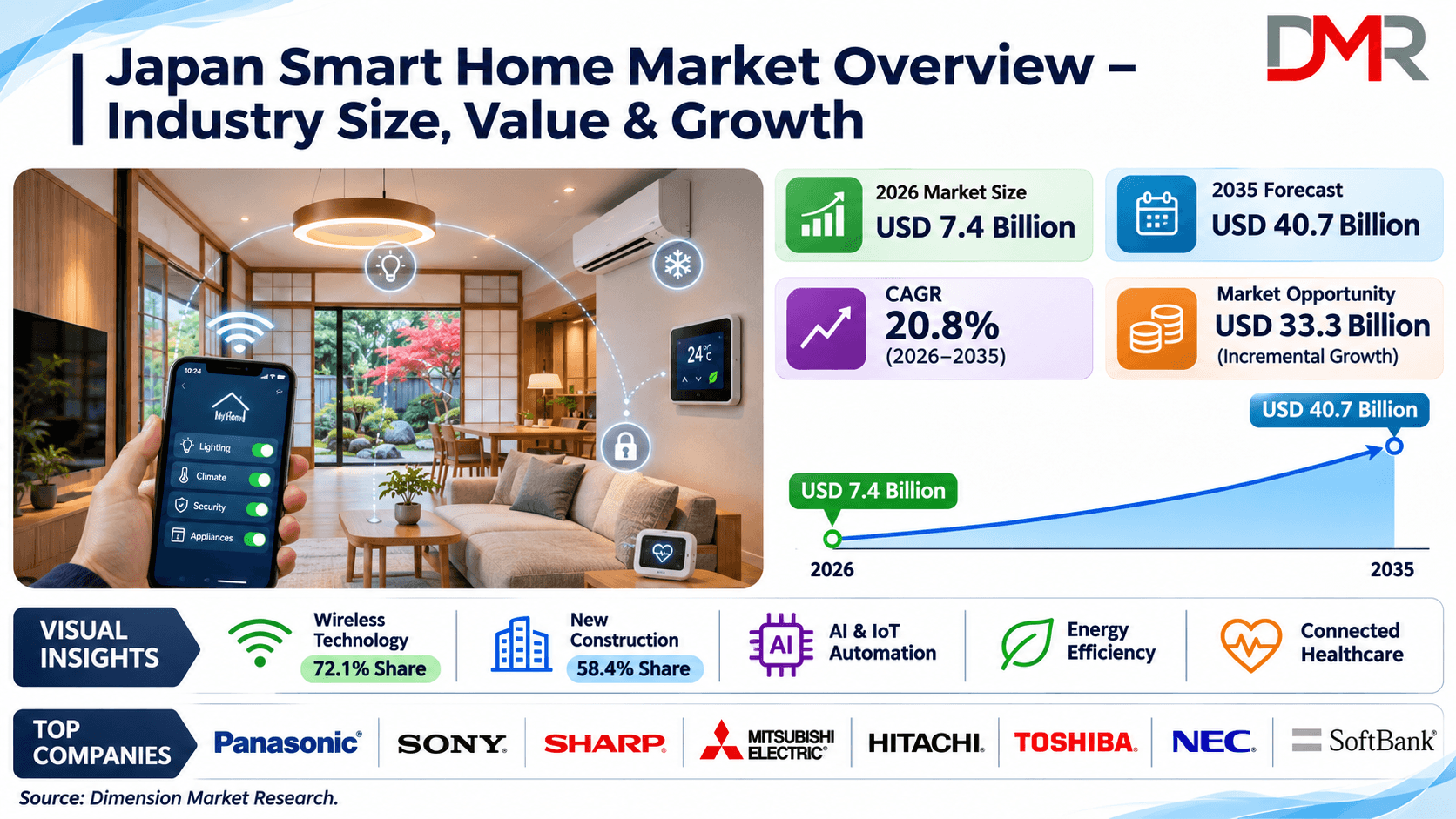
According to Dimension Market Research, the Japan Smart Home Market is projected to reach USD 7.4 billion in 2026 and expand to USD 40.7 billion by 2035, registering a compound annual growth rate (CAGR) of 20.8% during 2026–2035. Rising electricity costs, increasing demand for energy-efficient residential solutions, technological advancements in artificial intelligence (AI), and growing adoption of Internet of Things (IoT) devices are supporting the expansion of Japan's smart home industry.
What is the Japan Smart Home Market?
The Japan Smart Home Market represents the industry focused on connected residential technologies and automated home solutions that improve convenience, security, comfort, and energy efficiency. It includes smart lighting, security and access control, HVAC management, connected appliances, entertainment systems, and home healthcare devices. These solutions use IoT connectivity, artificial intelligence, sensors, and wireless communication technologies to enable centralized and remote control. In Japan, demand is supported by an aging population, rising household energy expenses, smart city development, and increasing consumer interest in intelligent residential environments.
Download Japan Smart Home Market Report Sample PDF: https://dimensionmarketresearch.com/request-sample/japan-smart-home-market/
Japan Smart Home Market Overview
Japan is experiencing a significant transformation in residential living as homeowners increasingly integrate connected technologies into their daily routines. Smart home systems are becoming important components of modern housing, allowing residents to manage lighting, appliances, temperature, and security through smartphones and voice-controlled platforms.
Energy conservation is a major factor influencing adoption. Smart thermostats, automated HVAC systems, and intelligent energy management solutions help households optimize electricity consumption. Additionally, Japan's aging population is creating demand for remote healthcare monitoring, emergency alerts, and connected wellness devices. Wireless connectivity technologies, including Wi-Fi, Bluetooth, Zigbee, and Matter, are making installation easier across new and existing residential properties.
Japan Smart Home Market Size, Growth & Future Scope
The market outlook highlights strong expansion opportunities throughout the forecast period, supported by residential digitalization and growing investments in connected infrastructure.
- The market is expected to reach USD 7.4 billion in 2026.
- Market revenue is forecast to reach USD 40.7 billion by 2035.
- The industry is projected to grow at a 20.8% CAGR through 2035.
- Wireless technologies are expected to capture 72.1% share in 2026.
- New construction is anticipated to account for 58.4% in 2026.
- Single-family homes are projected to hold 64.7% share in 2026.
- Security and access control are expected to capture 27.8% in 2026.
- Offline sales are forecast to account for 61.5% in 2026.
Key Trend in the Japan Smart Home Market
The rapid deployment of wireless connectivity technologies is a major trend shaping the Japanese smart home industry. Wi-Fi, Bluetooth, Zigbee, and Matter-enabled solutions are making connected devices easier to install, operate, and integrate. Consumers increasingly prefer flexible systems that can connect smart appliances, lighting, security cameras, and entertainment devices without extensive wiring. Meanwhile, AI-powered automation is improving energy management, predictive controls, personalized experiences, and residential security. The combination of wireless connectivity and intelligent automation is expected to strengthen smart home adoption across Japan.
Japan Smart Home Market Growth Drivers
- Rising electricity costs encourage energy-efficient home automation.
- Growing demand for connected residential security solutions.
- Increasing adoption of AI-powered home management systems.
- Japan's aging population supports remote healthcare monitoring.
- Smart city initiatives encourage connected residential infrastructure.
- Wireless technologies simplify smart home installation and upgrades.
Japan Smart Home Market Leading Segmentation & Analysis
By Installation Type: New Construction
New Construction is expected to dominate the Japan Smart Home Market, accounting for approximately 58.4% market share in 2026. The growing integration of intelligent infrastructure into modern residential developments is supporting this segment. Builders and property developers are increasingly incorporating automated lighting, HVAC controls, security systems, and connected appliances during construction. Integrating these technologies from the beginning can reduce installation complexity and improve residential energy management.
- New Construction: Expected to hold 58.4% share in 2026.
- Retrofit Installations: Supported by demand for wireless upgrades.
View Japan Smart Home Market Full Report with TOC: https://dimensionmarketresearch.com/report/japan-smart-home-market/
By Technology: Wireless Technologies
Wireless Technologies are projected to dominate the market with approximately 72.1% share in 2026. Their popularity comes from flexible installation, lower infrastructure requirements, and compatibility with multiple connected residential devices. Wi-Fi, Bluetooth, Zigbee, and Matter-based systems enable homeowners to manage appliances, lighting, security, and entertainment through integrated platforms. Wireless solutions are also suitable for existing properties where extensive wiring modifications may be expensive or inconvenient.
- Wireless Technologies: Expected to capture 72.1% share in 2026.
- Wired Technologies: Remain relevant in premium residential developments.
Japan Smart Home Market Key Challenges and Future Opportunities
High initial installation costs remain a significant challenge for smart home adoption, particularly among households upgrading older residential properties. Compatibility between different manufacturers' devices, data privacy concerns, and cybersecurity requirements can also influence purchasing decisions. However, the development of smart cities, growing demand for energy-efficient housing, and increasing availability of affordable wireless devices are creating new opportunities. Partnerships between technology providers, real estate developers, telecommunications companies, and utility operators can further expand connected residential ecosystems across Japan.
Japan Smart Home Market Competition Analysis: List of Major Players
The competitive landscape is characterized by technology innovation, product development, ecosystem integration, and strategic partnerships. Leading companies are investing in AI-powered automation, wireless connectivity, smart appliances, residential security, and energy management solutions to strengthen their market positions.
Major companies operating in the Japan Smart Home Market include:
- Panasonic Holdings Corporation
- Sony Group Corporation
- Sharp Corporation
- Mitsubishi Electric Corporation
- Hitachi Ltd.
- Toshiba Corporation
- NEC Corporation
- SoftBank Group Corporation
- Rakuten Group Inc.
- LIXIL Corporation
- Daikin Industries Ltd.
- Fujitsu Limited
- Murata Manufacturing Co. Ltd.
- Omron Corporation
- Buffalo Inc.
- Iris Ohyama Inc.
- Balmuda Inc.
- Google LLC
- com Inc.
- Apple Inc.
What Are the Future Growth Opportunities in the Japan Smart Home Market?
The future of Japan's smart home industry will be shaped by intelligent automation, energy optimization, and connected healthcare solutions. AI-powered devices can improve residential energy consumption through predictive controls, while remote monitoring technologies can support independent living among elderly residents. Smart city development and digital infrastructure investments will create additional opportunities for technology providers and residential developers. Furthermore, improved device interoperability and affordable wireless solutions are expected to encourage adoption across both newly constructed and existing homes, supporting long-term market expansion through 2035.
Get 10% instant discount on report purchase
Related Reports:
- Docks Market
- Smart Kitchen Market
- Voice Controlled Kitchen Devices Market
- Connected Cooking Devices Market
Frequently Asked Questions (FAQs)
1. What is the projected size of the Japan Smart Home Market in 2026?
2. What will be the Japan Smart Home Market value by 2035?
3. What is the expected CAGR of the Japan Smart Home Market during 2026–2035?
4. What are the major factors driving Japan Smart Home Market growth?
5. Which technology segment is expected to dominate the Japan Smart Home Market?
6. What is the leading installation type in the Japan Smart Home Market?
7. Which product segment holds the largest share of Japan's smart home industry?
8. Who are the major players operating in the Japan Smart Home Market?
9. What challenges are affecting smart home adoption across Japan?
10. What are the emerging opportunities in Japan's smart home industry through 2035?
About Us
Dimension Market Research (DMR) is a global market intelligence and consulting firm delivering data-driven insights that help organizations make informed strategic decisions. With expertise across 12+ industries and global markets, DMR provides syndicated reports, custom research, competitive analysis, white space analysis, and business strategy consulting.
Our research solutions combine analytical rigor, industry expertise, and forward-looking intelligence to identify opportunities, reduce risks, and support sustainable growth. Trusted by clients across diverse sectors, DMR is committed to delivering accurate, actionable insights that enable businesses to navigate evolving market landscapes with confidence.
Contact Us
Phone USA: +17323699777
Phone India: +919310023843
E-mail: [email protected]
Address USA: 957 Route 33, Suite 12 #308, Hamilton Square, NJ-08690
Address India: D44, Sector 6, Noida 201301, India