
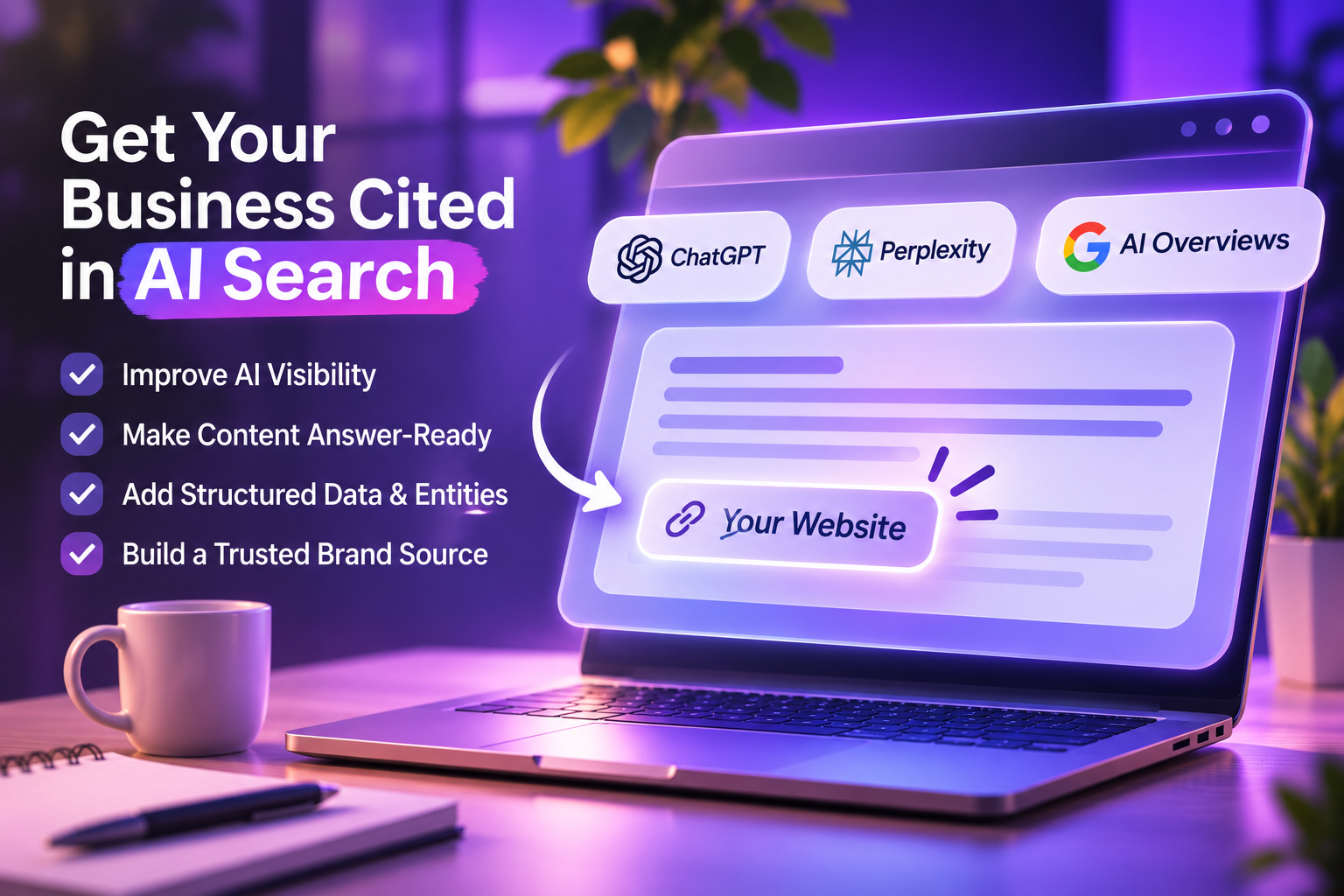
Beyond Google Rankings: How Businesses Can Build Visibility in AI Search

The way people discover businesses online is changing. A few years ago, finding a service usually meant searching Google, opening several websites, and comparing the results. Today, someone might ask ChatGPT for recommendations, use Perplexity to research a product, or rely on Google's AI Overviews to understand a topic.
This shift creates a new challenge for businesses. Having a website that ranks in traditional search results is still valuable, but brands also need to consider how their information appears in AI-generated answers.
This is where AI SEO and Generative Engine Optimization (GEO) become important. The goal is to make a business easier for AI-powered search systems to discover, understand, and potentially reference when answering relevant questions.
What Is AI SEO?
AI SEO is the practice of improving a website's visibility across AI-powered search experiences and answer engines.
Traditional SEO focuses heavily on helping web pages appear in search results for relevant queries. AI SEO extends that objective by considering how information is retrieved, interpreted, summarized, and cited in generated responses.
For example, imagine someone asks an AI assistant:
"Which digital marketing agencies specialize in SEO for small businesses?"
The response may include a shortlist of businesses, explanations, and links to supporting sources. A company that wants to appear in that conversation needs more than a collection of keyword-optimized pages. Its website must communicate clearly what the business does, who it serves, and why its information is worth referencing.
AI SEO is closely connected to two terms:
- Answer Engine Optimization (AEO): Improving content so it can provide clear answers to specific questions.
- Generative Engine Optimization (GEO): Improving a brand's chances of being represented and cited in AI-generated responses.
These approaches complement traditional SEO rather than replace it.
Why Traditional SEO Still Matters
One common misconception is that AI search requires an entirely different set of optimization rules.
That isn't quite true.
Google's official guidance explains that its generative search experiences still rely on core Search systems. Websites need to meet existing technical requirements and provide useful, original information. Strong SEO fundamentals therefore remain relevant to AI visibility.
This means businesses shouldn't abandon keyword research, technical SEO, internal linking, or quality content. Instead, they should understand how these elements contribute to a wider search experience.
A technically accessible website with useful information gives search systems a stronger foundation for discovering its pages. Without that foundation, even well-written content may struggle to reach its intended audience.
Five Ways to Improve Your Visibility in AI Search
1. Make Your Website Easy to Discover
Before an AI-powered search experience can reference a page, the information needs to be accessible through the relevant discovery and retrieval systems.
Start with the technical basics:
- Check whether important pages can be crawled and indexed.
- Review robots.txt rules and server-level bot restrictions.
- Ensure important content is available without unnecessary rendering problems.
- Maintain clear internal links and XML sitemaps.
- Fix broken pages, redirect issues, and duplicate URLs.
Crawler access deserves particular attention. Different AI services may use different crawlers for search and training purposes, so businesses should understand which access rules they actually need.
Technical accessibility doesn't guarantee a citation, but it removes avoidable barriers to discovery.
2. Create Content That Answers Real Questions
People often interact with AI search using complete questions rather than short keyword phrases.
Instead of searching only for "accounting software," someone might ask:
"Which accounting software is suitable for a small business with international clients?"
Businesses should understand these conversational queries and create content that addresses the underlying information need.
A useful page should:
- Answer its main question early.
- Explain important terms clearly.
- Include relevant examples.
- Discuss alternatives and limitations.
- Provide enough context to make the information useful.
For instance, a software company shouldn't publish another generic article about its product category. It should explain which business problems its solution addresses, who benefits from it, and where it may not be the right choice.
The aim is to produce genuinely useful information, not simply content that looks optimized for an algorithm.
3. Give AI Systems Something Worth Referencing
A large amount of online content repeats information that is already available elsewhere. This makes it difficult for a brand to stand out as a distinctive source.
Original information gives readers—and potentially AI search systems—more reasons to pay attention.
Businesses can develop useful reference material through:
- Original surveys and industry research.
- First-hand case studies.
- Expert interviews.
- Product comparisons based on real testing.
- Proprietary datasets and practical tools.
- Detailed explanations of industry-specific problems.
Whenever a business publishes statistics or research findings, it should explain the methodology and provide supporting evidence.
A page containing specific, verifiable information is more useful than one filled with broad marketing statements.
4. Build Clear Brand and Entity Information
Search systems need to understand which organization a page represents and how it relates to the information being discussed.
Businesses should maintain consistent details across their website and important external profiles.
This includes:
- A clear company description.
- Accurate contact and location information.
- Consistent brand naming.
- Named authors and relevant expertise.
- Well-maintained service and product pages.
- Appropriate structured data.
Schema markup can help describe information in a standardized format, provided it accurately reflects visible page content.
However, structured data is not a shortcut to AI recommendations. It supports clarity and interpretation; it does not guarantee that a system will select a particular brand.
5. Build Credibility Beyond Your Own Website
A company describing itself as an industry leader is not the same as independent sources recognizing its expertise.
Relevant third-party coverage, expert contributions, industry publications, customer experiences, and genuine brand mentions can help establish a stronger reputation.
This is why digital PR and content-led authority building remain relevant to AI visibility.
The important distinction is quality. Random mentions and artificial link-building campaigns do not create meaningful credibility. Businesses should focus on earning recognition from sources that are genuinely relevant to their industry.
How Should Businesses Measure AI SEO Performance?
Traditional SEO reporting often focuses on keyword rankings, organic traffic, clicks, and conversions.
AI SEO requires a broader measurement approach.
Businesses can monitor:
AI citations and mentions: Does the brand appear when users ask relevant questions in AI-powered search tools?
Share of visibility: How frequently does the business appear compared with competitors across a consistent set of queries?
Referral traffic: Are visitors arriving from AI platforms, and what do they do after reaching the website?
Assisted conversions: Does AI-referred traffic contribute to enquiries, registrations, or purchases?
Content performance: Which pages are being referenced, and what information makes them useful?
AI-generated responses can vary depending on the query, context, and platform. Therefore, visibility checks should use a consistent set of relevant prompts and be repeated over time.
No single citation or mention should be treated as proof of a lasting ranking position.
Why Businesses Are Exploring Professional AI SEO Services
AI search optimization combines several disciplines: technical SEO, content strategy, entity optimization, digital PR, and performance measurement.
For businesses without an in-house team covering all these areas, coordinating the work can become difficult.
This is where a structured service can help. MoxSEO's AI SEO Services focus on areas such as AI crawler accessibility, answer-ready content, structured data, entity clarity, original research, and AI visibility tracking.
Rather than treating AI SEO as a collection of isolated tricks, businesses can approach it as an ongoing optimization process: understand the current visibility, identify weaknesses, improve the website, and measure what changes.
The exact strategy should depend on the company's industry, audience, existing search performance, and business objectives.
Final Thoughts
AI-powered search is creating another way for people to discover businesses, products, and services. That doesn't make traditional SEO irrelevant. It makes a strong search foundation even more important.
Businesses should focus on being accessible, providing original and reliable information, communicating their expertise clearly, and building credibility across the web.
There is no guaranteed formula for getting cited by ChatGPT, Perplexity, or Google AI Overviews. But a website that consistently provides useful information and makes that information easy to discover is better prepared for the changing search landscape.
The objective is no longer just to attract a visit from a search result. It's also to become a source worth considering when someone asks an important question.