
Is Your Inbound Marketing Strategy Ready? A 7-Point Checklist

An inbound marketing strategy can look busy and still fail to produce qualified conversations. Posts go out on schedule, traffic charts trend upward, and yet the pipeline does not move in the way leadership expected.
The gap is usually not effort. It is a missing link somewhere between discovery and sales: content that attracts the wrong people, pages with no clear next step, or a handover that drops good prospects.
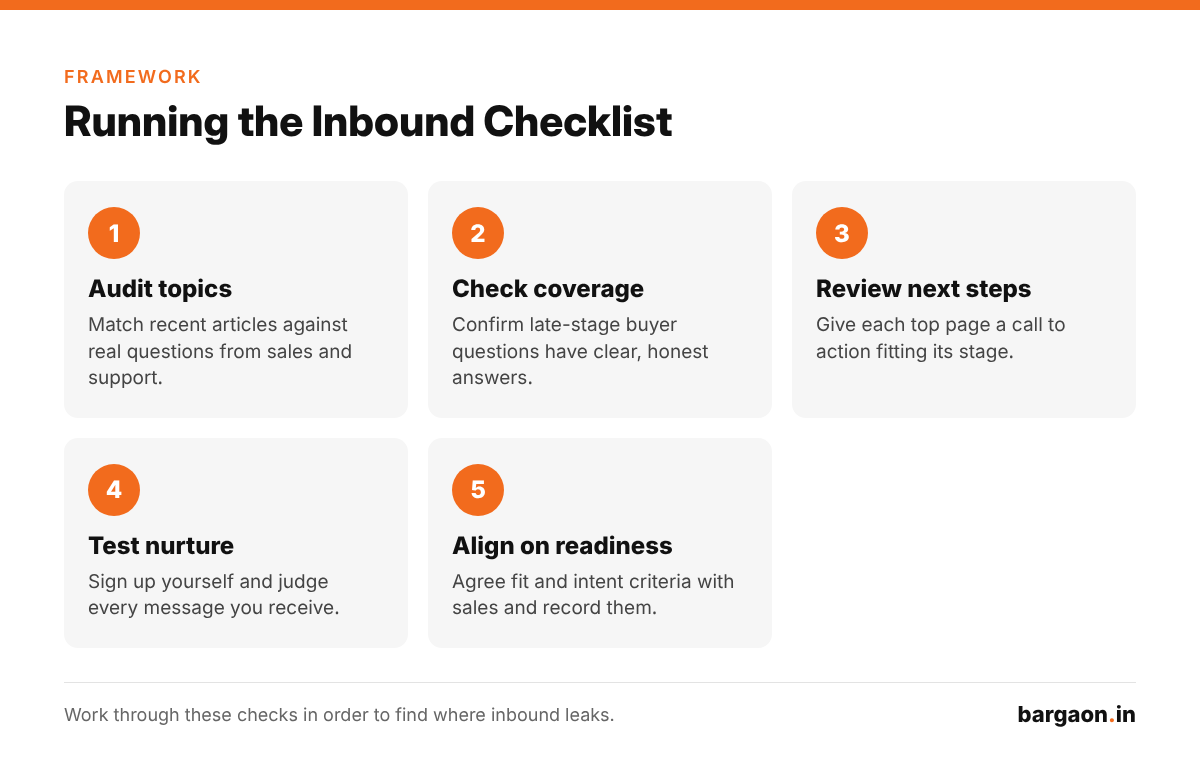
Use this checklist to find where your own system is leaking. Each point includes what good looks like and a quick way to test it.
1. Your content starts from real buyer questions
Strong inbound programmes are built on what buyers actually ask, not on what the company wants to say. Topics come from sales calls, support tickets, customer interviews and search behaviour.
Customer language matters as much as the topic itself. If buyers describe a problem as messy reporting and your team calls it data governance, your content will miss the people it was written for.
Quick test: pick five recent articles and ask a salesperson whether a prospect has ever raised that question. If the answer is mostly no, your topic list needs rework.
2. Your inbound marketing strategy covers every stage
Many sites are heavy on early-stage awareness content and thin on the material buyers need later: comparisons, implementation detail, case studies and honest answers about cost and effort.
Late-stage content often feels uncomfortable to publish because it means discussing price ranges, timelines and limitations openly. Yet that candour is exactly what builds trust with buyers who are close to a decision.
Quick test: list the questions a buyer asks in the final month before signing. Check whether your site answers each one clearly. The guide to inbound marketing strategy explains how to plan content across the full journey so these gaps close.
3. Your best pages are built to be found and quoted
Buyers increasingly meet content through AI summaries and answer panels, not only through traditional search listings. Clear headings, direct answers and well-structured pages help your expertise surface in these places.
Google's documentation on AI features and your website explains how its AI experiences draw on web content and what site owners should focus on. The short version: helpful, well-organised pages remain the foundation.
Quick test: search for three of your core topics and see whose answers appear first. If competitors dominate, look at how their pages are structured compared with yours.
4. Every page has a sensible next step
A reader who finishes a useful article should know what to do next. That might be a deeper resource, a tool, a case study or a conversation, depending on how far along they are.
Match the offer to the reader's likely stage. Someone reading an introductory explainer is rarely ready for a demo, but may happily take a checklist or a related guide that helps them go deeper.
Quick test: open your ten most visited pages and note the main call to action on each. If they all say the same thing, or if some have none at all, you are losing interested readers.
5. You nurture people who are not ready yet
Most people who engage with inbound content are not ready to buy today. Without a nurture path, they drift away and return months later through a competitor.
A good nurture sequence sends a small number of genuinely useful messages tied to the topic that brought someone in. It invites a conversation without pressure. If you use HubSpot, the HubSpot Knowledge Base covers how to segment contacts by interest and lifecycle stage.
Quick test: download one of your own gated assets with a test email address and see what arrives over the next month. Would you keep reading?
6. Marketing and sales agree on what ready means
Inbound lead generation fails quietly when marketing and sales define readiness differently. Marketing celebrates volume; sales ignores most of it.
Agree on fit criteria, such as industry, size and role, and readiness signals, such as visiting pricing pages or requesting an assessment. Write them down, apply them in your CRM and review them together every quarter.
Quick test: ask marketing and sales leaders separately to describe a qualified inbound lead. If the descriptions differ, start there.
7. You measure outcomes, not activity
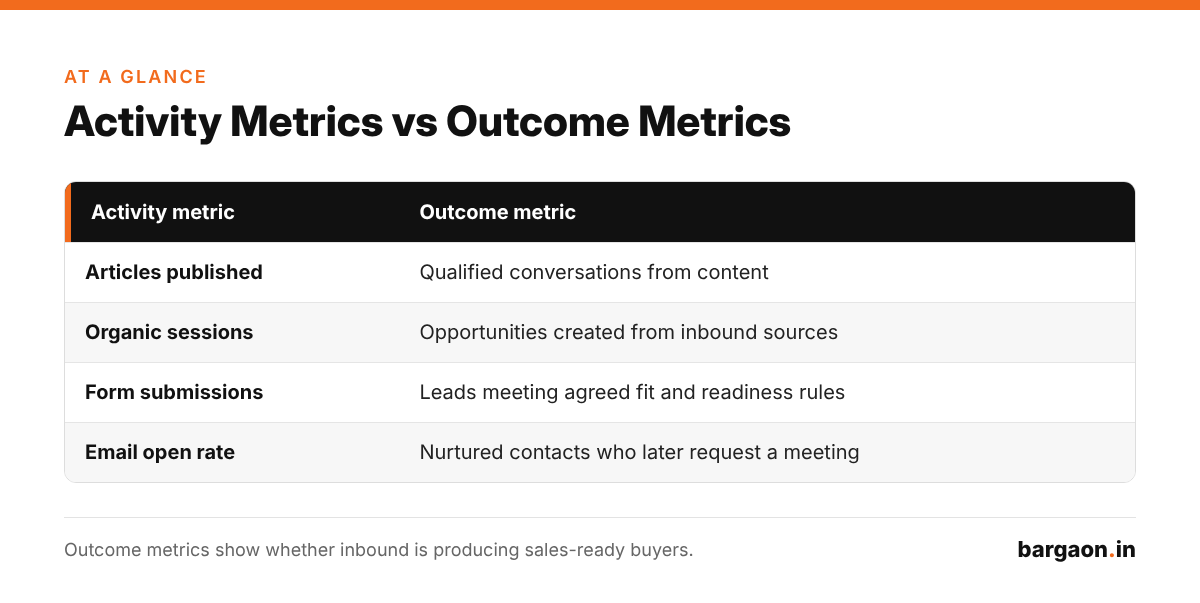
Posts published and sessions gained are activity measures. The outcomes that matter are qualified conversations, opportunities created and revenue influenced by inbound sources.
Connect your analytics and CRM so that the first and last pages a buyer visited are recorded against each opportunity. Even a basic setup gives you far better evidence than traffic reports alone.
Quick test: can you name the three pages most often read by buyers who later became customers? If not, your measurement setup needs attention before your next content plan. Teams that pass most of this checklist usually find that small fixes produce noticeable gains, and the full Bargaon guide sets out how to strengthen each layer in turn.


