
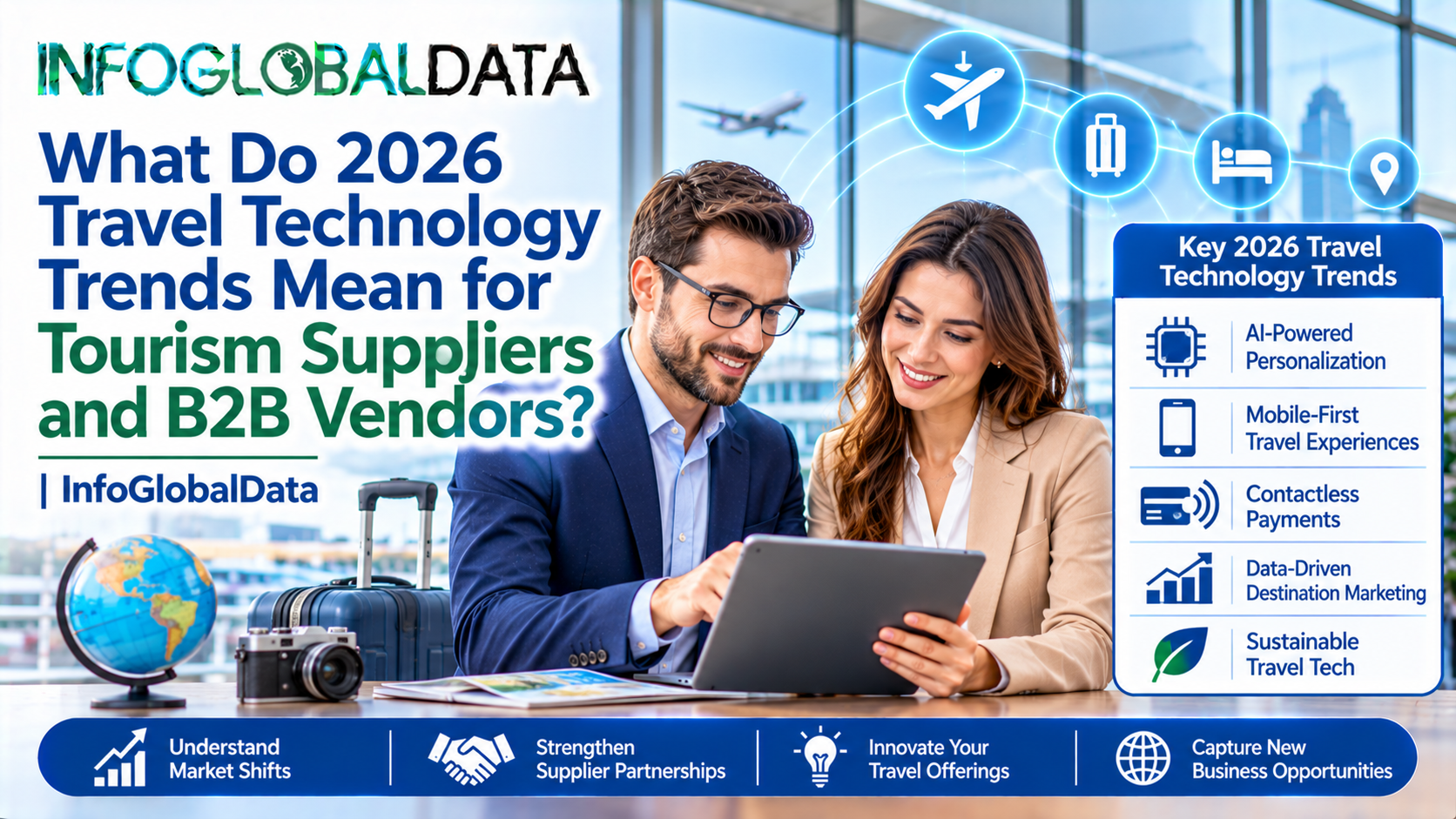
What Do 2026 Travel Technology Trends Mean for Tourism Suppliers and B2B Vendors? | InfoGlobalData

Introduction
Travel technology is changing how travelers discover trips, how travel agents evaluate suppliers, and how tourism businesses compete for bookings. Artificial intelligence (AI), smarter distribution systems, personalized recommendations, and richer digital content are becoming part of everyday travel operations. Phocuswright’s 2026 research reports that 56% of U.S. travelers used AI for planning, booking, or in-destination assistance for at least one trip in the previous 12 months, up from 33% in the first half of 2025.
For tourism suppliers and B2B vendors, this shift creates opportunities to reach new partners—but also raises expectations for accurate information, relevant communication, and dependable digital experiences. Understanding these changes can help sales and marketing teams build more effective relationships with travel professionals.
1. AI Is Becoming Part of the Travel Agent’s Daily Workflow
AI is moving beyond experimentation and becoming a practical tool for travel research, recommendations, and sales support. Phocuswright’s Travel Innovation and Technology Trends 2026 reports that 83% of surveyed travel businesses use generative AI in some capacity, while 88% reported a positive impact. It also found that 61% of travel executives were experimenting with or scaling agentic AI—systems designed to perform tasks rather than simply generate answers.
Travel agents are adopting these tools too. Amadeus’s 2026 Global Travel Agent Report, based on 756 travel agents across the Americas, EMEA, and Asia-Pacific, found that more than three-quarters use AI as part of their selling toolkit. Applications include researching options, comparing travel products, preparing recommendations, and improving productivity.
What this means for suppliers: Tourism businesses need to provide accurate, structured, and current product information. Hotels, tour operators, destination-management companies, and technology vendors should make details such as availability, pricing, inclusions, cancellation terms, and destination information easy to access and verify. Inaccurate information can undermine both an agent's recommendation and the automated systems supporting it.
2. Distribution Platforms Still Matter, but Content Quality Is Critical
The growth of AI does not mean traditional travel distribution systems are becoming irrelevant. Global distribution systems (GDSs) remain important tools for travel professionals comparing inventory, rates, and booking options.
Amadeus's 2026 research found that 43% of travel agents used GDS platforms more frequently than they did in 2024. Agents accessed these platforms more than six times per day on average and spent nearly eight hours connected. The study also found that 90% relied on hotel descriptions supplied by properties when comparing and recommending accommodation.
These findings highlight an important opportunity for tourism suppliers: distribution visibility must be supported by dependable product content. A hotel or tour operator may appear in multiple booking channels, but inconsistent descriptions, outdated amenities, or unclear pricing can weaken an agent's confidence.
For B2B vendors selling booking engines, channel-management software, payment solutions, or travel-management platforms, this creates demand for tools that improve data consistency and simplify distribution.
Suppliers should regularly review:
-
Product descriptions and destination information.
-
Rate consistency across direct and third-party channels.
-
Availability, booking conditions, and cancellation policies.
-
Images, amenities, and service inclusions.
-
Sustainability information and other relevant credentials.
The commercial lesson is straightforward: technology improves access to travel products, but reliable information helps agents make decisions.
3. Personalization Is Raising Expectations for Supplier Communication
Travelers increasingly expect recommendations that reflect their interests, budgets, and preferred experiences. AI-powered planning tools are accelerating this expectation by helping travelers compare destinations and create more tailored itineraries.
Phocuswright's 2026 research found that 56% of U.S. travelers had used AI for planning, booking, or in-destination assistance for at least one trip during the previous 12 months. This represented an increase from 33% in the first half of 2025.
For travel agents, personalization creates an opportunity to provide more relevant recommendations and differentiate their services from generic online booking experiences. For suppliers, it means that broad promotional messages are less likely to address every agent's commercial priorities.
A cruise specialist, for example, may be interested in group packages, seasonal itineraries, and onboard experiences. A corporate travel agency may prioritize booking flexibility, expense integration, and reliable support. A luxury travel advisor may focus on exclusive experiences, premium accommodation, and personalized services.
B2B marketing teams can respond by segmenting their outreach according to:
-
Agency specialization, such as leisure, corporate, luxury, or adventure travel.
-
Business size and geographic market.
-
Relevant product categories and supplier partnerships.
-
Professional responsibilities and purchasing influence.
-
Previous engagement and expressed business interests.
A well-segmented Travel Agents Mailing List can support this approach when records contain accurate business information and are organized around relevant audience characteristics. Segmentation should guide message relevance rather than assume that every listed contact is interested in a particular offer.
4. Email Deliverability Is a Business Requirement, Not Just a Technical Metric
As travel suppliers increase digital outreach, the quality of their contact information becomes increasingly important. A campaign may contain relevant offers and carefully written content, but it cannot generate meaningful engagement if messages are sent to invalid or outdated addresses.
Validity's 2026 Email Deliverability Benchmark Report recorded an average unknown-user rate of 1.46%. The report defines unknown users as invalid email addresses that generate hard bounces. It explains that high levels of these addresses can send negative signals to mailbox providers, damage sender reputation, and reduce inbox placement. It also notes that inactive accounts may be closed over time, making older lists more likely to contain invalid addresses.
The challenge is particularly relevant to B2B campaigns. Validity reported that average inbox placement for B2B senders declined by 1.3 percentage points at hosting platforms and 5.8 percentage points at filtering companies during 2025. Its report also highlights the additional difficulty created when corporate email security systems filter messages after they pass through hosting platforms.
For marketers using a Travel Agents Email List, this means contact accuracy should be evaluated before campaign deployment. Relevant checks include:
-
Whether the email address is valid and active.
-
Whether the contact still works at the listed agency.
-
Whether the person's role is relevant to the campaign.
-
Whether the agency's name, location, and business details are current.
-
Whether the contact can appropriately receive the proposed communication.
An Accountant Email Database or any other industry-specific dataset can also become less reliable as employees change jobs and organizations update their systems. Travel-sector contact records face the same general data-decay challenge.
Importantly, a valid email address does not establish consent or guarantee inbox placement. Sender authentication, sending practices, engagement, and applicable privacy and marketing laws remain essential.
5. Travel Technology Vendors Need More Precise B2B Targeting
Technology adoption is creating opportunities for vendors serving travel agencies and tourism businesses. Companies offering CRM platforms, AI itinerary tools, booking systems, payment technology, analytics, and customer communication software need to reach professionals who influence technology evaluation and purchasing.
However, the travel industry is not a single audience. Independent travel advisors, corporate travel management companies, tour operators, hotel groups, and destination-management businesses have different operational needs.
A vendor promoting an AI itinerary platform, for example, may want to reach agency owners, operations managers, and travel consultants. A payment technology provider may prioritize finance and technology decision-makers at larger travel organizations.
A targeted Travel Agents Email Database can help organize outreach around these distinctions, provided its records are accurate, appropriately sourced, and maintained. Useful segmentation fields may include:
|
Segmentation field |
Why it matters |
|---|---|
|
Agency type |
Distinguishes leisure, corporate, luxury, and specialist agencies |
|
Job title |
Helps identify owners, managers, consultants, and technology decision-makers |
|
Geographic location |
Supports region-specific campaigns and market planning |
|
Company size |
Helps align solutions with operational scale |
|
Business specialization |
Connects product features with relevant travel services |
|
Contact verification date |
Helps assess how recently records were checked |
This approach can reduce irrelevant outreach and make campaign performance easier to interpret. It also helps sales teams prioritize accounts according to product fit rather than relying on list size alone.
6. What Tourism Suppliers Should Do Next: Five Practical Steps
The technology trends shaping travel in 2026 point to several practical priorities for B2B marketing and sales teams.
1. Review digital product information regularly. Keep descriptions, pricing, availability, booking conditions, and service details consistent across websites and distribution channels.
2. Segment travel professionals by business needs. Separate agency owners, corporate travel managers, independent advisors, and specialist consultants where relevant. Tailor messaging to their responsibilities and market focus.
3. Verify contact records before campaigns. Check email validity, job changes, company information, and duplicate records. Remove hard bounces promptly and establish a regular data-maintenance process.
4. Improve email authentication and monitoring. Follow mailbox-provider requirements for SPF, DKIM, and DMARC where applicable. Google advises bulk senders to keep user-reported spam rates below 0.1% and prevent them from reaching 0.3%.
5. Measure more than opens and clicks. Track bounce rates, qualified replies, meetings, opportunities, and conversions. These measures provide a clearer picture of whether the campaign is reaching the right travel businesses.
For organizations building or refreshing their prospecting data, InfoGlobalData can be considered as a resource for business contact and audience-list research. A relevant Travel Agents Email List may help sales and marketing teams identify potential agency contacts, but marketers should independently assess record freshness, relevance, sourcing, and permission requirements before using any dataset.
Conclusion
Travel technology trends in 2026 are changing how travel products are discovered, compared, distributed, and sold. AI adoption is increasing among both travelers and travel professionals, while GDS platforms and accurate supplier content continue to influence booking decisions. These developments create opportunities for tourism suppliers and B2B vendors, but they also increase the importance of relevant communication and dependable business data.
For marketing and sales teams, effective outreach requires more than expanding contact volume. It depends on accurate records, meaningful segmentation, responsible email practices, and offers that reflect the needs of travel professionals. Businesses that combine these fundamentals with evolving travel technology will be better positioned to develop productive supplier and agency relationships.
Frequently Asked Questions
1. How is AI changing the travel industry in 2026?
AI is helping travelers research destinations, compare options, and plan itineraries. Travel businesses and agents are also using it for research, recommendations, and operational tasks, with Phocuswright reporting that 83% of surveyed travel businesses use generative AI in some capacity.
2. Why is accurate contact data important for travel industry email marketing?
Accurate contact data reduces the risk of sending messages to invalid addresses or people who have changed roles. Better data quality can help limit hard bounces, protect sender reputation, and improve the relevance of B2B campaigns.
3. What information should a Travel Agents Email List contain?
Useful fields include professional name, business email address, agency name, job title, location, agency specialization, and verification date. Marketers should also evaluate the source of the information and whether the intended communication is legally permissible.
4. How often should travel agent contact data be verified?
Verification frequency depends on campaign volume, list age, and how quickly the target market changes. Marketers should validate addresses before major campaigns, monitor bounce activity continuously, and review older records regularly.
5. What is the difference between a Travel Agents Mailing List and a Travel Agents Email Database?
The terms are often used interchangeably. A mailing list generally refers to contacts organized for outreach, while an email database may include additional fields such as job titles, agency details, locations, and business categories.
6. Does email verification guarantee better deliverability?
No. Verification can identify invalid or risky addresses, but it cannot guarantee inbox placement. Authentication, sender reputation, message relevance, engagement, sending volume, and mailbox-provider policies also influence deliverability.
7. How can tourism suppliers improve B2B outreach to travel agencies?
Suppliers should segment agencies by specialization, communicate relevant product information, maintain accurate contact records, and personalize messages around business needs. They should also monitor campaign outcomes and comply with applicable email marketing and data protection requirements.


