
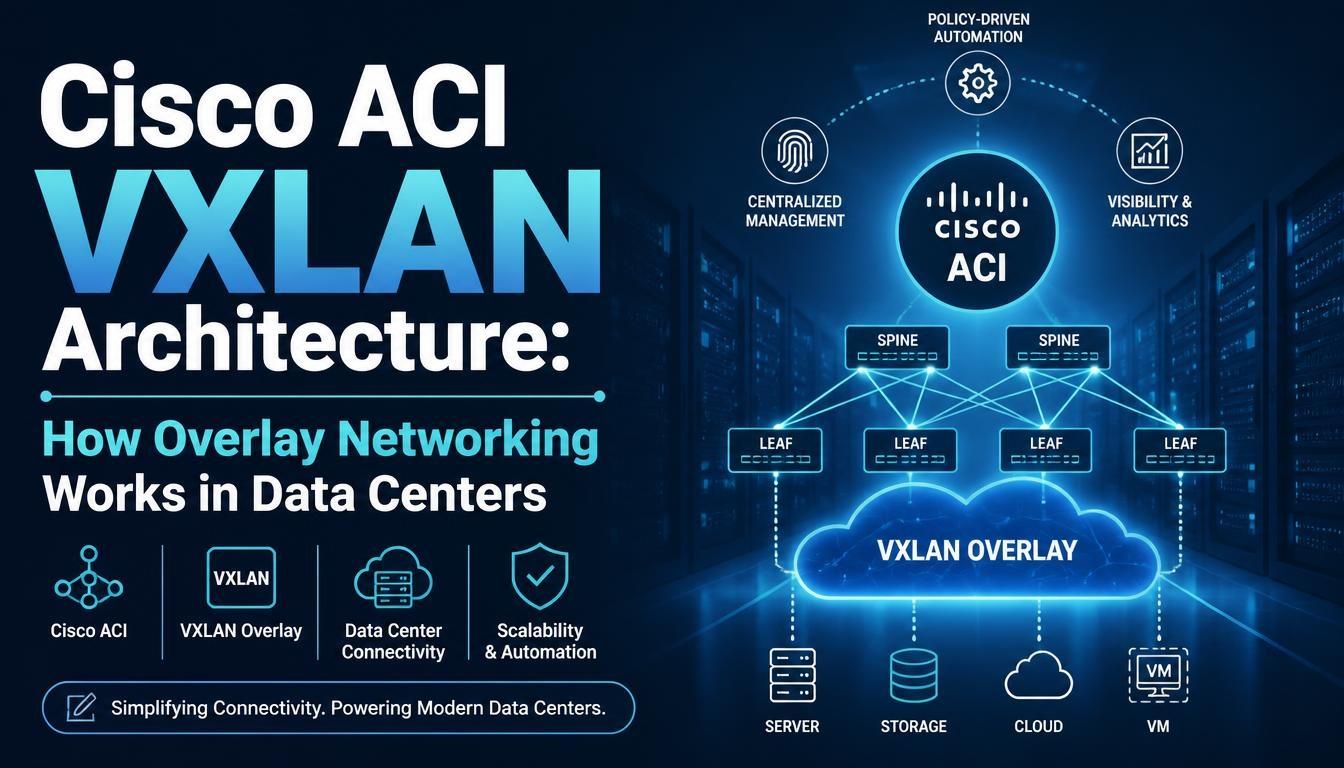
Cisco ACI VXLAN Architecture: How Overlay Networking Works in Data Centers

Modern data centers require flexible and scalable networking technologies to support growing application workloads, virtual machines, and cloud-based environments. Traditional network architectures often face limitations when managing large numbers of network segments and maintaining connectivity across distributed infrastructure. VXLAN (Virtual Extensible LAN) addresses these challenges by extending Layer 2 networks over a Layer 3 infrastructure, making network virtualization more efficient.
Cisco Application Centric Infrastructure (ACI) uses VXLAN technology to provide logical network segmentation, flexible workload connectivity, and efficient traffic forwarding across data center environments. Understanding how this technology works is an important part of Cisco ACI Training, as it helps network engineers understand fabric architecture, endpoint communication, and overlay networking. This article explains Cisco ACI VXLAN architecture, its components, encapsulation process, and practical benefits.
What Is VXLAN in Cisco ACI?
VXLAN (Virtual Extensible LAN) is a network virtualization technology that extends Layer 2 networks over a Layer 3 infrastructure. It encapsulates Ethernet frames inside UDP packets, allowing virtual networks to operate across an IP-based underlay network.
Traditional VLANs support approximately 4,094 usable network segments, which can become a limitation in large data center environments. VXLAN addresses this limitation by supporting approximately 16 million unique VXLAN Network Identifiers (VNIs).
Cisco ACI uses VXLAN as its primary data plane encapsulation technology to transport traffic between endpoints connected to different leaf switches.
Understanding Cisco ACI VXLAN Architecture
Cisco ACI follows a spine-leaf architecture in which leaf switches connect to servers, storage systems, and external networks, while spine switches provide high-speed connectivity between leaf switches.
VXLAN operates across this fabric to support communication between endpoints without requiring traditional Layer 2 connectivity throughout the physical network.
1. Leaf Switches
Leaf switches connect directly to physical servers, virtual machines, and other network devices. They perform important forwarding operations, including endpoint learning, traffic encapsulation, and decapsulation.
When a packet enters a leaf switch, the switch identifies the destination endpoint and determines the appropriate forwarding path through the fabric.
2. Spine Switches
Spine switches provide the transport infrastructure between leaf switches. They forward VXLAN-encapsulated packets across the fabric using the underlay IP network.
Spine switches do not normally perform endpoint learning or policy enforcement in the same way as leaf switches. Their primary responsibility is to provide efficient connectivity between the fabric's leaf switches.
3. Application Policy Infrastructure Controller (APIC)
APIC is the centralized management and policy control platform for Cisco ACI. It allows administrators to define tenants, application profiles, endpoint groups, bridge domains, and network contracts.
APIC distributes the required policies and configuration information to the fabric switches. The actual packet forwarding takes place in the leaf and spine infrastructure rather than through APIC.
How VXLAN Encapsulation Works in Cisco ACI
VXLAN encapsulation allows network traffic to travel across the physical infrastructure while preserving the original Ethernet frame.
The process generally involves the following steps:
Step 1: Traffic Enters the Leaf Switch
When a server sends traffic to another endpoint, the connected leaf switch receives the Ethernet frame and identifies the source and destination information.
Step 2: Destination Identification
The leaf switch checks its endpoint information and forwarding tables to identify the destination endpoint. It determines whether the destination is connected locally or through another leaf switch.
Step 3: VXLAN Encapsulation
If the destination is located behind another leaf switch, the source leaf encapsulates the original Ethernet frame inside a VXLAN packet.
The encapsulated packet includes an outer Ethernet header, an outer IP header, a UDP header, and a VXLAN header containing the relevant network identifier.
Step 4: Packet Forwarding Through the Fabric
The packet travels through the spine switches using the IP underlay network. Spine switches forward the traffic toward the destination leaf switch based on the outer IP destination address.
Step 5: VXLAN Decapsulation
The destination leaf switch receives the encapsulated packet and removes the VXLAN and outer network headers.
It then forwards the original Ethernet frame to the destination endpoint.
This process allows workloads connected to different leaf switches to communicate without extending physical Layer 2 connections across the entire data center.
What Is a VXLAN Network Identifier (VNI)?
A VXLAN Network Identifier (VNI) is a 24-bit field used to identify individual VXLAN segments. It provides logical separation between virtual networks that share the same physical infrastructure.
Cisco ACI uses VNIs to represent different network objects within its policy model.
Important VXLAN-related identifiers in Cisco ACI include:
-
Tenant VNI: Identifies tenant-level network segmentation.
-
VRF VNI: Represents a virtual routing and forwarding context.
-
Bridge Domain VNI: Identifies a Layer 2 forwarding domain.
-
EPG VNI: Represents endpoint group-related policy and segmentation information.
These identifiers help the fabric maintain logical separation and apply the appropriate forwarding and policy behavior.
Benefits of VXLAN in Cisco ACI
VXLAN provides several advantages for modern data center environments.
Improved Network Scalability
VXLAN supports a significantly larger number of logical network segments than traditional VLANs. This makes it suitable for environments with multiple applications, tenants, and workloads.
Flexible Workload Mobility
VXLAN-based overlays allow workloads to communicate across different leaf switches without requiring the same physical Layer 2 network to span the entire data center.
Network Segmentation
VXLAN identifiers help maintain logical separation between network environments. Organizations can use this capability to support different applications, departments, and tenant environments.
Efficient Data Center Connectivity
VXLAN operates over a routed IP underlay, allowing data center networks to use scalable Layer 3 connectivity between leaf and spine switches.
Simplified Network Management
When combined with Cisco ACI's centralized policy model, VXLAN helps administrators manage network segmentation and connectivity through application-based policies.
Common VXLAN Issues in Cisco ACI and Troubleshooting
Although VXLAN supports scalable network connectivity, configuration and operational issues can affect communication between endpoints.
Common problems include:
Endpoint Learning Issues
If a leaf switch does not have the correct endpoint information, traffic may not reach the intended destination. Administrators should verify endpoint learning and forwarding information.
Underlay Connectivity Problems
Incorrect routing or connectivity between leaf and spine switches can prevent VXLAN traffic from reaching its destination. Checking fabric node status and underlay routing helps identify these problems.
Incorrect Policy Configuration
Missing or incorrectly configured contracts, endpoint groups, and bridge domains can prevent expected communication between endpoints.
MTU Configuration Issues
VXLAN encapsulation adds additional headers to the original packet. An insufficient MTU can cause packet drops or fragmentation issues. Administrators should verify that the fabric supports the required packet size.
Conclusion
Cisco ACI VXLAN architecture provides a scalable approach to network virtualization and data center connectivity. By combining VXLAN encapsulation with a spine-leaf topology and centralized policy management, Cisco ACI supports logical segmentation, flexible workload communication, and efficient traffic forwarding.
Understanding leaf switches, spine switches, VNIs, encapsulation, and underlay and overlay networking is important for network engineers working with modern data center infrastructure. Professionals preparing for a Cisco ACI Course can benefit from understanding these concepts along with practical fabric configuration and troubleshooting exercises.