
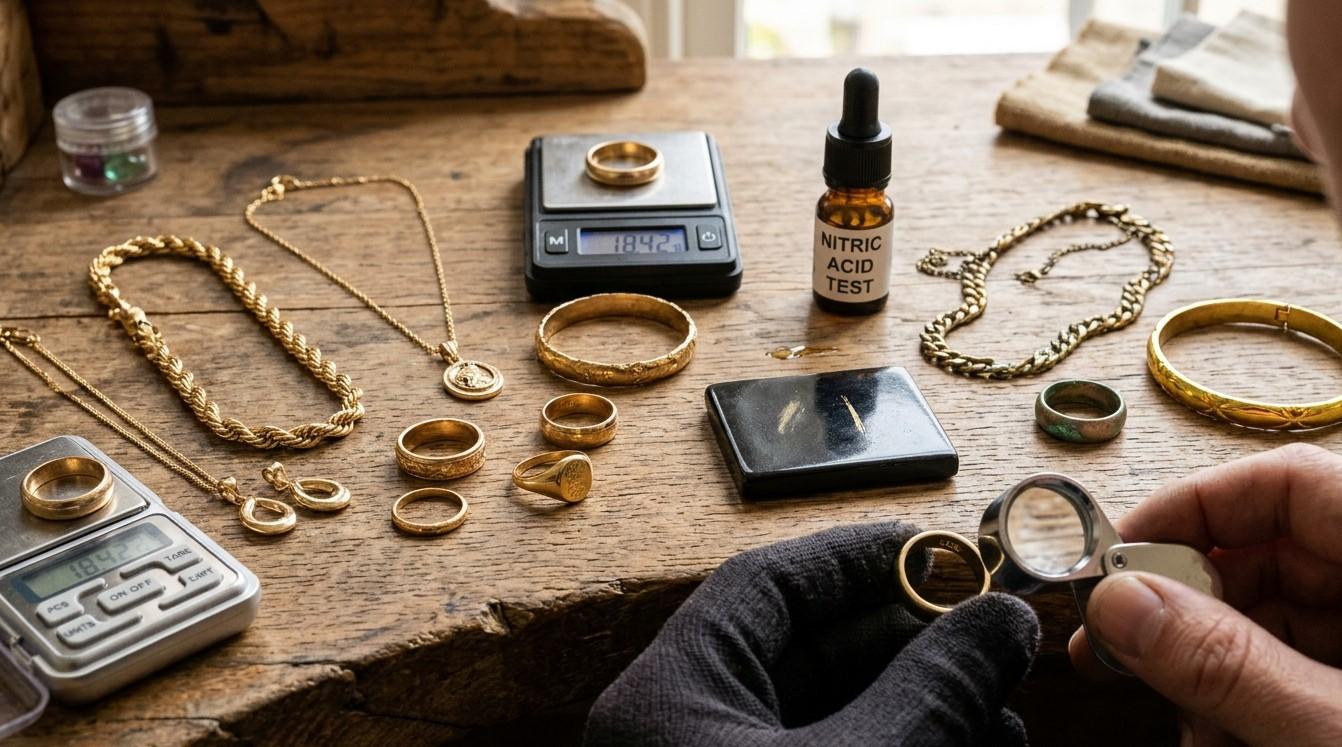

Gold jewelry is popular for its beauty, durability, and lasting appeal, but not every gold-colored piece contains genuine gold. Whether you own an old necklace, inherited ring, bracelet, or pair of earrings, knowing how to identify real gold jewelry from fake or imitation pieces can help you understand what you have. Little Rock Gold & Silver Buyer encourages customers to learn about gold purity and jewelry markings before exploring where to sell. If you are searching for the best place to sell gold in Little Rock or planning to sell gold Little Rock, understanding these basic identification methods is a useful first step.
Table of Contents
-
Check Gold Purity Hallmarks
-
Understand Common Gold Markings
-
Look for Signs of Gold Plating
-
Consider the Jewelry's Weight and Appearance
-
Understand the Magnet Test
-
Get Professional Gold Testing
-
Common Mistakes to Avoid
-
FAQs
1. Check Gold Purity Hallmarks
One of the easiest ways to begin identifying genuine gold jewelry is by checking its hallmark. Manufacturers commonly place small stamps on jewelry to indicate its gold purity.
Look for markings inside ring bands, on necklace clasps, behind pendants, or on earring posts. Common markings include 10K, 14K, 18K, and 22K.
However, a hallmark alone does not guarantee authenticity because markings can sometimes be misleading or counterfeit. Always consider additional verification. <Cite refs={["turn367328search0","turn367328search12"]}/>
2. Understand Common Gold Markings
Gold jewelry markings help explain how much pure gold an item contains.
| Gold marking | Approximate gold content |
|---|---|
| 10K | 41.7% |
| 14K | 58.3% |
| 18K | 75% |
| 22K | 91.7% |
| 24K | Nearly 100% |
You may also find numbers such as 417, 585, 750, and 916. These indicate gold fineness in parts per thousand.
Understanding these markings can help you distinguish different gold purities and compare jewelry more accurately. <Cite refs={["turn367328search0","turn367328search5"]}/>
3. Look for Signs of Gold Plating
Gold-plated jewelry has a thin gold layer covering another metal. It may look similar to solid gold, especially when new.
Check for markings such as:
-
GP: Gold plated
-
GEP: Gold electroplated
-
HGE: Heavy gold electroplate
-
GF: Gold filled
-
RGP: Rolled gold plate
These terms describe different types of gold coverings or construction. Gold-filled jewelry has a mechanically bonded gold layer, while gold-plated pieces have a surface coating.
Knowing the difference helps prevent confusion when identifying your jewelry. <Cite refs={["turn367328search0","turn367328search12"]}/>
4. Consider the Jewelry's Weight and Appearance
Genuine gold is relatively dense, so some gold pieces may feel heavier than similarly sized imitation items.
Also examine the jewelry for:
-
Uneven color or fading
-
Different-colored metal showing through worn areas
-
Loose or poorly finished components
-
Signs of surface coating wearing away
These observations can provide clues, but appearance and weight cannot independently confirm gold authenticity.
5. Understand the Magnet Test
Gold is not magnetic, so a strong magnetic attraction may indicate that an item contains certain other metals.
However, this test has limitations. Many imitation metals are also nonmagnetic, and some genuine jewelry components, such as clasp springs, may contain magnetic materials.
Therefore, a magnet test should never be treated as final proof that jewelry is real or fake.
6. Get Professional Gold Testing
Professional testing is one of the most reliable ways to understand jewelry composition and purity.
Depending on the item, a qualified professional may use:
-
XRF testing: Helps identify the metal composition without damaging the jewelry.
-
Electronic testing: Uses specialized equipment to assess gold purity.
-
Other professional methods: May be appropriate when an item's construction or surface coating makes results difficult to interpret.
Ask how the item will be tested and whether the results can be explained before making a selling decision.
7. Common Mistakes to Avoid
When checking gold jewelry, avoid relying on just one identification method.
Common mistakes include:
-
Assuming every 14K stamp is genuine.
-
Confusing gold-filled jewelry with solid gold.
-
Treating a nonmagnetic result as proof of authenticity.
-
Judging gold purity only by color.
-
Using abrasive or chemical home tests that could damage jewelry.
A careful inspection combined with professional evaluation can provide a clearer understanding of your items.
Frequently Asked Questions
1. How can I identify real gold jewelry at home?
Start by checking purity markings, examining worn areas, and observing the jewelry's overall construction. These checks provide clues but cannot guarantee authenticity.
2. Does real gold always have a hallmark?
Many gold jewelry pieces have purity markings, but older or unusual items may not. Professional testing can help verify unmarked jewelry.
3. What does 585 mean on gold jewelry?
The 585 marking indicates approximately 58.5% gold content, equivalent to 14K gold.
4. Is gold-filled jewelry the same as solid gold?
No. Gold-filled jewelry has a bonded gold layer over another metal, while solid gold jewelry contains a gold alloy throughout its metal structure.
5. Can fake gold jewelry look real?
Yes. Imitation and gold-plated pieces can look very similar to genuine gold, making professional verification useful.
Conclusion
Identifying genuine gold jewelry requires more than checking its color or reading a stamp. Understanding purity markings, recognizing gold-plated materials, and seeking professional testing can help you make informed decisions. Little Rock Gold & Silver Buyer can be a local option to explore when researching the best place to sell gold in Little Rock. Before you sell gold Little Rock, take time to understand your jewelry's composition and potential value.
Call to Action
Have old rings, necklaces, bracelets, or other gold jewelry you would like evaluated? Contact Little Rock Gold & Silver Buyer to learn more about gold evaluation and selling options.


