
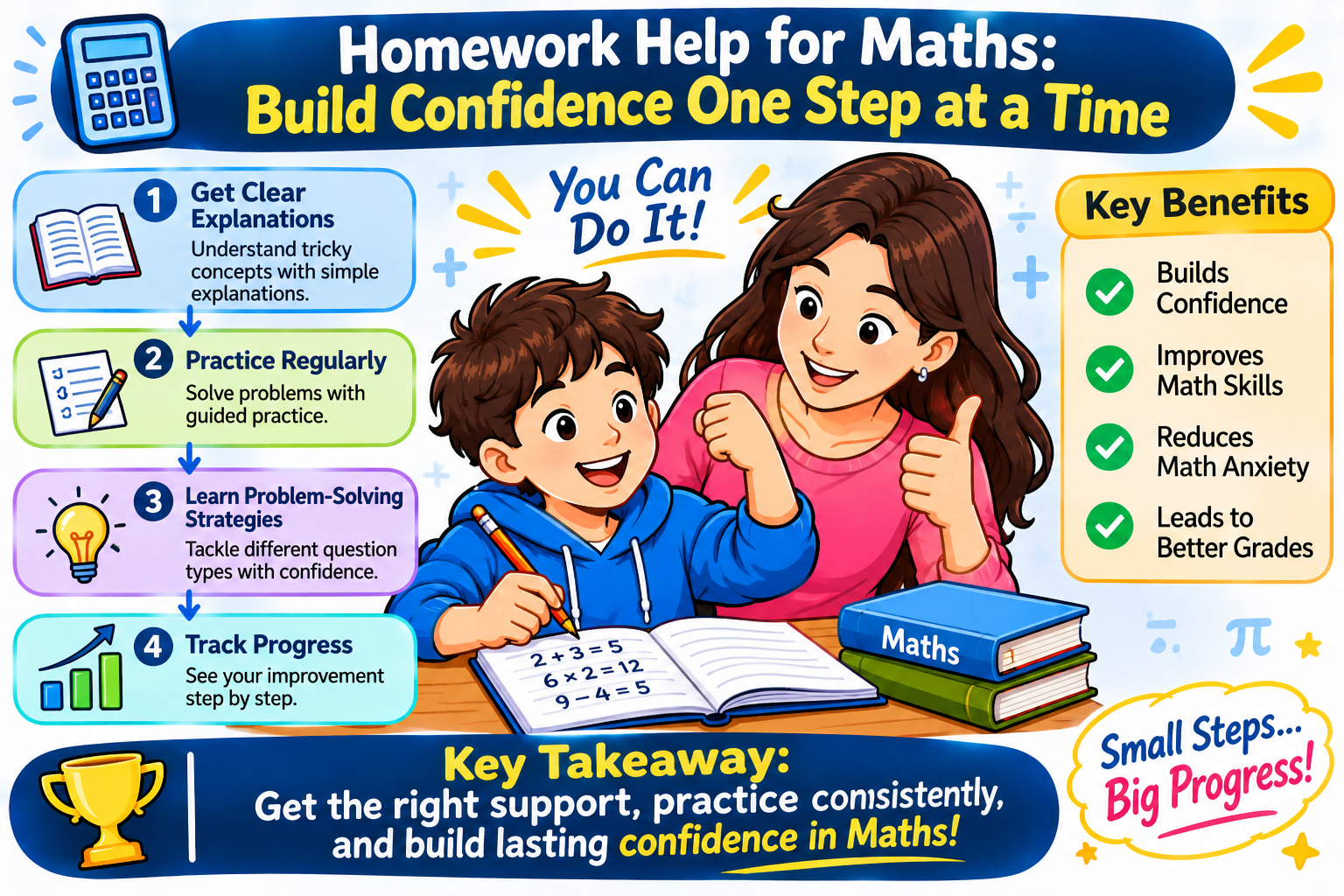
Homework Help for Maths: Build Confidence One Step at a Time

Few subjects divide students like maths. Some enjoy the logic and the clean answers. Others feel their stomach drop when a page of equations appears. Often the difference is not talent but habit. Students who do well tend to follow the same small routines, and those routines can be learned by anyone. This guide walks through them in plain language. Whether you are a student, a parent, or a tutor, you will find practical homework help that builds understanding rather than just chasing the right answer.
Why Maths Feels Harder Than Other Subjects
Maths builds on itself more directly than almost any other subject. A missed idea in week three quietly breaks the work in week six, and the student rarely knows why things suddenly feel confusing. Fractions underpin algebra, algebra underpins calculus, and a shaky base makes every new floor feel unstable.
Speed anxiety adds another layer. Many students believe that fast means smart, so they rush, make careless slips, and then conclude they are bad at maths. In truth, careful beats fast almost every time. Slowing down is not a weakness. It is the habit that strong students quietly share.
A Six-Step Method for Any Problem
Use this routine on every question until it becomes automatic:
- Read the problem twice and underline what is given and what is asked
- Draw a diagram or table if the problem involves shape, flow, or comparison
- Write the rule or formula you plan to use before you use it
- Work one line at a time and keep the equals signs lined up
- Check your answer against the question: does the size and unit make sense?
- Write one sentence explaining what you did and why
That last step matters more than it seems. If you cannot explain a step in plain words, you have not fully understood it yet, and that is useful information.
Learn From Mistakes Instead of Hiding Them
Mistakes are not signs of failure. They are the most direct feedback a maths student receives. A wrong answer points to a specific gap, such as a sign error, a misread question, or a misunderstood rule. Students who study their errors improve far faster than students who simply move on to the next problem.
Treat each error with curiosity. Ask what exactly went wrong, why it felt right at the time, and what small check would have caught it. This habit turns every red mark into a lesson.
Keep an Error Log
A simple notebook makes this habit easy:
- Write the question number and the topic
- Note what went wrong: arithmetic slip, wrong rule, or misread question
- Write the correct method in your own words
- Redo the problem two days later without looking
- Review the log before every test
Practice That Actually Works
How you practise matters as much as how long. Students often repeat ten similar problems in a row, which feels productive but builds weak memory. Mixed practice works better. Shuffle problem types so your brain must choose the right method each time, which is exactly what a test demands.
Keep sessions short, around 20 minutes, and try each problem before looking at an example. The most useful homework help for maths is often a short, clear explanation of one stuck point, followed by a fresh problem to try alone. That pattern builds skill instead of dependence.
Building Number Confidence
Confidence grows from small, regular wins:
- Practise times tables and number facts for five minutes a day
- Estimate answers before calculating
- Use real examples, such as shopping totals, travel times, or recipes
- Talk through a problem aloud as if teaching a friend
- Celebrate the first correct step, not only the final answer
When to Ask for Help
Struggle is useful, up to a point. If you have been stuck for 15 to 20 minutes with no new ideas, it is time to ask. Bring your attempt, not a blank page. Show where you started, what you tried, and where you stopped. A teacher, tutor, or study partner can then target the exact gap instead of repeating the whole lesson.
Prepare one specific question, such as "Why do I flip the sign here?" Specific questions get specific answers, and those answers stick far better than general explanations.
Conclusion
Maths rewards patience and routine more than speed or genius. Use a clear method, keep an error log, practise in short bursts, and ask for help at the right moment. These habits turn confusing pages into manageable steps. Good homework help in maths always aims to build understanding that lasts beyond tonight's task. Keep the focus on the process, and the answers will follow. With steady practice and honest homework help, even the most nervous maths student can grow into a confident one.


