
The Importance of Discourse Annotation in Training Context-Aware NLP Models

Human communication is rarely limited to individual words or isolated sentences. People express ideas through conversations, follow-up questions, references to previous statements, opinions, and relationships between different parts of a discussion. Understanding these connections is essential for Natural Language Processing (NLP) models that aim to interpret language accurately and generate meaningful responses.
This is where discourse annotation becomes important. It helps NLP models understand how sentences and conversational elements relate to one another within a broader context. Instead of processing each sentence independently, models trained on discourse-annotated datasets can recognize relationships such as cause and effect, contrast, elaboration, and references to previously mentioned information.
As conversational AI, virtual assistants, chatbots, and Large Language Models (LLMs) become increasingly sophisticated, the demand for high-quality contextual language data continues to grow. Accurate annotation plays a critical role in developing these capabilities and improving real-world NLP performance.
What Is Discourse Annotation in NLP?
Discourse annotation is the process of identifying and labeling relationships between sentences, clauses, utterances, and other linguistic elements within a conversation or document. It provides structured information that enables NLP models to understand how different parts of a text contribute to an overall meaning.
Unlike traditional text annotation, which may focus on identifying entities, keywords, or individual sentence categories, discourse annotation examines the connections between linguistic units.
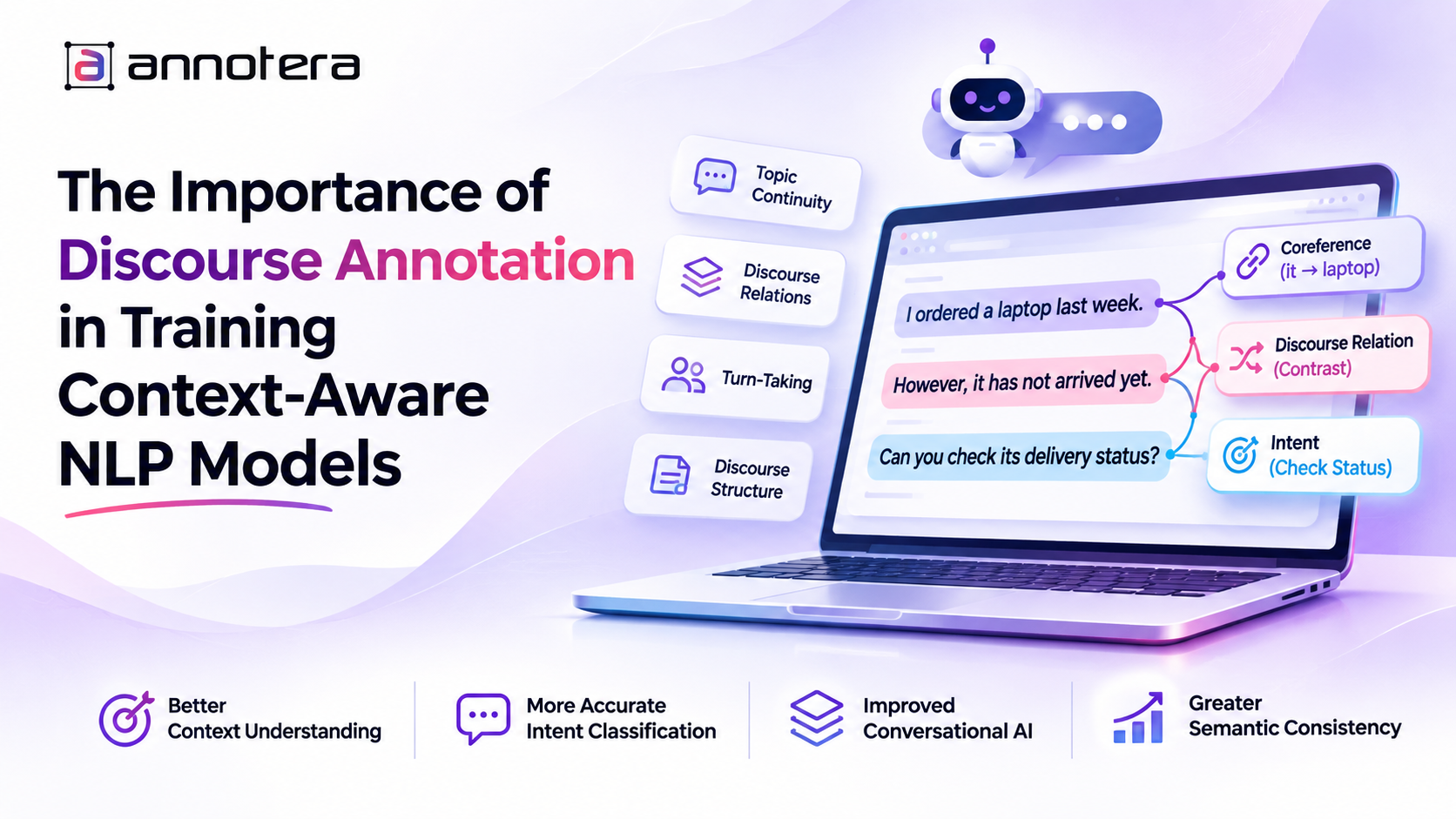
For example, consider the following conversation:
-
User: I ordered a laptop last week.
-
User: However, it has not arrived yet.
-
User: Can you check its delivery status?
A context-aware NLP model needs to understand that "it" refers to the laptop and that the final question relates to the earlier order. Discourse annotation helps identify these relationships, allowing the model to interpret the conversation as a connected sequence rather than three unrelated statements.
Common discourse elements include:
-
Coreference relationships: Identifying expressions that refer to the same entity.
-
Discourse relations: Recognizing connections such as contrast, explanation, cause, and elaboration.
-
Topic continuity: Tracking how conversations move between related subjects.
-
Turn-taking: Understanding how conversational participants contribute to an interaction.
-
Discourse structure: Identifying how individual sentences contribute to larger sections of a discussion.
Why Context-Aware NLP Models Need Discourse Annotation
Context is fundamental to understanding human language. A sentence can have different meanings depending on what was discussed previously, the speaker's intention, and the relationship between surrounding statements.
Discourse annotation helps address several important challenges in NLP development.
1. Improving Contextual Understanding
Traditional language processing approaches may struggle when individual sentences depend on information introduced earlier in a conversation. Discourse annotation provides explicit relationships between linguistic elements, helping models interpret statements using surrounding information.
For instance, when a user asks, "Can you cancel it?", the model must identify what "it" refers to before taking the appropriate action. Without contextual understanding, the system may generate irrelevant responses or request unnecessary clarification.
Annotated discourse relationships help models maintain continuity and interpret conversational references more accurately.
2. Strengthening Intent Classification
Understanding user intent requires more than identifying keywords. The same phrase can communicate different intentions depending on the surrounding conversation.
For example, "That sounds expensive" could express dissatisfaction, a request for a cheaper alternative, or a general observation.
Discourse annotation helps NLP models interpret these statements by connecting them with previous messages and identifying their communicative function.
Combining discourse labels with intent classification enables conversational AI systems to distinguish between requests, complaints, confirmations, follow-up questions, and other user intentions. This improves response relevance and reduces incorrect predictions.
3. Enhancing Conversational AI Performance
Modern chatbots and virtual assistants are expected to manage multi-turn conversations without losing important information.
Discourse annotation supports this requirement by helping models recognize conversational dependencies, identify topic transitions, and connect follow-up questions with earlier statements.
For example, a customer might first ask about a product's availability, followed by questions about delivery charges and return policies. A context-aware system should understand that these questions relate to the same purchase decision.
With properly annotated conversational datasets, NLP models can maintain a more consistent understanding throughout the interaction.
4. Improving Semantic Consistency
Words and expressions frequently depend on surrounding sentences for their intended meaning. Discourse annotation helps models understand relationships between statements and avoid interpreting individual expressions in isolation.
This is particularly valuable when processing lengthy documents, customer support conversations, research papers, and legal content.
By learning how information is introduced, explained, contrasted, and referenced, NLP models can produce more coherent summaries, classifications, and responses.
Major Types of Discourse Annotation
Different NLP applications require different discourse annotation approaches. Some of the most widely used categories include:
1. Rhetorical Structure Annotation: Identifies relationships between different parts of a document, including elaboration, contrast, explanation, and evidence. It helps models understand how arguments and supporting information are organized.
2. Coreference and Anaphora Annotation: Identifies expressions that refer to previously mentioned entities or concepts. This enables models to resolve pronouns and maintain entity-level context across multiple sentences.
3. Discourse Relation Annotation: Labels semantic relationships between clauses and sentences, such as cause-effect, condition, comparison, and temporal sequence.
4. Conversational Discourse Annotation: Focuses on dialogue structure, speaker turns, conversational roles, interruptions, acknowledgments, and topic changes.
5. Topic and Coherence Annotation: Identifies topic continuity, topic shifts, and logical connections between different sections of a conversation or document.
Selecting the appropriate annotation framework depends on the intended NLP application, dataset characteristics, and model training objectives.
The Role of High-Quality Text Annotation in Discourse Analysis
The effectiveness of discourse annotation depends heavily on dataset quality. Inconsistent labels, unclear guidelines, and incorrect relationship identification can introduce noise into training data and negatively affect model performance.
This makes structured annotation workflows essential.
Organizations should establish clear annotation guidelines defining discourse categories, labeling rules, edge cases, and relationship boundaries. Annotators should also receive domain-specific training to ensure consistency across complex linguistic structures.
A robust quality assurance process should include:
-
Multiple annotation reviews for ambiguous discourse relationships.
-
Inter-annotator agreement measurements to evaluate labeling consistency.
-
Expert validation of complex linguistic structures.
-
Regular updates to annotation guidelines based on identified errors.
-
Dataset balancing across different conversational styles and language patterns.
Working with experienced text annotation outsourcing services can help organizations manage large-scale annotation requirements while maintaining structured quality control.
A reliable text annotation company can provide trained linguistic annotators, domain-specific workflows, and multi-level quality assurance to support the development of context-aware NLP models.
Applications of Discourse Annotation Across Industries
Discourse annotation supports several real-world applications where understanding contextual relationships is essential.
-
Customer Support: Helps AI chatbots understand follow-up questions, complaints, and references to previous customer interactions.
-
Healthcare NLP: Supports the interpretation of clinical narratives by connecting symptoms, treatments, medical history, and related statements.
-
Financial Services: Helps systems understand relationships between financial statements, customer queries, and supporting explanations.
-
Legal Document Processing: Enables NLP models to identify relationships between clauses, arguments, evidence, and references across lengthy documents.
-
Conversational AI: Improves dialogue continuity, contextual response generation, and intent recognition across multi-turn interactions.
These applications demonstrate why discourse-level information is becoming increasingly valuable for organizations developing advanced language technologies.
How Annotera Supports High-Quality Text Annotation
Building context-aware NLP models requires more than collecting large volumes of textual data. It requires accurately structured datasets that capture the relationships, dependencies, and contextual meaning within human communication.
Annotera supports AI development initiatives through scalable text annotation services designed to improve training dataset quality. Our annotation workflows focus on linguistic accuracy, consistent labeling, and structured quality assurance to support diverse NLP requirements.
From discourse relationship identification and coreference resolution to intent classification and conversational text annotation, Annotera helps organizations prepare high-quality datasets for advanced language processing applications.
By combining trained human annotators with systematic quality validation, businesses can develop more reliable datasets for conversational AI, LLM development, and other context-sensitive NLP applications.
Conclusion
Discourse annotation is a fundamental component of training context-aware NLP models. By identifying relationships between sentences, resolving references, and capturing conversational structure, it enables AI systems to move beyond isolated text interpretation and develop a deeper understanding of human communication.
As NLP applications increasingly handle complex conversations and lengthy documents, the importance of accurately annotated discourse data will continue to grow. Investing in structured annotation processes, trained linguistic expertise, and reliable quality assurance can help organizations build more coherent, context-sensitive, and dependable AI systems.
Looking to improve your NLP training datasets? Partner with Annotera for scalable text annotation solutions that support more accurate and context-aware AI development.


