
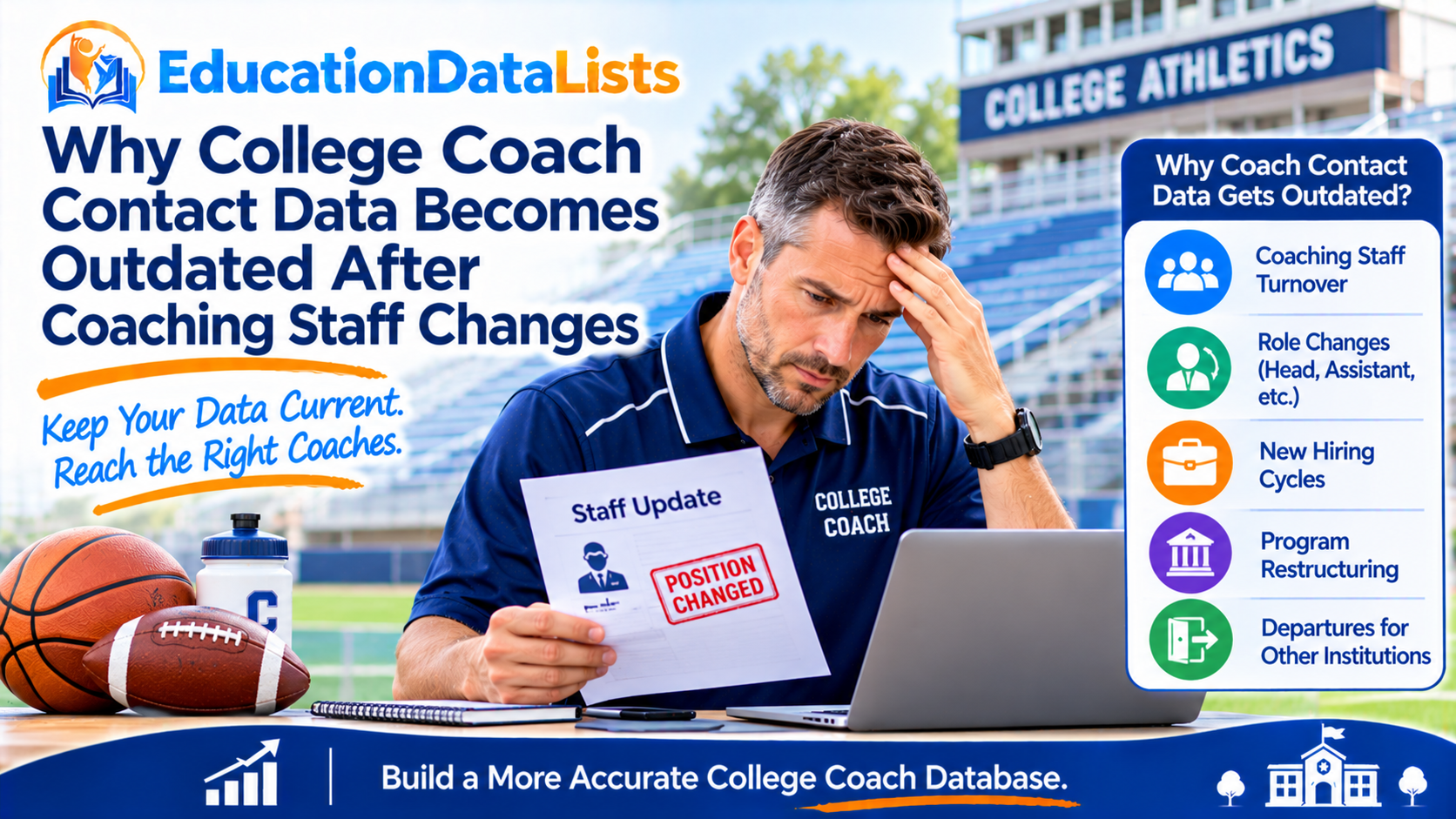
Why College Coach Contact Data Becomes Outdated After Coaching Staff Changes | EducationDataLists

1. Coaching Changes Create More Than One Outdated Contact
A head coach's departure can affect an entire athletic department's contact network. Assistant coaches may follow the departing coach, receive promotions, move to other programs, or leave the profession. Even when a coach stays at the same university, a change in responsibilities can make an old job title or department listing inaccurate.
CBS Sports' May 2025 Coaching Carousel Audit documented 2,163 on-field college football coaches changing jobs over a four-year period. It also identified 550 hires and promotions among head coaches and the top 10 assistants during the 2024–25 cycle. The report noted that 61 FBS programs changed head coaches over the preceding two years, including 30 in the most recent cycle.
These figures demonstrate why a contact record should not be treated as permanent. A coach's email address may still function after a move, but the institutional affiliation, team assignment, and relevance to a campaign may all have changed.
For marketers, the issue extends beyond bounced emails. An outdated record can send a sponsorship proposal, training offer, recruiting technology pitch, or equipment promotion to someone who no longer works with the intended program.
2. Head Coach Turnover Can Trigger Assistant Staff Changes
The head coach is often the most visible leadership change, but assistant coaches are an important part of the same professional network.
When a new head coach arrives, they may retain existing assistants, promote internal staff, or recruit coaches from other universities. Coordinators, position coaches, recruiting personnel, and strength and conditioning staff can all be affected.
CBS Sports' 2025 audit reported 550 hires and promotions among head coaches and the top 10 assistants during the 2024–25 cycle, a 4% increase from the previous cycle. Its analysis also described how the transfer portal, NIL-related demands, and changing college football operations were contributing to a more active coaching job market.
The implication for a College Coach Email List is that updating only head coach records is insufficient. A database can have the correct head coach but still contain several outdated assistant coach contacts.
A useful staff record should identify:
-
Current coaching position and sport
-
University and athletic department
-
Team or program affiliation
-
Coaching level, such as head coach, assistant coach, or coordinator
-
Current institutional email address
-
Date the role was last confirmed
This structure makes it easier to identify which contacts need review after a leadership announcement.
3. Coaches Change Schools, but Their Professional Email Addresses May Not Follow
A coach's email address is usually associated with the institution where they work. When they move to another university, their previous institutional account may eventually be disabled, redirected, or retained temporarily under the institution's policies.
This creates two separate data-quality questions:
-
Is the email address technically capable of receiving messages?
-
Does the address still belong to the coach at the institution and in the role recorded?
Email verification can help with the first question, but it cannot reliably answer the second. A technically valid address may belong to a former staff member, a shared department mailbox, or an account that no longer reaches the intended person.
The 2025–26 FBS coaching cycle illustrates the scale of institutional movement. CBS Sports reported that 32 head coaching jobs had opened by December 26, 2025, while 17 positions among the power conferences had changed hands. The publication also counted 93 head coaches changing jobs over the preceding three cycles.
For marketers, this reinforces the need to verify both the person and the institution before sending a campaign. A College Coach Mailing List should distinguish a coach's current professional affiliation from a previous employer rather than treating an old email record as current simply because it has not bounced.
4. Sport, Division, and Coaching Role Must Be Recorded Separately
A contact database becomes less useful when it groups all coaches into one broad category. A football head coach, a women's basketball assistant coach, and a baseball recruiting coordinator may work in the same athletic department, but their responsibilities and purchasing influence differ.
The 2025 college basketball coaching cycle provides another example of how movement varies by sport. CBS Sports reported that 14 of 79 power-conference men's basketball head coaching positions changed hands in spring 2025, representing 18% of those jobs. It also noted that the same group of high-major conferences had experienced 14 coaching changes in each of the previous two years.
This is a specific sample of men's basketball programs, not a measure of turnover across every college sport. However, it shows why databases should use sport-specific and role-specific classifications.
Useful segmentation fields include:
| Data field | Examples |
|---|---|
| Sport | Football, basketball, baseball, soccer, volleyball |
| Coaching role | Head coach, assistant coach, coordinator, position coach |
| Institution | College or university name |
| Athletic division | NCAA Division I, II, III, or other applicable association |
| Conference | Current athletic conference |
| Team affiliation | Men's, women's, or combined program |
| Contact status | Current, moved, unconfirmed, or departed |
These fields help suppliers avoid irrelevant outreach. A company selling football training equipment can prioritize football staff, while a provider of basketball analytics software can focus on relevant basketball programs.
5. Institutional Directories Are Important Sources for Contact Updates
College athletic departments commonly publish staff directories on official university websites. These pages can provide a useful reference for checking names, job titles, team assignments, and professional contact details.
However, directory information should be reviewed rather than copied once and treated as permanent. A university may update its head coach announcement before revising every assistant coach biography or department contact page. Different pages may also be maintained by separate departments.
A robust College Coach Email Database should therefore retain source and update information for each record:
-
Official university or athletic department source
-
Date the coach's role was last checked
-
Date the email address was last verified
-
Previous institution, where relevant and appropriately retained
-
Current sport and team assignment
-
Status of the record and any unresolved discrepancies
Where two official pages show different information, the record should be marked for review rather than automatically treating one version as correct.
This approach is particularly useful during the coaching carousel, when announcements, staff appointments, and directory updates may happen at different times.
6. Email Verification and Deliverability Still Matter
Once a coach's current role and institution have been confirmed, the email address itself should be checked. A correct job title does not guarantee that the associated mailbox is active.
Google's current email sender guidelines state that bulk senders sending 5,000 or more messages per day to personal Gmail accounts must meet authentication and unsubscribe requirements. Google advises senders to keep reported spam rates below 0.1% and prevent them from reaching 0.3% or higher. Its guidance also identifies SPF, DKIM, DMARC, and one-click unsubscribe requirements for relevant bulk marketing messages.
For organizations contacting college coaches, these requirements reinforce several practical steps:
-
Verify addresses before sending large campaigns.
-
Remove confirmed hard bounces.
-
Review contacts after coaching announcements and staff changes.
-
Authenticate sending domains with the appropriate email protocols.
-
Make unsubscribe options clear and honor requests promptly.
-
Monitor bounce rates, spam complaints, and engagement patterns.
Deliverability is not determined by list quality alone. Sender reputation, message relevance, authentication, and recipient preferences also matter. A clean contact database reduces avoidable errors, but it cannot guarantee inbox placement.
7. Practical Ways to Keep College Coach Contact Data Current
Marketing and sales teams can reduce outdated records by treating coaching changes as regular data-maintenance events.
-
Monitor coaching announcements. Review official university announcements and athletic department news during hiring periods and after major staff changes.
-
Recheck the entire affected staff. When a head coach leaves, review assistant coaches, coordinators, and other relevant staff rather than updating only the top position.
-
Confirm the current institution. Match each coach's name and role against an official staff directory or university announcement.
-
Separate role verification from email verification. Confirm that the individual still holds the recorded position, then check whether the email address is valid.
-
Record update dates and sources. Keep an audit trail so teams can identify old or uncertain information before a campaign.
EducationDataLists can be considered by organizations evaluating education and college athletics contact data. Before using a College Coach Email List, buyers should review its sport coverage, coaching-role classifications, institutional accuracy, verification process, and update frequency. The number of records alone does not indicate whether a database reflects current staff structures.
Conclusion
College coaching changes can make contact data outdated even when an email address still appears technically valid. Head coach departures may lead to assistant staff movement, new institutional affiliations, revised responsibilities, and changes to professional contact details. CBS Sports' recent coaching audits show how substantial this movement can be in college football and power-conference basketball. For marketers, the solution is to maintain records at both the individual and team levels. Combining official directory checks, role confirmation, email verification, and documented update dates makes a College Coach Email List more dependable. As college athletics continues to evolve, contact-data maintenance should be an ongoing process rather than a task performed only before a campaign.
Frequently Asked Questions
1. Why does college coach contact data become outdated?
Coaches may change universities, accept new roles, leave athletic departments, or move with a head coach who has taken another position. These changes can make their institutional email address, team affiliation, and job title inaccurate.
2. How often should a college coach email list be updated?
It should be reviewed regularly, with additional checks during coaching hiring periods and after major staff announcements. There is no single update interval that guarantees accuracy across every sport and institution.
3. Why should marketers update assistant coach contacts when a head coach leaves?
A new head coach may bring assistants from another program, promote existing staff, or reorganize the coaching team. Updating only the head coach can leave several other records outdated.
4. What information should a college coach email database contain?
Useful records include the coach's name, current title, sport, team, university, athletic division, conference, professional email address, verification status, and last-checked date. Source information helps teams investigate conflicting or outdated records.
5. Can email verification identify whether a coach still works at a university?
No. Email verification checks aspects of an address's technical validity, but it does not reliably confirm a person's current employer or coaching role. Marketers should compare the contact with an official university or athletic department source.
6. Which college coaching roles should a contact database include?
Depending on the campaign, it may include head coaches, assistant coaches, coordinators, position coaches, recruiting staff, and strength and conditioning personnel. The appropriate roles depend on the product or service being marketed.
7. What is the best way to verify a college coach's current email address?
Start with the official athletic department directory or a recent university announcement, confirm the coach's current role and institution, and then check the email address using an appropriate verification process. Record the source and date so the information can be reviewed later.


