
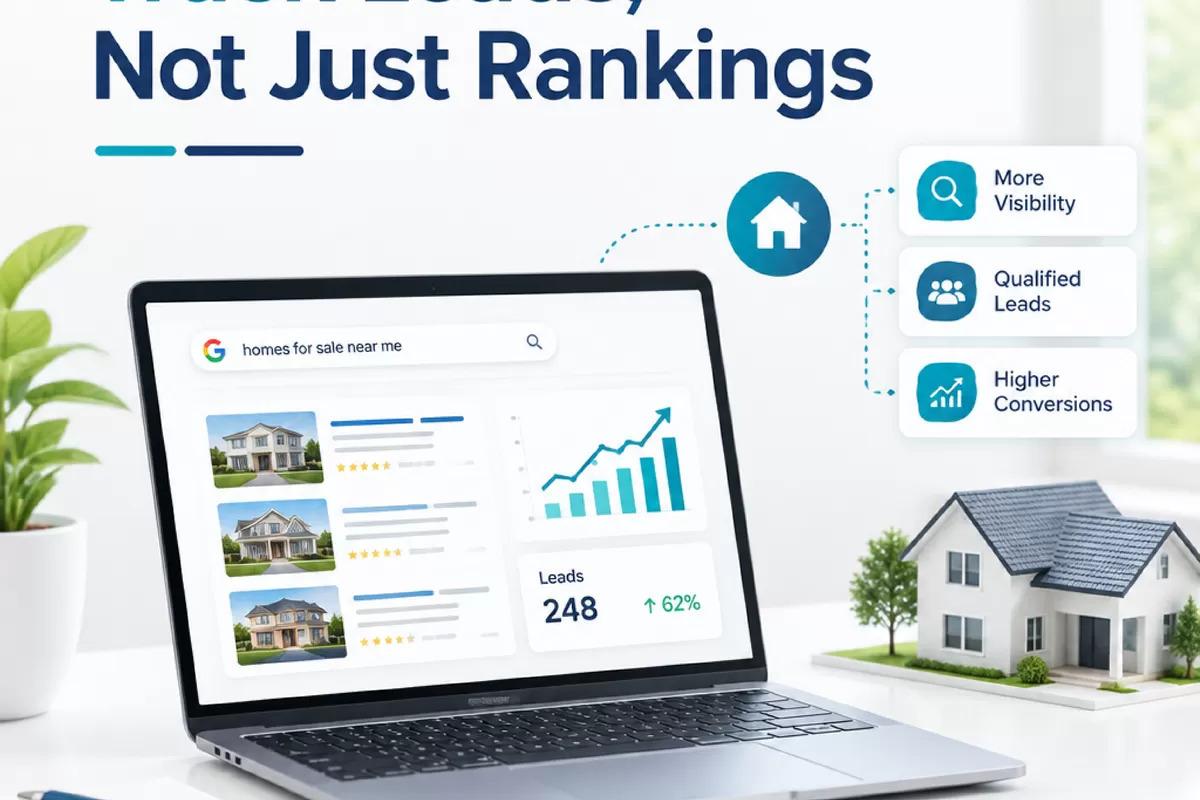

A real estate website can rank for a local search and still attract few useful inquiries. Rankings are one signal, but they do not show whether buyers or sellers can find the right office, whether a location page answers their questions, or whether search visits lead to meaningful conversations. To evaluate real estate SEO services, look beyond position tracking and ask how the work connects local visibility to business goals.
A useful measurement plan follows the path from search to inquiry. It checks map visibility and organic results, evaluates whether local pages match what people need, and reviews the quality of calls and forms. That gives you a clearer basis for deciding what to improve and whether an SEO program is doing relevant work.
What real estate SEO services should measure locally
Local visibility is not a single ranking. A searcher may see a map listing, regular website results, an answer in a search feature, or content surfaced by an AI-powered search experience. Results can also vary by location and search context. A report that checks one keyword from one fixed point may miss what prospective clients see in other parts of your service area.
Ask how a provider evaluates map visibility across the places you actually serve. They should explain which locations and search terms they monitor, how often they review them, and what the data can and cannot tell you. Map results are useful to watch, but a change in visibility is not proof that the business gained or lost inquiries. Compare it with website activity and real contact data before drawing conclusions.
Local landing pages need the same scrutiny. A useful page should make clear which community or office it serves and provide details that help a prospective client decide what to do next. A page that swaps in a town name but offers no local context may be less helpful than a focused page with accurate service information, relevant property expertise, and clear contact options. Check that each location page is distinct, current, and consistent with the services your team can provide there.
Technical issues can interfere with that experience. Slow or broken pages, confusing navigation, duplicate location pages, and inaccurate business details can make it harder for people and search systems to understand the site. A sound program should identify these issues, explain which ones matter most, and show what was fixed. Content, local visibility, technical improvements, and ethical link building work best as connected parts of a plan, not isolated tasks.
SEO services may also include Answer Engine Optimization (AEO), which helps organize useful information for direct-answer search features, and Generative Engine Optimization (GEO), which focuses on making information clear and dependable for AI-generated search responses. These efforts complement local SEO. They do not replace accurate pages, sound technical foundations, or measurement tied to actual inquiries.
How to evaluate reporting and inquiry quality

A ranking report answers, “Where did this term appear in the results we checked?” It does not answer, “Did the right person contact us?” A stronger report puts visibility alongside actions such as calls, form submissions, and visits to key local pages. It also defines what counts as an inquiry and separates meaningful contacts from spam, vendor pitches, or requests outside the business’s service area.
When assessing a provider’s reporting approach, ask to see how they connect search activity to outcomes without implying that every inquiry came from SEO. A practical real estate seo services guide can help you review the mix of technical fixes, local visibility, content, ethical link building, and reporting tied to leads and revenue. The useful question is whether the provider can show what was measured, where the data came from, and what decision the report supports.
Agree on definitions before work begins. For example, decide whether a qualified inquiry must include a valid phone number or email, concern a service you offer, and come from a location you serve. Your team can then review a sample of incoming contacts with the marketing report. This human check matters because analytics can record a form submission, but they usually cannot tell you whether the person was a potential client or whether the inquiry was relevant.
At minimum, a clear report should explain:
- Which local searches, locations, and map or organic visibility signals were reviewed.
- Which pages received search visits and whether those pages match the intended service area.
- How calls and forms are tracked, including known gaps in attribution.
- What work was completed, what changed, and what the team recommends testing next.
Attribution has limits. Someone may discover an agent through one search, return later through a direct visit, and call after seeing a listing elsewhere. Call tracking, analytics, and customer relationship management records can help connect those steps, but they do not always identify the full journey. Treat reporting as evidence for better decisions, not as a perfect account of how every client found you.
How to choose a provider and improve measurement
Choose a provider that can explain its methods in plain language. Ask who will handle technical fixes, how location pages will be reviewed, and how the team will evaluate local visibility beyond a few keyword positions. Find out how often reporting arrives, who discusses it with you, and whether recommendations are tied to observed problems. A provider should be willing to state what a metric means and what it does not prove.
Look for a plan that respects the realities of your business. A brokerage with several offices may need clear, distinct location pages and a way to review inquiry quality by office. An independent agent may need a tighter focus on the communities and services they can realistically support. In either case, expanding into locations without a genuine presence or publishing thin pages for many towns can create maintenance problems and confuse visitors.
Common mistakes include treating a top ranking as the goal, reporting total traffic without context, and counting every call or form as a qualified lead. Another is changing pages frequently without recording what changed. When that happens, it becomes harder to tell whether a shift in visibility or inquiries followed a technical fix, a content update, or something else.
Start with a short baseline review. List your key service areas and the pages intended to serve them. Check business details, page accuracy, contact paths, and whether mobile visitors can call or submit a form without friction. Then ask your provider to report local visibility, page activity, and inquiry quality together, with known limitations stated plainly. Review the pattern over time and use it to set the next priority. The goal is not to discard rankings, but to understand whether search visibility is helping the business reach the people it can serve.


