
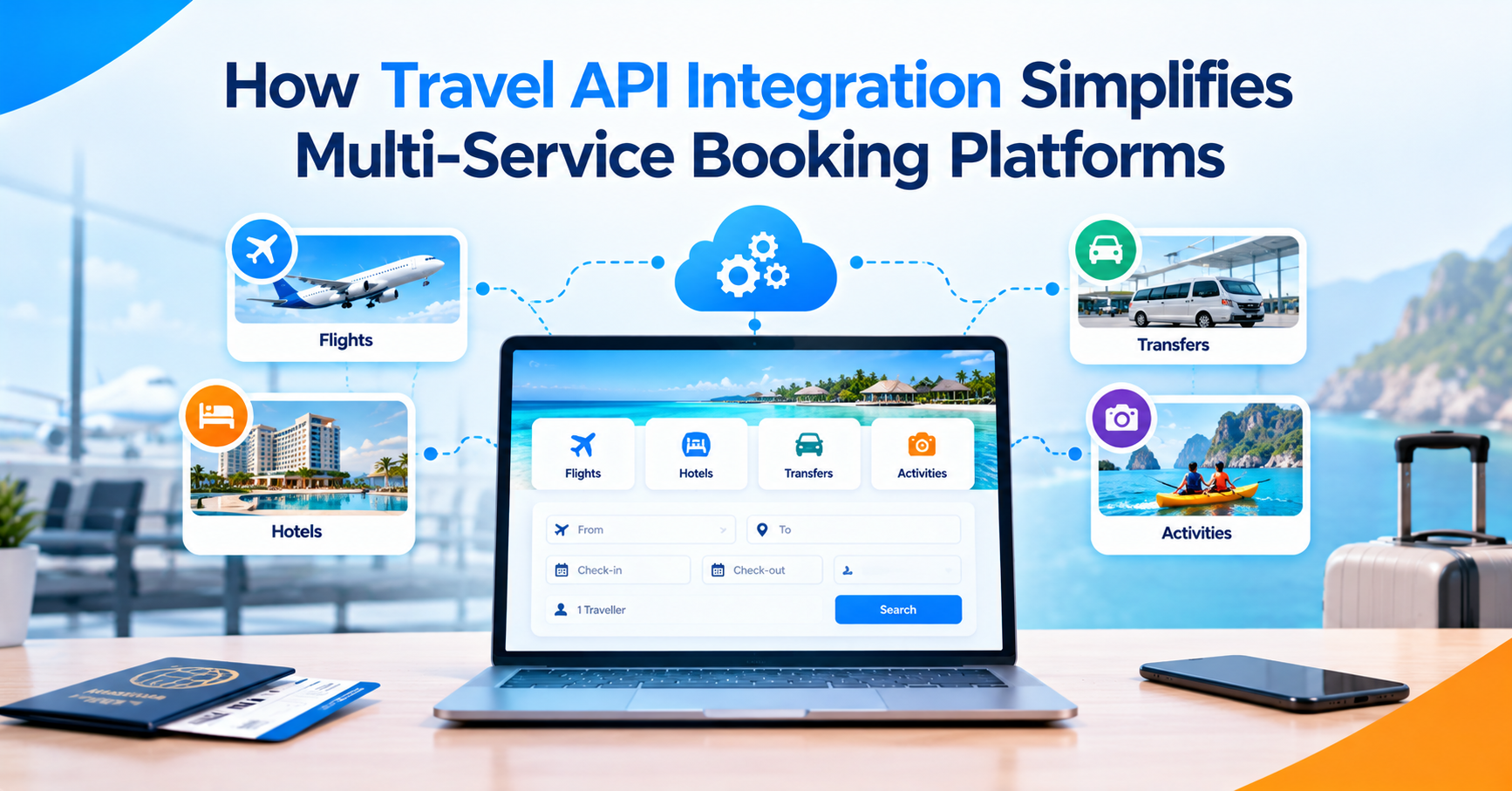
How Travel API Integration Simplifies Multi-Service Booking Platforms

Travelers expect to book flights, hotels, airport transfers, and activities through one platform. They also want accurate prices, quick confirmations, and simple trip management. Travel businesses need reliable API integrations to meet these expectations. According to the International Air Transport Association, global passenger demand grew by 10.4% in 2024 compared with 2023. This growth highlights the need for travel platforms that can handle increasing booking volumes. The World Travel and Tourism Council also reported that travel and tourism contributed $10.9 trillion to global GDP in 2024. These figures show the importance of digital systems across the travel industry.
However, combining travel services creates several technical challenges. Each supplier may use different APIs, data formats, booking rules, and payment methods. A flight provider may return availability differently from a hotel supplier. Transfer operators and activity platforms may also follow separate confirmation processes. A unified travel platform must connect these systems through a reliable technical structure. It must normalize supplier data, manage bookings, handle failures, and maintain accurate prices. Travel Technology Services help businesses design and maintain these complex integrations.
Understand the Role of Travel APIs
What Is a Travel API?
An Application Programming Interface (API) allows two software systems to exchange information. Travel companies use APIs to retrieve availability, compare prices, create bookings, and access supplier services.
Each travel category has different data and business rules. Your platform must understand these differences before combining the services.
-
Hotel APIs: Provide room availability, rates, property details, and reservation options.
-
Flight APIs: Return schedules, fares, seat availability, baggage rules, and ticketing options.
-
Transfer APIs: Provide airport pickups, private cars, shared rides, and ground transport prices.
-
Activity APIs: Offer tours, attraction tickets, guided experiences, and time-based reservations.
A single platform can connect several suppliers within each category. This approach reduces dependence on one provider and expands product choices.
Choose Suitable API Suppliers
Before integration, evaluate each supplier's technical capabilities and business terms.
Review these areas:
-
API documentation and supported operations
-
Authentication methods and access limits
-
Real-time availability and price updates
-
Booking, cancellation, and refund functions
-
Currency, tax, and fee handling
-
Sandbox access and testing tools
-
Service-level commitments and support
-
Commercial terms and geographic coverage
A supplier with broad inventory may not offer every function your platform needs. Evaluate the full booking process rather than availability alone.
Design a Unified Travel Platform Architecture
Build a Central API Integration Layer
Connecting every supplier directly to the frontend creates unnecessary complexity. Each supplier may require different request formats, authentication methods, and error handling.
A central integration layer provides one interface for the frontend. It communicates with suppliers and converts their responses into a consistent internal format.
A practical architecture includes these components:
-
Frontend: Displays search results, prices, itineraries, and booking details.
-
API gateway: Routes requests and applies authentication, rate limits, and request controls.
-
Travel orchestration service: Coordinates searches and booking workflows.
-
Supplier adapters: Connect to individual hotel, flight, transfer, and activity APIs.
-
Data normalization service: Converts supplier responses into common data models.
-
Booking service: Manages reservations, booking states, and supplier references.
-
Payment service: Handles payment authorization, capture, refunds, and reconciliation.
-
Database and cache: Store booking records and temporarily retain suitable search results.
-
Monitoring service: Tracks failures, response times, and supplier performance.
This structure separates supplier-specific code from core business logic. Developers can add or replace suppliers without rebuilding the entire platform.
Use Separate Services for Major Functions
A modular design helps teams manage different travel products independently. Each service can handle its own validation and business rules.
For example, the flight service can manage fare rules and ticketing. The hotel service can manage room occupancy and cancellation policies. The orchestration service coordinates both services when a traveler books a complete trip.
Smaller platforms can begin with a modular application. They can introduce separate microservices when traffic, team structure, or operational needs justify them.
Integrate Hotel Booking APIs
1. Retrieve Property and Room Availability
Hotel APIs often provide property information, room types, rate plans, occupancy rules, and cancellation terms. Your integration must convert these details into a consistent format.
A hotel search request may include:
-
Destination or property identifier
-
Check-in and check-out dates
-
Number of adults and children
-
Children's ages
-
Room count
-
Preferred currency
-
Required amenities
The supplier adapter converts the request into the provider's required format. It then maps the response into your internal hotel model.
2. Handle Different Rate Plans
Hotels may return refundable, non-refundable, breakfast-inclusive, and room-only rates. These options can have different taxes and cancellation conditions.
Your platform should display the total payable price clearly. It should also show relevant restrictions before the traveler proceeds.
Never assume that a displayed rate remains available throughout the booking process. Recheck availability and price before confirming the reservation.
3. Manage Hotel Booking Confirmation
A typical hotel booking workflow includes availability verification, reservation creation, and confirmation retrieval.
The system should store the supplier's booking reference and your internal booking ID. It should also save the selected rate, occupancy details, cancellation terms, and total amount.
If the supplier delays confirmation, the platform should check the booking status. It should avoid creating another reservation until the first request's outcome becomes clear.
Integrate Flight Booking APIs
1. Search Flights and Compare Fares
Flight APIs can return routes, departure times, connections, fare classes, baggage allowances, and ticket conditions. Some providers offer search and booking functions through one API. Others require separate services for pricing, booking, and ticket issuance.
Your flight adapter should normalize important fields, including:
-
Origin and destination airport codes
-
Departure and arrival times
-
Airline and flight numbers
-
Connection details
-
Fare family and cabin class
-
Baggage allowance
-
Taxes and total price
-
Refund and change conditions
Time zones require special attention. Store timestamps consistently and display them using the correct local time for each airport.
2. Revalidate Fares Before Booking
Airline inventory and fares can change between search and purchase. A flight result should not guarantee a final price until the supplier completes its required validation.
The platform should reprice the selected itinerary before payment or ticketing. If the price changes, explain the difference and request approval when necessary.
3. Handle Booking and Ticket Issuance
Flight booking may involve several steps. The workflow can include passenger validation, reservation creation, payment, and ticket issuance.
A reservation reference does not always mean the airline has issued a ticket. The platform must track these states separately.
Use explicit booking states, such as pending, confirmed, ticketed, failed, and cancelled. Reconcile supplier responses before showing the final status to the traveler.
Integrate Transfer APIs
1. Support Different Ground Transport Options
Transfer APIs connect travelers with airport pickups, private vehicles, shuttles, and other ground transport services. These products require location and timing details that differ from hotel and flight searches.
A transfer request may include:
-
Pickup and drop-off locations
-
Pickup date and local time
-
Passenger count
-
Luggage requirements
-
Vehicle category
-
Flight number, when relevant
-
Child seat requirements
-
Special assistance needs
The integration should normalize location formats and supplier-specific vehicle categories. It should also verify passenger and luggage capacity.
2. Connect Transfers With Flight Details
A flight delay can affect airport pickup timing. Your platform should store flight information when the transfer supplier supports flight tracking or schedule updates.
Define clear rules for pickup adjustments and waiting times. Do not assume every transfer provider automatically monitors flight delays.
The confirmation screen should show the pickup location, contact details, meeting instructions, and cancellation terms.
Integrate Activity and Tour APIs
1. Search Tours and Experiences
Activity APIs may provide museum tickets, guided tours, theme park entry, excursions, and local experiences. Availability often depends on dates, times, ticket categories, and participant ages.
Your activity adapter should support:
-
Activity descriptions and locations
-
Available dates and time slots
-
Adult and child ticket categories
-
Participant limits
-
Duration and meeting points
-
Accessibility details
-
Cancellation rules
-
Voucher and confirmation details
Some suppliers require instant confirmation. Others return a request that needs manual approval. Your platform must represent these outcomes accurately.
2. Manage Time Slots and Vouchers
Activities may have limited capacity for each time slot. The system should recheck availability before confirming a selected session.
After confirmation, store the voucher or ticket reference. Make redemption instructions available through the booking page and confirmation email.
If an activity requires supplier approval, show a pending status. Avoid promising immediate confirmation when the supplier has not approved the booking.
Create a Common Travel Data Model
1. Normalize Supplier Responses
Different APIs often use different names for the same concept. One supplier may use propertyId, while another uses hotel_code.
A common data model maps these differences into standard internal fields. It allows the frontend to display consistent results across suppliers.
Your internal models may include:
-
TravelProduct: Common product information and supplier details.
-
HotelOffer: Property, room, occupancy, rate, and cancellation data.
-
FlightOffer: Itinerary, fare, baggage, and passenger details.
-
TransferOffer: Locations, vehicle, timing, and passenger capacity.
-
ActivityOffer: Experience, time slot, participant types, and voucher details.
-
Booking: Customer, selected products, payment status, and supplier references.
Keep supplier-specific details when they affect booking rules. A common model should simplify integration without removing important restrictions.
2. Standardize Currency, Taxes, and Time Zones
Price comparison becomes unreliable when suppliers return different currency formats. Your platform should store currency codes and monetary values consistently.
Separate base prices, taxes, service fees, and final totals where the supplier provides them. Define clear rules for currency conversion and rounding.
Use recognized time zone identifiers for travel locations. This helps prevent mistakes involving overnight flights, transfers, and timed activities.
Build a Reliable Booking and Payment Workflow
1. Coordinate Multiple Reservations
A combined itinerary may include a flight, hotel, transfer, and activity. Each supplier may confirm its reservation independently.
This creates a major technical challenge: one booking can succeed while another fails.
A single database transaction cannot normally control independent supplier systems. Instead, use a coordinated workflow with explicit booking states and recovery actions.
A suitable process may follow these steps:
-
Search and compare travel products.
-
Revalidate the selected offers.
-
Create a pending master itinerary.
-
Follow each supplier's reservation requirements.
-
Process payment according to the supplier's booking flow.
-
Confirm each reservation independently.
-
Update the master itinerary with every result.
-
Notify the traveler about confirmed and pending items.
-
Start recovery or refund procedures when required.
The exact order depends on supplier rules and payment requirements.
2. Handle Partial Failures
Suppose a traveler books a flight, hotel, transfer, and tour. The flight and hotel confirm, but the transfer supplier returns an error.
The platform must not mark the entire itinerary as fully confirmed. It should show the confirmed items and explain the transfer's status.
Use idempotency keys where supported to prevent duplicate bookings. Store request identifiers and supplier references for safe retries.
Define compensation rules for failures. Depending on supplier terms, the platform may retry, cancel confirmed components, or request customer approval.
3. Process Payments Carefully
Payment authorization, capture, refunds, and supplier settlement require clear business rules. Avoid charging travelers multiple times during retries.
Use a payment provider that supports the required operations. Keep payment details secure and store only the information your application needs.
Reconcile payment records against supplier booking records. This helps identify missing confirmations, duplicate charges, and refund delays.
Secure the Integration and Protect Customer Data
1. Apply Strong API Security
Travel platforms handle personal details, passenger information, and payment-related data. Weak API security can expose sensitive information or allow unauthorized bookings.
Apply these security practices:
-
Use HTTPS for API communication.
-
Store API credentials in a secure secrets manager.
-
Rotate credentials according to policy.
-
Use least-privilege access for service accounts.
-
Validate incoming requests and supplier responses.
-
Apply rate limits and abuse detection.
-
Encrypt sensitive data at rest.
-
Record security events and administrative changes.
Never place private supplier credentials in frontend code. Keep supplier authentication within protected backend services.
2. Protect Customer Information
Collect only the data required for each booking. Restrict access to passenger details and define suitable retention periods.
Avoid writing passport numbers, payment data, or authentication tokens into application logs. Mask sensitive fields during debugging and monitoring.
Review supplier data handling terms before sharing customer information. Your platform must follow applicable privacy and payment security requirements.
Test, Monitor, and Improve the Platform
1. Test Every Supplier Workflow
A successful search response does not prove that a complete integration works. Test the entire process from availability checks through cancellation and refund handling.
Your test plan should cover:
-
Successful and failed searches
-
Price changes during booking
-
Sold-out inventory
-
Invalid passenger details
-
Supplier timeouts
-
Duplicate requests
-
Delayed confirmations
-
Cancellation and refund requests
-
Partial itinerary failures
Use supplier sandbox environments where available. Test production workflows carefully before opening the service to customers.
2. Monitor Performance and Reliability
Track API response times, error rates, booking success rates, and supplier availability. Monitor each supplier separately so teams can identify the source of problems.
Use structured logs and distributed tracing to follow requests across services. Set alerts for unusual failure rates and slow responses.
Caching can improve search performance, but cached results must not replace final availability checks. Set cache durations according to supplier rules and product type.
Work With an Experienced Travel Technology Company
1. Plan the Right Integration Strategy
A Travel Technology Company can help businesses select suitable suppliers and design a scalable integration architecture. Its team can assess API capabilities, booking requirements, and expected traffic.
Experienced developers can build supplier adapters and common data models. They can also design booking workflows that handle cancellations, payment failures, and delayed responses.
2. Support Growth and Maintenance
Travel APIs change over time. Suppliers may update authentication methods, response fields, commercial terms, or booking procedures.
Your platform needs ongoing monitoring and maintenance. A technical team should track supplier changes, update integrations, and test critical booking flows.
Travel Technology Company can also support analytics, automated testing, performance improvements, and new supplier connections. These services help businesses expand inventory without losing control of system reliability.
Conclusion
Integrating hotel, flight, transfer, and activity APIs requires more than connecting separate endpoints. Businesses need a unified architecture, common data models, reliable booking workflows, and strong security controls. A central integration layer simplifies supplier management. Revalidation protects price accuracy, while explicit booking states help teams manage partial failures. Monitoring and automated tests support reliable operations as traffic grows.
Businesses should start with clear supplier requirements and a modular technical design. They should then integrate one travel category at a time and validate each complete booking workflow. Travel Technology Services can help companies build and maintain this infrastructure. With the right architecture and technical support, a unified platform can offer travelers a consistent booking experience across their entire journey.


