
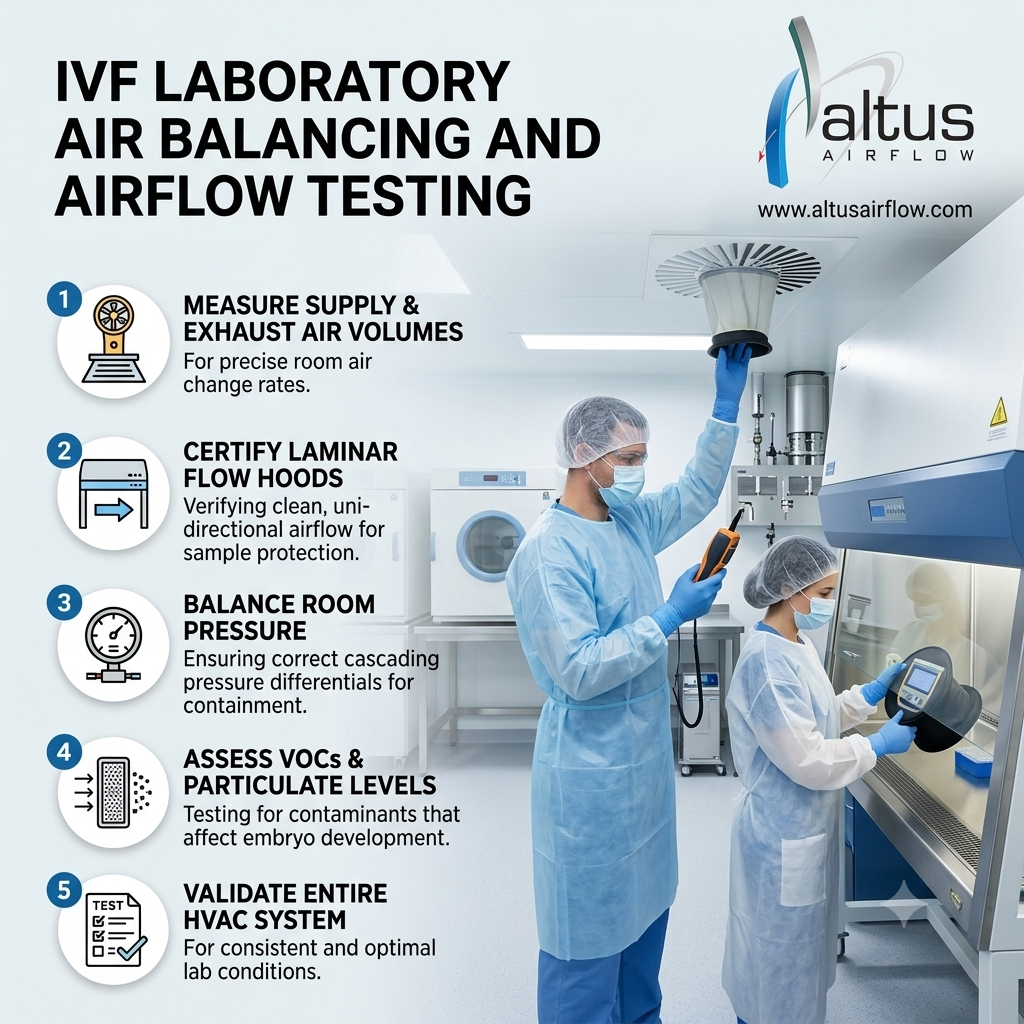
How do IVF Lab Design Services maintain uniform airflow distribution?

INTRODUCTION
IVF Lab Design Services maintain uniform airflow distribution by coordinating HVAC capacity, air-supply locations, return-air positions, HEPA filtration, room zoning, pressure relationships, equipment placement, temperature and humidity requirements, and airflow testing. Uniform airflow is important because an IVF laboratory requires a controlled environment for handling gametes, embryos, reproductive tissues, culture media, and other sensitive biological materials. Rather than selecting one airflow velocity for the entire facility, professional design considers the function of each area and develops an airflow strategy appropriate to its risks and processes.
The 2026 ESHRE Recommendations on Good Practice in the IVF Laboratory emphasize controlled environmental conditions, HEPA and VOC control, positive pressure, sufficient fresh-air changes, and regular risk-based monitoring of laboratory air cleanliness. They also recommend that laboratory design support optimal workflow and minimize the time reproductive cells and tissues are outside controlled environmental conditions.
Why Uniform Airflow Is Important in an IVF Laboratory
Uniform airflow means that air is distributed predictably throughout the intended area without creating significant dead zones, excessive turbulence, or undesirable short-circuiting between supply and return points.
In an IVF laboratory, effective airflow distribution can support:
- Consistent environmental conditions
- Particulate-control objectives
- Temperature stability
- Humidity management
- Pressure control
- HEPA filtration performance
- VOC management
- Personnel comfort
- Equipment heat-load management
- Controlled laboratory workflow
Uniformity does not mean that every point in the laboratory must have exactly the same air velocity. Different locations can have different airflow characteristics depending on their function.
For example, background room ventilation and a localized laminar-flow workstation are engineered differently. A professional design therefore focuses on achieving the required environmental performance rather than applying a single airflow value everywhere.
Initial Assessment of the IVF Laboratory
The first stage is understanding the laboratory before designing its HVAC and airflow system.
An IVF Lab Design Consultant or design team generally evaluates:
- Room dimensions
- Ceiling height
- Number of functional areas
- Personnel occupancy
- Laboratory procedures
- Equipment requirements
- Incubator locations
- Workbench locations
- Cryostorage arrangements
- Access points
- Existing HVAC infrastructure
- Fresh-air requirements
- Pressure relationships
- Environmental-control requirements
This assessment establishes the foundation for airflow planning.
The design should also consider future equipment and workflow changes. ESHRE's 2026 recommendations emphasize adequate laboratory facilities, appropriate equipment, efficient workflow, and environmental control as part of good IVF laboratory practice.
Airflow Distribution Begins With Zoning
Proper zoning is one of the most important methods for maintaining controlled airflow.
An IVF laboratory may include areas such as:
- Embryology laboratory
- Andrology laboratory
- Oocyte handling area
- Micromanipulation area
- Media preparation area
- Sample preparation areas
- Cryostorage room
- Equipment/support spaces
- Staff changing areas
These areas may have different environmental requirements.
Separating functions allows HVAC engineers to establish appropriate airflow and pressure relationships rather than attempting to control the entire facility as one undifferentiated space.
ESHRE recommends separating technical facilities, staff areas, and storage from the laboratory areas reserved for procurement, processing, and release of human cells and tissues. Cryopreservation storage also requires special precautions and should generally be separated from the main laboratory working area while remaining conveniently accessible.
Correct Supply-Air Placement
The location of supply-air outlets has a major effect on airflow uniformity.
Poorly positioned diffusers can create:
- High-velocity zones
- Dead spots
- Turbulence
- Short-circuit airflow
- Uneven temperature distribution
Professional designers therefore position supply-air outlets according to room geometry, equipment layout, ceiling configuration, and return-air locations.
The objective is to distribute conditioned and filtered air throughout the intended space while minimizing unnecessary turbulence.
Supply-air positioning should also be coordinated with lighting, ceiling-mounted equipment, ductwork, sensors, and other utilities.
Strategic Return-Air Placement
Supply-air design cannot be separated from return-air design.
Air must have a predictable path from supply points through the occupied space toward return points.
Return-air grilles that are poorly positioned can cause air to travel directly from the supply outlet to the return without adequately mixing or conditioning the intended room volume.
Designers therefore evaluate:
- Supply-to-return distance
- Airflow direction
- Room geometry
- Equipment obstruction
- Pressure relationships
- Contamination-control objectives
The supply and return arrangement should be verified after installation because actual airflow can differ from theoretical design assumptions.
HEPA Filtration and Air Distribution
HEPA filtration is an important component of controlled IVF laboratory environments.
The 2026 ESHRE recommendations state that laboratory air should be subject to HEPA and VOC control and that air cleanliness should be monitored according to risk.
HEPA filters influence airflow because they introduce resistance into the air path.
Consequently, designers must coordinate:
- Filter efficiency
- Filter size
- Filter quantity
- Filter location
- Fan capacity
- Pressure drop
- Housing design
- Sealing
- Maintenance access
A filter system that is not properly matched to the HVAC capacity can contribute to insufficient airflow or excessive energy consumption.
Maintaining Appropriate Airflow Velocity
Airflow velocity must be selected according to the location and purpose of the airflow.
Background room ventilation, supply diffusers, HEPA filter faces, and localized unidirectional airflow systems may all have different velocity requirements.
Excessive velocity can produce turbulence, while insufficient velocity may reduce the effectiveness of the intended airflow pattern.
Therefore, IVF Lab Design Services typically determine airflow velocity after considering:
- Air volume
- Cross-sectional area
- Diffuser design
- Filter resistance
- Room dimensions
- Equipment arrangement
- Occupancy
- Environmental requirements
The simplified engineering relationship between airflow volume, area, and velocity is:
Q = A × V
Where Q represents airflow volume, A represents cross-sectional area, and V represents airflow velocity.
This equation is useful for engineering calculations, but it is only one part of a complete airflow design.
Avoiding Turbulence
Uniform airflow does not mean simply increasing air movement.
Too much airflow can create turbulence around:
- Workstations
- Microscopes
- Incubators
- Laboratory equipment
- Personnel
- Shelving
- Ceiling fixtures
Turbulence can make airflow patterns unpredictable.
For this reason, equipment placement and HVAC design should be coordinated during the planning stage.
A laboratory should be designed so that important work areas are not unnecessarily exposed to airflow disturbances created by large equipment or poorly positioned supply outlets.
Equipment Placement and Airflow
IVF laboratories contain many pieces of equipment that can affect airflow.
Examples include:
- Embryo incubators
- Microscopes
- Micromanipulation systems
- Refrigerators
- Freezers
- Centrifuges
- Workstations
- Computers
- Monitoring systems
Equipment generates heat and can also obstruct airflow.
An equipment layout that looks efficient from a workflow perspective may still create HVAC challenges if it blocks supply or return paths.
Consequently, IVF Lab Design Services coordinate laboratory workflow and HVAC engineering rather than developing the two independently.
Temperature and Humidity Control
Uniform airflow also contributes to stable temperature and humidity.
IVF laboratories require carefully controlled environmental conditions because changes in temperature and humidity can affect laboratory operations and equipment performance.
ESHRE's 2026 recommendations specifically identify controlled humidity and temperature as appropriate environmental conditions for IVF laboratories.
HVAC design therefore considers:
- Room heat loads
- Equipment heat generation
- Occupancy
- Supply-air temperature
- Cooling requirements
- Humidity levels
- Seasonal conditions
- Fresh-air requirements
Uniform distribution helps reduce localized hot or cold areas.
Pressure Relationships
Pressure control is another part of airflow management.
Positive pressure can help reduce the movement of less-controlled air into the IVF laboratory.
The 2026 ESHRE recommendations state that positive pressure is recommended to minimize air contamination and that the air supply should provide sufficient fresh-air changes.
Designers may establish pressure relationships between:
- Main IVF laboratory
- Corridors
- Anterooms
- Preparation areas
- Support spaces
- Other controlled zones
Pressure relationships should be established according to the facility's risk assessment and applicable requirements.
Fresh-Air Management
Fresh air contributes to overall laboratory environmental quality.
The HVAC design should consider:
- Required fresh-air volume
- Outdoor-air conditions
- Filtration
- Temperature and humidity
- Pressure relationships
- Occupancy
- VOC control
The objective is to introduce sufficient fresh air while maintaining the required environmental conditions.
The 2026 ESHRE recommendations specifically state that air supply should ensure sufficient fresh-air changes and that laboratory air quality should be regularly monitored.
VOC Control
Volatile organic compounds are an additional concern in IVF laboratory environments.
Potential VOC sources include:
- Construction materials
- Paints
- Adhesives
- Sealants
- Furniture
- Cleaning products
- Laboratory materials
ESHRE recommends HEPA and VOC control and consideration of VOC trend analysis. It also recommends that construction, flooring, furniture, and other materials be appropriate for cleanroom environments and minimize VOC release.
Uniform airflow and appropriate ventilation can support VOC management, but material selection is equally important.
Airflow Modelling
Complex IVF laboratories may benefit from airflow modelling during design.
Engineering analysis can help evaluate:
- Air distribution
- Temperature patterns
- Turbulence
- Equipment interaction
- Supply-air locations
- Return-air locations
- Potential dead zones
Computational fluid dynamics can be particularly useful for complex spaces where equipment, partitions, or unusual architectural features make airflow difficult to predict.
However, modelling should support—not replace—physical commissioning and testing.
Airflow Testing After Installation
Design calculations must be verified after the HVAC system is installed.
Testing may include:
- Airflow volume measurement
- Air velocity measurement
- Airflow visualization
- Pressure differential testing
- Temperature measurement
- Humidity measurement
- HEPA filter integrity testing
- Particle counting
ISO 14644-3:2019 provides test methods for cleanrooms and clean zones, including both unidirectional and non-unidirectional airflow environments and different occupancy states such as as-built, at-rest, and operational.
This makes physical testing an important part of confirming whether the installed system performs as intended.
Airflow Balancing
Air balancing is essential when multiple supply and return points are present.
During balancing, technicians measure airflow at different locations and adjust dampers, fan settings, controls, or other components to achieve the intended distribution.
Balancing can help identify:
- Under-supplied areas
- Over-supplied areas
- Pressure problems
- Incorrect damper positions
- Uneven airflow
- Fan-performance issues
The final measurements should be documented for future reference.
Environmental Monitoring
Uniform airflow should be supported by ongoing environmental monitoring.
Monitoring systems may track:
- Temperature
- Relative humidity
- Differential pressure
- Particle levels
- Airflow
- HVAC alarms
- Filter condition
ESHRE's 2026 recommendations state that IVF laboratory air cleanliness should be assessed using a risk-based approach and monitored regularly, including at least annual assessment in both "at rest" and "in operation" states.
Continuous monitoring can provide additional information between formal performance tests.
Maintenance of Airflow Uniformity
Airflow performance can change over time.
Potential causes include:
- HEPA filter loading
- Fan wear
- HVAC deterioration
- Damper movement
- Sensor drift
- Equipment relocation
- Building modifications
- Ductwork changes
Preventive maintenance should therefore include:
- Filter inspection
- Filter replacement when required
- Fan and motor checks
- Sensor calibration
- Air balancing
- HVAC servicing
- Pressure verification
- Environmental monitoring
Maintaining records allows facility teams to compare current performance with commissioning baselines.
Role of Cleanroom Construction
Airflow performance is affected by the physical condition of the laboratory.
Walls, ceilings, flooring, doors, and service penetrations should support the intended controlled environment.
Considerations include:
- Smooth surfaces
- Sealed joints
- Low-emission materials
- Cleanable finishes
- Properly sealed penetrations
- Appropriate doors
- Hygienic flooring
ESHRE recommends materials appropriate for cleanroom standards and designed to minimize VOC release and potential embryo toxicity.
The construction system therefore works together with HVAC engineering to support environmental control.
Managing Personnel Movement
People can influence airflow distribution.
Personnel introduce particles and create air disturbances through movement and door opening.
An effective IVF laboratory design therefore considers:
- Restricted access
- Staff changing areas
- Clean entry
- Controlled movement
- Door-opening frequency
- Workflow paths
ESHRE recommends restricted laboratory access and a double-door system for clean access of personnel and materials.
Workflow planning can consequently help maintain environmental stability while improving laboratory efficiency.
Validation and Commissioning
Commissioning brings together the different aspects of airflow performance.
A typical process may include:
- Review of approved HVAC drawings
- Installation inspection
- Equipment startup
- Air balancing
- HEPA inspection
- Airflow testing
- Pressure testing
- Environmental testing
- Particle testing where applicable
- Corrective actions
- Retesting
- Documentation
- Final commissioning
ISO 14644-3 provides standardized test methods for cleanrooms and controlled environments, supporting objective evaluation of airflow and related performance parameters.
Common Airflow Design Mistakes
Several mistakes can compromise airflow uniformity.
Poor Supply-Air Placement
Improper diffuser positioning can create turbulence or dead zones.
Ignoring Equipment
Large equipment can obstruct airflow and change room conditions.
Treating the Whole Laboratory as One Zone
Different laboratory activities may require different environmental strategies.
Using Excessive Airflow
Higher airflow does not automatically produce better environmental control.
Skipping Air Balancing
A theoretically correct design can still perform poorly if the installed system is not balanced.
Neglecting Maintenance
Filter loading and HVAC deterioration can gradually alter airflow distribution.
How to Evaluate IVF Lab Design Services
Fertility clinics should assess IVF Lab Design Services based on the provider's ability to integrate laboratory planning and environmental engineering.
Important questions include:
- How will airflow be distributed?
- How will supply and return locations be selected?
- What filtration strategy is proposed?
- How will pressure relationships be established?
- How will equipment affect airflow?
- Will airflow balancing be performed?
- What testing is included?
- How will environmental conditions be monitored?
- What commissioning documents will be provided?
- What preventive maintenance is recommended?
A provider should be able to explain the reasoning behind the proposed airflow strategy rather than simply provide a fixed specification.
Benefits of Uniform Airflow Distribution
Proper airflow distribution can provide:
- More consistent environmental conditions
- Better particulate-control support
- Reduced turbulence
- Improved temperature uniformity
- Better humidity control
- More predictable pressure relationships
- Improved HVAC performance
- Easier environmental monitoring
- Better equipment integration
- Stronger commissioning documentation
- Improved long-term maintenance planning
Uniform airflow should therefore be considered part of a complete IVF laboratory environmental-control strategy.
Future Trends in IVF Laboratory Airflow
IVF laboratories are increasingly incorporating smart environmental technologies.
Future systems may include:
- Real-time particle monitoring
- Smart HVAC controls
- Automated pressure management
- Digital environmental dashboards
- Predictive filter maintenance
- VOC trend monitoring
- IoT-enabled sensors
- Automated alarm systems
- Building management system integration
- Digital commissioning records
These technologies can improve visibility into environmental performance and help facility teams identify deviations earlier.
Conclusion
IVF Lab Design Services maintain uniform airflow distribution through coordinated zoning, HVAC engineering, supply and return-air planning, HEPA filtration, pressure control, equipment placement, temperature and humidity management, airflow balancing, physical testing, and continuous environmental monitoring. Uniform airflow should not be interpreted as identical velocity at every point; instead, the objective is to achieve a predictable and appropriate airflow pattern for each laboratory function while minimizing turbulence and environmental variation. By integrating cleanroom construction, laboratory workflow, HVAC engineering, testing, and maintenance, Altus Airflow supports the development of controlled IVF laboratory environments designed for reliable air-quality management and long-term performance.
Frequently Asked Questions
1. How do IVF Lab Design Services maintain uniform airflow distribution?
Professional IVF Lab Design Services maintain uniform airflow through appropriate zoning, HVAC calculations, supply and return-air placement, HEPA filtration, air balancing, equipment coordination, pressure control, and post-installation testing.
2. Why is uniform airflow important in an IVF laboratory?
IVF Lab Design Services use uniform airflow strategies to support stable temperature and humidity, controlled particulate levels, appropriate pressure relationships, and a predictable laboratory environment.
3. Do IVF Lab Design Services use HEPA filtration?
Yes. IVF Lab Design Services can incorporate HEPA filtration into the HVAC system to support airborne particulate control. The 2026 ESHRE recommendations specifically recommend HEPA and VOC control for IVF laboratory air.
4. How do IVF Lab Design Services prevent airflow turbulence?
IVF Lab Design Services reduce turbulence by coordinating diffuser locations, airflow velocities, equipment placement, ceiling arrangements, return-air positions, and room geometry during the design stage.
5. Do IVF Lab Design Services include airflow balancing?
Comprehensive IVF Lab Design Services can include airflow balancing after installation to verify and adjust supply and return airflow so that the system performs according to its approved design criteria.
Read Our Previous Blog------>How is airflow velocity determined for IVF Lab Design Consultant?


