
7 Benefits of Working With Experienced Carbon Fiber Booth Contractors

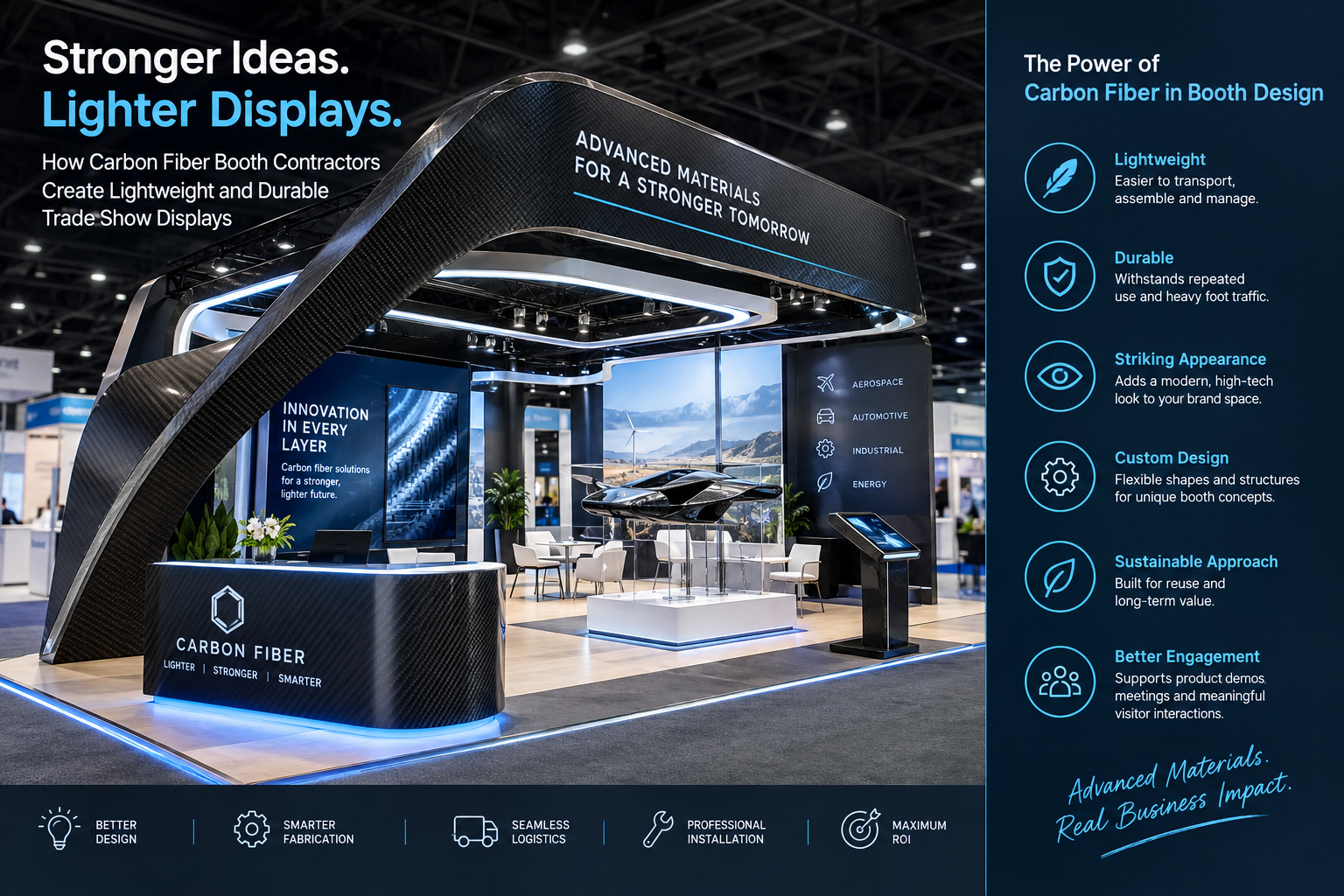
Trade shows give businesses an important platform to introduce products, connect with industry professionals, and strengthen their presence in competitive markets. However, creating an exhibit that looks impressive and functions efficiently requires careful planning, suitable materials, and professional execution. For companies exhibiting at specialized events such as CAMX, advanced booth construction can help communicate innovation from the moment visitors approach the stand. Working with experienced Carbon fiber booth contractors can help exhibitors explore custom displays that combine lightweight components, distinctive design, practical logistics, and durable construction.
What Are Carbon Fiber Booths?
Carbon fiber booths use carbon-fiber composite components as part of their exhibition structure or visual design. Carbon fiber is made from extremely thin carbon filaments that are typically combined with a resin matrix to create a composite material.
The material is known for characteristics such as:
-
Low weight
-
High strength-to-weight performance
-
Rigidity
-
Distinctive appearance
-
Design flexibility
-
Dimensional stability
Not every booth needs carbon fiber throughout its structure. In many cases, it can be strategically incorporated into selected architectural or display elements.
The final material choice should depend on the booth's intended application, structural requirements, budget, event regulations, and design objectives.
Benefit 1: Lightweight Construction
One of the most recognized characteristics of carbon-fiber composites is their lightweight nature relative to many traditional structural materials.
Trade show booths have to be moved through several stages before and after an event. Components may travel from a fabrication facility to a convention center and then to storage or another exhibition.
Lightweight components can make certain handling activities more manageable.
They can potentially help with:
-
Packing
-
Transportation
-
Loading
-
Unloading
-
On-site movement
-
Installation
-
Dismantling
-
Storage
For businesses that attend multiple exhibitions, these considerations can become particularly important.
A contractor can also design components around efficient packing and assembly rather than focusing only on their appearance.
Benefit 2: Strong and Durable Components
Trade show booths are assembled and dismantled repeatedly. Components may experience handling during transportation, installation, and storage.
Carbon-fiber composites can provide useful rigidity and strength when properly engineered.
This makes them an interesting option for selected applications such as:
-
Display frames
-
Architectural features
-
Product platforms
-
Counters
-
Structural accents
-
Custom panels
-
Demonstration areas
Durability still depends on the specific material formulation, fabrication process, component design, and handling conditions.
Professional engineering is therefore essential.
Benefit 3: Distinctive Visual Appeal
Trade show floors can be filled with similar-looking structures.
A distinctive booth can help a company establish a recognizable presence.
Carbon fiber has a technical appearance that can work particularly well with brands involved in engineering, aerospace, automotive, advanced manufacturing, composites, and other technology-driven industries.
Its texture can be incorporated into:
-
Reception counters
-
Feature walls
-
Product displays
-
Architectural frames
-
Demonstration platforms
-
Decorative elements
The material can also be combined with lighting to emphasize specific shapes and surfaces.
A successful booth does not need to cover every surface in carbon fiber. Strategic use can create visual contrast while keeping the overall design balanced.
Benefit 4: Greater Design Flexibility
Custom fabrication allows exhibitors to move beyond standard rectangular structures.
Depending on the manufacturing method and engineering requirements, composite components can support customized shapes and configurations.
Possible design elements include:
-
Curved frames
-
Geometric structures
-
Sculptural displays
-
Lightweight architectural features
-
Custom product stands
-
Branded installations
This can help exhibitors create a booth that reflects their individual brand rather than looking like a generic rental system.
Before choosing a complex shape, however, the exhibitor and contractor should consider fabrication time, transportation, installation, structural requirements, and venue restrictions.
Benefit 5: Easier Integration With Modern Technology
Technology has become an important part of many trade show exhibits.
Companies use digital tools to explain products, demonstrate applications, collect leads, and engage visitors.
A modern booth may include:
-
LED screens
-
Touchscreen kiosks
-
Interactive product models
-
Digital catalogs
-
Video walls
-
Product configurators
-
Augmented-reality experiences
-
Lead-capture systems
Carbon-fiber structures can provide a modern architectural background for these technologies.
However, digital integration should begin during the design phase.
The contractor needs to consider screen dimensions, power access, cable management, viewing angles, equipment weight, and visitor positioning.
When these details are planned early, technology can become a natural part of the booth instead of an addition made at the last minute.
Benefit 6: Potential for Reuse
A trade show booth can provide more value when it is designed for multiple events.
Companies often participate in several exhibitions each year. Building a completely new booth for every event can require significant time and resources.
A reusable design can allow exhibitors to retain key structural elements while changing:
-
Graphics
-
Product displays
-
Furniture
-
Digital content
-
Layouts
-
Messaging
Carbon-fiber components can be incorporated into reusable systems when they are designed appropriately for repeated assembly and transportation.
For example, a central architectural element could remain consistent across several exhibitions while the surrounding displays are changed to suit different audiences.
This can help maintain a consistent brand identity.
Benefit 7: Better Brand Alignment for Technical Industries
Some brands need their physical exhibition environment to reflect their technical identity.
A company selling advanced composites, aerospace components, automotive technologies, or industrial engineering solutions may want its booth to communicate precision and innovation.
Carbon fiber can support this visual language.
At an event such as CAMX, the material can be especially relevant because attendees are already interested in composites and advanced-material technologies.
The booth can combine material-focused architecture with technical demonstrations, product samples, application graphics, and knowledgeable staff.
This creates a more complete brand experience.
Why Professional Expertise Matters
Working with an advanced material requires more than choosing an attractive finish.
The contractor should understand how the material behaves in the intended application and how it needs to be fabricated, transported, assembled, and maintained.
A professional project may involve:
Design
The contractor develops the visual concept based on the exhibitor's goals.
Engineering
Structural requirements and connection details are evaluated.
Material Selection
The team determines where carbon fiber and other materials should be used.
Fabrication
Components are produced according to approved specifications.
Finishing
Surfaces are prepared to achieve the desired visual appearance.
Testing
Where appropriate, components can be checked before shipment.
Installation
The booth is assembled at the exhibition venue.
This complete workflow can help reduce problems during the event.
Carbon Fiber Does Not Replace Every Material
One important consideration is that carbon fiber should not automatically be used for every booth component.
Different materials have different advantages.
For example, aluminum may be useful for modular framing. Fabric can provide large graphic surfaces. Acrylic can create transparent product displays. Wood can make meeting areas feel warmer.
Carbon fiber can then be reserved for components where its lightweight properties, rigidity, or visual appearance provide specific value.
This mixed-material approach can create a more practical and visually balanced booth.
Planning the Booth Around Visitor Behavior
A successful exhibit should be designed around the people who will use it.
Visitors should be able to identify the company from the aisle, enter comfortably, understand the main offering, and interact with products without encountering unnecessary obstacles.
A basic visitor journey could be:
See → Enter → Explore → Interact → Discuss → Connect
Each stage requires appropriate design decisions.
Large branding should be visible from a distance.
Product displays should be positioned where visitors can easily see them.
Demonstration zones need sufficient space.
Meeting areas should provide enough comfort and privacy.
The reception area should not block the main entrance.
These details can have a major effect on the practical performance of a booth.
Using Lighting Effectively
Lighting is another important part of modern booth design.
Carbon-fiber surfaces can provide a strong contrast against illuminated graphics and fixtures.
Lighting can be used to:
-
Highlight products
-
Emphasize architectural features
-
Improve graphic visibility
-
Create visual pathways
-
Define meeting zones
-
Draw attention to demonstrations
However, excessive lighting can make the booth uncomfortable or distract from the products.
A balanced lighting plan should provide both visual impact and functional illumination.
Storage Should Not Be Forgotten
One common exhibition design problem is insufficient storage.
Staff members may need space for:
-
Bags
-
Marketing materials
-
Product samples
-
Cleaning supplies
-
Personal belongings
-
Technical equipment
-
Packaging materials
Storage can be integrated into counters, walls, cabinets, or dedicated rooms.
A contractor should consider these needs during the initial design stage rather than trying to find space after fabrication.
Transportation and Packaging
Custom booth components require appropriate protection during transportation.
Carbon-fiber surfaces and finished components should be packaged according to their specific characteristics.
The contractor may need to consider:
-
Protective cases
-
Padding
-
Component separation
-
Weight distribution
-
Assembly order
-
Handling instructions
Well-organized packaging can also make installation more efficient because components can be unpacked according to the construction sequence.
Considering CAMX 2026 Requirements
Companies preparing for CAMX 2026 should begin by reviewing the event's exhibitor requirements and deadlines.
Booth designs may need to account for:
-
Booth dimensions
-
Height restrictions
-
Hanging structures
-
Electrical services
-
Fire safety
-
Accessibility
-
Installation schedules
-
Venue-specific regulations
These requirements should influence the booth design from the beginning.
Waiting until fabrication is underway to address venue rules can lead to costly revisions.
How to Choose the Right Contractor
Choosing a booth contractor requires careful evaluation.
Instead of looking only at portfolio images, exhibitors should investigate the contractor's technical and project-management capabilities.
Important questions include:
-
Do you have experience with carbon-fiber components?
-
Can you create custom architectural designs?
-
Do you provide 3D booth renderings?
-
Do you have engineering support?
-
How do you manage fabrication?
-
Can you integrate lighting and technology?
-
Do you provide installation and dismantling?
-
How are custom components transported?
-
Can the booth be reused?
-
How do you coordinate venue approvals?
These questions can help exhibitors identify a contractor capable of handling a technically detailed project.
Budget Planning
Carbon fiber can be more specialized than conventional booth materials, so exhibitors should establish a realistic budget before finalizing the concept.
The overall budget may include:
-
Design
-
Engineering
-
Materials
-
Fabrication
-
Graphics
-
Lighting
-
Furniture
-
Technology
-
Shipping
-
Installation
-
Dismantling
-
Storage
A contractor can help identify areas where advanced materials provide the most value.
Using carbon fiber selectively may provide the desired appearance while keeping other booth elements within budget.
Sustainability and Long-Term Use
Exhibitors are increasingly considering how their booths can be reused rather than discarded after one event.
A reusable booth can potentially extend the useful life of its components.
Long-term planning may include:
-
Modular structures
-
Durable components
-
Replaceable graphics
-
Reusable packaging
-
Adaptable layouts
-
Efficient storage
Sustainability should be considered across the complete lifecycle of the exhibit, including fabrication, transportation, event use, storage, refurbishment, and eventual disposal.
Common Mistakes to Avoid
Designing Only for Appearance
A visually impressive booth still needs to function effectively.
Ignoring Installation
Complex structures require adequate setup time and experienced installation teams.
Forgetting Future Events
A booth designed for only one floor plan may have limited long-term flexibility.
Adding Technology Too Late
Screens, lighting, and electrical requirements should be integrated from the beginning.
Using Too Many Materials
Excessive visual variation can make the booth feel cluttered.
Underestimating Logistics
Transportation, storage, and packaging should be included in the planning process.
Final Thoughts
Experienced booth contractors can help exhibitors turn advanced materials into practical exhibition environments. Carbon fiber offers possibilities for lightweight construction, distinctive aesthetics, custom architectural features, and reusable booth components when it is selected and engineered appropriately. Its benefits become more meaningful when combined with thoughtful visitor flow, effective branding, technology integration, transportation planning, and professional installation.
For companies preparing for CAMX 2026, researching Carbon fiber booth contractors can be a useful part of the exhibit-planning process. The right contractor can help connect material selection with design, engineering, fabrication, logistics, and installation, allowing exhibitors to develop a booth that supports their products, brand message, and long-term trade show strategy.


