

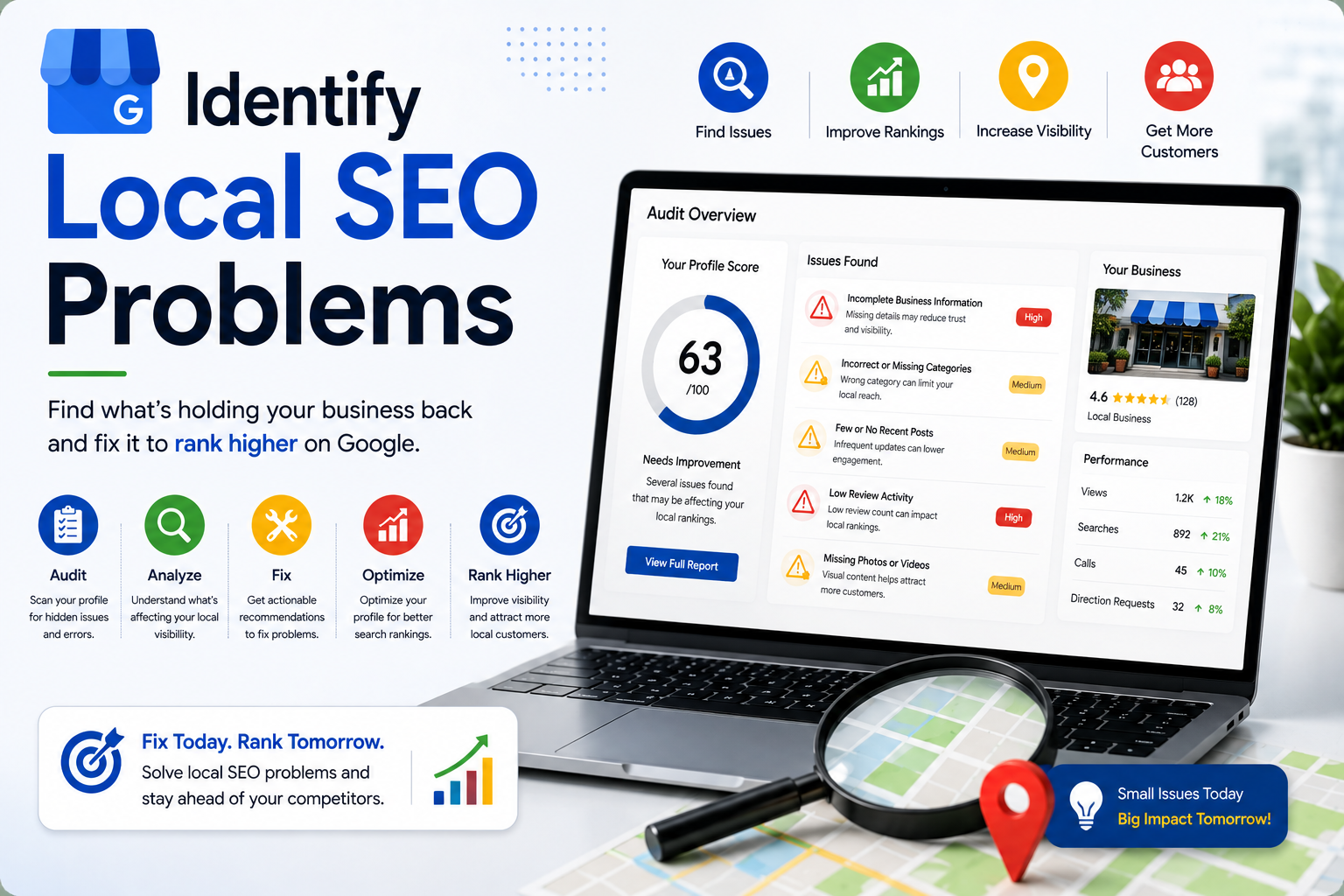
How to Identify Local SEO Problems With a Google Business Profile Audit

A local business may have a website, an active Google Business Profile, customer reviews, and accurate contact details but still struggle to gain consistent visibility on Google Search and Maps.
The problem is not always obvious. An incorrect primary category, incomplete services, outdated hours, duplicate profiles, inconsistent business details, or weak reputation signals can all deserve investigation.
A Google Business Profile audit provides a structured way to identify these problems instead of making random changes. Google says local results are primarily based on relevance, distance, and prominence, so an effective audit should examine your profile with these factors in mind.
Why Start With a Google Business Profile Audit?
Your Business Profile contains information Google and customers use to understand your business.
Google recommends maintaining complete and accurate information, including your address, phone number, business type, and opening hours. It says businesses with complete and accurate information are more likely to appear in relevant local results.
An audit helps answer important questions:
Is Google receiving accurate information about the business? Does the profile clearly represent your main services? Can customers easily understand and contact the business? Are there obvious gaps affecting your local presence?
Finding these issues gives you a better foundation for deciding what to improve.
Problem 1: Incorrect or Incomplete Business Information
Start with basic profile accuracy.
Review your business name, address or service area, phone number, website, opening hours, and special hours.
Even small errors can create problems.
For example, an outdated phone number can lead to missed enquiries. Incorrect hours can result in customers arriving when the business is closed.
Google specifically recommends keeping business information and opening hours accurate.
What to fix: Correct outdated information and make sure your profile reflects how the business currently operates.
Problem 2: Wrong Primary Category
Categories are one of the most important areas to check during an audit.
Your primary category should describe your main business activity as specifically as possible. Additional categories should represent genuine secondary activities.
For example, a specialist business using a broad category when a more accurate category is available may not be giving Google the clearest possible information about what it does.
Google advises businesses to choose categories that complete the statement: "This business IS a..." rather than using categories for everything the business HAS.
What to fix: Select the most accurate primary category and remove additional categories that do not genuinely represent the business.
Problem 3: Your Profile Does Not Clearly Represent Your Services
Google defines relevance as how well a Business Profile matches what someone is searching for.
This makes service information worth auditing.
Check whether your major services are represented accurately. Look for outdated services, missing core offerings, unclear descriptions, or information that no longer reflects the business.
Avoid repeating the same keywords unnaturally across different fields.
The goal is to help both customers and Google understand what the business genuinely provides.
What to fix: Keep important services complete, accurate, and easy to understand.
Identify Problems in Your Business Profile
If you are unsure where to start, use the Google Business Profile Audit Tool to review important profile elements and identify potential optimization gaps.
Use the audit as a diagnostic starting point rather than treating its score as an official Google ranking score.
Problem 4: Weak or Inconsistent Review Activity
Reviews influence customer decisions and can contribute to local visibility.
Google states that more reviews and positive ratings can help local ranking. It also encourages businesses to respond to reviews because responses show customers that their feedback matters.
During your audit, examine:
- Total number of reviews
- Overall rating
- Recent review activity
- Owner responses
- Common customer feedback
A business should focus on earning genuine feedback from real customers rather than purchasing or manipulating reviews.
What to fix: Build a consistent process for requesting legitimate reviews and responding professionally to customer feedback.
Problem 5: Outdated or Unhelpful Photos
Photos may not solve every ranking problem, but they are an important customer-facing part of your Business Profile.
Look at the profile from a potential customer's perspective.
Do the images accurately represent the current business? Can customers see the location, products, facilities, services, team, or completed work where relevant?
Google encourages businesses to add photos and videos that help customers understand what they offer.
What to fix: Replace outdated visuals and add authentic, relevant images that accurately represent the business.
Problem 6: Duplicate Business Profiles
Duplicate profiles can create unnecessary confusion.
Search Google and Maps using your business name, phone number, and address. Look for old profiles, profiles created by previous employees, or duplicates associated with the same business.
Google generally recommends having only one Business Profile for each eligible business.
However, some individual practitioners, departments, or separately eligible businesses can legitimately have their own profiles.
What to fix: Investigate duplicates carefully before requesting removal or taking other action.
Problem 7: Inconsistent Business Information Online
Your GBP should not be audited in isolation.
Compare your Name, Address, and Phone Number (NAP) with your official website and important online business listings.
Look for old addresses, incorrect phone numbers, spelling differences, or outdated website links.
The biggest concern is not minor formatting differences. Focus on genuine inconsistencies that could confuse customers or misrepresent the business.
What to fix: Update important incorrect or outdated business information across your online presence.
Problem 8: Your Website Does Not Support Your Local Presence
Sometimes the Business Profile itself is reasonably complete, but the connected website is weak.
Google says prominence can be influenced by information about a business from across the web, including links. Google also notes that organic web ranking contributes to local search performance.
Audit whether your website clearly explains your business, major services, contact information, and location where relevant.
Also check whether the GBP website link works and takes customers to an appropriate page.
What to fix: Strengthen useful website content and ensure information aligns with the actual business.
Problem 9: You Are Misreading Ranking Changes
A lower ranking does not always mean something is wrong with your profile.
Google uses distance as one of its primary local ranking factors.
This means the same business can appear differently depending on where a person performs the search. You might have strong visibility near your location and weaker visibility farther away.
Search intent and competition can also affect results.
What to fix: Evaluate local visibility across relevant geographic areas rather than relying on one manual search.
Problem 10: You Are Tracking Rankings but Not Customer Actions
Ranking position is useful, but it does not tell the entire story.
Google Business Profile Performance can provide information about how people discover and interact with your profile. Available metrics can include searches, views, calls, website clicks, direction requests, messages, and bookings.
Ask whether improved visibility is contributing to useful actions.
A business moving from position six to position three is positive, but the business impact becomes clearer when that visibility also generates more calls, enquiries, visits, or bookings.
What to fix: Monitor customer interactions alongside local rankings.
Look Beyond Your Google Business Profile
A GBP audit may reveal that some local SEO problems exist outside the profile.
Website SEO, online reputation, local visibility, and other digital signals can also deserve attention.
Use the Fly SEO and Digital Marketing Tools to explore other areas of your online presence and identify additional optimization opportunities.
How Should You Prioritize Audit Problems?
Fix accuracy problems first.
Start with incorrect business details, verification, categories, address, phone number, website, and opening hours.
Next, review services, reviews, responses, photos, and duplicate profiles.
Then examine your website and broader online presence.
Finally, monitor local visibility and customer actions to determine where further work is needed.
Avoid changing multiple profile elements unnecessarily whenever rankings fluctuate.
Conclusion
Learning how to identify local SEO problems with a Google Business Profile audit is about finding genuine weaknesses rather than searching for quick ranking tricks.
Review your profile information, primary category, services, reviews, photos, duplicate listings, NAP consistency, website, rankings, and customer interactions.
Most importantly, remember how Google describes local ranking: relevance, distance, and prominence are the primary factors.
You can improve many aspects of relevance and prominence, but you cannot control every factor—especially the distance between your business and each searcher.
A regular GBP audit gives you a clearer picture of what is wrong, what is already working, and which improvements deserve priority.
FAQs
What local SEO problems can a GBP audit identify?
It can reveal incorrect information, category issues, missing services, review gaps, duplicates, outdated photos, and inconsistent business details.
Can a GBP audit guarantee better rankings?
No. Local rankings depend on multiple factors, including relevance, distance, and prominence.
Should I change my GBP whenever rankings drop?
Not automatically. Rankings can vary by search location, query, and competition. Investigate the cause before making changes.
Are reviews important for local SEO?
Yes. Google states that review count and positive ratings can contribute to local ranking.


