
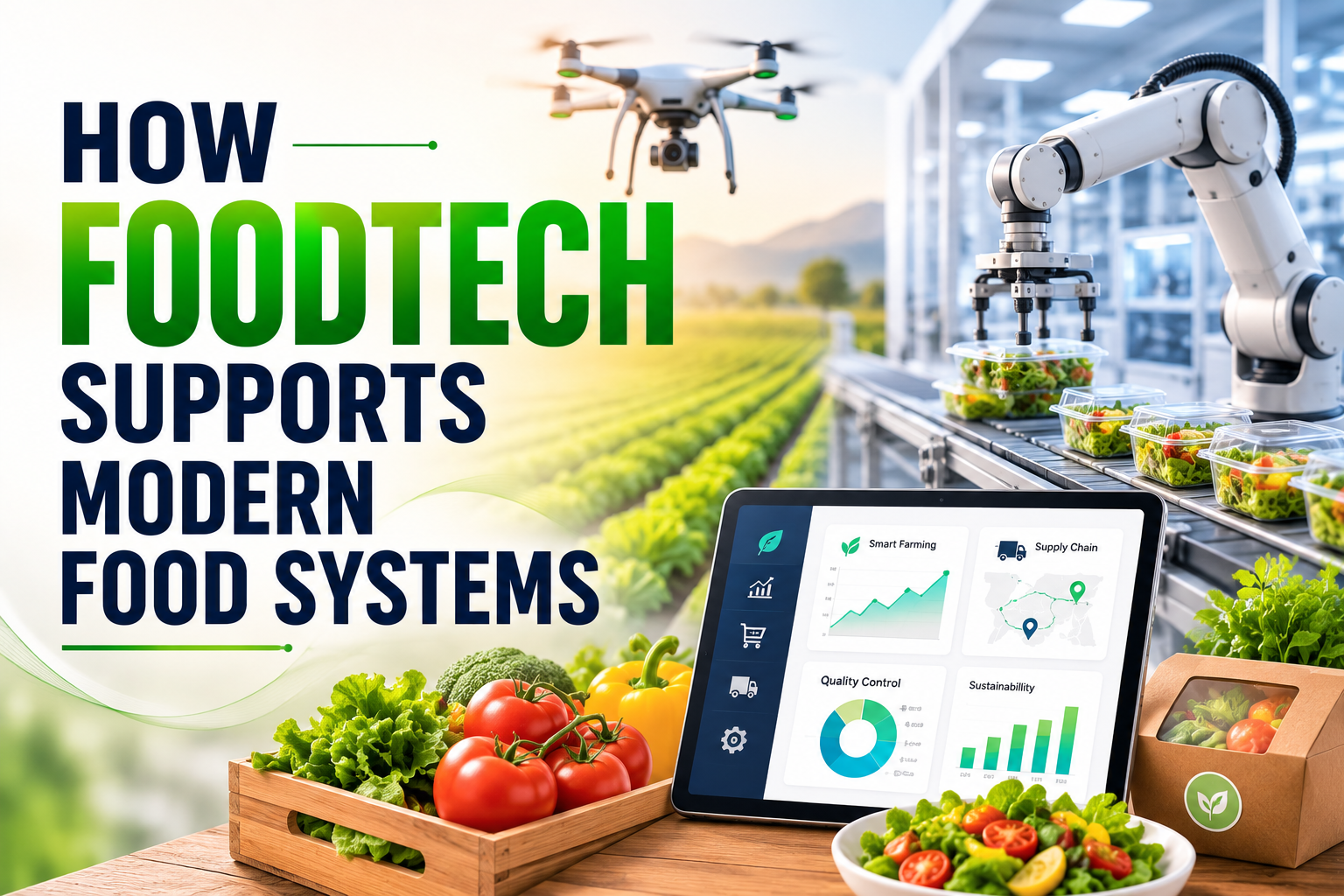
How FoodTech Supports Modern Food Systems

FoodTech is becoming important as food companies, retailers, restaurants, farms, logistics providers, and consumers use technology across the food value chain. It includes digital ordering platforms, food delivery systems, smart kitchens, automation, precision agriculture, food safety tools, supply-chain tracking, alternative proteins, smart packaging, and data-driven retail. Its growth reflects the need for convenience, efficiency, transparency, and better food access.
A recent global FoodTech industry study by MarkNtel Advisors highlights demand from hardware, online food platforms, Asia-Pacific adoption, digital payments, and food value-chain transformation. The study values the sector at USD 245.20 billion in 2025 and projects it to grow from USD 256.91 billion in 2026 to USD 395.79 billion by 2032, reflecting a CAGR of around 7.47% during 2026–2032.
Digital Food Platforms Drive Adoption
Digital food platforms are one of the most visible parts of FoodTech. Consumers use mobile apps and websites to order meals, groceries, fresh produce, snacks, and ready-to-cook products. Restaurants and retailers use these platforms to reach customers, manage orders, offer promotions, and improve delivery coordination.
This shift is supported by smartphone use, digital payments, urban lifestyles, and demand for convenience. Online food platforms also create data that helps companies understand customer preferences, delivery patterns, pricing, and product demand. This makes technology central to both consumer experience and business planning.
Hardware Leads Component Demand
Hardware accounted for the leading component share in 2026, according to the shared study. This includes equipment and connected devices used in food processing, smart kitchens, farms, warehouses, restaurants, retail stores, vending systems, and logistics networks. Sensors, robotics, automated machines, scanners, and monitoring devices help improve consistency and productivity.
Hardware is important because digital food systems still depend on physical operations. Orders, payments, and data platforms may be digital, but food must still be grown, prepared, packed, stored, transported, and delivered safely. This creates demand for reliable equipment that can connect with software and analytics systems.
Asia-Pacific Holds a Strong Position
Asia-Pacific accounted for around 32% share in 2026, making it the largest regional segment in the report. The region’s leadership is supported by large consumer populations, mobile-based ordering, digital payment expansion, urbanization, and rising adoption of technology in food retail and delivery.
Countries such as China, India, Japan, South Korea, Indonesia, Vietnam, and Singapore are seeing strong digital food activity. Local food habits, dense cities, and growing online commerce encourage technology-led food services. At the same time, the region’s large agricultural base creates opportunities for farm technology, food processing automation, and supply-chain digitization.
Food Safety Needs Better Tracking
FoodTech also supports food safety through traceability, temperature monitoring, digital records, quality checks, and faster recall systems. These tools help companies track products from farms and factories to warehouses, stores, restaurants, and consumers. Better visibility can reduce waste and improve confidence in food quality.
The World Health Organization’s food safety guidance states that unsafe food containing harmful bacteria, viruses, parasites, or chemical substances can cause more than 200 diseases. This wider public-health context supports the need for stronger monitoring and technology-enabled safety controls across food systems.
Smart Farming Expands the Base
FoodTech is not limited to restaurants and delivery apps. It also includes farm-level tools such as sensors, drones, irrigation systems, climate monitoring, precision spraying, livestock tracking, and data platforms. These technologies help farmers monitor resources, reduce losses, and improve productivity where adoption is practical and affordable.
FAO’s digital agriculture work highlights the role of digital technologies in transforming agriculture and food systems. This supports the wider FoodTech idea that technology can improve decisions across production, processing, distribution, and consumption.
Automation Improves Food Operations
Automation is becoming more relevant in food processing, kitchens, packaging lines, warehouses, and delivery operations. Robots and automated systems can support repetitive tasks such as sorting, cutting, mixing, packing, labeling, storage movement, and order preparation. This helps businesses improve speed, consistency, and labor productivity.
However, automation requires investment, maintenance, workforce training, and process redesign. Smaller food businesses may adopt automation gradually through point-of-sale systems, inventory software, digital menus, or kitchen display systems before moving toward advanced robotics or connected production equipment.
Sustainability Shapes Innovation
Sustainability is another important part of FoodTech. Companies are exploring ways to reduce food waste, optimize inventory, improve packaging, lower energy use, and create alternative protein products. Digital tools can help forecast demand, manage expiry dates, track surplus food, and improve cold-chain performance.
Food waste reduction is especially important because losses occur across farms, logistics, retail, restaurants, and households. Technology cannot solve the issue alone, but better data, storage, forecasting, and redistribution platforms can help reduce avoidable waste when combined with strong operational discipline.
Outlook for FoodTech
FoodTech demand is being shaped by digital food platforms, hardware adoption, Asia-Pacific growth, smart farming, food safety needs, automation, and sustainability-focused innovation. The report figures indicate steady expansion through 2032 as technology becomes more embedded across the food value chain.
The long-term direction will depend on consumer trust, affordability, data security, infrastructure quality, food regulations, and business readiness. As food systems become more connected, FoodTech will remain important for improving convenience, safety, efficiency, and transparency from production to consumption.


