


Healthcare AI Solutions Powering the Next Generation of Telehealth and Virtual Hospital Systems
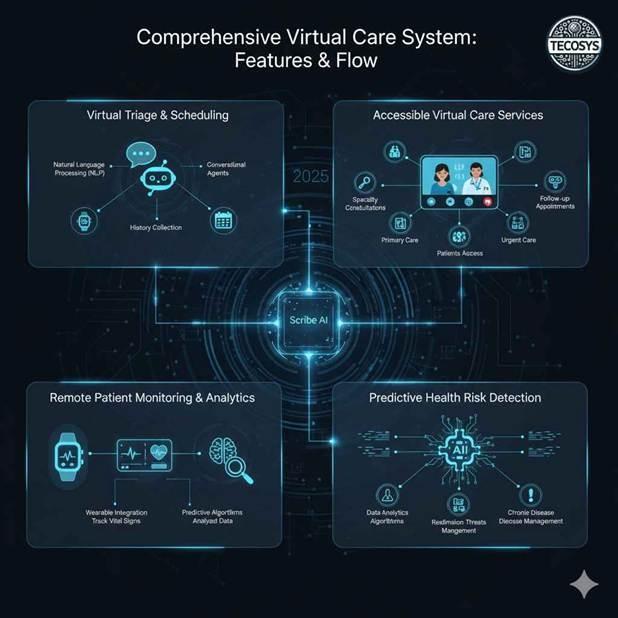
Virtual hospitals and telehealth have become foundational pillars of modern healthcare transformation. By connecting patients and clinicians through seamless digital workflows—instant virtual visits, continuous monitoring, and real-time remote alerts—care delivery is now expanding beyond the physical walls of traditional hospitals. The question is no longer if telehealth will reshape healthcare, but how quickly the transformation will take place.
This article explores how AI-enabled telehealth platforms, remote patient monitoring (RPM), virtual consultations, and cloud-based digital health infrastructure are collectively shaping the “Virtual Hospital of 2025.”
The focus is on system architecture, patient-centric workflows, data governance, and the practical evolution of care delivery.
Why the Virtual Hospital of 2025 Is Emerging Now
1. Market Momentum & Opportunity
The global market for AI in telehealth and telemedicine is expected to grow from USD 5.3 billion in 2025 to USD 86.3 billion by 2034, with a projected 36% CAGR.
This rapid expansion signals a long-term structural shift toward digitally enabled care—creating opportunities for health systems, technology innovators, and care delivery organizations.
2. Trends Driving Acceleration
Several industry shifts are accelerating the rise of virtual hospitals:
- AI-based triage systems and conversational assistants are now supporting patient intake, symptom review, and escalation.
- Remote patient monitoring (RPM) devices continuously track vitals throughout the patient journey.
- Cloud-based telehealth platforms enable integrated, multi-disciplinary virtual care environments.
- Hybrid care models—blending in-person visits with virtual services—have become standard expectations.
- Consumer search behavior highlights demand for immediate, localized digital care (e.g., “online doctor near me,” “virtual urgent care,” “remote patient monitoring platform”).
3. Search Intent in 2025
Healthcare SEO shows strong growth in patient searches related to quick-access virtual care. Matching content to these patient-driven search patterns strengthens discoverability and aligns with real-world behavior.
What the Virtual Hospital Looks Like in Practice
1. The Digital Front Door
The digital front door acts as the core access point for patients. It supports:
- Scheduling
- Video visits
- Wearable data uploads
- Conversational navigation via virtual assistants
- Access to records, care plans, and clinical teams
This unified entry simplifies navigation and reduces barriers to care.
2. Core System Components
A modern virtual hospital integrates:
- NLP-driven virtual triage: Automated history-taking, scheduling, and escalation
- Remote monitoring: Wearables and sensors transmitting vitals in real time
- Virtual clinical services: Primary care, urgent care, and speciality consults
- Predictive analytics: Identifying risk of deterioration, readmission, or non-adherence
- Secure cloud infrastructure: Scalability, data integrity, and interoperability across systems
3. Real-World Scenarios
- A patient discharged with chronic heart failure uses a connected wearable that triggers an alert when risk markers appear—prompting a proactive tele-cardiology consultation.
- A parent schedules a pediatric video consult, uploads images of a rash, completes AI-assisted triage, and connects with the clinician—all within a single workflow.
Designing the Virtual Hospital Platform
1. Expertise Domains
Building a virtual hospital requires combined expertise in:
- Clinical documentation workflows
- AI automation
- Device integration
- Telehealth systems architecture
- Scalable cloud and data engineering
2. Platform Architecture Essentials
A functional platform typically includes:
- Automated clinical documentation through real-time speech and NLP
- Conversational triage for urgent/non-urgent routing
- Unified RPM dashboards for clinicians
- Predictive analytics for risk stratification
- Interoperable cloud deployment aligned with HIPAA, SOC2, and security protocols
3. Operational Impact
Health systems adopting these architectures report:
- Lower virtual visit no-show rates
- Faster triage and escalation
- Reduced administrative burden on clinicians
- More consistent patient engagement with chronic-care programs
Building Trust: Experience, Authority, and Transparency
1. Experience & Expertise
Virtual hospital design draws on years of clinical workflow development, device integration, and large-scale digital health implementation.
2. Authoritativeness
Industry research emphasizes AI use cases such as:
- Automated documentation
- Early disease detection
- Predictive monitoring
These priorities shape the design of virtual hospital systems.
3. Trust & Safety
Key governance practices include:
- Transparent data-use policies
- Algorithmic bias testing
- Strong encryption and audit trails
- Clear communication about the role of AI in care pathways
4. SEO & Content Quality
High-ranking content adheres to:
- Evidence-based frameworks
- Real-world examples
- Clear patient focus
- Compliance-friendly language
From Plan to Launch: Steps to Building a Virtual Hospital
Phase 1: Planning
- Define target patient populations
- Map care pathways (triage → consult → monitoring → follow-up)
- Select partners for speech AI, RPM devices, analytics, and cloud infrastructure
Phase 2: Building
- Configure virtual assistants
- Integrate RPM tools
- Set up scheduling and video workflows
- Build analytics dashboards
Phase 3: Testing & Scaling
- Pilot with a small patient group
- Assess metrics: satisfaction, clinical load, no-shows, adherence
- Adjust for data fairness, privacy, workflow optimization
- Scale across departments and locations
Phase 4: Continuous Optimization
- Track emerging telehealth trends
- Update AI models and device integrations
- Expand virtual services and specialty care
Challenges and Practical Solutions
1. Regulatory Differences
Licensing, reimbursement rules, and cross-state practice laws vary.
Solution: Flexible rollouts, compliance tracking, and adaptable workflows.
2. Data Quality, Privacy & Fairness
AI requires high-quality, representative datasets.
Solution: Bias audits, diverse patient participation, and continuous monitoring.
3. Clinician Adoption
Digital tools must integrate smoothly into clinical routines.
Solution: Early involvement, training, and workflow simplification.
4. Patient Experience & Access
Not all patients have equal digital readiness.
Solution: Multichannel support, user-friendly design, and digital literacy assistance..
Frequently Asked Questions
1. Are AI-enabled telehealth platforms secure?
Yes. Leading platforms follow standards like HIPAA, SOC 2, and GDPR, with encryption, authentication, and audit controls.
2. Does AI replace clinicians?
No. AI supports clinicians by automating documentation, triage, and data interpretation—while clinical judgment remains central.
3. What technologies power virtual hospitals?
Key components include NLP, machine learning, remote sensors, IoT devices, and cloud interoperability.
4. How do patients access care?
Through mobile apps or web portals enabling appointment booking, wearable data sharing, AI-assisted support, and follow-ups.
5. What challenges affect telehealth deployment?
Data privacy, digital inequality, regulatory variations, clinical workflow alignment, and technology adoption.
The “Virtual Hospital of 2025” represents a fundamental shift in care delivery—not merely video visits, but a fully integrated ecosystem combining AI automation, continuous monitoring, predictive analytics, and streamlined digital workflows. As healthcare moves toward hybrid and virtual-first models, organizations that invest early in telehealth infrastructure, interoperability, and patient-centric design will be best positioned to meet evolving needs.
The future of healthcare is distributed, data-driven, and AI-enabled—and it is already taking shape.
Explore Telehealth Solutions more….
Organizations evaluating telehealth, AI-driven workflows, or virtual hospital models can explore relevant technologies from trusted digital health solution providers. Platforms such as TecosysAI and Nutaan AI offer insights into AI-supported care coordination, data systems, and digital workflow integration.
For teams wishing to discuss telehealth strategy or implementation planning, an introductory conversation can be scheduled via Calendly

 Arabic
 French
 Spanish
 Portuguese
 Deutsch
 Turkish
 Dutch
Dutch
 Italiano
 Russian
 Romaian
 Portuguese (Brazil)
 Greek
Greek