


How AI-Powered Assistants Improve Patient Rights Protection and Modernize Care Coordination
Healthcare has always been about people. Yet for decades, many patients have struggled to be heard inside a system weighed down by administrative complexity, insurance red tape, and information silos. This is why patient advocacy has become a lifeline—guiding patients through treatment decisions, insurance disputes, and access challenges. But the traditional advocacy model is strained. Limited staff, overwhelming case volumes, and fragmented data leave many patients without the support they need.
Today, artificial intelligence (AI) is reshaping what’s possible.
While much attention focuses on AI in diagnosis, drug discovery, and clinical decision support, its role in patient advocacy may be equally transformative. AI is amplifying patient voices, helping people navigate care more effectively, reducing systemic barriers, and supporting advocacy groups with smarter tools. Rather than replacing empathy, AI strengthens it—freeing human advocates to focus on high-impact, emotionally complex cases.
This guest post explores how AI is redefining patient advocacy, the benefits for patients and organizations, and the roadmap for responsible adoption.
AI Gives Patients a Stronger Voice in a Complicated System
One of the most profound impacts of AI is its ability to elevate the patient’s voice in an environment where individuals often feel overwhelmed and unheard.
Patients managing chronic conditions, insurance appeals, or administrative delays often lack time, literacy, or medical expertise to present their needs clearly. AI changes this dynamic through:
1. Natural Language Processing (NLP) that Identifies Systemic Issues
AI-driven NLP tools analyze emails, chat logs, feedback forms, and support transcripts to surface recurring themes—such as denied treatment, confusing billing, or delays in authorization.
Instead of a single complaint being buried in bureaucracy, AI identifies patterns across thousands of interactions, giving advocates clear evidence for action.
2. AI-Generated Letters, Claims, and Personal Statements
Generative AI helps patients prepare:
-
Insurance appeal letters
-
Complaint submissions
-
Medical necessity narratives
A patient fighting a denied chemotherapy claim, for example, can produce a polished, policy-referenced appeal with AI assistance—something that was once extremely difficult without expertise.
3. Chatbots That Provide Rights-Based Guidance
AI assistants integrated into advocacy platforms help patients:
-
Understand their rights
-
Navigate insurance processes
-
Prepare for conversations with hospitals or administrators
This democratizes access to knowledge, ensuring no patient remains voiceless due to institutional barriers or lack of resources.
Why AI Fits Perfectly Into Patient Advocacy
Advocacy work is demanding and emotionally intensive. AI strengthens advocates by offering:
-
Scalability — Handle thousands of queries simultaneously
-
Speed — Automate repetitive steps that slow care
-
Trend Detection — Spot patterns across populations
-
Personalization — Tailor responses to each patient’s context
-
Barrier Reduction — Improve translation, literacy support, and document navigation
AI allows human advocates to do more meaningful work, while routine tasks are handled efficiently in the background.
How AI Strengthens Patient Rights
Healthcare is full of information asymmetry—insurers and hospitals have legal and technical expertise that most patients lack. AI helps level the playing field.
1. Simplifying Complex Information
Policies, medical reports, and insurance documents often feel unintelligible. AI tools summarize and rewrite them in plain language, enabling patients to understand:
-
Their coverage
-
Their treatment options
-
Their legal rights
2. Accelerating Appeals and Grievances
AI speeds up the appeals process by:
-
Drafting structured responses
-
Identifying similar case precedents
-
Suggesting next steps based on outcomes
This makes appeals more accessible and far less intimidating.
3. Empowering Advocacy Organizations
Advocacy groups gain access to powerful analytics:
-
Patterns in denials
-
Time-to-resolution trends
-
Success factors for different cases
This helps optimize strategies and use limited resources effectively.
4. Promoting Healthcare Equity
AI assists those who typically lack adequate support:
-
Non-English speakers
-
Rural populations
-
Low-literacy communities
-
Patients without digital tools
By reducing barriers, AI increases fairness and access across the healthcare ecosystem.
Roadmap for Responsible AI Adoption in Advocacy
Organizations adopting AI should follow a clear, ethical framework:
Phase 1: Strategy & Assessment
-
Audit workflows and bottlenecks
-
Analyze existing tools
-
Define success metrics
-
Build governance and oversight policies
Phase 2: Pilot & Validation
-
Start with low-risk, high-impact tasks
-
Compare AI-assisted results vs manual work
-
Validate accuracy, fairness, and user satisfaction
-
Collect patient and advocate feedback
Phase 3: Scale & Integration
-
Expand into more complex processes
-
Integrate with CRM, case management, and documentation tools
-
Maintain human oversight and continuous assessment
Phase 4: Collaboration & Ecosystem Building
-
Partner with insurers, hospitals, and policy experts
-
Share anonymized insights to improve systems
-
Engage regulators in responsible AI development
-
Build patient feedback loops
This phased approach ensures AI enhances—not disrupts—trust in care.
AI-Powered Healthcare Navigation: Reducing Friction at Every Step
Navigating healthcare—choosing providers, scheduling appointments, understanding benefits—is one of patients’ biggest stress points. AI simplifies this experience.
AI-driven navigation tools can:
1. Recommend High-Quality, In-Network Providers
By analyzing coverage, history, and location, AI can suggest:
-
Nearby specialists
-
Shortest wait times
-
Most cost-effective options
2. Manage Scheduling & Coordination
AI syncs:
-
Physician availability
-
Specialist referrals
-
Diagnostic appointments
And can flag pre-authorization needs before delays occur.
3. Predict Costs and Reduce Financial Surprises
AI estimates out-of-pocket expenses, compares prices across providers, and warns patients of potential billing issues—helping prevent medical debt.
4. Monitor Continuity of Care
If a follow-up test is overdue or a claim is denied, AI notifies the patient and advocate to take action before issues escalate.
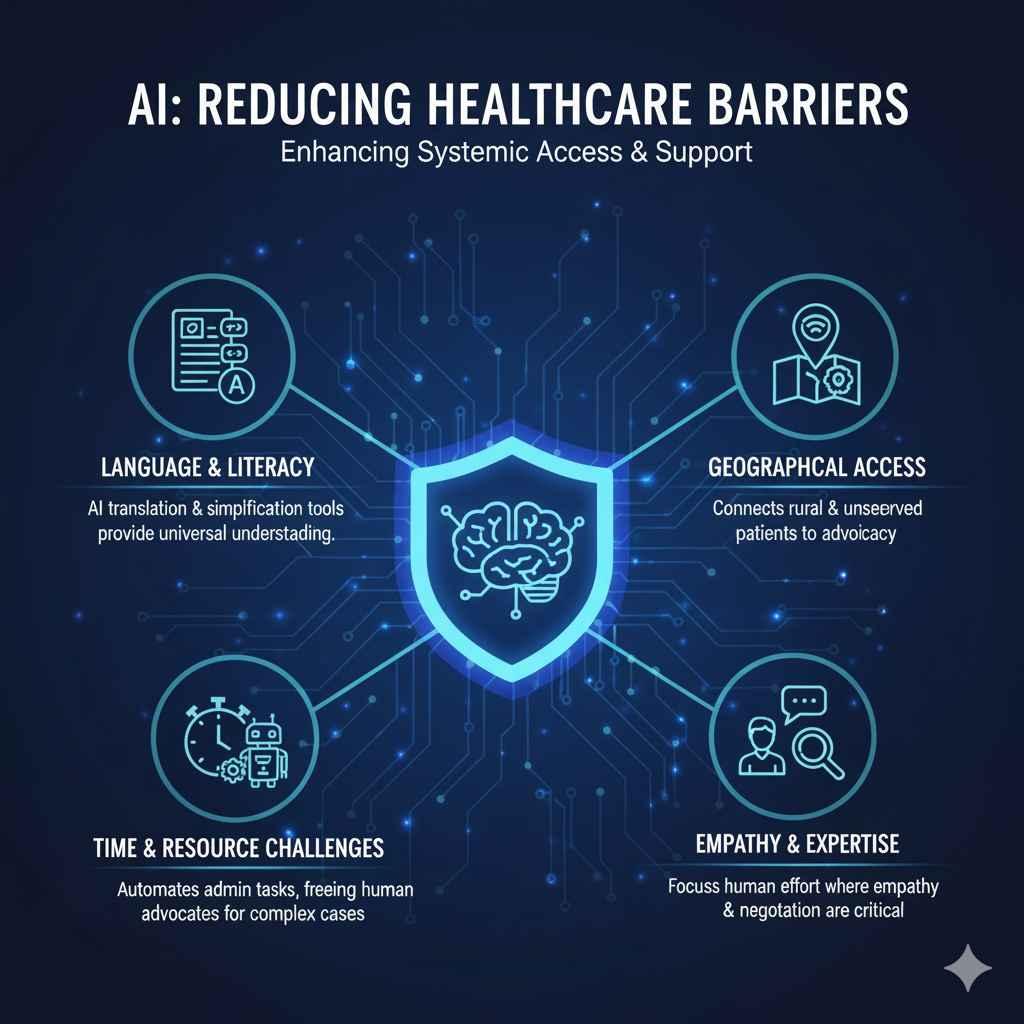
AI Reduces Systemic Barriers to Care
Beyond one-on-one assistance, AI addresses broader systemic issues:
-
Language barriers — Real-time translation and simplified explanations
-
Geographical limitations — Remote access for rural and underserved communities
-
Resource constraints — Automating intake, FAQs, and documentation
-
Risk prediction — Identifying patients likely to miss care due to transportation, finances, or literacy challenges
These capabilities promote equitable access and better outcomes.
AI Tools That Strengthen Advocacy Organizations
For advocacy groups, AI is becoming a strategic necessity.
1. Workflow Automation
Case management systems automatically:
-
Organize records
-
Track progress
-
Prioritize urgent cases
2. Data-Driven Insights
AI identifies systemic issues—like insurers repeatedly denying a specific treatment—supporting evidence-based policy action.
3. Scalable Communication
Chatbots and automated responses help organizations provide 24/7 support without expanding staff.
4. Collaborative Networks
Sharing anonymized data across organizations builds stronger, unified advocacy ecosystems.
Conclusion: AI is Reshaping Patient Advocacy for the Better
AI is not replacing human advocates—it is expanding their capacity to support more patients with greater accuracy, speed, and fairness. When deployed responsibly, AI strengthens patient rights, improves navigation, and reduces systemic inequities.
The future of patient advocacy is smarter, more compassionate, and deeply human-centered—with AI serving as the engine behind this transformation.
Looking to Build Ethical, Scalable Patient Advocacy Tools?
If you’re exploring ethical and scalable AI solutions for patient advocacy, platforms like Tecosys and Nutaan AI offer advanced tools that enhance navigation, support, and care coordination. To discuss your AI or patient advocacy needs directly, you can also book a strategy call anytime through Book a Call . These resources help organizations adopt AI responsibly while strengthening patient voices and improving care experiences.
 Spanish
 English
 Arabic
 French
 Portuguese
 Deutsch
 Turkish
 Dutch
Dutch
 Italiano
 Russian
 Romaian
 Portuguese (Brazil)
 Greek
Greek