

Voice biometrics is rapidly emerging as a powerful authentication technology across industries such as banking, healthcare, telecom, and government services. By analyzing the unique characteristics of an individual’s voice, organizations can verify identity quickly and securely without relying on traditional passwords or security questions. However, the accuracy and reliability of voice biometric systems depend heavily on the quality of the audio data used to train them.
At the heart of this process lies high-quality audio labeling, a crucial component in developing robust machine learning models for speaker recognition and authentication. As a specialized data annotation company, Annotera helps organizations build reliable voice biometric systems through scalable and precise audio annotation services. In this article, we explore how voice biometrics works and why high-quality audio labeling plays a vital role in its success.
Understanding Voice Biometrics
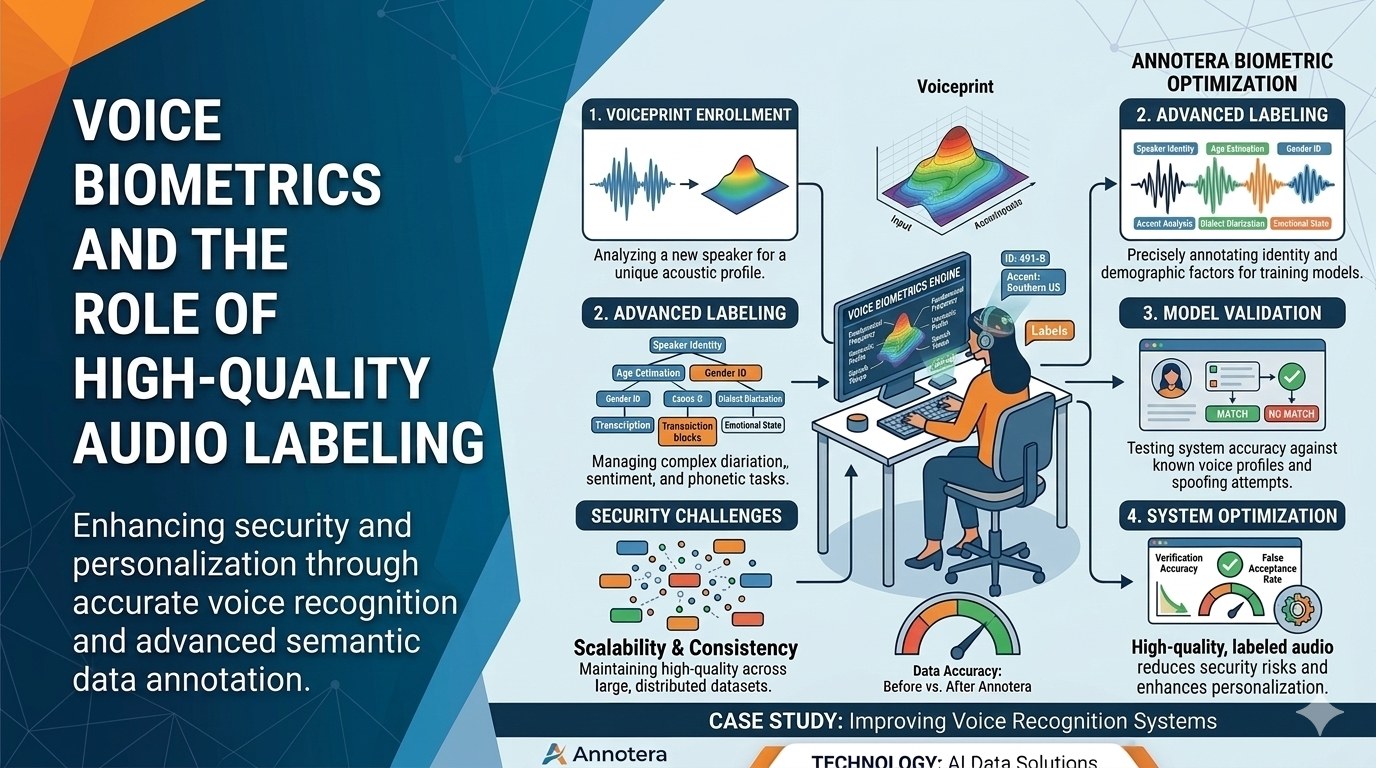
Voice biometrics is a technology that identifies or verifies individuals using the distinctive patterns in their speech. Every person’s voice has unique acoustic features such as pitch, frequency, tone, and rhythm, which can be analyzed and converted into a digital representation known as a voiceprint.
When a user speaks, the system captures their voice sample and extracts measurable characteristics. These features are then compared with a stored voiceprint to determine whether the speaker matches the registered identity. If the similarity score exceeds a predefined threshold, the user is authenticated.
Modern voice biometric systems rely heavily on artificial intelligence and machine learning to improve accuracy, filter background noise, and detect spoofing attempts such as recorded or synthetic voices.
Voice biometrics can operate in two primary modes:
-
Active voice biometrics: The user speaks a specific passphrase for verification.
-
Passive voice biometrics: The system authenticates the user during natural conversation without requiring a specific phrase.
Both approaches require highly accurate training data to ensure reliable identification.
The Growing Applications of Voice Biometrics
Voice biometrics is gaining traction in several industries due to its convenience and security benefits.
1. Banking and Financial Services
Financial institutions increasingly use voice authentication to verify customers during phone banking or digital transactions. Voice biometrics reduces reliance on knowledge-based authentication methods that can be easily compromised.
2. Contact Centers
Customer service centers use passive voice biometrics to authenticate callers in real time, improving user experience while reducing call handling times.
3. Healthcare
In telemedicine environments, voice biometrics helps verify the identity of patients and healthcare providers before accessing sensitive medical records.
4. Smart Devices and Voice Assistants
Voice-enabled devices use biometric recognition to personalize user experiences and restrict access to sensitive commands or data.
As these applications expand, organizations require large volumes of accurately labeled audio data to train reliable models.
What Is Audio Labeling in Voice Biometrics?
Audio labeling is the process of annotating audio recordings with structured metadata that machine learning models can interpret. It transforms raw sound recordings into meaningful training data for AI systems.
In voice biometrics, labeling tasks may include:
-
Speaker identification and diarization
-
Timestamped transcription
-
Accent and language tagging
-
Emotion detection
-
Background noise classification
-
Acoustic event tagging
Accurate audio annotation allows machine learning models to identify patterns in speech and differentiate between speakers effectively. Precise labeling of speaker transitions, overlapping speech, and acoustic events forms the foundation of reliable speaker recognition systems.
Why High-Quality Audio Labeling Is Critical
The performance of any voice biometric system depends on the quality of its training data. Poorly labeled or inconsistent datasets can significantly reduce model accuracy.
1. Improving Model Accuracy
High-quality labeled audio datasets enable machine learning models to understand subtle differences in speech patterns, leading to more accurate speaker recognition.
When annotations precisely capture features such as speech timing, speaker identity, and audio events, AI models can learn robust patterns that improve identification performance.
2. Reducing False Acceptance and Rejection Rates
In voice authentication systems, even minor errors can lead to false acceptance (allowing unauthorized access) or false rejection (denying legitimate users).
Well-annotated datasets help models distinguish between similar voices and environmental variations, reducing these risks.
3. Handling Noisy Environments
Real-world audio data often contains background noise, overlapping conversations, and variations in recording quality. High-quality annotation enables models to learn how to filter noise and focus on relevant speech features.
Research shows that poor audio quality and noisy recordings can significantly increase authentication failures, while clean and well-labeled data can dramatically improve system reliability.
4. Supporting Multilingual and Diverse Datasets
Voice biometric systems must work across languages, accents, and demographic groups. Comprehensive labeling helps capture this diversity, ensuring models perform consistently across global user bases.
Challenges in Audio Annotation for Voice Biometrics
Despite its importance, audio labeling presents several challenges:
Large Data Volumes
Voice biometric models require thousands or even millions of audio samples to train effectively.
Speaker Variability
Voice characteristics can change due to illness, age, or emotional state, making consistent labeling more complex.
Overlapping Speech
In conversational audio, multiple speakers may talk simultaneously, complicating speaker identification.
Annotation Consistency
Ensuring consistent labeling across large datasets requires standardized guidelines and quality control processes.
These challenges highlight the need for specialized audio annotation outsourcing partners with domain expertise.
How Annotera Supports Voice Biometrics Development
As a trusted audio annotation company, Annotera provides end-to-end annotation solutions tailored for speech AI and biometric applications. Our services help organizations build high-performance voice recognition systems with scalable and reliable datasets.
Expert Audio Annotation
Annotera’s trained annotators deliver precise labeling for tasks such as speaker diarization, acoustic event tagging, transcription, and speech segmentation.
Advanced Quality Control
Our multi-layer quality assurance workflows ensure annotation accuracy and consistency across large datasets.
Scalable Data Annotation Outsourcing
Through flexible data annotation outsourcing models, organizations can scale their training data pipelines without building large internal teams.
Customized Annotation Pipelines
Every voice biometric project has unique requirements. Annotera develops customized annotation frameworks tailored to specific use cases such as speaker verification, fraud detection, or conversational AI.
Multilingual and Global Data Coverage
Our annotation teams support multiple languages and accents, helping organizations build globally robust voice biometric systems.
By partnering with an experienced data annotation company, businesses can significantly accelerate AI development while maintaining high data quality standards.
The Future of Voice Biometrics and Audio Annotation
As AI technologies continue to evolve, voice biometrics will play an increasingly important role in digital security and user authentication. Advances in deep learning, edge computing, and synthetic voice detection will further expand the capabilities of voice-based identity verification.
However, these innovations will require even larger and more diverse datasets. High-quality audio labeling will remain a critical component in ensuring that voice biometric systems are accurate, secure, and resistant to spoofing attacks.
Organizations investing in voice biometrics must prioritize data quality from the start. Partnering with an experienced audio annotation company enables them to build reliable AI models faster while maintaining scalability.
Conclusion
Voice biometrics is transforming the way organizations authenticate users, offering a secure and convenient alternative to traditional passwords and PINs. By analyzing the unique acoustic patterns in human speech, voice biometric systems enable fast and frictionless identity verification across numerous applications.
Yet the success of these systems depends on the quality of the underlying training data. High-quality audio labeling ensures that machine learning models can accurately interpret speech patterns, differentiate between speakers, and perform reliably in real-world environments.
As a specialized data annotation company, Annotera helps organizations unlock the full potential of voice biometrics through scalable audio annotation outsourcing and high-precision labeling workflows. By delivering expertly annotated datasets, Annotera empowers businesses to build smarter, more secure voice-driven technologies for the future.


