
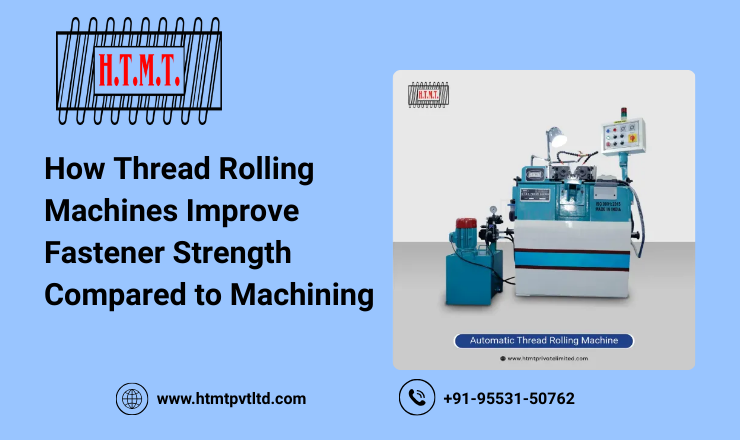
How Thread Rolling Machines Improve Fastener Strength Compared to Machining

Fastener strength is not just about raw material quality—it heavily depends on how threads are manufactured. Many buyers still rely on traditional machining methods, but experienced engineers and Rolling Machine Manufacturers know that thread rolling delivers far superior results.
In modern manufacturing, the Thread Rolling Machine has become the preferred solution for producing high-strength, long-lasting fasteners used in automotive, scaffolding, and industrial applications. This article explains, in simple terms, why thread rolling improves fastener strength compared to machining and why industries worldwide are shifting toward this technology.
Understanding Thread Rolling Technology
A Thread Rolling Machine forms threads by pressing hardened dies against a rotating workpiece. Instead of cutting material, the metal is plastically deformed into the thread shape.
Because no material is removed, the metal structure remains intact—this is the foundation of stronger fasteners.
Machining vs Thread Rolling: A Strength Comparison
Thread Machining (Cut Threads)
- Material is removed from the rod or bolt
- Grain structure gets interrupted
- Micro-cracks may form at thread roots
- Lower fatigue life under repeated load
Thread Rolling (Rolled Threads)
- Metal is compressed, not cut
- Grain flow follows the thread profile
- Higher resistance to fatigue failure
- Consistent and smoother thread finish
Independent manufacturing studies show that rolled threads can offer up to 40% higher fatigue strength compared to machined threads.
Why Thread Rolling Produces Stronger Fasteners
1. Continuous Grain Flow
Thread rolling aligns the grain structure along the thread shape, which significantly increases load-bearing capacity. This is why fasteners produced on a Thread Rolling Machine perform better under vibration and cyclic stress.
2. Increased Surface Hardness
Cold working during rolling slightly hardens the surface, improving wear resistance without additional heat treatment.
3. Better Dimensional Accuracy
Machines supplied by reliable Rack Rolling Machine Exporters ensure uniform thread depth and pitch, reducing assembly failures.
Importance of Machine Capacity in Strength Output
Machine tonnage directly affects thread quality and strength:
- 10 Ton Thread Rolling Machine Suppliers cater to small and medium fastener sizes
- Higher-tonnage machines handle heavy bolts and rods
- Infrastructure and scaffolding industries depend on 20 Ton Scaffolding Pipe Threading Machine Manufacturers for strong pipe connections
Choosing the correct capacity prevents tool wear and ensures consistent results.
CNC Rolling Machines and Strength Consistency
A modern CNC Rolling Machine enhances strength consistency by:
- Maintaining precise pressure control
- Eliminating operator-dependent variations
- Supporting high-volume production
This is especially valuable for export-focused businesses and Pipe Threading Machine Suppliers in India serving global quality standards.
Why Industries Prefer Thread Rolling Over Machining
Manufacturers prefer thread rolling because it delivers:
- Longer fastener life
- Lower rejection rates
- Faster production cycles
- Reduced material waste
This combination makes thread rolling the most cost-effective and performance-driven solution today.
Conclusion
When strength, durability, and reliability matter, thread rolling clearly outperforms machining. A well-designed Thread Rolling Machine produces fasteners with superior grain flow, higher fatigue resistance, and better surface quality.
By working with experienced Rolling Machine Manufacturers and trusted Pipe Threading Machine Suppliers in India, manufacturers can improve product performance while reducing long-term costs. If you’re planning to upgrade your production, thread rolling is the smartest investment for the future.
FAQs
1. Is thread rolling stronger than machining?
Yes, rolled threads are stronger because the grain structure remains continuous, improving fatigue and tensile strength.
2. What industries benefit most from thread rolling machines?
Automotive, construction, scaffolding, fastener manufacturing, and heavy engineering sectors.
3. How do I choose between 10 ton and 20 ton machines?
Smaller fasteners suit machines from 10 Ton Thread Rolling Machine Suppliers, while heavy scaffolding and pipes need higher tonnage.
4. Are CNC rolling machines worth the investment?
Absolutely. A CNC Rolling Machine ensures consistent quality, higher productivity, and lower rejection rates.
5. Do rolled threads reduce production cost?
Yes, they reduce material waste, rework, and tool wear, lowering cost per component.


