
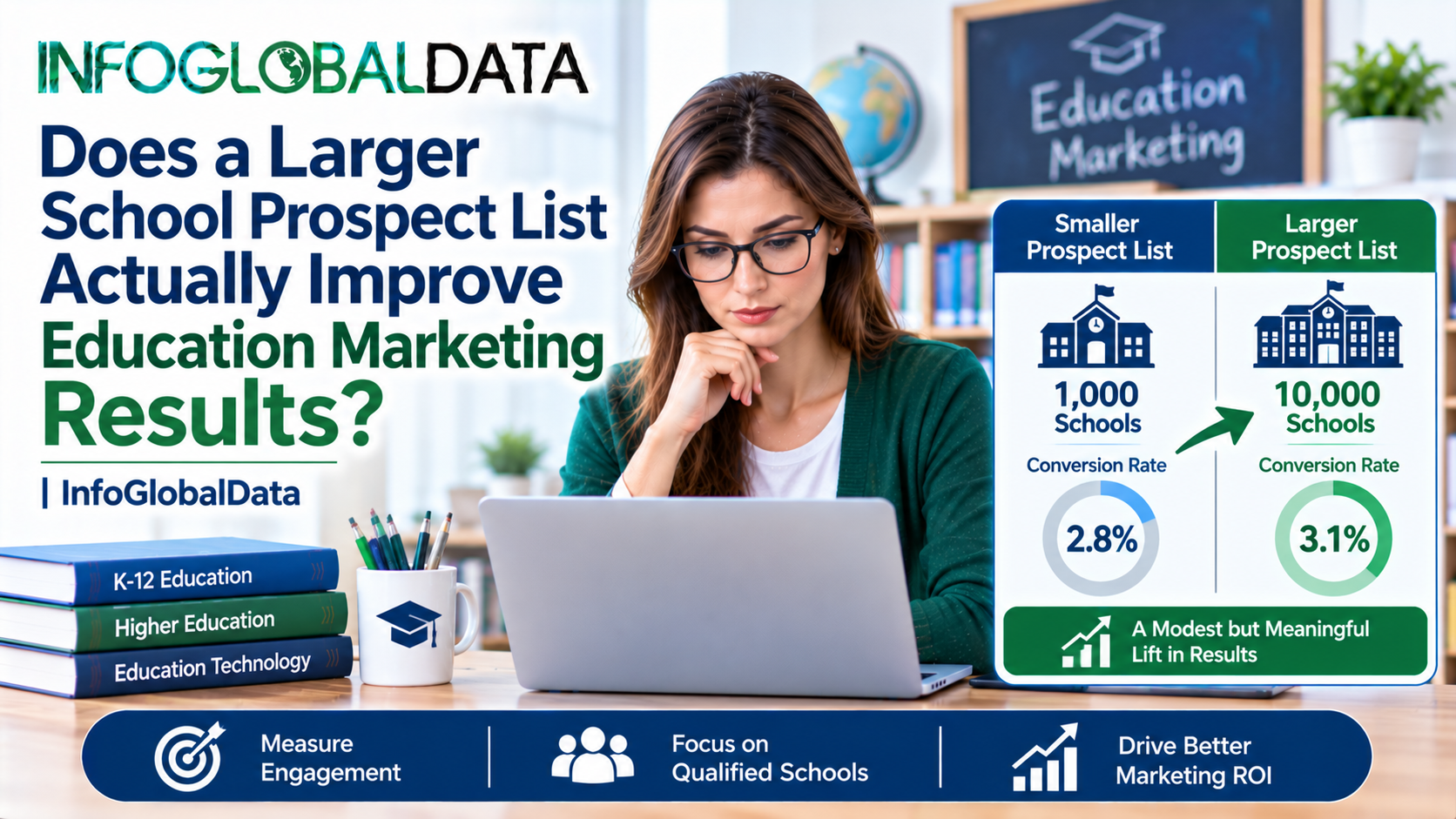
Does a Larger School Prospect List Actually Improve Education Marketing Results? | InfoGlobalData

A larger prospect database may give education marketers access to more schools, but it does not automatically generate more qualified leads, meetings, or sales. The challenge is finding the right institutions, relevant decision-makers, and accurate contact information. According to the National Center for Education Statistics (NCES), the United States had 99,297 operating public elementary and secondary schools in 2023–24. This represents a substantial prospecting market, but not every school is a suitable buyer for every education product or service.
For B2B marketers, the real question is not how many contacts a database contains, but how many match the ideal customer profile. Evaluating School Email Lists through relevance, segmentation, contact accuracy, and campaign performance can help organizations build more productive education marketing strategies.
1. Why a Larger School Prospect List Does Not Always Mean Better Results
Expanding a prospect list increases the potential audience, but it can also introduce irrelevant institutions, outdated contacts, duplicate records, and professionals who have no involvement in purchasing decisions.
For example, an education technology provider selling classroom assessment software may want to reach curriculum directors, instructional technology leaders, principals, and district administrators. A supplier of school transportation services may need transportation directors, operations managers, and school business officials instead.
Sending the same campaign to every available school contact ignores these differences.
The 2026 State of School Purchasing Report, based on a survey of 2,277 US education decision-makers, found that 80% identified funding and budgets as their biggest current challenge. It also found that 63% considered subscription costs a purchasing deal-breaker, while 41% identified implementation complexity as a concern.
These findings demonstrate why audience relevance matters. A large list cannot compensate for an offer that does not match an institution's budget, requirements, or purchasing priorities.
The better approach: Build a prospect database around the institutions most likely to need and afford the solution, rather than maximizing the number of records.
2. Understand the Size and Diversity of the Education Market
The US education market contains different types of institutions with distinct administrative structures, purchasing processes, and operational requirements.
NCES reported 99,297 operating public elementary and secondary schools for 2023–24. This included 90,461 regular schools, 1,865 special education schools, 1,575 career and technical education schools, and 5,396 alternative education schools.
These categories represent different prospecting opportunities. For example:
-
Public schools: Potential buyers of instructional resources, classroom technology, and administrative solutions.
-
Private schools: May have different ownership structures, budgets, and purchasing processes.
-
Charter schools: Can have distinct governance and procurement arrangements.
-
Special education schools: May require specialized instructional materials, accessibility solutions, and support services.
-
Career and technical schools: May need vocational equipment, industry-specific training, and workforce development resources.
A single campaign targeting all these institutions is unlikely to address their different needs effectively.
Marketers should segment School Mailing List records by school type, location, enrollment, grade levels, ownership, and other relevant characteristics. This creates smaller but more meaningful audiences and helps sales teams prioritize institutions based on product fit.
3. Target the Right School Decision-Makers
An institution may be an ideal prospect, but contacting the wrong employee can still prevent a campaign from generating meaningful engagement.
School purchasing decisions frequently involve multiple stakeholders. Principals may influence building-level purchases, instructional directors may evaluate curriculum products, technology directors may assess software and infrastructure, and district administrators may approve larger investments.
The 2026 State of School Purchasing Report identified the following purchasing influencers:
|
School purchasing stakeholder |
Reported influence |
|---|---|
|
Building-level administrators |
61% |
|
Instructional staff |
59% |
|
Instructional directors |
54% |
|
Technology directors |
52% |
|
Superintendents |
46% |
|
School board members |
24% |
These figures show why school prospecting should consider professional roles rather than relying exclusively on institution-level contact information.
For example, an educational publisher may prioritize curriculum directors and instructional coordinators. An IT solutions provider may focus on technology directors and district IT administrators.
Before purchasing or using School Email Lists, marketers should determine whether the records include relevant job titles and departmental information. A database containing several contacts from the same school can be valuable when those contacts represent different members of the buying group, but unnecessary duplication can inflate list size without improving market coverage.
4. Measure Engagement Instead of Counting Contacts
A prospect database should be evaluated through campaign outcomes, not simply the number of available email addresses.
Useful performance indicators include:
-
Delivery rate: Percentage of emails successfully delivered.
-
Bounce rate: Percentage of messages that could not be delivered.
-
Click-through rate: Percentage of recipients who clicked a link.
-
Reply rate: Percentage of recipients who responded.
-
Qualified meeting rate: Percentage of prospects who became relevant sales conversations.
-
Conversion rate: Percentage of prospects who progressed to a defined business outcome.
MailerLite's 2025 email marketing benchmark report analyzed more than 3.6 million campaigns from 181,000 approved accounts. Its education-sector benchmark data showed an average click rate of 1.93% for educational institutions and 2.15% for higher education.
These figures offer useful context, but they should not be treated as expected results for cold B2B prospecting. The benchmark covers email marketing campaigns, which can include opted-in audiences, whereas purchased or externally sourced school contacts may behave differently.
The distinction is important: a campaign sent to 5,000 highly relevant, permission-appropriate contacts may generate better business opportunities than one sent to 25,000 poorly matched records.
Marketers should compare campaigns using consistent audience definitions, messaging, and measurement periods. That makes it easier to determine whether list expansion actually improves results.
5. Prioritize Data Quality and Contact Accuracy
A larger database can create more work if it contains outdated or incomplete information. School administrators change roles, employees move between institutions, and organizational structures evolve.
A useful School Email Database should be assessed on more than its total record count. Relevant quality indicators include:
-
Correct school name and institutional identity.
-
Current business email addresses.
-
Accurate job titles and departmental affiliations.
-
Geographic and school-type information.
-
Duplicate-record management.
-
Data source transparency and update practices.
-
Available email verification details.
The importance of data quality is also reflected in current education technology procurement practices.
CoSN's U.S. State of EdTech 2026 report, based on responses from more than 600 district technology leaders across 44 states, found that 43% of districts included interoperability requirements in their requests for proposals, while 39% included them in purchasing evaluation rubrics.
Although these figures concern technology procurement rather than contact databases, they illustrate a broader point: education buyers evaluate whether solutions fit their existing environments and requirements. Vendors should apply similar discipline when selecting prospects, ensuring that their outreach is relevant to the institution and its decision-making structure.
6. Align Prospect Segmentation With School Purchasing Priorities
Even accurate contact information will not produce strong results if campaign messaging is disconnected from what schools currently need.
The 2026 State of School Purchasing Report found that 68% of surveyed decision-makers anticipated spending on educator professional development over the following 12–24 months, while 63% identified instructional tools and systems as spending priorities. It also reported that 37% were considering AI tools.
These findings offer practical segmentation opportunities:
|
Product or service |
Potential target contacts |
|---|---|
|
EdTech platforms |
Technology directors, principals, instructional leaders |
|
Teacher training |
Professional development directors, curriculum coordinators |
|
Learning management systems |
IT directors, instructional technology leaders |
|
Educational supplies |
Procurement managers, school administrators |
|
Assessment software |
Assessment coordinators, curriculum directors |
|
Special education resources |
Special education directors, school psychologists |
The goal is to connect each campaign with a relevant school need. A teacher training provider, for instance, should not automatically send the same message to procurement officers and classroom teachers.
Segmenting School Email Lists by product category and professional responsibility helps marketers develop more focused messaging and gives sales teams a clearer understanding of which prospects deserve priority.
7. Practical Ways to Improve School Prospecting Results
Instead of continuously increasing database size, education marketers can improve campaign performance through a more disciplined approach.
Here are five practical recommendations:
-
Define an ideal school profile: Specify school type, location, enrollment range, grade levels, and other characteristics relevant to the product.
-
Segment contacts by responsibility: Separate principals, superintendents, technology directors, teachers, and procurement professionals.
-
Validate contact information: Check email accuracy, job titles, school affiliations, and available update information before launching campaigns.
-
Personalize campaign messaging: Connect each message to a relevant institutional challenge, such as professional development, technology integration, or instructional improvement.
-
Measure qualified outcomes: Track replies, qualified leads, meetings, and conversions instead of judging success by database size or email volume alone.
InfoGlobalData provides B2B contact data, email lists, and lead-generation resources that education marketers can evaluate when developing school prospecting campaigns. Before selecting a School Mailing List, buyers should assess its institutional coverage, contact relevance, freshness, and suitability for their intended audience.
Conclusion
A larger school prospect list can expand market reach, but size alone does not guarantee better education marketing results. The strongest campaigns combine relevant institutions, accurate professional contacts, meaningful segmentation, and messaging aligned with school purchasing priorities. Recent education-sector research shows that budgets, implementation complexity, technology integration, and stakeholder involvement all influence buying decisions. Marketers should therefore evaluate School Email Lists based on their ability to identify qualified opportunities rather than simply counting available records. By improving data quality, targeting the right decision-makers, and measuring meaningful campaign outcomes, education vendors can build more efficient prospecting strategies. Ultimately, a smaller, well-qualified audience can be more commercially valuable than a much larger database with limited relevance.
Frequently Asked Questions
1. Does a larger school prospect list generate more leads?
Not necessarily. A larger list increases the number of potential contacts, but lead generation also depends on audience relevance, contact accuracy, campaign messaging, and product-market fit. A smaller, carefully segmented audience may generate more qualified opportunities.
2. What information should School Email Lists contain?
Useful records should include school names, locations, institutional categories, business email addresses, and relevant professional roles. Enrollment, grade-level information, ownership type, and data-update details can also improve segmentation.
3. How can education marketers improve school email campaign performance?
Marketers should segment institutions by school type and location, target relevant decision-makers, personalize messaging, and maintain accurate contact information. Campaign performance should be measured through replies, qualified meetings, and conversions rather than email volume alone.
4. Who are the main decision-makers in school purchasing?
Common purchasing influencers include building-level administrators, instructional staff, instructional directors, technology directors, and superintendents. The appropriate contact depends on the product, purchase value, and whether the decision is made at the school or district level.
5. How often should a School Email Database be updated?
There is no universal update interval that guarantees accuracy. Marketers should revalidate records regularly and check important contact details before major campaigns, particularly when targeting professionals whose roles or institutional affiliations may have changed.
6. What is the difference between a School Mailing List and a School Email Database?
A School Mailing List generally refers to a collection of school-related contacts used for outreach, while a School Email Database emphasizes the underlying organized contact records and associated information. In practice, the terms can overlap depending on the provider.
7. Which metrics should marketers track when evaluating school prospect lists?
Track delivery rates, bounce rates, reply rates, click-through rates, qualified meetings, and conversions. Also measure the percentage of records that match the intended school categories and professional roles.


