
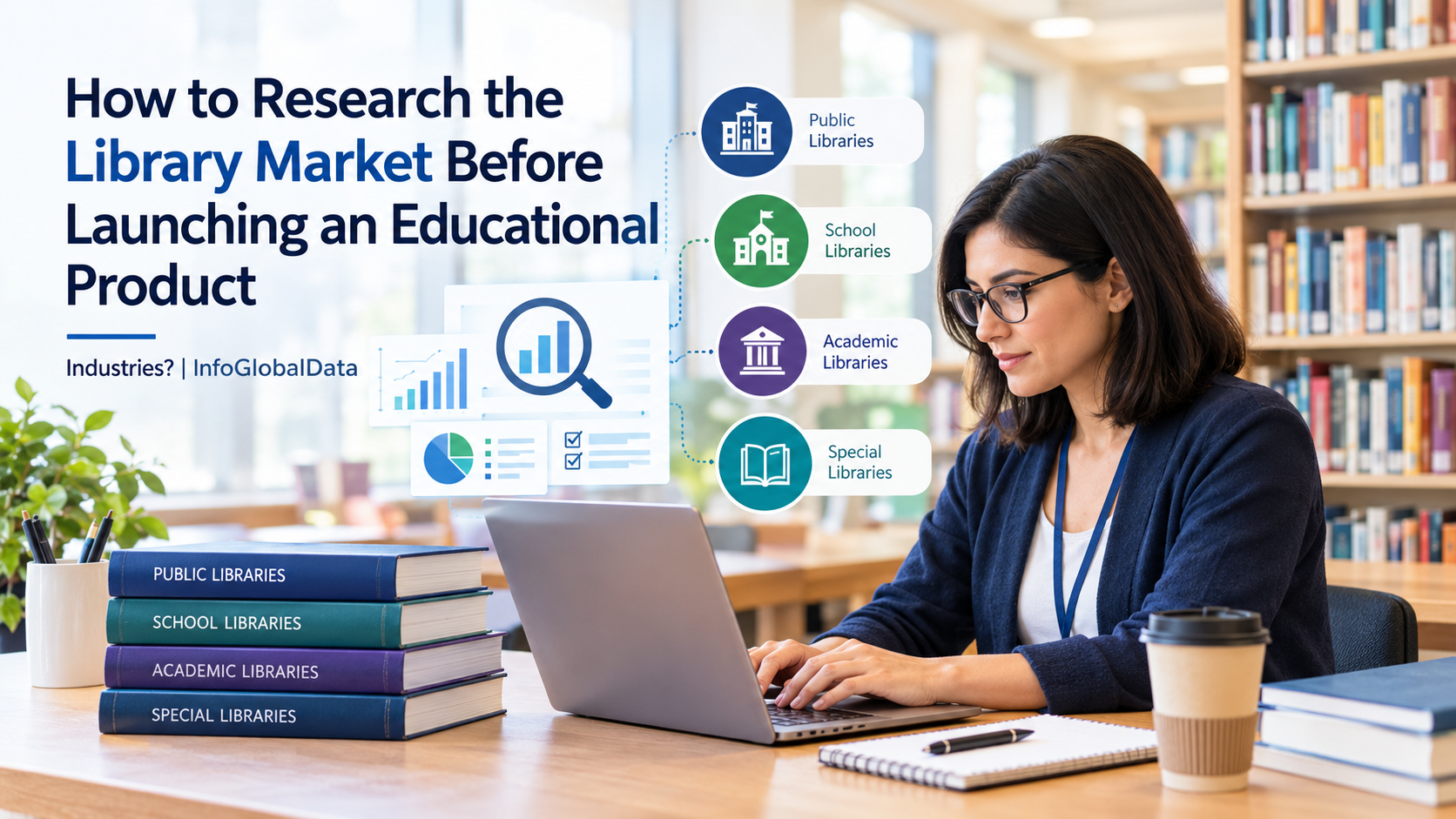
How to Research the Library Market Before Launching an Educational Product Industries? | InfoGlobalData

Launching an educational product for libraries requires more than identifying institutions that might purchase it. Public, academic, school, and special libraries serve different audiences, operate under different funding models, and evaluate products according to distinct priorities. A digital learning platform that appeals to a university library may not address the budget constraints or instructional needs of a K–12 school library. Market research helps product teams understand these differences before investing in development or outreach. It also helps marketers identify the librarians and other decision-makers who influence purchasing. By combining library-sector research, buyer segmentation, product validation, and reliable contact data, businesses can build a more focused launch strategy and reduce the risk of targeting the wrong institutions.
1. Define the library segments before estimating demand
The library market is not a single buyer category. Educational product companies should distinguish at least four segments:
-
Public libraries: Often prioritize community learning, digital inclusion, literacy, and accessible public services.
-
School libraries: Support curriculum delivery, reading development, research skills, and student learning.
-
Academic libraries: Serve students, faculty, researchers, and institutional priorities such as scholarly communication and information literacy.
-
Special and national libraries: Focus on particular professional, government, medical, legal, or research communities.
These segments differ in governance, funding, procurement procedures, staffing, and product evaluation. A product designed for university research support, for example, may have little relevance to a primary-school library.
The Institute of Museum and Library Services (IMLS) provides Public Libraries Survey datasets, including fiscal year 2024 files, that can help businesses examine public-library characteristics and compare institutions. Its data can support research into library locations, staffing, services, and other institutional indicators.
Institute of Museum and Library Services
What this means: Establish the market boundaries first. Decide whether the product is intended for public, school, academic, or specialist libraries, and identify the countries or regions where the business can realistically sell and support it.
2. Measure the market using credible library-sector data
A market estimate should combine the number of potential institutions with their likely needs, purchasing capacity, and suitability for the product. Avoid treating every library as an equally valuable prospect.
For academic libraries in the United States, the Association of College and Research Libraries (ACRL) published findings from its 2025 Annual Survey in October 2026. The weighted survey represents U.S. academic libraries and reports a median annual expenditure of $470,000, excluding fringe benefits. It also found that academic libraries spent a median of $523 per student FTE.
These figures provide useful context, but they should not be interpreted as the amount available for a new educational product. Total expenditure includes staffing, collections, services, facilities, and other operating costs. A product's addressable budget depends on its category and the institution's priorities.
The same ACRL survey found that 79.7% of academic library collection holdings and 98.2% of circulation were digital in fiscal year 2025.
This suggests that digital access, discovery, and resource-management capabilities are important areas to investigate when assessing academic-library demand.
To estimate the addressable market, collect information such as:
-
Number of institutions in the target segment and geography.
-
Institution size, student enrollment, or community served.
-
Existing digital and physical collections.
-
Current technology and service priorities.
-
Procurement processes and likely purchasing cycles.
-
Product relevance to the institution's mission.
Use official datasets and sector surveys wherever possible. Treat market-size estimates from commercial sources as directional unless their methodology and definitions are transparent.
3. Identify the problems librarians want products to solve
A product launch should begin with a clearly defined library problem, not a list of features. Research what librarians are trying to improve and where current tools or workflows fall short.
The 2025 Ithaka S+R US Library Survey, which gathered responses from library leaders at four-year, nonprofit postsecondary institutions, highlights continuing pressure around budgets, staffing, student learning, and information literacy. It also found that the proportion of leaders prioritizing transformative agreements declined from 38% to 26%, while the share prioritizing a shift from subscription spending to open investments fell from 45% to 23% compared with the previous survey cycle.
For educational product companies, these findings point to an important research question: does the product address a current institutional priority, and can its value be demonstrated within the library's financial constraints?
Conduct interviews with librarians, library directors, educators, and procurement staff. Ask questions such as:
-
Which tasks consume the most staff time?
-
What challenges do students, teachers, or researchers frequently report?
-
Which existing products are difficult to use or integrate?
-
What evidence would justify purchasing a new solution?
-
Who evaluates, approves, and manages technology purchases?
Do not rely exclusively on interviews with enthusiastic potential users. Include people responsible for budgets and procurement because they may assess products differently from day-to-day users.
4. Track technology trends without assuming every library is ready to adopt them
Technology trends can reveal product opportunities, but adoption levels and implementation barriers matter just as much as interest.
The 2025 Pulse of the Library report from Clarivate surveyed more than 2,000 librarians across 109 countries and regions. It found that 67% of libraries were exploring or implementing AI tools, while more than 60% of respondents identified budget as a major challenge to AI adoption. The report also noted that over half of librarians recognized a need for team upskilling or reskilling.
A separate 2025 survey of 483 library deans and directors at U.S. four-year nonprofit postsecondary institutions found that libraries were already using AI for activities including discovery and analysis (40%), research support services (29%), internal data analysis (26%), and metadata creation and validation (22%). However, 24% reported that their library did not use AI for internal work or services.
These findings show why product research should distinguish between interest, experimentation, and operational adoption. A library may be interested in AI but lack the budget, staff expertise, governance policies, or technical infrastructure to implement a new platform.
For each emerging technology, investigate:
-
Use case: What specific library workflow or user need does it address?
-
Readiness: Does the institution have the staff and infrastructure to use it?
-
Trust: Are privacy, accessibility, accuracy, and ethical concerns addressed?
-
Integration: Can it work with existing library systems and institutional platforms?
-
Evidence: Can the vendor demonstrate measurable improvements?
A product positioned around AI, analytics, or digital learning should explain its practical value rather than depend on technology terminology alone.
5. Map the library buying committee and decision-making process
Librarians are important product evaluators, but they may not be the only people involved in a purchase. Depending on the institution and product category, the buying group may include:
-
Librarians and subject specialists: Evaluate relevance to collections, research, and user services.
-
Library directors and department heads: Assess strategic fit, staffing requirements, and budgets.
-
IT teams: Review security, compatibility, integrations, and technical support.
-
Teaching and learning teams: Assess curriculum relevance and student outcomes.
-
Procurement and finance teams: Review contracts, pricing, vendor requirements, and purchasing approvals.
The 2025 Ithaka S+R survey highlights how library priorities connect to wider institutional objectives, including student learning, critical thinking, and information literacy.
This reinforces the importance of understanding both the library's internal needs and the goals of the wider institution.
When building a prospecting strategy, record each contact's job title, department, institution, location, and likely role in the purchase. A generic contact list may reach a librarian but miss the director or IT stakeholder who must approve the solution.
A carefully segmented Librarian Email List can help sales teams identify relevant professionals for research interviews, product demonstrations, and launch communications. The value depends on the accuracy of the contact information and whether the selected roles match the product's buying process.
6. Evaluate competitors, pricing, and product differentiation
Competitor research helps establish whether a product solves an unmet need or enters an already crowded category. Examine direct competitors, alternative solutions, and the possibility that libraries will continue using existing tools rather than purchase anything new.
Build a comparison covering:
|
Research area |
What to examine |
|
Product capabilities |
Core features, accessibility, integrations, and support |
|
Pricing |
Subscription, licensing, institution-wide, or usage-based models |
|
Target customers |
Public, school, academic, or specialist libraries |
|
Implementation |
Setup time, training, migration, and maintenance |
|
Evidence of value |
User outcomes, time savings, adoption, and service improvements |
|
Limitations |
Missing features, technical barriers, or unmet user needs |
Pricing research should consider institutional purchasing realities. A small public library, a school district, and a large research university may have very different budgets and approval processes. The ACRL 2025 median expenditure of $470,000 for academic libraries offers a sector benchmark, but it is not a universal product budget or a pricing recommendation.
Use interviews and demonstrations to test what customers consider essential, optional, or unnecessary. Product differentiation should be tied to a measurable outcome, such as easier resource discovery, improved accessibility, reduced administrative workload, or stronger information-literacy support.
7. Build a reliable prospect database for launch outreach
Once the market and buying roles are understood, translate the research into a structured prospect database. Useful fields include:
-
Library name and type.
-
Institution or parent organization.
-
Geographic location.
-
Website and relevant department.
-
Librarian or library director's name and job title.
-
Professional email address.
-
Technology or subject-area responsibility, where relevant.
-
Source and date of the last contact-data verification.
A segmented Librarian Mailing List is more useful than a broad list of unrelated education contacts when the campaign targets library professionals. Likewise, a well-maintained Librarian Email Database can support targeted outreach when records are organized by institution type, geography, and job responsibility.
InfoGlobalData can be considered as a resource for businesses researching librarian and education-sector contacts. Before using any external database, assess its coverage, field-level accuracy, update frequency, sourcing practices, and compliance processes. Verify priority contacts before launching campaigns, and ensure outreach follows applicable privacy and email-marketing requirements.
8. Practical takeaways for educational product marketers
Before committing to a library-market launch, apply these five steps:
-
Choose a specific segment: Define whether the product is intended for public, school, academic, or specialist libraries.
-
Use sector-specific evidence: Review current ACRL, IMLS, Ithaka S+R, and other relevant library research rather than relying on general education-market estimates.
-
Validate the problem: Interview users, directors, IT teams, and procurement stakeholders to confirm that the product addresses a real need.
-
Test willingness and readiness to buy: Examine budget constraints, technology requirements, approval processes, and implementation capacity.
-
Prepare accurate, segmented contact data: Organize prospects by institution type and decision-making role, and verify records before outreach.
These steps help transform broad market interest into a launch plan built around actual institutional needs.
Conclusion
Researching the library market before launching an educational product helps businesses understand who needs the solution, how institutions make purchasing decisions, and which product capabilities are most relevant. Recent research shows that academic libraries are heavily reliant on digital collections, while library leaders are balancing financial pressures with changing expectations around AI, research support, and information literacy. These trends create opportunities, but they do not mean every library is ready or able to purchase new technology. Companies should validate demand by segment, speak with both users and budget holders, evaluate competing solutions, and build accurate prospect data. With this groundwork, InfoGlobalData's librarian contact resources can support more focused outreach to relevant library professionals.
Frequently Asked Questions
1. Why should educational product companies research the library market before launching?
Market research helps companies identify suitable library segments, understand purchasing priorities, and assess competition. It also reduces the risk of developing products that do not match librarians' operational needs or institutional budgets.
2. What are the main types of libraries to target?
The main segments include public libraries, school libraries, academic libraries, and special libraries. Each has different users, funding structures, procurement processes, and product requirements.
3. How can businesses identify librarians who influence purchasing decisions?
Research job titles, department responsibilities, institutional structures, and procurement processes. Librarians, library directors, IT managers, and department heads may all influence purchasing, depending on the product.
4. What trends are influencing the library market in 2026?
Digital collections, AI-assisted discovery, research support, information literacy, accessibility, and data privacy are important areas of change. Recent surveys also highlight budget and staff-capacity constraints that can affect adoption.
5. How can a Librarian Email List support an educational product launch?
A targeted list can help businesses reach relevant librarians and library professionals for product research, demonstrations, and launch communications. Its usefulness depends on accurate contact details, appropriate segmentation, and compliance with applicable marketing rules.
6. What information should a librarian contact database contain?
Useful fields include the librarian's name, professional email, job title, library name, institution type, location, and department. Recording verification dates and data sources also helps teams maintain contact accuracy.
7. How can companies validate demand for a new library product?
Conduct interviews, surveys, and product demonstrations with librarians, library directors, IT teams, and procurement stakeholders. Test whether the product addresses a clearly defined problem and whether institutions have the budget and capacity to adopt it.


