
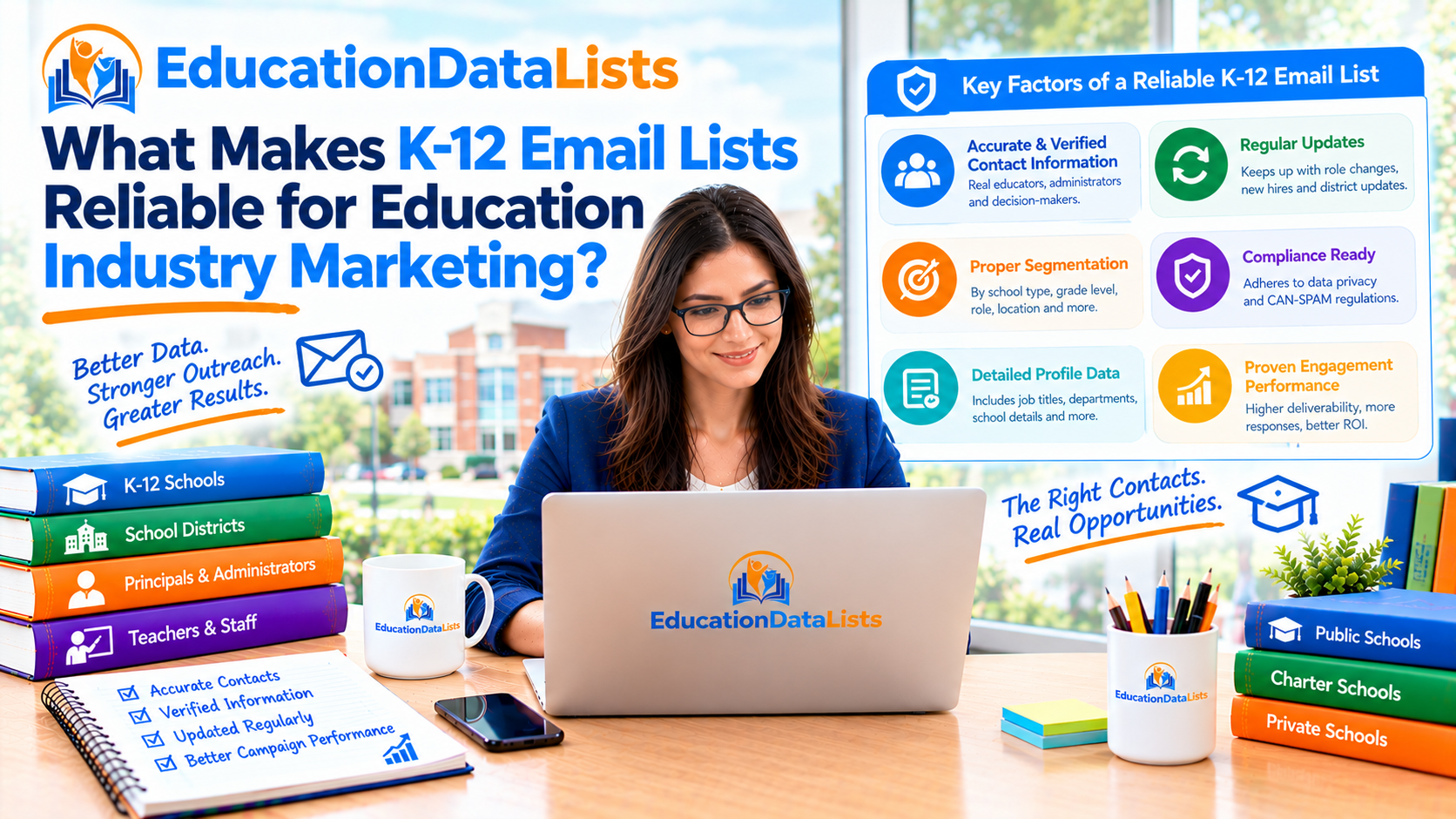
What Makes K-12 Email Lists Reliable for Education Industry Marketing? | EducationDataLists

Introduction
Education technology vendors, curriculum publishers, classroom equipment suppliers, and professional development providers depend on accurate school contact data to reach relevant education professionals. Yet a large contact database is not necessarily a reliable one. Outdated email addresses, incorrect job titles, duplicate school records, and poorly defined audience segments can waste marketing resources and lead to irrelevant outreach.
The National Center for Education Statistics (NCES) reported 99,073 operating public elementary and secondary schools and 19,183 operating public school districts in the United States during the 2024–25 school year. These figures illustrate the scale of the K-12 market and the importance of identifying the right schools and contacts (NCES, 2024–25 Common Core of Data).
Reliable K-12 contact data combines accurate institutional information, current professional details, valid email addresses, meaningful segmentation, and responsible data practices. Understanding these factors helps education marketers assess database quality before launching campaigns.
1. Confirm That School and District Records Are Accurate
The first measure of a reliable K-12 database is whether its records correctly identify the institutions being targeted. A school may change its name, join a different administrative structure, close, or become part of a charter or specialized education network. If the underlying school information is incorrect, even a technically valid email address may lead to an irrelevant contact.
NCES data for 2024–25 distinguishes among regular schools, special education schools, career and technical education schools, alternative education schools, and other institutional categories. Its tables also distinguish school-level records from district and agency records (NCES, Table 1).
These distinctions matter because education suppliers do not always sell to the same type of institution. A curriculum provider, for example, may target elementary schools, while a specialist technology supplier may focus on districts or career and technical education programs.
What to check in every school record
Before using K-12 Email Lists, review:
-
Official school name: Confirm spelling and distinguish similarly named institutions.
-
School type: Identify whether the record represents an elementary, middle, high, special education, or other school.
-
District affiliation: Check whether the school belongs to the correct district or operates independently.
-
Geographic details: Validate the state, city, and address where relevant.
-
Institutional status: Confirm that the school is operating and that the record is not obsolete.
-
Source and update date: Record where the information came from and when it was last reviewed.
NCES directories are particularly useful for validating public school and district information. For private schools and other education organizations, marketers may need additional authoritative sources because public-school datasets do not provide complete coverage of every institution.
2. Verify Professional Contacts and Their Current Roles
Accurate school information is only one part of contact reliability. A record must also identify a professional whose role is relevant to the campaign.
School leaders, principals, superintendents, curriculum coordinators, technology directors, teachers, and purchasing staff may influence different decisions. A supplier offering district-wide software may need to reach technology leadership or district administrators, while a classroom resource provider may benefit from connecting with curriculum leaders or relevant teachers.
Gartner's June 2025 B2B buyer survey found that 73% of buyers actively avoid suppliers that send irrelevant outreach. The survey included 632 B2B buyers and was conducted in August and September 2024. It is not specific to education marketing, but it illustrates the commercial cost of sending messages that do not match a recipient's needs (Gartner, 2025).
Build role-based segments
For each contact, verify:
-
Full name and current professional title.
-
School or district affiliation.
-
Department or area of responsibility, where relevant.
-
Whether the person is an end user, influencer, evaluator, or likely purchasing decision-maker.
-
The source used to confirm the information.
Do not assume that every principal controls purchasing decisions or that every teacher can authorize a district-wide purchase. Where buying authority is uncertain, treat the contact as a potential stakeholder rather than a confirmed decision-maker.
A well-maintained K-12 Email Database should make these distinctions visible so that sales and marketing teams can tailor their outreach to the recipient's actual responsibilities.
3. Validate Email Addresses and Monitor List Quality
A contact record can be accurate in every other respect and still contain an email address that no longer works. Common problems include typographical errors, inactive mailboxes, changed domains, and addresses that cannot be confirmed by verification tools.
ZeroBounce's 2026 Email List Decay Report analyzed more than 11 billion email addresses processed during 2025. The company reported that 62% were classified as valid and 23% as invalid. These figures cover submitted email data across multiple industries and list types, rather than K-12 databases specifically. They should therefore be treated as a broad warning about contact quality, not as an estimate of the proportion of invalid school contacts (ZeroBounce, 2026).
A practical email validation checklist
-
Check formatting. Look for missing characters, spaces, and obvious spelling errors.
-
Confirm the domain. Compare the email domain with the school's or district's official website where possible.
-
Use a reputable verification service. Check available syntax, domain, and mailbox-validation signals.
-
Review uncertain addresses. Catch-all configurations and restricted mail servers can prevent definitive verification.
-
Monitor hard bounces. Remove confirmed invalid addresses from future campaigns.
-
Keep verification dates. Record when each address was checked so that old records can be prioritized for review.
Email verification cannot guarantee that a message will reach the inbox. Sender reputation, authentication, message content, recipient filtering, and mailbox-provider policies also influence deliverability. Reliable list management should therefore combine verification with ongoing campaign monitoring.
4. Segment K-12 Mailing Lists Around Actual Education Needs
Reliable data is not just accurate; it is organized in a way that supports relevant outreach. A generic list containing every school in a region may be less useful than a smaller, carefully segmented database that matches the supplier's product to the institutions most likely to need it.
NCES's 2024–25 school-level tables report different school counts and average enrollment figures by school level. For example, its national figures include 51,463 regular operating elementary schools, 15,825 middle schools, and 17,640 high schools. These distinctions provide a useful starting point for school-level market segmentation (NCES, Table 4).
Useful segmentation criteria
Depending on the product, a K-12 Mailing List may be organized by:
-
School level: elementary, middle, or high school.
-
Institution type: public, private, charter, special education, or career and technical education.
-
Geography: state, district, county, or service area.
-
Professional role: principal, superintendent, teacher, curriculum leader, or technology administrator.
-
Product relevance: classroom resources, learning platforms, school supplies, professional development, or IT services.
-
Institutional context: verified information about programs, publicly stated priorities, or relevant initiatives.
For instance, a provider selling learning management software may prioritize district technology leaders and administrators. A publisher producing elementary reading materials may instead focus on elementary schools and relevant curriculum professionals.
These segments should be grounded in verified information. School level alone does not establish a school's budget, purchasing timeline, or willingness to buy a particular product.
5. Review Data Freshness and Establish Maintenance Procedures
K-12 contact information changes as professionals move between schools, take on new responsibilities, or leave the education sector. School websites and district directories can also change, which means a database that was accurate when collected may gradually become unreliable.
ZeroBounce's 2026 report identified invalid addresses as a major component of email data-quality problems and noted that changes in people's roles and abandoned email accounts contribute to deteriorating contact information. Its figures are based on data submitted for verification, not a longitudinal study of individual K-12 records, but they reinforce the need for regular review (ZeroBounce, 2026).
Create a repeatable data-maintenance process
-
Review records before major campaigns.
-
Prioritize contacts with missing or old verification dates.
-
Recheck school and district information when discrepancies appear.
-
Update contacts when a role change is confirmed.
-
Suppress invalid addresses, unsubscribes, and contacts who should not receive further messages.
-
Track recurring errors by data source to identify unreliable records.
There is no universal verification interval that fits every K-12 database. The right schedule depends on the age and source of the information, campaign frequency, and the rate at which errors emerge. A record that has repeatedly bounced or contains conflicting role information should receive more attention than one recently confirmed against a current official source.
6. Evaluate Data Sources, Compliance, and Campaign Results
A reliable database should have a clear origin and a defined process for collection, verification, updates, and permitted use. Marketers should ask providers how contacts are sourced, how frequently records are reviewed, what validation means, and whether uncertain records are clearly identified.
For U.S. commercial email campaigns, the Federal Trade Commission's CAN-SPAM guidance requires accurate sender information and non-deceptive subject lines, a valid physical postal address, a clear opt-out method, and timely handling of opt-out requests. Organizations remain responsible for compliance even when they use a third party to send their campaigns (FTC, CAN-SPAM Act Compliance Guide).
Education marketers should also assess privacy and data-use requirements relevant to their audience and jurisdiction. Publicly available school contact information is not blanket permission for every marketing use. Contacting education professionals for B2B purposes also differs from marketing directly to children or using student-level data, which may raise additional legal and ethical concerns.
Measure reliability after outreach
Track metrics that reveal both data quality and campaign effectiveness:
-
Hard-bounce rate: identifies addresses that cannot accept messages.
-
Contact accuracy: measures whether sampled individuals still hold the recorded roles.
-
Institutional accuracy: checks whether contacts are linked to the correct schools or districts.
-
Reply and qualified inquiry rates: indicate whether outreach generates useful conversations.
-
Unsubscribe and complaint rates: reveal possible relevance, frequency, or permission problems.
-
Conversion rate: connects marketing activity to demos, registrations, meetings, or sales.
Avoid treating open rates as definitive evidence of engagement. Privacy features and automated activity can distort them. Compare similar audience segments and monitor whether improved contact accuracy leads to better business outcomes.
EducationDataLists can be considered as a resource when researching education-related contact data. As with any provider, buyers should assess school coverage, role accuracy, source transparency, verification practices, update frequency, and permitted use before integrating records into their campaigns.
Practical Takeaways for Education Marketers
-
Verify the institution first. Match school names, types, locations, and district affiliations against appropriate authoritative sources.
-
Confirm professional roles. Make sure contacts are current and relevant to the product or purchasing process.
-
Validate email addresses. Use appropriate verification methods and monitor bounces after sending.
-
Segment for relevance. Organize contacts by school level, institution type, geography, and professional responsibility.
-
Maintain and measure the database. Record verification dates, update changed records, and track contact accuracy alongside campaign outcomes.
Conclusion
Reliable K-12 Email Lists require more than extensive coverage. They need accurate school and district information, current professional contacts, usable email addresses, meaningful segmentation, and a repeatable process for maintaining records. NCES data helps marketers understand the size and structure of the public K-12 landscape, while broad email-quality research shows why address verification and list hygiene deserve ongoing attention.
For education industry marketers, the goal should be to reach the right professional with a relevant message—not simply to send more emails. By validating contact details, matching outreach to institutional needs, following applicable marketing rules, and measuring meaningful outcomes, organizations can make better use of their prospect data as education markets and contact records change.
Frequently Asked Questions
1. What makes K-12 Email Lists reliable?
Reliable lists contain accurate school details, current professional roles, valid email addresses, clear data sources, and recent verification information. They should also support appropriate segmentation, suppression, and ongoing updates.
2. How can I verify a K-12 email address?
Check the school or district's official website, confirm the person's current role where possible, and use an appropriate email verification service. Continue monitoring hard bounces because verification cannot guarantee inbox delivery.
3. What should a K-12 Email Database include?
Useful fields may include school name, school type, district, location, contact name, professional title, email address, data source, and last-verified date. Additional fields should be included only when they are reliable and relevant to the intended campaign.
4. How often should K-12 contact data be updated?
Review records before campaigns and whenever bounce rates, role changes, or conflicting information suggest that records may be outdated. The appropriate schedule depends on the source, age of the data, and frequency of outreach.
5. What is the difference between a K-12 Email List and a K-12 Mailing List?
A K-12 Email List generally refers to electronic contact records for email outreach. A K-12 Mailing List may refer to email contacts or physical postal addresses depending on the provider, so buyers should confirm the actual fields, coverage, and permitted uses.
6. Why is school-level segmentation important for education marketing?
Elementary schools, middle schools, high schools, and specialized institutions may have different instructional needs and purchasing processes. Segmentation helps marketers match their products and messages to the relevant audience rather than assuming every school needs the same solution.
7. Can businesses use publicly available school email addresses for marketing?
Not automatically. Marketers should confirm that the intended use is permitted and comply with applicable privacy and commercial email rules. Public availability does not remove the need for accurate sender information, appropriate opt-out handling, and responsible data practices.


