
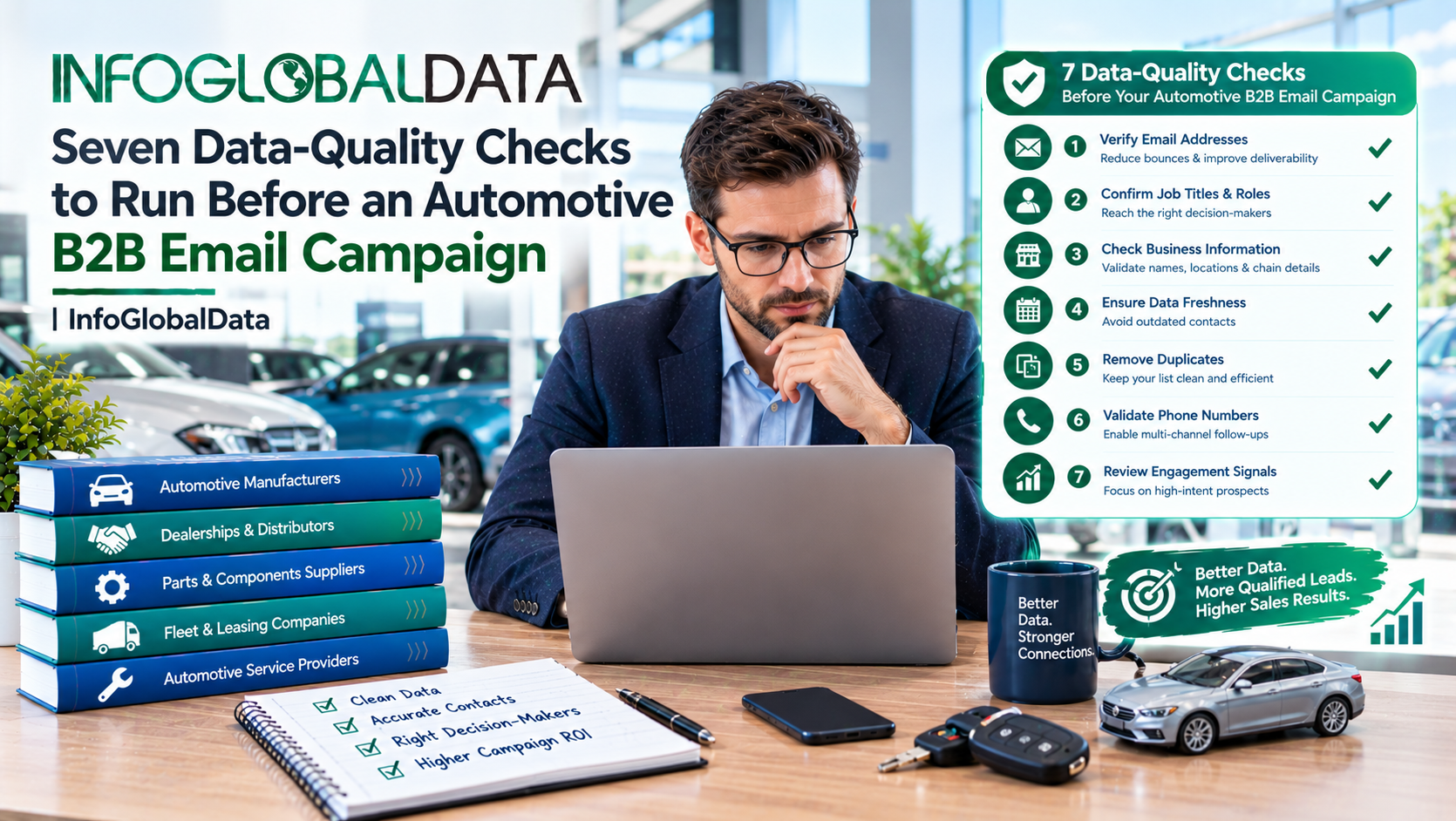
Seven Data-Quality Checks to Run Before an Automotive B2B Email Campaign | InfoGlobalData

Introduction
Automotive B2B email campaigns depend on more than reaching a large number of dealerships. Suppliers of vehicle parts, dealership software, diagnostic equipment, financing solutions, and service technology need accurate contact details and relevant decision-makers to generate meaningful responses. An outdated email address, a former employee, or a contact who has no purchasing responsibility can waste sales time and undermine campaign performance.
The scale of the data-quality challenge is illustrated by ZeroBounce’s 2026 Email List Decay Report, which analyzed more than 11 billion email addresses processed in 2025. The provider reported that 62% were valid and 23% were invalid across its dataset—a cross-industry finding, not an automotive-specific benchmark.
This highlights why marketers should validate an Auto Dealer Email List before launching a campaign. The following seven checks can help automotive suppliers improve targeting, reduce avoidable delivery problems, and maintain more reliable prospect records.
1. Verify Email Addresses Before Sending
Email verification should be the first step in preparing an automotive prospect database. Even when a dealership is still operating, an employee’s email address may have changed, a mailbox may have been deactivated, or a domain may no longer accept messages.
ZeroBounce’s 2026 report found substantial invalid-address rates across its processed data, demonstrating that a contact list should not automatically be treated as deliverable simply because it was collected recently.
Before using an Auto Dealer Email List, check for:
-
Invalid, malformed, or incomplete email addresses.
-
Domains that no longer resolve or accept email.
-
Duplicate email records and obvious data-entry errors.
-
Risky addresses that verification tools flag for further review.
Use a reputable verification service before major sends, especially when importing older records or combining data from several sources. Verification results are not a guarantee of inbox placement, but they can help identify addresses that need correction, suppression, or additional review.
2. Confirm That the Contact Still Works at the Dealership
A valid email address does not necessarily belong to the right person. Dealership employees change roles, move between locations, or leave the automotive industry. A message sent to a former general manager or parts director may reach a different person—or fail altogether.
The U.S. Bureau of Labor Statistics publishes employment and occupational data that can help businesses understand the changing workforce, although it does not provide a specific turnover benchmark for dealership contacts.
For each record, review the contact’s:
-
Current job title and department.
-
Dealership or dealer-group affiliation.
-
Location and business contact information.
-
Purchasing influence or responsibility for the product being promoted.
This is particularly important for campaigns selling inventory systems, service-lane software, parts-management tools, and dealership marketing services. The appropriate recipient may be a general manager, fixed-operations director, service manager, parts manager, marketing leader, or IT decision-maker, depending on the offer.
An Auto Dealer Mailing List becomes more useful when contact details are linked to current roles rather than relying on names collected months or years earlier.
3. Match Each Contact to the Right Dealership Department
Automotive dealerships are not single-decision-maker businesses. Sales, service, parts, finance, marketing, and IT teams often evaluate different products and services. Sending every prospect the same message can reduce relevance even when the contact details are accurate.
The National Automobile Dealers Association (NADA) reported approximately 15,366 new-car dealerships in the United States in 2025, illustrating the scale of the market—and the variety of businesses a supplier might need to segment. NADA also publishes dealership employment data by role and department.
Build campaign segments around the solution being promoted:
|
Product or service |
Relevant dealership contacts |
|---|---|
|
Inventory and sales software |
General manager, sales manager, used-car manager |
|
Service and diagnostic equipment |
Service manager, fixed-operations director, shop manager |
|
Parts and accessories |
Parts manager, parts director, purchasing manager |
|
Digital marketing services |
Marketing director, internet sales manager, general manager |
|
Cybersecurity and IT systems |
IT director, systems administrator, operations leader |
Use job title as a starting point, not proof of purchasing authority. Where possible, validate responsibilities and tailor the message to the recipient’s department. A well-segmented Auto Dealer Email Database can help sales teams avoid sending a service-department pitch to a marketing contact or a software proposal to someone with no role in technology decisions.
4. Check Dealership Names, Locations, and Business Status
A contact record may contain a valid email but still be commercially inaccurate. Dealerships can change ownership, join dealer groups, relocate, close, or operate multiple franchise locations. These changes matter when a campaign depends on geography, brand affiliation, or the size of a potential account.
NADA’s auto-retailing resources provide state-level information on dealership counts, employment, and economic activity. Its 2025 data can help marketers cross-check market coverage and evaluate whether their prospect records reflect the intended geography.
For each dealership record, verify:
-
Business identity: Confirm the dealership’s current trading name and website.
-
Location: Check the physical address and distinguish separate branches.
-
Ownership or group affiliation: Identify dealer-group relationships where relevant.
-
Franchise or vehicle category: Record relevant brands or whether the business sells cars, trucks, or specialty vehicles.
-
Operating status: Remove or investigate closed, merged, or duplicate businesses.
This check is especially useful for regional campaigns. A supplier selling equipment available only in certain territories should not rely on an old address or an unverified franchise field to determine eligibility.
5. Remove Duplicate Records and Standardize CRM Data
Duplicates create more than a reporting problem. They can cause the same person to receive repeated emails, lead multiple sales representatives to contact one account, and make campaign performance appear stronger or weaker than it really is.
Validity’s State of CRM Data Management in 2025 reported that 76% of surveyed respondents said less than half of their CRM data was accurate and complete. The report also found that 37% said poor data quality had contributed to revenue loss. These are survey findings across businesses, not automotive-only statistics, but they illustrate the commercial consequences of unreliable records.
Before launching a campaign, standardize and deduplicate fields such as:
-
Email address and contact name.
-
Dealership name and website domain.
-
Street address, city, state, and ZIP code.
-
Job title, department, and parent dealer group.
-
CRM owner, lead source, and last-verified date.
Match records using multiple identifiers rather than names alone. Two contacts may share a name, while a single dealership may appear under an abbreviated name and a formal business name. Preserve useful historical information, but establish one authoritative record for each contact and account.
6. Review Data Freshness, Source, and Verification History
A database is not permanently accurate simply because it was checked once. Email addresses can become invalid, job titles can change, and business records can fall out of date. The challenge is to know not only what the record says, but also when it was last checked and where the information came from.
ZeroBounce’s 2026 report states that at least 23% of email data it analyzed was invalid in 2025, compared with 28% in its 2024 analysis. Its results cover multiple industries and customer types, so they should be used as a general warning about data decay—not as a prediction that every automotive list will lose the same percentage of records.
Add a maintenance process to your Auto Dealer Email List:
-
Store the source and date each contact was added.
-
Record the last email-verification date and outcome.
-
Recheck older records before using them in a major campaign.
-
Update contacts when a role change, bounce, or reply signals that information may be outdated.
-
Suppress hard bounces and maintain a record of opt-outs.
Set review intervals according to risk. Recently verified contacts may need less immediate attention than old, imported records with no source history. A clear audit trail also helps teams identify which sources consistently produce usable contacts.
7. Confirm Compliance and Email-Sending Readiness
Accurate data is only one part of a successful campaign. Marketers must also respect opt-outs, follow applicable marketing laws, and configure their sending infrastructure correctly.
In the United States, the Federal Trade Commission’s CAN-SPAM guidance confirms that the law applies to commercial email, including business-to-business messages. Requirements include accurate sender information, non-deceptive subject lines, a valid postal address, a clear opt-out method, and timely processing of opt-out requests.
Before sending, confirm that:
-
Suppression lists are applied across campaigns and CRM exports.
-
Opt-outs and other do-not-contact requests are honored.
-
Your campaign follows the applicable rules for each recipient’s jurisdiction.
-
Your sending domain is configured with appropriate email authentication.
-
The email platform monitors delivery failures and spam complaints.
Google’s sender guidelines require all senders to Gmail accounts to use SPF or DKIM authentication and keep reported spam rates below 0.3%. Senders delivering more than 5,000 messages per day to Gmail accounts must meet additional requirements, including SPF, DKIM, and DMARC.
These technical controls do not fix poor contact data, but they complement verification and list hygiene. Compliance and deliverability should be treated as ongoing operating practices—not a final checkbox immediately before launch.
Practical Takeaways for Automotive B2B Marketers
Use the following checklist before activating an automotive email campaign:
-
Verify addresses: Run email verification before sending, particularly for older or newly imported records.
-
Validate the recipient: Check current job titles, dealership affiliations, and responsibilities.
-
Segment by business need: Align the contact’s department and role with the offer.
-
Clean account records: Standardize dealership names and locations, remove duplicates, and review business status.
-
Maintain governance: Track data sources, verification dates, opt-outs, and email performance.
For teams that need to expand or refine their prospect coverage, InfoGlobalData can be considered as a resource for business contact data and targeted prospecting. Any supplied or existing records should still be checked against campaign criteria, verified where appropriate, and handled according to applicable marketing rules.
Conclusion
Automotive B2B campaigns are more effective to manage when marketers treat contact data as an asset that requires regular maintenance. The seven checks—email verification, role validation, department segmentation, dealership-record review, deduplication, freshness monitoring, and compliance—help teams reduce avoidable errors before those errors affect outreach.
Industry sources reinforce why this process matters: dealership workforce and market data show the range of roles and locations in the automotive retail sector, while cross-industry email and CRM research highlights the risks of invalid addresses and incomplete records. These findings are not a guarantee of campaign results, but they provide a practical basis for stronger data governance.
Before the next campaign, audit a sample of your Auto Dealer Email List, document the problems you find, and make those checks part of your regular workflow. Better data creates a more dependable foundation for relevant, responsible B2B prospecting.
Frequently Asked Questions
1. Why should I verify an Auto Dealer Email List before sending a campaign?
Verification can identify invalid addresses and other risky records before they affect delivery. It should be combined with role and business checks because a deliverable address may still belong to the wrong person.
2. How often should an Auto Dealer Mailing List be updated?
There is no universal interval for every automotive campaign. Review older records before major sends, and prioritize records with no verification history, repeated delivery problems, or signs of job and business changes.
3. Which dealership contacts should automotive suppliers target?
It depends on the product or service. Parts suppliers may focus on parts managers and purchasing contacts, service-equipment vendors on service managers or fixed-operations directors, and marketing providers on dealership marketing leaders or general managers.
4. What information should an Auto Dealer Email Database contain?
Useful fields include contact name, current job title, department, business email, dealership name, website, location, franchise or vehicle category, source, and last-verified date. Add parent-group information when it is relevant to account targeting.
5. How can I reduce duplicate contacts in an automotive CRM?
Standardize email addresses, dealership names, domains, and location fields before matching records. Use more than one identifier when merging contacts, and preserve opt-out and suppression information so it is not lost during cleanup.
6. Does a valid email address guarantee good deliverability?
No. Verification helps identify address-level risks, but inbox placement also depends on sender authentication, sending practices, recipient engagement, spam complaints, and provider requirements. Follow the relevant email service guidelines and monitor campaign results.
7. Do U.S. B2B automotive marketing emails need to comply with CAN-SPAM?
Yes. The FTC states that CAN-SPAM covers commercial email, including B2B messages. Marketers must follow its requirements, including accurate sender information, non-deceptive subject lines, a valid postal address, and a clear opt-out process.
Sources and Further Reading
1. ZeroBounce — The Email List Decay Report for 2026
https://www.zerobounce.net/email-list-decay
2. National Automobile Dealers Association — Auto Retailing Data
https://www.nada.org/nada/research-data/auto-retailing
3. National Automobile Dealers Association — Dealership Workforce Study
https://www.nada.org/nada/research-data/nada-dealership-workforce-study
4. Validity — The State of CRM Data Management in 2025
https://www.validity.com/resource-center/the-state-of-crm-data-management-in-2025/
5. Federal Trade Commission — CAN-SPAM Act: A Compliance Guide for Business
https://www.ftc.gov/business-guidance/resources/can-spam-act-compliance-guide-business
6. Google — Email Sender Guidelines
https://support.google.com/mail/answer/81126


