
Buying With 5% Down: What You’ll Actually Pay in Monthly PMI

Buying a home with just 5% down can make homeownership more accessible, especially if you want to purchase a property without spending years saving for a 20% down payment. However, a smaller down payment usually means borrowing more money and paying private mortgage insurance (PMI) on a conventional mortgage.
So, how much will you actually pay in monthly PMI when buying a home with 5% down? The answer depends on your mortgage amount, credit score, loan-to-value ratio, and lender's insurance pricing.
In this guide, we'll break down estimated PMI costs, calculate an example monthly mortgage payment, explain what affects your insurance premium, and show you how to estimate your potential costs before applying for a home loan.
What Does Buying a Home With 5% Down Mean?
A 5% down payment means you pay 5% of the home's purchase price upfront and finance the remaining 95% through a mortgage.
For example, if you're buying a home for $400,000, your down payment would be $20,000. You would need a mortgage of approximately $380,000, excluding closing costs and other expenses.
Here's a quick breakdown:
| Home Purchase Price | 5% Down Payment | Mortgage Amount |
|---|---|---|
| $200,000 | $10,000 | $190,000 |
| $300,000 | $15,000 | $285,000 |
| $400,000 | $20,000 | $380,000 |
| $500,000 | $25,000 | $475,000 |
| $600,000 | $30,000 | $570,000 |
A 5% down payment can help you buy a home sooner while keeping more money available for moving expenses, emergencies, and other financial needs.
However, most conventional mortgage borrowers who put down less than 20% must pay private mortgage insurance. This additional expense should be included in your monthly housing budget.
What Is PMI, and Why Do You Have to Pay It?
Private mortgage insurance, commonly called PMI, is insurance that protects the mortgage lender if a borrower defaults on the loan. It does not protect the homeowner against missed-payment consequences or guarantee that the borrower can keep the property.
Lenders generally require PMI on conventional mortgages when the down payment is below 20% of the home's purchase price.
With a 5% down payment, your loan-to-value ratio (LTV) is initially 95%. Because you're financing most of the home's value, your lender may require mortgage insurance to reduce its risk.
PMI can increase your monthly payment, but it also allows eligible borrowers to purchase a home without waiting until they have saved a full 20% down payment.
It's important to remember that PMI requirements differ by loan program. FHA and USDA mortgages have their own mortgage insurance or guarantee-fee structures, so their costs should not automatically be treated as conventional PMI.
How Much Does Monthly PMI Cost With 5% Down?
There is no single PMI rate that applies to every borrower. Your premium depends on factors such as your credit profile, loan amount, down payment, mortgage terms, and the insurer's pricing.
As an illustrative planning range, PMI might cost approximately 0.30% to 1.50% of the original loan amount annually for some borrowers. Actual premiums can fall outside this range, so request a personalized quote from your lender.
Here's how different annual PMI rates affect a $380,000 mortgage.
| Annual PMI Rate | Estimated Annual PMI | Estimated Monthly PMI |
|---|---|---|
| 0.30% | $1,140 | $95 |
| 0.50% | $1,900 | $158 |
| 0.75% | $2,850 | $238 |
| 1.00% | $3,800 | $317 |
| 1.25% | $4,750 | $396 |
| 1.50% | $5,700 | $475 |
These figures are simplified estimates calculated using the original mortgage amount. They are not quotes or guaranteed premiums.
For example, a borrower with a $380,000 mortgage and an illustrative annual PMI rate of 0.75% would pay approximately $238 per month.
Another borrower with the same loan amount could pay substantially less or more depending on their credit profile and loan details.
The key takeaway: Don't assume your PMI will be a fixed amount simply because you're putting 5% down. Compare personalized loan estimates before choosing a mortgage.
Example: Your Monthly Mortgage Payment With 5% Down
Let's look at a hypothetical home purchase to understand how PMI affects the total monthly payment.
Suppose you're purchasing a $400,000 home with the following loan details:
-
Home price: $400,000
-
Down payment: 5%, or $20,000
-
Mortgage amount: $380,000
-
Mortgage term: 30-year fixed-rate loan
-
Illustrative interest rate: 6.50%
-
Illustrative annual PMI rate: 0.75%
Based on these assumptions, your estimated principal and interest payment would be approximately $2,402 per month.
Your estimated PMI would be approximately $238 per month.
Here's the breakdown:
| Monthly Expense | Estimated Cost |
|---|---|
| Principal and interest | $2,402 |
| Private mortgage insurance | $238 |
| Total before taxes and homeowners insurance | $2,640 |
Your actual monthly housing payment would likely be higher after adding property taxes, homeowners insurance, and any applicable homeowners association fees.
Closing costs, prepaid expenses, and your initial down payment are separate upfront expenses.
This example demonstrates why it's important to look beyond the advertised mortgage payment. PMI can add hundreds of dollars to your monthly housing expenses, depending on your loan and insurance rate.
How to Estimate Your PMI Using pmicalculator.net
Before committing to a mortgage, estimating your potential PMI can help you understand whether a home fits your budget.
You can explore pmicalculator.net as a starting point for estimating private mortgage insurance. Use any calculator result as an estimate rather than a guaranteed lender quote.
For a more useful calculation, gather the following information:
1. Enter the Home Purchase Price
Start with the price of the property you're considering.
For example, use $400,000 if that's the home's expected purchase price.
2. Add Your Down Payment
Enter your planned down payment of 5%, or $20,000 in this example.
Your mortgage amount would be approximately $380,000 before any financed fees or adjustments.
3. Enter Your Mortgage Details
Depending on the calculator, you may be asked for your mortgage amount, interest rate, loan term, or credit score.
Use the figures from your lender's quote whenever possible. If you don't have a quote yet, use reasonable assumptions and understand that the result may change.
4. Review Your Estimated PMI
Check the estimated monthly insurance cost and how it affects your total payment.
If the calculator offers different scenarios, compare several potential PMI rates rather than relying on a single estimate.
5. Verify the Estimate With Your Lender
A calculator cannot guarantee the premium you'll receive. Ask your lender for a personalized PMI quote and review the mortgage insurance amount on your Loan Estimate.
Comparing estimates from different lenders can help you understand the full cost of borrowing.
What Factors Affect Your PMI Premium?
Two homebuyers purchasing similarly priced properties with the same down payment may receive different PMI quotes.
Here are the main factors that can influence the cost.
Credit Score
Your credit profile can significantly affect conventional PMI pricing. Depending on the insurer's pricing structure, a stronger credit profile may qualify you for a lower premium.
Before applying, review your credit reports and correct any errors you identify.
Down Payment and Loan-to-Value Ratio
Your down payment determines how much of the home's purchase price you finance.
With 5% down, your initial LTV is approximately 95%. Increasing your down payment reduces the amount borrowed and may improve your PMI pricing.
For example, putting down 10% instead of 5% on a $400,000 home would reduce your mortgage from $380,000 to $360,000.
The insurance premium could also change, depending on the insurer's pricing.
Mortgage Amount
PMI is generally calculated using the loan amount and the applicable insurance premium rate.
A larger mortgage can result in a higher monthly PMI payment when other pricing factors remain the same.
Loan Type and Terms
Mortgage insurance requirements vary by loan program. Conventional loans, FHA loans, and USDA loans use different mortgage insurance arrangements.
Even among conventional mortgages, premiums can differ based on the lender, insurer, and loan characteristics.
Compare the full cost of each loan rather than assuming that one mortgage program will always be cheaper.
Can You Remove PMI After Buying With 5% Down?
Yes. One advantage of many conventional mortgages is that PMI does not necessarily last for the entire loan term.
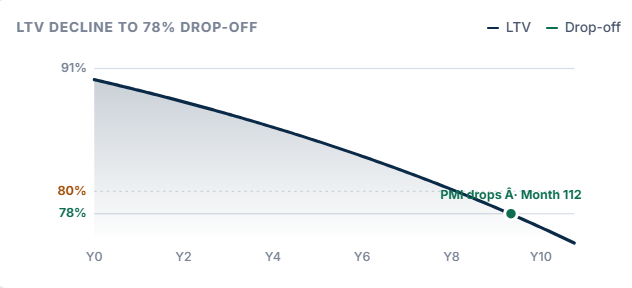
Under the Homeowners Protection Act, borrowers generally have the right to request PMI cancellation when their mortgage balance is scheduled to reach 80% of the home's original value, subject to applicable requirements.
You may also be able to request cancellation earlier if you make additional principal payments and meet your loan servicer's eligibility conditions.
Automatic termination generally applies when the principal balance is scheduled to reach 78% of the home's original value, provided the borrower is current on payments and other legal conditions are satisfied.
Your servicer may have additional requirements for borrower-requested cancellation, including a satisfactory payment history and, in some cases, evidence that the property has not declined in value.
Contact your mortgage servicer to confirm the specific requirements and dates that apply to your loan.
Ways to Reach the PMI Cancellation Threshold Faster
You may be able to build equity faster by:
-
Making additional principal payments when your budget allows.
-
Avoiding unnecessary increases in your mortgage balance.
-
Monitoring your amortization schedule.
-
Reviewing your loan servicer's cancellation requirements.
-
Asking whether an updated property valuation could help establish eligibility.
Do not assume that a rise in your home's market value automatically removes PMI. Cancellation based on current property value may be subject to different rules and lender requirements.
Is Buying With 5% Down Better Than Waiting to Save 20%?
The right decision depends on your financial circumstances, savings, housing costs, and plans for the future.
Putting down 5% may allow you to purchase a home earlier and begin building equity through principal payments. However, you'll generally have a larger mortgage balance and may need to pay PMI.
Putting down 20% on a conventional mortgage can eliminate the need for PMI, but saving that amount could take years. During that period, rent and home prices may change, so the financial trade-off isn't always straightforward.
Consider the following comparison for a $400,000 home:
| Expense | 5% Down | 20% Down |
|---|---|---|
| Down payment | $20,000 | $80,000 |
| Mortgage amount | $380,000 | $320,000 |
| PMI | Generally required | Generally not required |
| Cash needed for the down payment | Lower | Higher |
| Principal and interest payment | Generally higher | Generally lower |
The table excludes closing costs, property taxes, homeowners insurance, and other expenses. It also assumes that both loans have the same interest rate, which may not be the case in actual offers.
Before deciding, make sure you can afford the payment while maintaining an emergency fund. A larger down payment isn't necessarily the best choice if it leaves you without enough savings for unexpected expenses.
How to Reduce Your Overall PMI Costs
If you decide to buy with 5% down, you can take practical steps to understand and manage your mortgage insurance expenses.
Compare multiple lender offers. Request detailed quotes that show the interest rate, PMI premium, closing costs, and total monthly payment.
Improve your credit profile. Review your credit reports and address errors or outstanding issues before applying, where possible.
Compare different down payment amounts. Ask lenders to estimate your costs with 5%, 10%, and 15% down. A larger down payment may reduce your mortgage balance and change your PMI pricing.
Review different mortgage insurance options. Some lenders offer borrower-paid PMI, single-premium PMI, or lender-paid mortgage insurance. Each option has different upfront and long-term costs.
Understand cancellation rules. Ask when you can request PMI cancellation and what conditions you'll need to satisfy.
Keep your full housing budget in view. PMI is only one part of homeownership costs. Include property taxes, homeowners insurance, maintenance, utilities, and potential association fees when deciding how much you can afford.
Final Thoughts
Buying a home with 5% down can make homeownership possible without waiting to save a 20% down payment. However, the smaller upfront contribution usually means a larger mortgage and an additional PMI expense on a conventional loan.
For a $400,000 home with a $380,000 mortgage, an illustrative PMI rate of 0.75% would add approximately $238 to your monthly payment. Your actual premium will depend on your credit profile, loan details, and insurer's pricing.
Use pmicalculator.net to explore possible costs, compare different down payment scenarios, and prepare questions for your lender. Then verify the estimate using a personalized Loan Estimate before making a final decision.
The goal isn't simply to minimize PMI. It's to choose a mortgage that fits your monthly budget, preserves enough savings for emergencies, and supports your longer-term financial plans.
Frequently Asked Questions
1. How much is PMI on a $300,000 mortgage with 5% down?
The monthly premium depends on your credit profile, loan terms, and insurer's pricing. For illustration, an annual PMI rate of 0.50% on a $300,000 loan would equal approximately $125 per month. Your actual premium could be different.
2. Is PMI required with a 5% down payment?
PMI is generally required for conventional mortgages with a 5% down payment. However, requirements depend on the loan program and lender. Certain eligible mortgage programs may have different insurance arrangements.
3. Does PMI protect me if I lose my job?
No. PMI protects the mortgage lender against certain losses if you default on your loan. It does not cover your mortgage payments or protect you from foreclosure.
4. Can my PMI payment change over time?
It depends on the mortgage insurance arrangement. Your premium may follow a schedule or other terms established for your loan. Review your mortgage documents and contact your servicer if you need clarification.
5. Can I cancel PMI when my home value increases?
Possibly, but an increase in market value does not automatically cancel PMI. Your loan servicer may allow cancellation based on a new valuation if you meet the applicable requirements. Ask your servicer about its rules before relying on this option.
6. Is it worth buying a home with 5% down?
It can be worthwhile if the monthly payment is affordable, you have enough savings for emergencies, and buying fits your long-term plans. Compare the cost of PMI with the benefits of purchasing sooner and the alternative of saving a larger down payment.
7. How accurate is an online PMI calculator?
An online calculator can provide a useful estimate, but accuracy depends on the information entered and the calculator's assumptions. Your lender's personalized mortgage insurance quote is the better source for budgeting your actual payment.


