
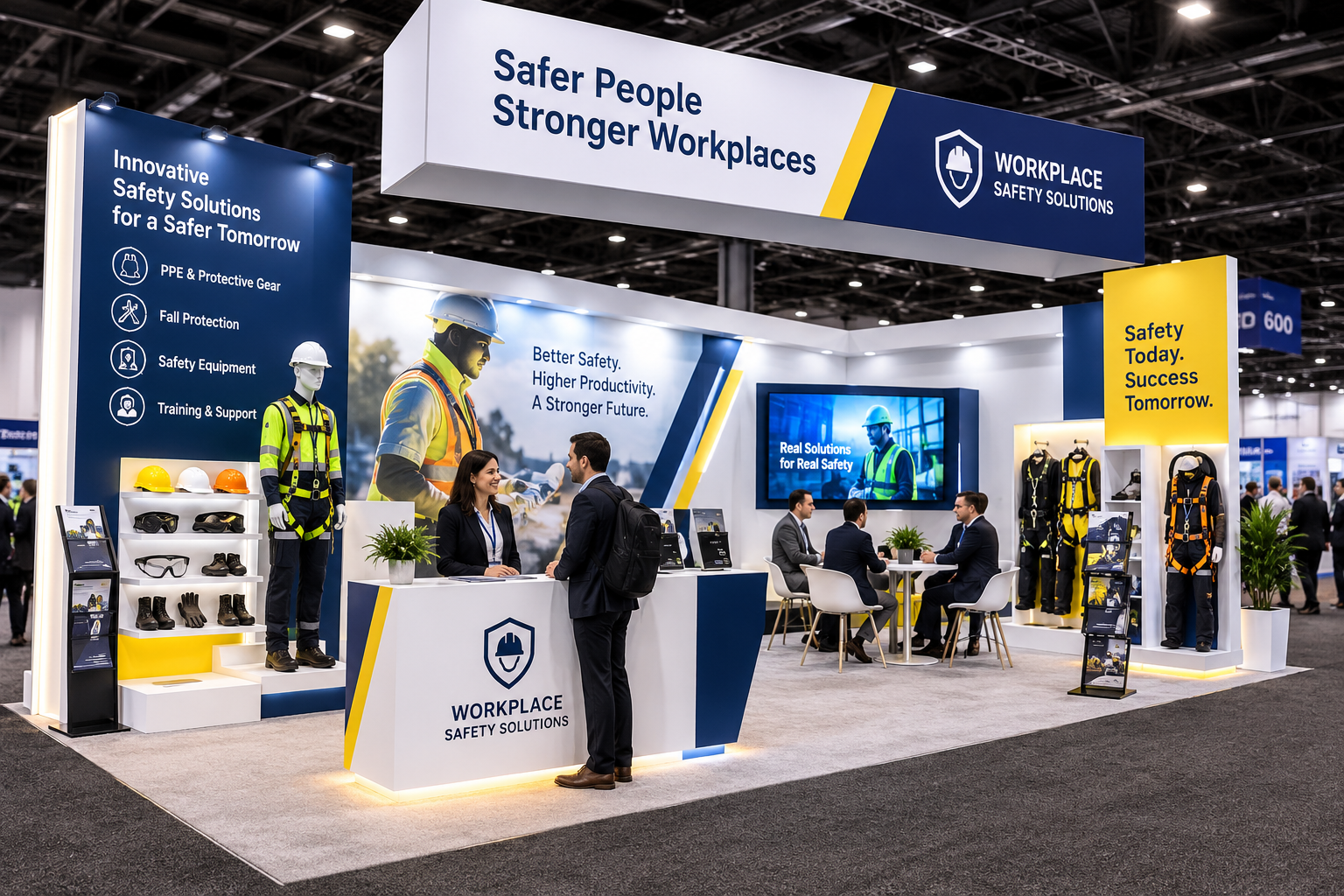
10 Creative Trade Show Booth Ideas for Safety Equipment Brands at NSC Expo

Standing out at a major safety industry event requires more than displaying products on shelves. Exhibitors need to communicate the value of their solutions, demonstrate how equipment works, and create opportunities for meaningful conversations with safety professionals, procurement managers, distributors, and decision-makers. Partnering with experienced Booth builders for NSC Safety Congress & Expo can help safety equipment brands transform these objectives into a well-designed exhibition experience that attracts relevant visitors and supports business growth.
The NSC Safety Congress & Expo brings together professionals focused on occupational safety, workplace health, industrial hygiene, risk management, and accident prevention. For brands selling personal protective equipment (PPE), fall-protection systems, respiratory protection, safety footwear, emergency response equipment, and industrial monitoring solutions, the event provides an opportunity to explain product benefits and develop relationships with potential customers.
However, a crowded exhibition floor presents a challenge. Visitors have limited time, and many competing exhibitors may offer similar products. A booth that combines clear messaging, practical demonstrations, useful technology, and thoughtful visitor engagement can make a stronger impression than a display that simply lists product specifications.
In this guide, we explore ten creative trade show booth ideas for safety equipment brands, along with practical design recommendations to help you develop an exhibit that supports your business objectives.
Why Booth Creativity Matters at NSC Expo
Creativity in a safety-focused exhibition should serve a clear purpose. The objective is not to make a booth visually complicated; it is to help visitors understand your products and recognize their relevance to real workplace challenges.
An effective booth can help your company:
-
Demonstrate how products address workplace hazards.
-
Explain technical features in a clear, accessible way.
-
Encourage visitors to participate in product demonstrations.
-
Collect qualified leads and identify purchase opportunities.
-
Build brand recognition among safety professionals.
-
Support conversations with distributors and potential business partners.
For example, a company selling industrial protective eyewear could display multiple products, but an interactive demonstration comparing lens features, comfort, and application suitability may be more informative. Similarly, a manufacturer of fall-protection equipment could use clearly labeled demonstration stations to explain system components and inspection considerations.
The best concept depends on your products, target audience, available floor space, and the conversations you want to initiate.
1. Create an Interactive Product Demonstration Zone
<AsyncImage query="industrial safety equipment trade show booth interactive PPE product demonstration display" aspectRatio="16:9" width="100%" />
One of the most effective booth concepts for safety equipment brands is a dedicated product demonstration zone. Visitors can examine equipment, learn about its features, and ask questions while interacting with your team.
Instead of arranging every product on a conventional display shelf, organize the booth around demonstrations that illustrate how your solutions work.
For example, a PPE manufacturer could create separate stations for protective eyewear, hearing protection, gloves, and respiratory protection. A fall-protection company could present system components using an appropriate static display or a controlled demonstration conducted by trained personnel.
How to design the demonstration zone
Start by identifying the products that benefit most from hands-on explanation. Give each product category a clearly defined area and provide enough room for visitors to gather without obstructing the main aisle.
Use concise signage to explain the problem each product addresses, its primary benefits, and the situations in which it may be appropriate. Staff members should be prepared to explain limitations, correct use, maintenance requirements, and relevant technical documentation.
For equipment that involves heights, moving machinery, electrical hazards, respiratory exposure, or other serious risks, demonstrations must follow applicable safety requirements. Do not invite visitors to perform hazardous activities simply to make the exhibit more exciting.
Why this idea works
Demonstrations turn passive viewing into active learning. They also give sales teams a natural starting point for conversations about applications, product selection, training, and purchasing requirements.
2. Build a Workplace Safety Simulation Experience
<AsyncImage query="industrial workplace safety training simulation exhibition booth hazard awareness interactive display" aspectRatio="16:9" width="100%" />
A workplace safety simulation can help visitors recognize hazards and understand how your products contribute to safer work environments.
The experience might involve a digital factory scene, an illustrated warehouse, a simulated construction site, or an interactive control panel. Visitors could identify potential hazards and then explore which protective measures or equipment may help address them.
For instance, a screen might present a warehouse environment with visual examples of pedestrian and forklift interaction, obstructed exits, poor housekeeping, and inadequate personal protection. Visitors select potential hazards and receive educational feedback.
Key design considerations
Keep the experience short enough to fit the pace of a busy trade show. A simple challenge lasting a few minutes can be more effective than a complicated simulation requiring a lengthy explanation.
Use realistic situations that relate directly to your product range. If your company specializes in respiratory protection, focus on exposure awareness, equipment selection, and relevant training principles rather than unrelated hazards.
The display should make clear that the simulation is educational and does not replace a formal workplace risk assessment or professional training.
Make it part of your lead-generation strategy
After visitors complete the activity, invite them to request a product guide, discuss their workplace requirements, or schedule a follow-up consultation.
Avoid making participation conditional on providing unnecessary personal information. A useful educational experience can encourage engagement without creating an uncomfortable sales interaction.
3. Design a PPE Comparison Wall
<AsyncImage query="personal protective equipment trade show booth organized wall display safety helmets gloves goggles hearing protection" aspectRatio="16:9" width="100%" />
A PPE comparison wall offers a practical way to showcase a broad product range while helping visitors understand the differences between available options.
Safety professionals often need to compare products according to application, material, protection level, compatibility, comfort, and maintenance requirements. A well-organized display can make these comparisons easier.
Organize products by application
Consider arranging equipment into categories such as:
-
Head and face protection
-
Eye and hearing protection
-
Hand and arm protection
-
Respiratory protection
-
Protective clothing and footwear
-
Fall-protection equipment
-
High-visibility products
Use labels and visual markers to guide visitors toward relevant product families. Keep technical information concise and provide access to detailed specifications through brochures or digital resources.
Use comparison graphics carefully
Comparison panels can explain meaningful differences between models, but they should not imply that products are interchangeable when their intended applications differ.
Make sure all claims about certifications, standards, performance, and protection ratings are accurate and current. Where appropriate, refer visitors to official product documentation for complete technical details.
Make the display visually engaging
Consistent shelving, thoughtful lighting, clear labels, and a logical arrangement can help the booth look professional without requiring elaborate construction.
This concept is especially useful for manufacturers and distributors with multiple product lines or products available in several configurations.
4. Incorporate Live Product Testing and Demonstrations
<AsyncImage query="industrial safety product demonstration station gloves protective eyewear equipment trade show exhibit" aspectRatio="16:9" width="100%" />
A live demonstration can help visitors understand features that are difficult to communicate through packaging or product photography alone.
For example, a manufacturer could demonstrate the adjustment mechanism of a safety helmet, the fit features of protective eyewear, the operation of a hearing protection device, or the setup of a non-hazardous monitoring instrument.
The goal is to show a product's relevant features and explain how they relate to practical use.
Choose the right products
Not every product needs a live demonstration. Prioritize equipment with features that visitors can understand quickly through observation or supervised interaction.
Products that require specialized facilities, hazardous materials, exposure to dangerous forces, or complex safety controls may be better presented through prerecorded footage, a digital model, or a controlled technical presentation.
Plan for visibility and crowd flow
Position demonstrations where visitors can see them without blocking access to neighboring exhibits. Provide a clear viewing area and keep the main entrance accessible.
If demonstrations run on a schedule, display the times prominently. Scheduled presentations help staff prepare, create reasons for visitors to return, and make it easier to manage crowd size.
Explain the evidence
Use the demonstration to explain what visitors are seeing and what it does—and does not—prove. A simple product demonstration should not be presented as proof of performance under every possible workplace condition.
Clear, accurate explanations strengthen credibility and help buyers make informed decisions.
5. Use Large Visuals to Explain Safety Problems and Solutions
<AsyncImage query="modern industrial safety trade show booth large format graphics workplace safety campaign branding" aspectRatio="16:9" width="100%" />
Large-format graphics can help visitors understand your company's core offering before they enter the booth.
Safety equipment is often technical, and product names alone may not communicate why a solution matters. Strong visuals can connect your products to recognizable workplace challenges.
For example, a company specializing in hearing protection might use a visual theme centered on noise exposure and hearing conservation. A fall-protection brand could emphasize safe work-at-height planning, while an industrial monitoring company might focus on early detection and situational awareness.
Build the message around a clear hierarchy
An effective graphic system usually includes three levels:
Primary message: A concise statement explaining what your company does or which problem it helps solve.
Supporting benefits: Two or three short points that explain the value of your solution.
Product evidence: Product images, application examples, diagrams, or technical highlights that support the message.
Visitors should be able to understand the basic proposition from a distance. More detailed information can appear on nearby product panels or digital displays.
Avoid overcrowded graphics
Filling every wall with specifications, paragraphs, and product photographs makes it harder for visitors to identify the most important information.
Use whitespace, readable typography, and consistent branding. Ensure that essential information remains visible under the exhibition hall's lighting conditions.
A strong visual identity can make your booth recognizable without relying on unnecessary decoration.
6. Add Touchscreens and Interactive Digital Catalogs
<AsyncImage query="industrial safety exhibition booth touchscreen interactive digital product catalog display" aspectRatio="16:9" width="100%" />
Digital displays can make it easier to present a large product portfolio without physically displaying every item.
A touchscreen catalog might allow visitors to browse products by industry, application, hazard type, or technical specification. They could compare models, view instructional videos, download documentation, or request information about a particular product.
This approach can be particularly useful for brands with extensive catalogs, specialized product configurations, or products that are too large to bring to the event.
Make the interface intuitive
Visitors should be able to navigate the system without lengthy instructions. Use clear categories, large touch targets, short descriptions, and a visible way to return to the main menu.
Avoid relying entirely on technology. Staff should still be available to answer questions and help visitors find relevant information.
Prepare a backup plan in case the internet connection fails. Important content should be available locally when practical, and screens should be tested before the event opens.
Connect digital engagement to follow-up
Allow visitors to request relevant product information or arrange a meeting. Where contact information is collected, explain how it will be used and follow applicable privacy requirements.
A useful digital interaction should make the visitor's next step easier rather than simply collecting data.
7. Create a Hands-On Product Education Area
<AsyncImage query="occupational safety training equipment exhibit educational demonstration area trade show" aspectRatio="16:9" width="100%" />
Some products require explanation before buyers can assess their suitability. A product education area gives your team space to explain correct use, maintenance, inspection, compatibility, and selection considerations.
This concept can work particularly well for fall-protection equipment, respiratory protection, industrial sensors, emergency response products, and complex PPE systems.
Structure the experience around common questions
Identify the questions customers ask most frequently. Then organize your education area around those topics.
A fall-protection manufacturer might explain how users should consult system specifications, understand compatibility requirements, and follow appropriate inspection procedures. A respiratory protection supplier might explain the importance of application-specific selection and relevant fit-testing requirements.
Use diagrams, sample components, short presentations, and supporting product literature to make technical topics accessible.
Keep education credible
Present information in accordance with applicable standards, product instructions, and organizational requirements. Avoid suggesting that a brief trade show presentation qualifies visitors to perform tasks requiring formal training or authorization.
A knowledgeable educational experience can position your company as a useful resource, helping visitors feel more confident about starting a technical discussion.
8. Design a Sustainable, Reusable Booth
<AsyncImage query="reusable modular trade show booth aluminum frame fabric graphics sustainable exhibition design" aspectRatio="16:9" width="100%" />
A reusable booth can help safety brands balance visual quality with long-term budget considerations.
Instead of fabricating a completely new structure for each event, consider modular framing, replaceable graphic panels, reusable counters, adjustable shelving, and standardized display components.
This can be especially valuable for businesses attending several safety, manufacturing, construction, or industrial exhibitions each year.
Build flexibility into the design
Choose a modular system that can accommodate different booth dimensions. Confirm whether components can be rearranged without compromising stability, branding, or accessibility.
Use replaceable graphics for product launches, updated messaging, or new campaigns. Standardized storage and packing systems can also simplify handling between events.
Evaluate sustainability realistically
Reuse can reduce the need to manufacture replacement structures, but the environmental impact also depends on transportation, material choices, product lifespan, and disposal practices.
Ask suppliers about material durability, repairability, packaging, and end-of-life options. Avoid unsupported claims that a booth is environmentally friendly simply because it uses a particular material.
A well-planned reusable exhibit can support consistent branding while reducing unnecessary rebuilding over time.
9. Create a Comfortable Meeting and Consultation Space
<AsyncImage query="professional industrial safety exhibition booth with small meeting table seating branded backdrop" aspectRatio="16:9" width="100%" />
Not every visitor interaction should happen in front of a product display. A dedicated meeting area gives prospective buyers, distributors, and existing customers a place to discuss requirements in more detail.
This can be particularly useful when your products involve technical evaluations, bulk purchasing, customized solutions, or longer sales cycles.
Design for the conversations you want to have
A small booth may need only a compact counter and a pair of stools. Larger exhibits may accommodate a table, several chairs, and a screen for reviewing technical information.
Keep the area accessible and avoid making it so enclosed that visitors feel excluded from the rest of the exhibit.
If privacy is important, discuss suitable options with your booth builder while considering the venue's regulations and the overall layout.
Make meetings purposeful
Encourage your sales team to schedule conversations with priority prospects before the event. Prepare product information and relevant case studies so discussions remain focused on the visitor's needs.
Use a consistent process to record agreed follow-up actions. A meeting area becomes more valuable when it supports meaningful business conversations rather than functioning solely as a place to sit.
10. Introduce a Product Discovery Trail or Themed Booth Journey
<AsyncImage query industrial safety exhibition booth product zones floor graphics visitor journey interactive product discovery display" aspectRatio="16:9" width="100%" />
A product discovery trail encourages visitors to explore your booth in a logical sequence.
Instead of presenting every product at once, organize the exhibit into connected zones that guide visitors from a workplace challenge to a potential solution.
For example, a company offering comprehensive industrial safety products could structure its booth around three stages: identify the hazard, select suitable protective equipment, and support safe implementation.
Each zone can include a product display, a short explanation, and an optional interactive activity.
Keep the visitor journey simple
The route should feel natural rather than forcing visitors to follow a rigid path. Provide clear entry points and allow people to explore the sections most relevant to them.
Use consistent signage and visual cues to connect the zones. Staff should be able to explain the entire product range without requiring visitors to complete every stage.
Adapt the journey to your booth size
A compact booth can use tabletop displays and a small number of vertical panels. A larger exhibit may incorporate separate demonstration stations and digital screens.
The objective is to help visitors discover relevant solutions efficiently, not to create a complicated attraction that consumes floor space without supporting business goals.
How to Choose the Best Booth Concept for Your Safety Brand
With ten potential concepts to consider, the next step is selecting the combination that suits your business.
Start by identifying your primary objective. If you want to introduce a new product, prioritize a strong focal display and a demonstration area. If your goal is to generate qualified leads across a large product portfolio, consider interactive catalogs, product comparison displays, and a clear lead-capture process.
If your products require technical explanation, invest in an education area staffed by knowledgeable representatives. If relationship building is your priority, include a comfortable space for scheduled meetings.
Next, consider your booth dimensions, budget, available staff, and logistics. Some concepts require more electrical services, equipment, or technical support than others.
You do not need to incorporate all ten ideas into one exhibit. A carefully selected combination of two or three concepts can produce a more coherent experience than a booth filled with unrelated features.
Working With Professional Booth Builders
Turning a creative concept into a functional exhibition booth requires planning, technical coordination, and an understanding of event requirements.
An experienced booth builder can help you assess layout options, choose suitable materials, coordinate graphics, plan lighting and electrical requirements, and manage fabrication or rental components.
For safety equipment brands, the builder should also understand how the products will be displayed, whether demonstrations require special provisions, and how visitors and staff will move through the space.
Before selecting a provider, review previous projects, clarify the scope of work, request an itemized quotation, and establish deadlines for design approval, production, shipping, installation, and dismantling.
Share your key objectives and product requirements early. This allows the design team to focus on practical solutions instead of adding expensive features that do not contribute to the visitor experience.
Measuring the Success of Your Booth Design
A creative booth should deliver more than visual attention. Establish measurable outcomes before the event so you can evaluate whether the design supports your business objectives.
Useful metrics include:
-
Number of qualified leads collected
-
Number of product demonstrations completed
-
Meetings held with target accounts
-
Requests for quotations or product information
-
Distributor and partnership conversations
-
Post-event sales opportunities generated
Your team should record not only how many visitors stopped by, but also which products interested them and what follow-up they requested.
After the event, review the results with your sales and marketing teams. Identify which displays attracted the most relevant visitors, which demonstrations led to productive discussions, and where visitors encountered confusion.
These insights can guide improvements to future booth layouts and help you allocate your exhibition budget more effectively.
Conclusion
A successful safety equipment booth combines clear communication, relevant product demonstrations, accessible educational content, and a layout designed around visitor needs. From interactive safety simulations and PPE comparison walls to digital catalogs, reusable structures, and dedicated consultation areas, the right concepts can help your brand communicate its value more effectively at NSC Expo. Start with your business objectives, choose the ideas that best support your products, and work with a capable design and fabrication partner to turn the concept into a practical exhibit. To explore suitable partners for your next exhibition, compare Booth builders for NSC Safety Congress & Expo and begin planning a booth that helps your safety brand connect with the right audience.


