

How to Calculate Fabric Yardage for Sewing a Tablecloth
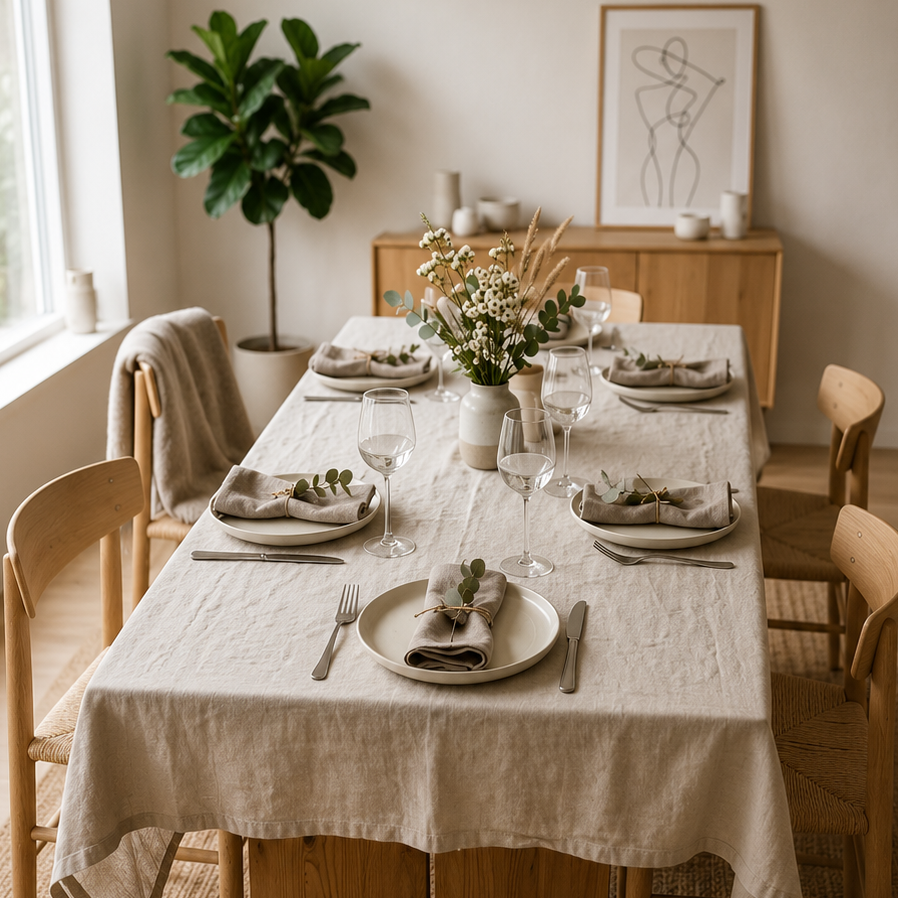
Making your own tablecloth is a practical way to create a covering that fits your table and matches your home decor. Whether you prefer a simple cotton design or a patterned fabric, calculating the correct amount of material before cutting can help reduce waste and avoid unnecessary expenses.
The amount of fabric you need depends on your table's dimensions, the desired drop along the edges, the fabric's width, and the finishing allowance. Understanding these measurements makes it easier to plan a project for round, rectangular, or square tables.
1. Measure Your Table Before Buying Fabric
Start by measuring the tabletop rather than estimating its size. Use a flexible measuring tape and record the measurements in inches for easier calculations.
For a rectangular table, measure the length and width. For a square table, measure one side and check that the other sides are approximately equal. For a round table, measure the diameter across the center.
Next, decide how far you want the fabric to hang below the tabletop. This is called the drop. A short drop creates a neat, practical appearance, while a longer drop gives the table a more traditional look.
For example, a rectangular table measuring 60 inches long and 36 inches wide with a 10-inch drop needs a finished tablecloth measuring 80 by 56 inches before adding the allowance for hems.
2. Calculate Fabric for a Rectangle Tablecloth
Use this simple formula:
Finished length = Table length + twice the desired drop
Finished width = Table width + twice the desired drop
If your table measures 72 inches long and 40 inches wide, with a 12-inch drop, the finished dimensions will be:
-
Length: 72 + 12 + 12 = 96 inches
-
Width: 40 + 12 + 12 = 64 inches
Add extra material for the hems. If you plan to fold each edge twice to create a half-inch finished hem, allow approximately one inch of extra fabric on each side.
Your cutting dimensions would therefore be approximately 98 inches long and 66 inches wide.
A rectangle table cloth project is usually straightforward when the fabric is wide enough to cover the full width without adding a seam.
3. Calculate Fabric for a Square Tablecloth
A square design follows the same principle, but you use the same measurement for both sides.
Suppose your table measures 36 inches on each side and you want an 8-inch drop.
36 + 8 + 8 = 52 inches
The finished tablecloth should measure 52 by 52 inches. Add your preferred hem allowance to determine the final cutting size.
When buying fabric, check whether its usable width is sufficient. If the material is narrower than your required cutting dimension, you may need to join fabric panels or select a wider fabric.
This calculation works well for square table cloths intended for everyday dining, occasional entertaining, or decorative use.
4. Calculate Fabric for a Round Tablecloth
For a round table, measure the diameter and add twice the desired drop to determine the finished diameter.
For example, if your table is 48 inches across and you want a 10-inch drop:
48 + 10 + 10 = 68 inches
The finished Tablecloth should have a diameter of 68 inches. Add the hem allowance around the circumference before cutting.
The challenge is that the fabric must accommodate the full circular cutting area. For a circle with a cutting diameter of 70 inches, a fabric width of at least 70 inches is needed to cut the piece from a single section.
If the fabric is narrower, you may need to sew panels together before cutting the circle. Plan the seam placement carefully, especially when working with stripes or repeating prints.
5. Check Fabric Width and Pattern Direction
Fabric yardage calculations are not based on table measurements alone. Standard fabric widths vary, so check the usable width before purchasing.
To convert inches into yards, divide the required length in inches by 36. For example, 108 inches equals 3 yards. When shopping, round up to a practical amount that accounts for cutting adjustments and possible mistakes.
Pattern direction also matters. Large floral prints, checks, and stripes may require additional material so the design looks balanced across the tabletop. Repeating patterns may need extra fabric to align the motifs at seams.
A cotton table cloth is a useful sewing project because cotton is available in many colors and prints. However, check the fabric's care instructions and consider prewashing it if shrinkage is possible.
6. Avoid Common Fabric-Calculation Mistakes
Before cutting, review your measurements and sewing plan.
-
Forgetting the drop: Include the desired overhang on both sides.
-
Ignoring hem allowances: Add extra fabric for the finishing method you plan to use.
-
Assuming all fabric widths are identical: Confirm the actual usable width with the seller.
-
Overlooking shrinkage: Prewash suitable fabrics before cutting when necessary.
-
Buying too little for patterned fabric: Allow extra material for matching stripes, checks, or repeating designs.
-
Cutting before checking the layout: Mark the cutting dimensions and verify them twice.
A few minutes of planning can prevent wasted fabric and help your finished tablecloth sit evenly.
Conclusion
Calculating fabric yardage is an important first step when sewing a table covering at home. Measure the tabletop, select a suitable drop, include hem allowances, and confirm that the fabric width accommodates your cutting plan. Whether you are making a round, square, or rectangular design, accurate measurements make the process more manageable. If you prefer ready-made options instead of sewing, All Cotton and Linen offers tablecloth styles for different table shapes and everyday dining needs.


