
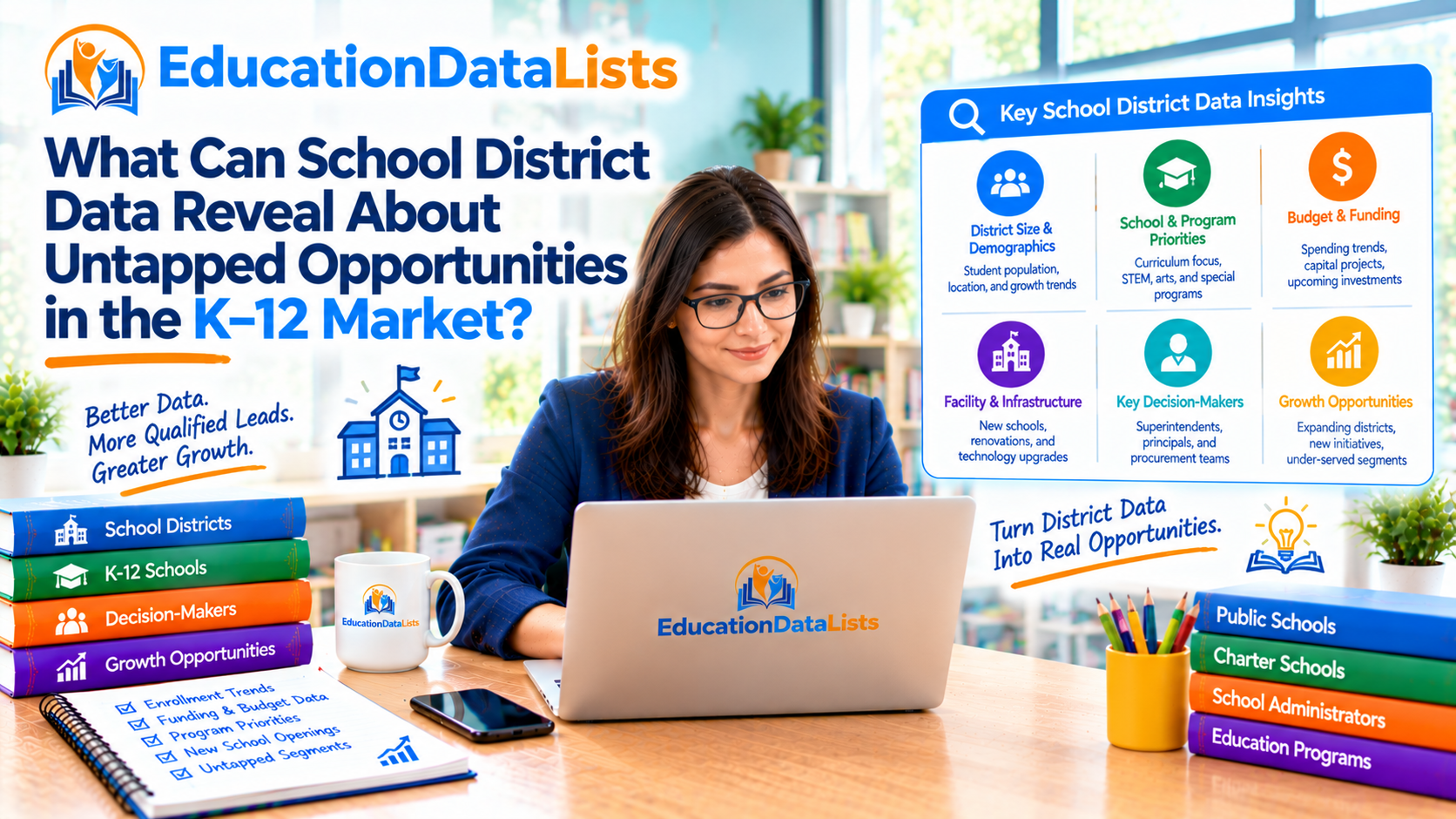
What Can School District Data Reveal About Untapped Opportunities in the K–12 Market? | EducationDataLists

Introduction
The K–12 education market offers opportunities for companies selling curriculum materials, educational technology, assessment tools, classroom supplies, and professional development services. However, identifying the right prospects requires more than compiling a list of school districts. Marketers need to understand enrollment patterns, district characteristics, purchasing pressures, technology priorities, and the people responsible for evaluating solutions. The National Center for Education Statistics (NCES) provides annual school district data covering agency characteristics, student populations, staffing, and financial information, giving market researchers a useful foundation for understanding the sector.
1. Use District Characteristics to Find Underserved Market Segments
School districts differ substantially in size, location, student demographics, grade configuration, and operational needs. A product designed for a large urban district may not be suitable for a small rural system with different staffing, infrastructure, or budget constraints.
The NCES Common Core of Data (CCD) provides annual information on public school districts and schools. Its district-level resources include directory and status information, while related datasets provide student membership, staffing, and other educational characteristics. The 2024–25 CCD releases make recent district and school information available for analysis.
For education vendors, this information can help reveal opportunities across segments such as:
-
Small and rural districts: Potential demand for affordable, easy-to-implement resources and solutions that reduce pressure on limited staff.
-
Large urban districts: Opportunities involving multi-school deployments, scalable platforms, and district-wide curriculum alignment.
-
Districts serving particular grade ranges: Prospects for elementary literacy, middle-school science, high-school career readiness, or other grade-specific offerings.
-
Districts with specialized program needs: Potential customers for accessible learning resources, multilingual materials, or professional development tailored to particular instructional priorities.
A well-segmented School District Mailing List can help sales teams organize prospects around these market characteristics. Public statistics should be used to understand market segments at an appropriate aggregate level, while contact records should be sourced and used in accordance with applicable data-use rules and privacy requirements.
2. Treat Enrollment and Funding Trends as Signals of Opportunity
District enrollment and funding can influence demand for educational products, but their implications are not always straightforward. Enrollment growth may create demand for additional classroom resources, while declining enrollment can increase pressure to justify spending or consolidate services.
In its September 2025 analysis, McKinsey reported that its K–12 school funding model projected nominal per-pupil spending to remain broadly flat in the 2025–26 and 2026–27 school years before growing with inflation in 2027–28. Its model also projected total K–12 funding at approximately $969 billion in 2025–26, compared with $969 billion in 2024–25. These are projections, not final spending results, and actual outcomes depend on policy and economic conditions.
For vendors, the implication is that account selection should consider both potential need and purchasing capacity. A district may have a pressing instructional challenge but limited flexibility to buy a new product. Another may be actively seeking a solution that reduces duplicated costs or improves existing services.
Useful indicators to examine include:
-
Enrollment changes over several years.
-
Available district revenue and expenditure data.
-
Staffing levels and reported operational needs.
-
Publicly announced grants, strategic plans, or procurement opportunities.
-
Existing initiatives related to curriculum, assessment, or technology.
The goal is to identify districts where a product solves a current problem and has a plausible path to funding—not to assume that a large student population automatically means a high-value opportunity.
3. Look for Demand Beyond the Most Obvious Product Categories
School district data can help businesses uncover opportunities in areas that receive less attention than traditional classroom materials. Staffing constraints, technology modernization, student support, cybersecurity, and special education can all create demand for targeted solutions.
McKinsey's July 2025 survey of more than 300 K–12 district administrators found that 46% identified special education needs as a priority for the next three years, while 40% highlighted chronic absenteeism. The survey also found that 64% ranked teacher retention among their leading priorities. These findings indicate that district needs extend beyond curriculum purchases alone.
The commercial opportunity depends on whether a company's offering addresses a documented need. For example:
-
Curriculum publishers can explore demand for special education materials and core instructional resources.
-
Professional development providers can focus on teacher retention, training, and instructional implementation.
-
Education technology companies can investigate secure platforms, data integration, and tools that reduce administrative workload.
-
Student support providers can assess demand for attendance interventions and related services.
A School District Email Database becomes more useful when its records help sales teams identify relevant accounts and connect them with appropriate product categories. Market researchers should compare district-level indicators with public strategic plans, purchasing notices, and product-specific requirements before assigning an account a high priority.
4. Use Technology Trends to Identify Emerging Buying Signals
Technology adoption can reveal opportunities, but it also shows why vendors must understand what districts already use. An institution with many existing tools may be more interested in integration, security, and measurable impact than in adding another standalone product.
LearnPlatform by Instructure's 2025 EdTech Top 40 report analyzed more than 64 billion interactions involving 3.7 million students and 546,000 educators. It found that districts accessed an average of 2,982 distinct education technology tools annually, a nearly 9% increase year over year. The report also noted growing emphasis on evidence of effectiveness and reducing tool duplication.
For vendors, this suggests three practical opportunities:
-
Integration: Explain how a solution works with the district's existing platforms and workflows.
-
Demonstrable value: Provide credible evidence, implementation details, and measurable outcomes rather than relying on broad performance claims.
-
Reduced complexity: Show how a product can consolidate processes, save staff time, or fill a clearly identified gap.
The 2026 CoSN State of EdTech report, based on responses from more than 600 education technology leaders across 44 states, found that cybersecurity and data privacy were leading priorities. It also reported that 55% of respondents required vendors to provide information about product safety.
Companies selling digital products should therefore prepare clear documentation covering security, privacy, accessibility, interoperability, and implementation support where relevant. A focused outreach campaign that anticipates these evaluation criteria is more likely to be useful than a generic product pitch.
5. Reach the Right Decision-Makers With Better Contact Data
District research identifies promising organizations, but converting that research into sales conversations requires accurate professional contact information. District purchasing decisions may involve superintendents, curriculum directors, chief technology officers, business officials, procurement teams, and school-level administrators.
The NCES CCD provides official district directory information and identifying details for public education agencies. However, it should be used according to its stated data-use conditions; marketers should not assume that every public-use dataset can be repurposed to identify individual contacts or build commercial mailing lists.
A responsible prospecting workflow combines market research with appropriately sourced contact records:
-
Match the product to the district's size, grade levels, and documented priorities.
-
Identify the likely purchasing or evaluation roles.
-
Confirm professional details through suitable, current sources.
-
Separate district-level contacts from school-level contacts.
-
Track when information was verified and where it came from.
-
Maintain suppression records and follow applicable privacy and email-marketing requirements.
EducationDataLists may serve as a resource for businesses assessing education-focused contact data. Before selecting any provider, evaluate its coverage, available fields, verification practices, sourcing transparency, and suitability for the intended outreach. A contact list is a starting point for research, not proof that a recipient has buying authority or has agreed to receive marketing.
Practical Takeaways for K–12 Marketers
Use district data to make prospecting more selective and measurable:
-
Build a clear ideal-customer profile. Define preferred district sizes, geographic areas, grade ranges, and institutional needs.
-
Combine multiple signals. Consider enrollment trends, financial context, public strategic plans, technology priorities, and procurement notices rather than relying on a single metric.
-
Prioritize documented problems. Focus on districts whose stated challenges align with the product being offered.
-
Verify contact records. Review professional roles, email validity, and organizational details before launching campaigns.
-
Measure account quality. Track positive replies, qualified meetings, proposal requests, and conversions by segment—not just the number of emails sent.
Conclusion
School district data can help education businesses discover opportunities that broad K–12 prospecting may overlook. Enrollment patterns, funding projections, instructional priorities, staffing pressures, and technology adoption all offer useful signals for deciding which accounts deserve attention. Recent research from McKinsey, LearnPlatform, and CoSN shows that districts are balancing significant educational needs with financial constraints and increasing expectations for measurable value, security, and efficiency.
For marketers, the implication is clear: effective outreach starts with understanding the district, not simply finding an email address. A carefully segmented School District Email List, supported by accurate professional contact information and research into current priorities, can help sales teams develop more relevant conversations. By combining credible market intelligence with responsible data practices and ongoing performance measurement, education suppliers can pursue K–12 opportunities with greater focus and confidence.
Frequently Asked Questions
1. What is a School District Email List?
A School District Email List is a collection of professional contact records associated with school districts and, where available, relevant administrators or purchasing decision-makers. Depending on its scope, it may include district names, locations, job titles, and professional email addresses. Its value depends on relevance, accuracy, appropriate sourcing, and lawful use.
2. How can school district data reveal untapped K–12 market opportunities?
District data can help businesses compare enrollment, staffing, grade levels, financial information, and documented educational priorities. These indicators can reveal which market segments may need particular products or services. Vendors should validate those signals against current district plans and purchasing information before prioritizing accounts.
3. What should a School District Mailing List include?
Useful fields may include district name, location, official website, relevant professional contacts, job titles, and verification dates. Depending on the provider and permitted data sources, additional segmentation fields may also be available. Buyers should confirm the actual coverage and sourcing practices rather than assuming every record contains complete information.
4. How is a School District Email Database different from a mailing list?
The terms are often used interchangeably. A mailing list typically emphasizes contacts for outreach, while a database may include more detailed organizational, role, and segmentation fields. The practical difference depends on how the provider structures, verifies, and updates its records.
5. Which school district decision-makers should education vendors target?
The appropriate contact depends on the product. Curriculum providers may focus on curriculum directors or instructional leaders, while technology vendors may target technology leadership and procurement stakeholders. Larger purchases often involve multiple reviewers, so account research should identify the relevant buying group rather than assume one person makes every decision.
6. How often should school district contact data be updated?
Contact information should be reviewed regularly, especially before major campaigns and when role changes or outdated records are detected. Update frequency depends on the data source, the type of contact, and how quickly the information changes. Verification should also include institutional status and professional relevance, not just email validity.
7. How can K–12 vendors improve outreach campaign results?
Start with a well-defined audience, match messaging to a documented district need, and use verified professional contacts. Track positive replies, qualified meetings, proposal requests, and conversions by segment to identify which accounts are most promising. Follow applicable email-marketing and privacy rules, and honor opt-out requests.


