

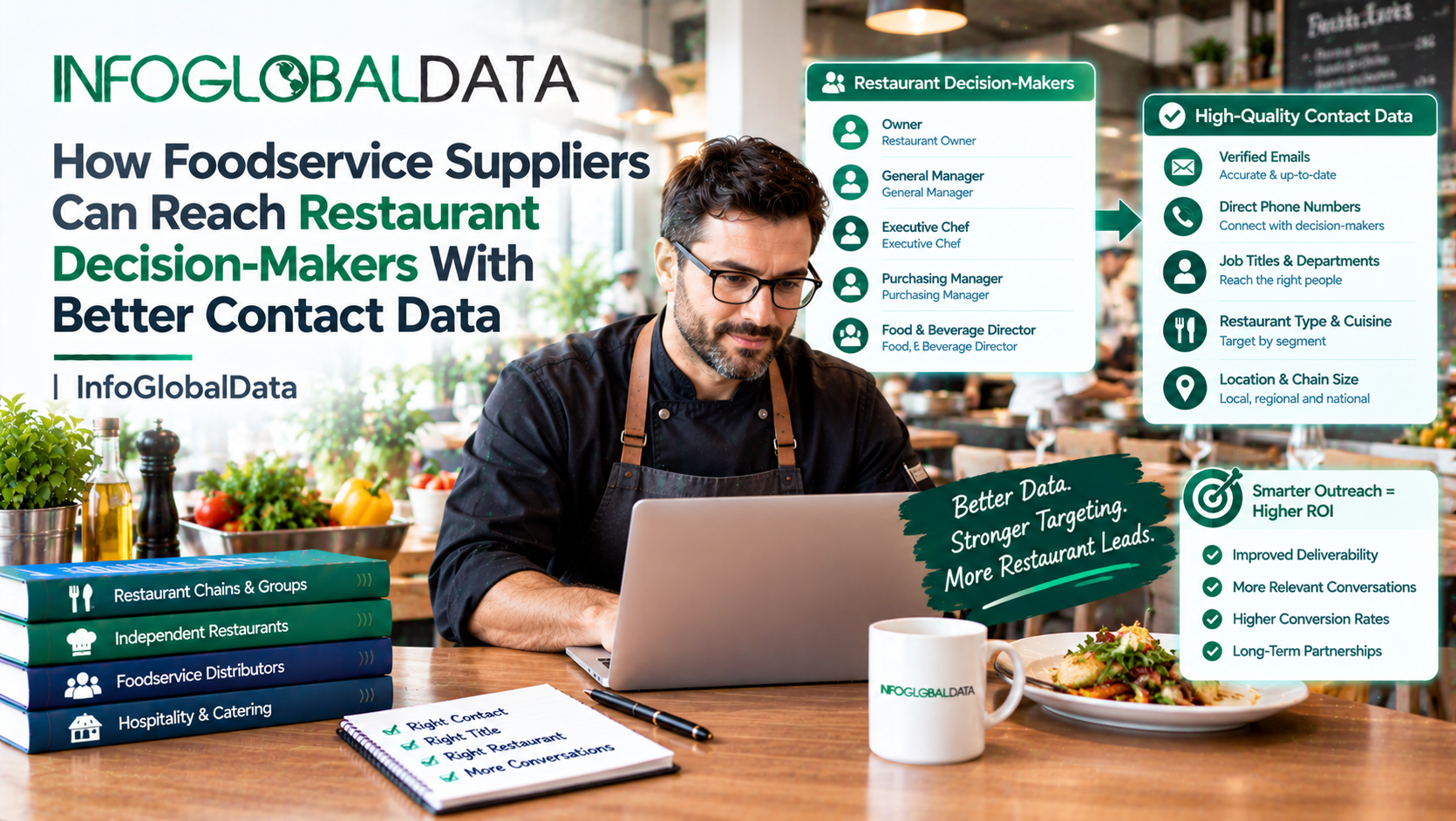
How Foodservice Suppliers Can Reach Restaurant Decision-Makers With Better Contact Data | InfoGlobalData

Introduction
Foodservice suppliers face a crowded market when trying to connect with restaurant owners, purchasing managers, chefs, and operations directors. Whether a business sells ingredients, commercial kitchen equipment, packaging, beverages, or restaurant technology, reaching the right decision-maker can determine whether an outreach campaign generates a sales conversation or gets ignored.
The quality of contact data is a practical starting point. MailerLite's 2025 email marketing benchmark study, covering more than 3.6 million campaigns sent between December 2024 and November 2025, reported a median click rate of 1.06% for restaurants and cafés, compared with 2.09% across all industries. These figures reflect broad email-marketing campaigns, not specifically supplier-to-restaurant B2B outreach, but they highlight the importance of relevance and measurable engagement.
A well-maintained Restaurant Email List can help suppliers prioritize suitable prospects, personalize their offers, and reduce wasted outreach. The key is to evaluate the data before launching.
1. Identify the Right Restaurant Decision-Makers
Restaurant businesses rarely have one universal purchasing contact. An independent café owner may approve every supplier, while a hotel restaurant or multi-location restaurant group may have separate procurement, culinary, finance, and operations teams.
Foodservice suppliers should first define the role most likely to influence the purchase:
-
Owners and operators: Relevant for independent restaurants and small groups.
-
Purchasing and procurement managers: Useful for distributors, multi-location operators, and larger hospitality businesses.
-
Executive chefs and kitchen managers: Important for ingredients, food products, kitchen equipment, and culinary supplies.
-
Operations directors: Often relevant to restaurant technology, equipment contracts, and operational services.
-
Franchise and corporate purchasing teams: Suitable for suppliers seeking larger, multi-location accounts.
The US National Restaurant Association's 2025 State of the Restaurant Industry provides industry context on restaurant operations, costs, and business conditions. Such research helps suppliers understand the challenges their prospects face, but it cannot replace verifying the individual contacts within a database.
When reviewing a Restaurant Mailing List, check whether records include a person's name, current job title, business name, and professional email address. A list that identifies only a restaurant's general inbox may still be useful for some outreach, but it offers less precision when the campaign requires a specific decision-maker.
2. Segment Restaurants by Type and Business Model
A restaurant's category influences its purchasing needs. A quick-service restaurant may prioritize packaging, speed, and consistency, whereas a fine-dining establishment may focus on specialty ingredients, presentation, and premium equipment.
Useful segments include:
-
Independent restaurants and cafés
-
Quick-service and fast-casual chains
-
Fine-dining establishments
-
Hotels, resorts, and hospitality groups
-
Catering companies and institutional foodservice operators
-
Bakeries, bars, and specialty food businesses
MailerLite's 2025 benchmarks reported a median click rate of 1.06% for restaurants and cafés, compared with 2.09% across all industries. Its data also reported a 3.28% click-to-open rate for restaurants and cafés. These measures are broad benchmarks, not proof that a particular segmentation strategy will improve B2B results. They can, however, serve as reference points when reviewing campaign engagement.
For example, a supplier of compostable takeaway containers could prioritize quick-service restaurants and delivery-focused businesses. A premium seafood distributor might focus on restaurants whose menus align with its products.
What to evaluate: Determine whether your database uses consistent restaurant classifications and whether each segment corresponds to a specific offer or sales objective.
3. Check Contact Accuracy and Database Freshness
Restaurant businesses can change ownership, relocate, close, expand, or replace their purchasing staff. An email address that was valid when collected may no longer reach the intended person.
A reliable Restaurant Email Database should be evaluated for:
-
Email validity: Check for malformed, invalid, or undeliverable addresses.
-
Business status: Confirm that the restaurant remains active.
-
Contact accuracy: Verify names, job titles, and restaurant affiliations.
-
Duplicate records: Identify repeated contacts and inconsistent entries.
-
Data freshness: Ask when records were last checked and how updates are managed.
-
Source transparency: Understand how the information was collected and what uses are permitted.
The European Commission's GDPR principles include accuracy and storage limitation. Where the GDPR applies, organizations must take reasonable steps to keep personal data accurate and avoid retaining it longer than necessary.
Before purchasing a list or deploying an existing database, request a representative sample. Verify selected records against restaurant websites and other reliable business sources. Ask the provider to explain its verification process rather than relying on a general claim that its data is “accurate” or “verified.”
Technical email verification is useful, but it does not guarantee that the recipient is still employed at the restaurant, is a decision-maker, or has agreed to receive marketing.
4. Evaluate Geographic and Commercial Fit
Contact accuracy matters, but commercial relevance matters just as much. A supplier should not target every restaurant in a region if its delivery network, product range, or pricing serves only a narrower market.
Consider these segmentation fields:
|
Data field |
Why it matters |
|---|---|
|
City, region, or postal area |
Helps align outreach with delivery coverage |
|
Restaurant type |
Matches the offer to the establishment's needs |
|
Number of locations |
Helps prioritize independent businesses or larger groups |
|
Contact role |
Directs the message to the appropriate decision-maker |
|
Cuisine or service style |
Can indicate potential product relevance |
|
Website and business details |
Supports validation and personalized outreach |
Industry research can help put this targeting into context. The National Restaurant Association's annual industry research tracks restaurant business conditions and operating pressures. Suppliers can use these insights to shape messaging around relevant issues, such as controlling operating costs or improving efficiency, without assuming that every restaurant faces the same priorities.
For example, a commercial refrigeration supplier may prioritize operators with larger kitchens or multiple locations. A specialty ingredient supplier may focus on restaurants whose menus align with its product range.
The goal is to build segments around a realistic buying opportunity—not simply to maximize the number of records in each campaign.
5. Measure Performance Beyond Email Opens
A contact list should support measurable business outcomes. Open rates alone are not enough to determine whether a database is valuable, because privacy features can register opens without a recipient actively reading the message.
MailerLite's 2025 benchmark analysis found a median click rate of 2.09% across all industries, with restaurants and cafés at 1.06%. The difference is useful context, but it should not be interpreted as a direct comparison between restaurant suppliers and restaurant marketing teams. Audience, offer, and campaign purpose can vary considerably.
For foodservice B2B campaigns, track:
-
Click-through rate: How often recipients click the main offer or call to action.
-
Positive reply rate: How often contacts express genuine interest.
-
Qualified lead rate: How many contacts match your ideal customer profile.
-
Meeting or sample-request rate: How many prospects take a meaningful next step.
-
Conversion rate: How many leads become customers.
-
Hard bounce, unsubscribe, and complaint rates: Whether list quality or targeting is creating problems.
Run a small, controlled campaign before scaling. For example, compare a segment of verified independent restaurant owners with a segment of procurement managers at restaurant groups. Use comparable offers and measurement periods, then evaluate which group generates more qualified conversations.
This process helps distinguish between a database that looks comprehensive and one that actually supports sales.
6. Confirm Compliance and Protect Deliverability
Better contact data does not remove the need to comply with email-marketing rules. Requirements depend on where recipients are located, whether the contact information identifies an individual, and which marketing laws apply.
In the United States, the Federal Trade Commission's CAN-SPAM compliance guide explains that the law covers commercial email, including B2B messages. It requires accurate sender information, non-deceptive subject lines, a valid postal address, and a clear way to opt out. Senders must also honor opt-out requests within the required timeframe.
Before launching, confirm that:
-
The source and intended use of the contact data are documented.
-
Applicable consent, lawful-basis, and regional marketing requirements have been reviewed.
-
Previous opt-outs are excluded from marketing sends.
-
Sender authentication and delivery monitoring are in place.
-
Bounce and complaint rates are monitored, with campaigns paused when problems arise.
Google's email sender guidelines also recommend keeping user-reported spam rates below 0.1% and preventing them from reaching 0.3% or higher. These are deliverability thresholds, not targets to approach while testing a questionable list.
Practical Takeaways for Foodservice Suppliers
Use this checklist before your next campaign:
-
Define the buyer: Identify the restaurant roles and business types most likely to need your product.
-
Inspect the data: Validate email addresses, business status, contact roles, and duplicate records.
-
Segment with purpose: Group restaurants by type, geography, size, and purchasing needs.
-
Test before scaling: Measure qualified replies, sample requests, conversions, and delivery problems in a small campaign.
-
Maintain compliance: Document data sourcing, respect opt-outs, and follow the rules applicable to each market.
For businesses exploring external B2B contact-data resources, InfoGlobalData can be considered as a source for investigating business contact solutions. Before selecting any provider, request sample records, ask about verification and refresh practices, and independently assess whether the data fits your campaign and compliance requirements.
Conclusion
Reaching restaurant decision-makers requires more than access to a large database. Foodservice suppliers need accurate professional contacts, useful restaurant classifications, appropriate geographic targeting, and a clear understanding of who influences purchasing decisions.
MailerLite's 2025 benchmarks show that restaurant and café campaigns recorded a median click rate of 1.06%, compared with 2.09% across industries. While these figures are not specific to B2B supplier outreach, they reinforce the importance of measuring actual engagement and business outcomes rather than relying on contact volume alone.
Before launching a campaign, verify your data, align each segment with a relevant offer, and monitor qualified responses alongside deliverability metrics. With regular maintenance and careful testing, a Restaurant Email List can become a more practical resource for building supplier relationships and identifying promising restaurant accounts.
Frequently Asked Questions
1. What is a Restaurant Email List?
A Restaurant Email List is a collection of business email contacts associated with restaurants and related foodservice businesses. Depending on the source, it may include owners, purchasing managers, chefs, operations staff, restaurant names, locations, and business categories.
2. What information should a Restaurant Email Database include?
Useful fields include a verified business email, restaurant name, contact role, location, business type, website, and last-verification date. The best fields depend on the supplier's product, service area, and target decision-maker.
3. How can foodservice suppliers reach restaurant owners and purchasing managers?
Identify the roles involved in purchasing the product, then segment contacts by restaurant type and business size. Validate current job titles and tailor the message to the recipient's likely business needs.
4. How often should a Restaurant Mailing List be updated?
There is no universal schedule that guarantees accuracy. Review records before major campaigns and refresh them according to data age, bounce rates, changes in restaurant status, and the provider's update practices.
5. What is a good email click rate for restaurant campaigns?
MailerLite's 2025 benchmark reported a 1.06% median click rate for restaurants and cafés, compared with 2.09% across all industries. These figures are broad reference points and should not be treated as guaranteed targets for B2B supplier campaigns.
6. How can suppliers improve the quality of restaurant contact data?
Verify email addresses, confirm restaurant status and contact roles, remove duplicates, and segment records by commercial relevance. Request information about the data's source and update process before purchasing or using an external list.
7. Is it legal to send B2B marketing emails to restaurants?
It depends on the recipient's location, business structure, data source, and applicable laws. In the United States, CAN-SPAM applies to commercial B2B email, while other jurisdictions may have different requirements for consent, personal data, and electronic marketing.


