
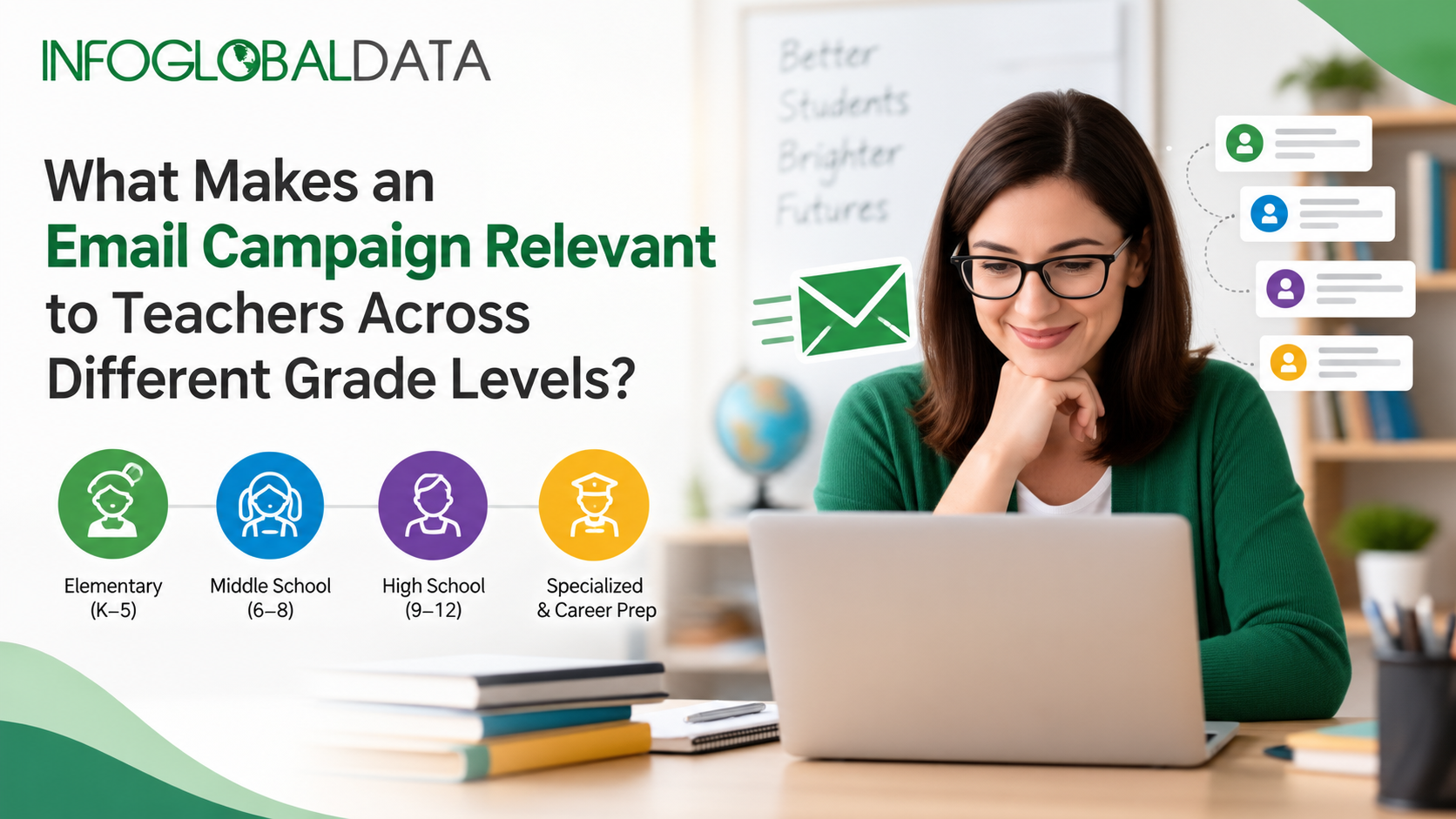
What Makes an Email Campaign Relevant to Teachers Across Different Grade Levels? | InfoGlobalData

Introduction
An email campaign aimed at educators is more effective when it reflects what teachers actually need at their grade level, subject area, and school setting. A kindergarten teacher searching for classroom learning materials has different priorities from a high school science teacher evaluating laboratory resources or a middle school teacher looking for student engagement tools. Treating these audiences as one group can make otherwise useful messages feel generic.
The scale of the education market makes audience relevance especially important. According to the National Center for Education Statistics (NCES), the United States has millions of public school students and a large, diverse teaching workforce across elementary and secondary education. For publishers, education technology companies, professional development providers, and school suppliers, a well-segmented Teachers Email List can support more relevant communication. The key is combining reliable contact information with grade-specific content, appropriate timing, and measurable outcomes.
1. Understand What Teachers Need at Each Grade Level
The first step toward relevance is recognizing that teachers do not share identical classroom challenges. Their needs vary according to student age, curriculum, subject, available resources, and school priorities.
The scale of the audience reinforces the need for segmentation. According to the NCES Common Core of Data for 2024–25, the United States had 99,073 public elementary and secondary schools and approximately 49.3 million public school students. A campaign designed for such a diverse education system should not assume that one message will resonate equally across all classrooms.
Consider how content can differ by grade band:
|
Teacher segment |
Potentially relevant email content |
|---|---|
|
Early childhood and kindergarten |
Play-based learning, foundational literacy, classroom routines, and age-appropriate activities |
|
Elementary school |
Reading comprehension, mathematics resources, classroom management, and differentiated instruction |
|
Middle school |
Student engagement, subject-specific resources, collaborative projects, and transition support |
|
High school |
Advanced coursework, laboratory resources, exam preparation, career readiness, and college preparation |
These are practical segmentation examples, not claims that every teacher within a grade band has the same priorities.
A targeted Teachers Email List becomes more useful when it includes dependable information about grade level, subject area, school type, and location. Marketers can then match the content to the audience instead of relying on broad job-title targeting alone.
2. Use Research to Make Educational Offers More Relevant
Effective educational marketing should address a problem educators recognize rather than simply promote a product or service.
For example, an education technology provider could introduce an elementary reading resource through a short demonstration of how it supports reading practice. For high school educators, the same company might emphasize subject-specific applications, assessment tools, or compatibility with existing classroom systems.
Recent research supports the importance of practical relevance. In an Education Week Market Brief report published in May 2026, a nationally representative survey of 499 K–12 teachers, school leaders, and district leaders found that 52% considered professional development most helpful when it provided knowledge, tools, or tactics they could apply immediately.
The finding concerns vendor-provided professional development rather than email marketing itself. Nevertheless, it offers a useful lesson for education marketers: teachers are more likely to see value in an offer when its practical benefit is clear.
To apply this insight, make each email specific about what the recipient will gain:
-
A ready-to-use lesson or classroom activity.
-
A demonstration of a teaching resource.
-
Guidance for a defined instructional challenge.
-
A professional development opportunity tied to relevant skills.
-
A product comparison or implementation guide.
A Teachers Mailing List segmented by teaching responsibilities can help deliver these resources to more appropriate audiences. The message should explain the benefit quickly and avoid unsupported claims about improving student achievement.
3. Personalize by Subject, Grade Level, and School Context
Personalization is more than inserting a teacher's first name into a subject line. Meaningful personalization connects the content to the recipient's professional role.
A mathematics teacher and an English language arts teacher may work at the same school and grade level, yet need different resources. Similarly, a science teacher in a school with well-equipped laboratories may have different purchasing priorities from one seeking affordable hands-on activities.
Useful segmentation attributes include:
-
Grade level or grade bands taught.
-
Subject or specialization.
-
Public, private, charter, or other school setting.
-
Geographic location and relevant curriculum requirements.
-
Teaching role, such as classroom teacher, specialist, or instructional coach.
-
Previously expressed interests and engagement with relevant content.
Education Week's April 2026 reporting on professional development needs drew on a survey of 5,802 teachers conducted between August and November 2025. It highlighted differences in professional development priorities across states, including varying needs related to artificial intelligence.
This matters because even teachers in similar roles may face different curriculum standards, policies, and training priorities depending on where they work.
A well-maintained Teachers Email Database should therefore support useful segmentation while distinguishing verified information from assumptions. If a teacher's grade level is unknown, marketers should not invent it. They can instead send a broader resource, invite the teacher to select their interests, and use the response to improve future targeting.
4. Choose Timing and Calls to Action That Respect Teachers' Workflows
Even relevant content can underperform if it arrives at an inconvenient time or asks too much of the recipient.
Teachers balance instruction, planning, assessment, communication with families, and administrative responsibilities. A lengthy promotional email that requires several steps to understand its value may be less practical than a concise message with one clear next action.
There is no universal send time that guarantees engagement among teachers. Rather than assuming that all educators prefer emails at a particular hour, test delivery times against your own campaign data and consider local school schedules, holidays, and academic calendars.
Use one primary call to action for each message. Examples include:
-
Download a lesson resource.
-
Register for a relevant webinar.
-
View a short product demonstration.
-
Explore a curriculum-aligned resource.
-
Request information about a school or district offering.
Keep the email focused. If the objective is webinar registration, avoid competing calls to action for several unrelated products.
Measure results using clicks, registrations, replies, and qualified inquiries. Opens can be useful as a directional signal, but they should not be the only indicator of interest because privacy features and automated activity can affect open tracking.
5. Measure Relevance Through Engagement and Outcomes
A campaign's success should be assessed by whether teachers take meaningful actions—not simply how many messages are sent.
Start by establishing a baseline and tracking results by grade level, subject, and school segment. That makes it easier to identify which audiences respond to which types of content.
Useful metrics include:
-
Delivery and bounce rates: Indicate whether contact information is usable.
-
Click-through rate: Measures interaction with the email's links, using a consistent denominator.
-
Conversion rate: Tracks actions such as downloads, registrations, or information requests.
-
Positive reply rate: Indicates whether the message generates relevant conversations.
-
Unsubscribe and complaint rates: Help identify audience mismatch, excessive frequency, or poor expectations.
-
Qualified inquiry rate: Measures how often engagement leads to a genuine business opportunity.
Compare similar campaigns wherever possible. A free classroom resource and a paid professional development program have different objectives, so their results should not be judged using identical conversion expectations.
Run controlled tests on subject lines, content formats, offers, and calls to action. Change one major variable at a time, and allow enough time to collect useful data. If elementary teachers respond strongly to classroom-ready resources while high school teachers engage more with subject-specific demonstrations, use that evidence to refine subsequent campaigns.
6. Protect Deliverability and Follow Email Marketing Rules
Relevance and contact accuracy are closely connected. Sending a suitable message to an outdated address—or continuing to contact someone who has opted out—undermines both campaign performance and recipient trust.
Google's Email Sender Guidelines require email authentication and other technical measures. Google recommends keeping user-reported spam rates below 0.1% and avoiding rates of 0.3% or higher. Bulk senders also face additional requirements, including SPF, DKIM, DMARC, and one-click unsubscribe for applicable marketing messages.
Before sending to a Teachers Email List:
-
Validate addresses and remove known invalid records.
-
Deduplicate contacts across campaigns.
-
Maintain suppression lists for opt-outs and complaints.
-
Ensure sender identity and subject lines are accurate.
-
Monitor bounce, complaint, and unsubscribe rates by segment.
Legal requirements also matter. The U.S. Federal Trade Commission's CAN-SPAM compliance guide confirms that commercial email rules apply to business-to-business messages as well. Other countries may have different or stricter requirements, so marketers should check the rules relevant to their recipients and campaigns.
InfoGlobalData can be considered as a resource for exploring targeted B2B contact data. Before using a Teachers Mailing List or Teachers Email Database, marketers should review available segmentation fields, verification processes, data-update practices, and suitability for their intended markets. A contact list is a starting point for relevant outreach, not a guarantee of engagement or permission to send every type of message.
7. Practical Takeaways for Education Marketers
Use these five steps to improve campaign relevance:
-
Segment the audience meaningfully. Start with grade level, subject, school type, and location where reliable data is available.
-
Lead with an immediate benefit. Offer a practical resource, demonstration, or professional learning opportunity tied to the recipient's work.
-
Personalize with verified information. Avoid assumptions about a teacher's classroom, curriculum, or purchasing authority.
-
Test and measure by segment. Track clicks, conversions, qualified inquiries, and opt-outs instead of relying on opens alone.
-
Maintain data quality and compliance. Validate contact information, honor opt-outs, and review deliverability before expanding a campaign.
These actions help transform broad education outreach into a more relevant communication strategy that respects teachers' time and professional responsibilities.
Conclusion
Relevant teacher email campaigns begin with a simple principle: educators at different grade levels and in different subjects need different kinds of support. Research on professional development reinforces the value of practical, immediately applicable resources, while the scale and diversity of the U.S. school system make thoughtful audience segmentation essential.
A well-maintained Teachers Email List, supported by accurate grade-level and subject information, can help education companies deliver more useful messages to appropriate audiences. However, contact data alone is not enough. Marketers must combine segmentation with valuable content, clear calls to action, consistent measurement, and responsible email practices.
As education needs and classroom technologies continue to evolve, organizations that learn from teacher engagement and adapt their content accordingly will be better positioned to build lasting professional relationships. The objective is not simply to reach more teachers, but to make each communication more useful to the educators receiving it.
Frequently Asked Questions
1. What makes an email campaign relevant to teachers?
A relevant campaign offers content aligned with a teacher's grade level, subject, school context, or professional needs. Practical resources, clear benefits, and a focused call to action can make messages more useful.
2. How can a Teachers Email List improve education marketing?
A Teachers Email List can help marketers organize and reach relevant educator audiences when its records are accurate and appropriately segmented. Its value depends on data quality, content relevance, and compliance with applicable email marketing rules.
3. How should marketers segment a Teachers Mailing List?
Useful segments include grade level, subject area, school type, geographic location, and professional role. Marketers should use verified data and avoid assuming that teachers with similar job titles have identical needs.
4. What type of email content do teachers find useful?
Potentially useful content includes classroom-ready activities, curriculum-related resources, subject-specific demonstrations, and practical professional development opportunities. The best format depends on the audience and should be tested against engagement and conversion results.
5. How can marketers measure the success of teacher email campaigns?
Track delivery, bounce rates, clicks, conversions, positive replies, qualified inquiries, unsubscribes, and spam complaints. Compare results across audience segments to learn which content is most relevant.
6. How often should marketers email teachers?
There is no single frequency that works for every educator audience. Establish a reasonable schedule, monitor engagement and opt-outs, and adjust frequency based on audience preferences and the value of the content.
7. What information should a Teachers Email Database contain?
Depending on its source and scope, useful fields may include professional email, name, school or organization, location, subject area, grade band, and role. Marketers should verify how records are sourced, updated, and handled when a recipient opts out.
8. Can one email campaign work for elementary and high school teachers?
It can work when the subject is broadly relevant, but specialized offers generally benefit from segmentation. Separate versions can address the different classroom needs, subject priorities, and instructional contexts of each grade band.


