

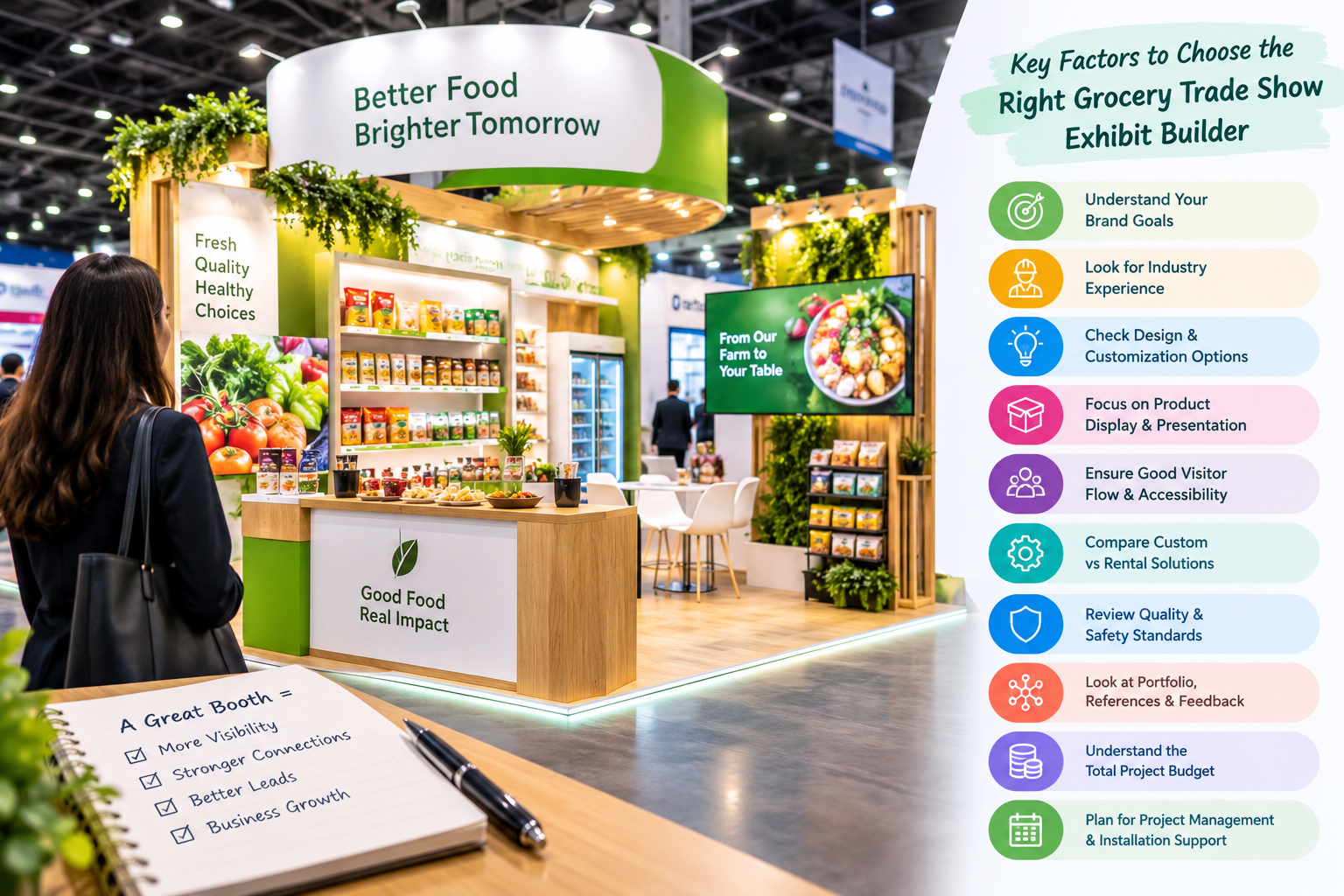
Creative Grocery Trade Show Booth Ideas to Attract More Buyers and Retailers

A well-planned Grocery trade show exhibit builder can help food manufacturers, supermarket suppliers, grocery retailers, and FMCG brands transform an ordinary exhibition space into an engaging brand experience. At grocery industry events, businesses compete to attract retail buyers, distributors, wholesalers, and other professionals who have limited time to explore every booth. Creative booth design can make products easier to discover, communicate a brand's value, and encourage visitors to start meaningful conversations. From interactive product demonstrations to attractive shelving and dedicated meeting areas, the right ideas can help exhibitors create a professional presence and make their participation at Groceryshop Expo more productive.
Why Creative Booth Design Matters at Grocery Trade Shows
Grocery trade shows provide opportunities for brands to introduce new products, explore retail partnerships, and understand changes in the grocery marketplace. However, a booth must compete with numerous other exhibitors for visitors' attention.
A creative design helps a company communicate its identity and product benefits quickly. Instead of relying entirely on brochures or sales conversations, businesses can use visual displays, lighting, product arrangements, and demonstrations to explain what makes their offerings different.
For example, a healthy snack brand might organize products by flavor and nutritional positioning, while a premium food company may use elegant shelving and focused lighting to create a refined presentation.
The most effective booth ideas combine creativity with functionality. Visitors should be able to recognize the brand, explore products comfortably, and speak with staff without navigating a cluttered space.
1. Create a Strong Brand-Focused Booth
Your booth should communicate your brand identity from the moment visitors approach it. Use consistent colors, a recognizable logo, clear signage, and a concise headline that explains what your business offers.
Avoid filling every wall with promotional messages. A focused design helps visitors understand the main benefit of your products without unnecessary distractions.
For grocery brands, visual identity should work together with packaging and product presentation. If your packaging uses bright colors, consider how those colors will appear against the booth's background.
A professional builder can help coordinate graphics, display units, lighting, and furniture so that all elements contribute to a consistent appearance.
2. Build an Attractive Product Display Wall
Product display walls are useful for brands with multiple grocery items, flavors, sizes, or product categories.
Organize products into logical groups rather than placing everything randomly. A beverage company, for example, could arrange products by flavor or product range, while a packaged food manufacturer could separate snacks, breakfast products, and ready-to-eat items.
Use shelves that allow visitors to see packaging clearly. Keep frequently discussed products at convenient viewing heights and make new launches easy to identify.
Labels and small information panels can help visitors understand product variations without requiring staff assistance for every question.
The display should remain organized throughout the event, so plan enough storage space for replacement stock and additional samples.
3. Introduce a Dedicated New Product Launch Zone
Trade shows are useful venues for introducing products to buyers and distributors. A dedicated launch zone helps a new offering receive attention instead of disappearing among an extensive product range.
Position the featured product in a prominent location and support it with concise messaging, product information, and relevant imagery.
You could use a separate counter, illuminated shelving, or a digital display to distinguish the launch area from the rest of the booth.
Make sure the launch message is accurate and easy to understand. Explain what is new about the product, who it is intended for, and how it fits into your existing range.
A dedicated launch space also gives your sales team a natural starting point for conversations with interested retailers.
4. Add a Product Sampling Counter
Sampling can be an effective way for eligible food brands to encourage visitors to experience their products directly.
A dedicated sampling counter can showcase taste, texture, serving suggestions, or product versatility. For packaged food companies, this creates an opportunity to discuss ingredients, packaging formats, and possible retail applications.
Design the counter to support safe and organized distribution. Include space for samples, serving materials, waste disposal, and staff movement.
Before planning sampling activities, confirm the event's food-handling rules, venue restrictions, hygiene requirements, and any necessary permissions.
For products that cannot be sampled, consider demonstrations, product comparisons, or short presentations that explain their features.
5. Use Interactive Digital Displays
Digital screens can make a grocery exhibition booth more informative and engaging when used with a clear purpose.
A screen might display a product catalog, manufacturing overview, brand story, packaging options, or product demonstration. Grocery technology providers can use interactive displays to explain inventory systems, retail analytics, and supply-chain solutions.
Keep the content concise and visually clear. Visitors should be able to understand the main message without watching a long presentation.
Position screens where they are visible from the aisle without blocking product displays or conversation areas.
Confirm power requirements, connectivity, mounting arrangements, and technical support before the event. A simple backup presentation can also be useful if equipment fails.
6. Design a Booth Around Product Categories
Businesses with extensive product ranges can make their booth easier to navigate by dividing it into clear zones.
For example, a food manufacturer might create separate areas for snacks, beverages, frozen products, and breakfast foods. A grocery supplier could organize its display around packaging, storage, merchandising, and retail support solutions.
Each zone should have a clear heading and a consistent visual style.
This approach allows visitors to move directly to the products most relevant to their business. It also helps staff direct buyers to specific categories during conversations.
Avoid creating too many zones in a small booth. A few well-defined sections are generally more useful than numerous crowded displays.
7. Incorporate Sustainable Booth Materials
Sustainability can be reflected in the way an exhibition booth is designed and constructed.
Consider reusable display systems, durable shelves, energy-efficient lighting, and graphics that can be updated for future events. Modular components may allow the booth to be adapted to different exhibition spaces without replacing the entire structure.
Natural textures and responsibly selected materials can also complement brands whose positioning emphasizes environmental responsibility.
However, sustainability claims should be accurate and supported by evidence. A brand should not describe a booth or product as environmentally friendly without an appropriate basis.
Ask potential builders about reusable components, storage, material sourcing, refurbishment, and waste management. These details can help you evaluate the practical benefits of different design approaches.
8. Create a Retail Buyer Meeting Area
Not every visitor interaction needs to take place in front of a product shelf. Retail buyers and distributors may want to discuss pricing, supply arrangements, product placement, and commercial terms in a quieter setting.
A small meeting table, consultation counter, or semi-private discussion area can make these conversations more comfortable.
Keep the area accessible without blocking the entrance or main product displays. If the booth is small, a compact counter with two chairs may be sufficient.
Prepare relevant business information in advance, including product specifications, catalogues, distribution details, and contact information.
This approach helps your team balance product discovery with the commercial discussions that can lead to future partnerships.
9. Use Lighting to Highlight Featured Products
Lighting can influence how visitors perceive your booth and the products displayed within it.
General lighting should make the space comfortable and easy to navigate. Focused lighting can draw attention to featured products, launch displays, or important brand graphics.
For grocery packaging, make sure lighting does not create excessive glare or distort the appearance of labels and colors.
Use lighting to support the booth's visual hierarchy rather than illuminate every area equally. The goal is to guide attention naturally toward the most important elements.
Your builder should also consider electrical access, fixture positioning, energy consumption, and venue safety requirements.
10. Make the Booth Easy to Navigate
An attractive booth may still underperform if visitors cannot move through it comfortably.
Plan clear entry points, open pathways, accessible displays, and enough room for staff to interact with visitors. Avoid placing large furniture pieces where they interrupt the main circulation area.
Think about how visitors will approach the booth from different directions and where queues might form during demonstrations or sampling.
For island booths, multiple access points can help distribute visitor movement. For inline booths, clear frontage and well-positioned displays can encourage people to stop without obstructing the aisle.
A practical layout improves both the visitor experience and the efficiency of your team.
11. Highlight Packaging and Shelf Appeal
Packaging plays an important role in grocery retail because it helps products communicate their identity on crowded shelves.
Use your exhibition booth to show how products look individually and as part of a larger range. Group related packaging formats together and make important product differences easy to understand.
Where appropriate, demonstrate packaging sizes, multipacks, display-ready cartons, or other formats relevant to retail buyers.
Avoid making unsupported claims about product performance or consumer preferences. Instead, use accurate product information and actual packaging examples to explain your offering.
For businesses launching a new package design, the booth can also provide an opportunity to collect feedback from relevant industry professionals.
12. Add a Live Product Demonstration Area
Live demonstrations help visitors understand products that benefit from explanation or practical use.
A food equipment supplier might demonstrate a machine, while a grocery technology company could show how its software supports retail operations. A food brand might demonstrate serving ideas if the venue permits the activity.
Design the demonstration area around visibility, safe operation, and visitor comfort.
Make sure the equipment fits within the booth and that power, ventilation, water, or other technical requirements are addressed in advance.
Keep demonstrations concise and schedule them at suitable intervals so that visitors can participate without waiting unnecessarily.
A well-organized demonstration can help your team communicate product benefits more effectively than printed materials alone.
13. Incorporate QR Codes for Easy Information Access
QR codes can provide visitors with quick access to product information without requiring large amounts of printed material.
A code might lead to a digital catalogue, product specification sheet, contact form, company website, or appointment booking page.
Place codes near the relevant products and include a short explanation of what visitors will receive after scanning.
Test every code before the exhibition and confirm that the linked content works on mobile devices. Make sure important information is accessible without unnecessary steps.
QR codes should complement personal conversations rather than replace them. Staff should remain available to answer questions and discuss potential business opportunities.
14. Use Brand Storytelling to Build Interest
A brand story can help visitors understand the business behind the products.
Consider displaying information about your company's history, production approach, product development, sourcing practices, or mission. Use concise text and relevant imagery instead of long paragraphs.
For a regional food brand, the story might explain the origin of a product. A growing FMCG company might highlight how its product range has developed over time.
All claims about sourcing, production, certifications, and product quality should be accurate and verifiable.
Storytelling works best when it supports the products on display. Visitors should be able to connect the brand's message with the actual items and business opportunities being presented.
15. Create an Inviting Hospitality Corner
Depending on the booth size and event rules, a small hospitality area can encourage longer conversations with potential buyers.
Comfortable seating, a tidy counter, and accessible product information can make the space more welcoming.
Keep refreshments and hospitality elements secondary to the primary purpose of the booth. Ensure that they do not occupy valuable display space or obstruct visitor movement.
For smaller exhibitors, a simple standing consultation counter may be more effective than a large lounge area.
The right choice depends on the audience, the duration of typical conversations, and the overall exhibition objectives.
16. Train Your Team to Support the Booth Design
Even the most creative booth needs a prepared team to deliver a good visitor experience.
Train staff to explain the main product benefits, answer common questions, and identify relevant business opportunities. Everyone should understand the company's key messages and know which team member handles technical, commercial, or distribution questions.
Assign responsibilities for welcoming visitors, conducting demonstrations, replenishing products, and collecting contact details.
Encourage staff to engage visitors naturally rather than relying on aggressive sales tactics. A helpful conversation can create a more positive impression and make it easier to establish a business relationship.
17. Choose the Right Booth Builder for Your Ideas
Creative concepts need practical execution. When evaluating potential builders, look for experience with product displays, retail brands, food exhibitions, and similar projects.
Review their portfolios, construction quality, project timelines, and ability to manage installation. Ask how they will accommodate product storage, electrical requirements, lighting, and visitor movement.
Request itemized quotations so you can compare design, fabrication, graphics, furniture, transport, installation, and dismantling costs.
A suitable builder should understand your objectives and explain how the proposed design will support them. The goal is to select a partner whose capabilities, approach, and commercial terms match your requirements.
Exhibitorly provides a starting point for exploring and comparing booth-building options for Groceryshop Expo, helping businesses identify potential providers for further evaluation.
18. Plan Your Booth Budget Strategically
A creative booth does not necessarily need to be expensive. The most useful investment is often the one that directly supports your exhibition goals.
Prioritize visible branding, appropriate product displays, functional lighting, comfortable visitor movement, and essential equipment before adding decorative features.
Modular components may offer value for businesses planning to attend several events. Reusable shelves and updated graphics can sometimes reduce the need for a completely new booth.
When comparing costs, account for design, materials, labor, transportation, installation, and storage. Consider the long-term value of reusable components rather than looking only at the initial quotation.
Set aside a contingency allowance for unexpected requirements and confirm which services are included in the agreed price.
19. Measure the Results of Your Booth Design
The success of an exhibition booth should be assessed through meaningful business outcomes rather than appearance alone.
Track the number of relevant buyer conversations, qualified leads, distributor inquiries, product demonstrations, and follow-up meetings. For a product launch, record feedback about packaging, product positioning, and commercial interest.
After the event, review which displays attracted attention and which activities encouraged useful conversations.
Ask staff to record common questions and recurring objections. These insights can help improve product messaging and booth planning for future events.
Comparing results with the original objectives will help you understand which design elements contributed to the exhibition's value.
Conclusion
Creative booth design can help grocery brands attract relevant visitors, showcase products effectively, and build stronger connections with retailers and distributors. From product sampling counters and interactive displays to organized shelving and comfortable meeting areas, every element should support the company's objectives. Successful exhibitors combine visual appeal with practical planning, clear messaging, trained staff, and reliable project execution. Before your next exhibition, evaluate your audience, product range, available space, and budget to identify the ideas that will deliver the greatest value. To explore potential partners for your upcoming event, visit Exhibitorly and compare options for a Grocery trade show exhibit builder that can help bring your exhibition concept to life.


