
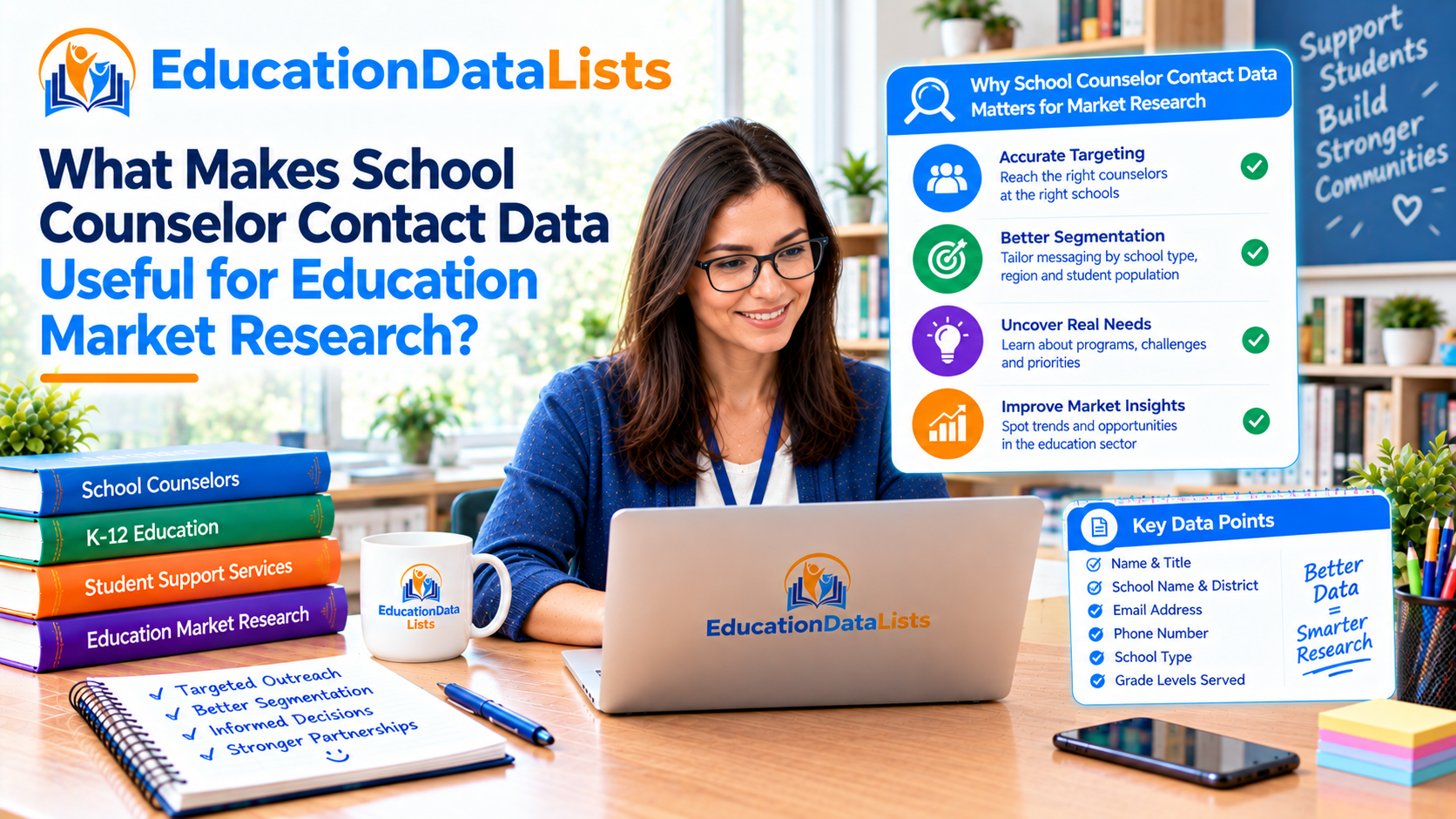
What Makes School Counselor Contact Data Useful for Education Market Research? | EducationDataLists

Introduction
School counselor contact data is valuable for education market research because it helps organizations identify the professionals who support students’ academic planning, career exploration, social-emotional development, and postsecondary decisions. According to the American School Counselor Association (ASCA), the United States had an average of 372 students per school counselor during the 2024–2025 school year, compared with ASCA’s recommended ratio of 250 to 1. This workload makes relevant, well-targeted communication particularly important.
For education technology providers, publishers, professional development companies, and education researchers, school counselor email lists can support audience segmentation, market analysis, and outreach planning. Their usefulness, however, depends on more than list size. Accurate professional details, appropriate segmentation, responsible data use, and reliable email deliverability determine whether contact information can support meaningful research and business decisions.
1. Why Is School Counselor Contact Data Valuable for Market Research?
School counselors can provide insight into student support priorities, college and career readiness, counseling resources, and the operational challenges schools face. Organizations serving K–12 education can use relevant professional contacts to understand these needs and identify potential audiences for research, educational resources, and solutions.
ASCA’s latest published ratio data for 2024–2025 reports 132,270 school counselors serving 49,269,882 students across the United States. These figures illustrate the scale of the school counseling workforce and the potential audience for research focused on counseling programs and student support.
For market researchers, this information helps answer practical questions:
-
Which geographic markets have a substantial school counseling workforce?
-
Which types of schools should be included in a research sample?
-
What resources or professional development topics may be relevant to counselors?
-
How should outreach be divided by school level, district, or region?
Contact data helps researchers reach the appropriate professional audience, while workforce statistics provide the broader context needed to interpret findings.
2. What Makes a School Counselor Email Database Useful?
A school counselor email database is most useful when its records contain accurate, relevant, and sufficiently detailed information. A large list with missing roles, outdated addresses, or limited organizational context may be less useful than a smaller, carefully segmented dataset.
Professional role and institutional details
Useful records may include:
-
Counselor name and professional email address
-
School name and school district
-
School level, such as elementary, middle, or high school
-
City, state, and geographic region
-
Professional role or counseling specialization, where available
-
Source and last verification date, when supplied
These fields help researchers determine whether a contact belongs in a particular study or campaign. For example, a provider researching college-readiness resources may prioritize high school counselors, while a company developing elementary student-support materials may need a different audience.
Accuracy and freshness
Job changes, school transfers, district restructuring, and changes to email systems can make professional contact records outdated. Researchers should therefore distinguish between an address that has been technically verified and a record whose role and institutional affiliation have also been confirmed.
The Validity State of CRM Data Management in 2025 report, based on a survey of 602 CRM users and administrators in the United States, United Kingdom, and Australia, found that 76% of respondents said less than half of their organization’s CRM data was accurate and complete.
This is a broad CRM finding, not a school-counselor-specific accuracy benchmark. Nevertheless, it highlights why education market researchers should assess data quality before relying on a contact database for sampling, outreach, or reporting.
3. How Does Segmentation Improve Education Market Research?
Segmentation helps researchers compare relevant groups instead of treating every school counselor as part of one uniform audience. Well-organized school counselor mailing lists can support more focused research questions and reduce irrelevant outreach.
Segment by school level
Elementary, middle, and high school counselors may work with students facing different developmental and educational challenges. High school research might examine college applications, career planning, financial aid awareness, or postsecondary transitions. Elementary school research may focus more on student well-being, social skills, and early intervention.
The research question should determine the segment, rather than assuming that every counselor has the same responsibilities or purchasing influence.
Segment by geography
ASCA’s 2024–2025 data shows substantial variation in student-to-counselor ratios across states. For example, the reported ratio was 570 students per counselor in Arizona and 432 in California, compared with 247 in Colorado. These figures can help researchers frame questions about differences in staffing conditions and student access to counseling.
They should not, however, be treated as direct evidence of demand for a particular product or service. Ratios provide context; additional research is needed to understand local priorities, budgets, procurement processes, and program needs.
Segment by institution or research purpose
Depending on the available fields, researchers may also segment contacts by district, school type, or professional responsibility. Before launching a study, define the intended population and decide which fields are essential for inclusion.
This approach makes findings easier to interpret and helps teams identify gaps in their sample. It also prevents a list of contacts from being mistaken for a representative research sample.
4. How Can Researchers Evaluate Contact Data Quality?
A useful dataset should be evaluated against the purpose of the research. A list suitable for broad awareness outreach may not meet the requirements of a study that compares counselor responses by state or school level.
Consider these checks before using school counselor email lists:
| Quality check | What to evaluate | Why it matters |
|---|---|---|
| Email validity | Whether addresses are correctly formatted and deliverable | Reduces avoidable delivery failures |
| Role relevance | Whether contacts are actually school counselors | Keeps the audience aligned with the research question |
| Institutional accuracy | Whether school and district details are current | Supports reliable segmentation |
| Record duplication | Whether the same person appears more than once | Prevents distorted counts and duplicate outreach |
| Coverage | Whether relevant regions and school levels are represented | Helps identify sampling gaps |
| Verification date | When contact details were last checked | Makes freshness easier to assess |
No single verification process guarantees that a record is accurate in every respect. Email validation can identify certain technical issues, but it does not necessarily confirm that a person still works at a particular school or is the right respondent for a study.
For that reason, researchers should combine technical checks with role and institution verification where possible. They should also document exclusions, missing fields, and other limitations when reporting results.
5. What Role Do Deliverability and Compliance Play?
Even relevant contact data cannot support effective research if messages fail to reach recipients or are sent without appropriate safeguards.
Google’s email sender guidelines advise senders to keep user-reported spam rates below 0.1% and avoid reaching 0.3% or higher. Bulk senders sending 5,000 or more messages per day to personal Gmail accounts must also meet additional authentication and unsubscribe requirements.
For research and marketing teams, these guidelines reinforce the importance of relevant targeting, properly configured email authentication, and clear unsubscribe options. Sending repeated or poorly targeted messages can harm sender reputation and undermine future communication.
Legal requirements matter, too. In the United States, the Federal Trade Commission’s CAN-SPAM compliance guide explains that the law covers commercial email, including business-to-business messages. Requirements include accurate sender information, non-deceptive subject lines, a valid physical postal address, and a working opt-out mechanism. Opt-out requests must be honored within 10 business days.
Organizations should also assess applicable privacy and electronic-marketing laws in the jurisdictions where they operate and where recipients are located. Buying or obtaining a contact list does not remove the sender’s responsibility to use the data appropriately.
6. Practical Steps for Getting More Value From School Counselor Contact Data
Education marketers and research teams can improve the usefulness of their contact data through five practical steps:
-
Define the research objective first. Decide whether the goal is to study counselor needs, evaluate interest in a resource, understand regional differences, or identify an audience for professional development.
-
Set clear inclusion criteria. Specify school level, geography, professional role, and any other essential fields before selecting contacts.
-
Verify records before outreach. Check email validity, role relevance, school affiliation, duplicates, and verification dates. Treat unverified details as limitations rather than confirmed facts.
-
Measure meaningful outcomes. Track delivery failures, responses, completed surveys, and qualified conversations. Do not rely on open rates alone, and avoid presenting a small or self-selected sample as representative of all school counselors.
-
Maintain compliance and update records. Respect opt-outs, document data sources and permitted uses, and establish a process for correcting or removing outdated information.
EducationDataLists can be considered as a resource for organizations exploring education-focused contact data. Before using any school counselor email database, prospective users should assess its coverage, available fields, verification practices, permitted uses, and suitability for their specific research objectives.
Conclusion
Useful school counselor contact data combines accurate professional details, relevant segmentation, adequate audience coverage, and responsible outreach practices. ASCA’s 2024–2025 workforce figures show that school counselors serve a large student population, while differences in counselor-to-student ratios demonstrate why geography and school context can matter in education market research.
However, the size of a contact list alone does not establish its quality or the representativeness of research findings. Organizations should verify records, define their target population, account for sampling limitations, and monitor deliverability and compliance. When these practices are applied consistently, school counselor email lists can help researchers identify appropriate audiences, investigate education-sector needs, and develop better-informed engagement strategies. The strongest results come from treating contact data as a research resource that requires ongoing validation—not as a static collection of email addresses.
Frequently Asked Questions
1. What are school counselor email lists used for?
They can help education technology companies, publishers, researchers, and professional development providers identify relevant school counseling professionals. Common uses include research recruitment, surveys, resource distribution, and targeted professional outreach, subject to applicable laws and recipient preferences.
2. What should a school counselor email database include?
Useful fields may include the counselor’s name, professional email, school, district, school level, location, and verification date. The exact requirements depend on whether the database is being used for broad outreach, research sampling, or a more specific project.
3. How can marketers check the accuracy of school counselor mailing lists?
They can validate email addresses, confirm professional roles and school affiliations, remove duplicate records, and review the date of the latest verification. Email validation alone does not confirm that a contact still holds the same position.
4. Why should school counselor contacts be segmented by school level?
Counselors working in elementary, middle, and high schools may face different student needs and professional priorities. Segmenting contacts by school level helps researchers develop more relevant questions and interpret findings within the appropriate context.
5. Are school counselor email lists suitable for market research surveys?
They can help researchers identify potential survey participants, but the list must match the study’s target population. Researchers should assess coverage, selection bias, nonresponse, and other limitations before generalizing findings to the wider school counseling workforce.
6. How often should school counselor contact data be updated?
There is no universally applicable update interval for every dataset. Organizations should review records before important campaigns or studies and establish a regular verification schedule based on observed job changes, bounce rates, data source reliability, and the importance of accuracy.
7. What should organizations consider before using a school counselor contact list?
They should review the data’s source, coverage, verification methods, permitted uses, and compliance requirements. They should also ensure outreach is relevant, identify the sender clearly, provide required opt-out mechanisms, and respect recipients’ communication preferences.


