
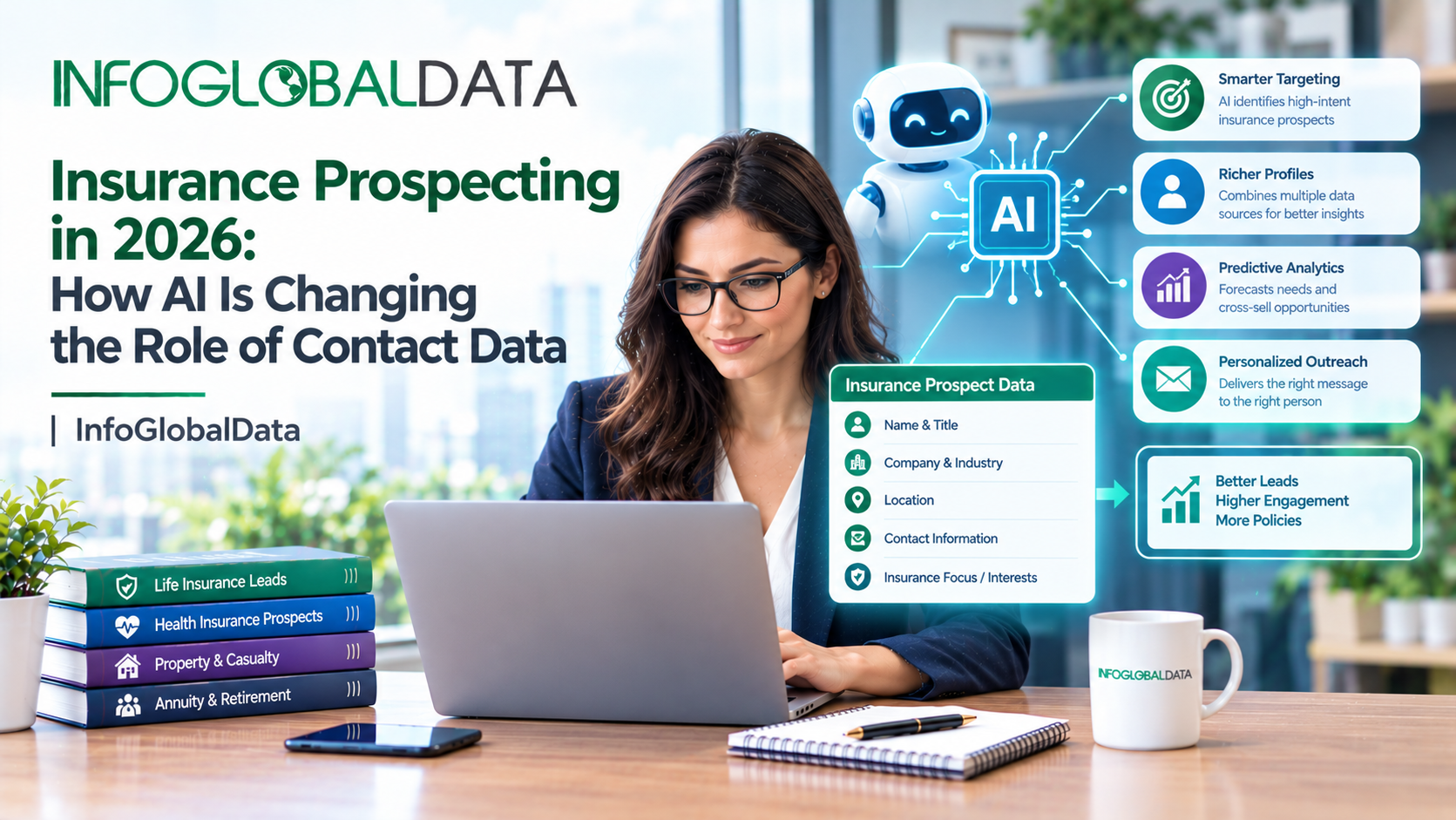
Insurance Prospecting in 2026: How AI Is Changing the Role of Contact Data | InfoGlobalData

Introduction
Insurance prospecting is becoming increasingly dependent on the quality and context of contact data. The reason is simple: AI can now help sales teams identify prospects, prioritize accounts, personalize messages, and automate follow-up, but those capabilities depend on having reliable information to work from.
The shift is already visible across the industry. McKinsey reports that insurance is among the industries where AI agents are seeing comparatively strong adoption in marketing and sales, while Salesforce's 2026 State of Sales research found that 55% of sales professionals use AI for prospecting and another 38% plan to do so. At the same time, 74% of sales teams using AI are prioritizing data hygiene.
For insurers, brokers, agencies, and insurance technology companies, the implication is significant: an insurance industry email list is no longer simply a collection of names and addresses. It increasingly functions as an input layer for AI-assisted prospecting.
AI Is Moving Insurance Prospecting From Volume to Precision
Traditional insurance prospecting often relied on broad lists segmented by geography, company type, product line, or job title. AI changes the economics of that approach because sales teams can analyze more signals and prioritize prospects before human representatives engage.
McKinsey's 2026 insurance research describes AI as having the potential to reshape insurance economics across distribution, underwriting, claims, and customer service. The firm also identifies insurance as an industry where AI agents are already being used in marketing and sales at relatively advanced levels.
This makes contact data more strategically important.
An AI prospecting workflow might combine:
-
Company and agency information
-
Job title and seniority
-
Insurance specialty
-
Geographic market
-
Distribution channel
-
Recent organizational changes
-
Existing customer relationships
-
Engagement history
-
Technology adoption
-
Firm size and growth indicators
The goal is not to send more emails. It is to determine which prospects deserve attention, what they may need, and when outreach is most relevant.
Why Data Quality Is Becoming an AI Requirement
AI does not eliminate the problems caused by outdated contact information. It can amplify them.
Salesforce's 2026 State of Sales study surveyed 4,050 sales professionals and found that 51% of sales leaders with AI said disconnected systems were slowing their AI initiatives. Meanwhile, 74% of sales professionals were prioritizing data cleansing, and high-performing sales teams were more likely to prioritize data hygiene than underperforming teams.
This is particularly relevant to insurance because the market contains multiple layers of participants: carriers, independent agencies, brokerages, MGAs, wholesalers, BGAs, IMOs, insurtech firms, and specialized service providers.
A contact can change:
-
Agency
-
Carrier
-
Brokerage
-
Role
-
Territory
-
Specialty
-
Distribution responsibility
-
Seniority
An AI system working with an outdated insurance industry email database can therefore produce highly personalized outreach that is personalized to the wrong person.
That is worse than generic outreach because the message may appear intelligent while being factually irrelevant.
Insurance AI Is Moving Into Customer-Facing Functions
The insurance industry's AI adoption is also changing the type of information that marketers need to capture.
EY's 2025 GenAI insurance research found that insurers were shifting from back-office experimentation toward front-office applications. Enhanced marketing, personalization, and customized services were among the leading customer-facing use cases. EY also reported that commercial P&C insurers were particularly active in enhanced marketing and personalized outreach, with 78% identified as leading in this area.
The significance for prospecting is substantial.
If insurers increasingly use AI to personalize customer experiences, their B2B acquisition processes are likely to demand similarly precise segmentation. A campaign aimed at commercial P&C decision-makers should not treat them the same way as life insurance, health insurance, or personal-lines prospects.
Useful segmentation dimensions include:
-
P&C versus life and annuity
-
Commercial versus personal lines
-
Independent versus captive distribution
-
Agency versus carrier
-
Brokerage versus MGA
-
Specialty versus general insurance
-
Executive versus operational roles
-
Regional versus national organizations
An insurance industry mailing list becomes more valuable when these distinctions are available as structured fields rather than being inferred manually.
Distribution Is Becoming a More Important Prospecting Signal
Insurance distribution itself is changing.
LIMRA's September 2026 Future Ready Distribution research identifies strategic consolidation, advisor growth and succession planning, changing customer expectations, intermediary evolution, holistic planning, and technology-driven transformation as six forces reshaping insurance and financial-services distribution.
LIMRA and NAILBA's 2026 study of more than 60 brokerage general agencies and independent marketing organizations found that 85% considered increasing sales of existing products a top priority, while 82% were focused on expanding their networks of financial professionals.
For B2B marketers, this creates a useful distinction.
A company selling technology to carriers may need to identify CIOs, heads of innovation, distribution executives, underwriting leaders, or claims executives. A company supporting independent financial professionals may instead prioritize BGAs, IMOs, agency owners, and distribution executives.
Therefore, an insurance database should be structured around how an organization participates in the insurance value chain, not merely whether it has “insurance” in its industry classification.
AI Agents Increase the Value of Context-Rich Contact Data
The next stage of AI prospecting is agentic rather than purely generative.
Salesforce reports that 92% of sellers using AI agents say those agents benefit their prospecting efforts. The research also found that 55% of sales professionals already use AI for prospecting.
Insurance is moving in the same direction.
EY's insurance research found that nearly half of insurers had agentic AI use cases in early testing or production stages. Among the applications being prioritized, 69% focused on risk assessment and mitigation, 60% on customer service and engagement, and 48% on regulatory and compliance decisions.
For prospecting teams, this means AI systems will increasingly need structured context to determine:
-
Which account fits the ICP?
-
Which contact influences the buying decision?
-
What insurance segment does the organization serve?
-
What problem is most relevant?
-
Which communication channel should be used?
-
What evidence indicates that outreach is timely?
The more of these questions that can be answered from reliable data, the more useful an AI prospecting system becomes.
Compliance and Governance Cannot Be Separated From AI Prospecting
Insurance is a highly regulated industry, making responsible data use particularly important.
Deloitte's 2026 global insurance outlook notes that AI success depends heavily on data quality, system modernization, and robust security. The report also highlights the growing focus on practical AI use cases with measurable returns and manageable risk.
EY's September 2026 research across large organizations illustrates the broader governance challenge: 98% of surveyed senior AI executives reported having formal AI governance policies, but 49% of organizations using agentic AI said their existing governance framework had not yet been updated specifically for agentic-AI risks. Data-quality problems were identified in 57% of formal AI assurance reviews.
For insurance marketers, AI should therefore assist with prospecting without becoming a reason to ignore privacy, accuracy, permission, or organizational policies.
The practical objective is controlled automation: clean data, transparent processes, appropriate human review, and measurable campaign outcomes.
Contact Data Should Support Human-AI Collaboration
AI is not making insurance salespeople irrelevant. It is changing where their time is spent.
The BLS projects U.S. insurance sales-agent employment to grow 3% from 2025 to 2035, with approximately 43,100 openings per year. The agency notes that customers increasingly research and purchase insurance online, but agents remain important because many customers still need help understanding choices and selecting suitable coverage.
That creates a hybrid prospecting model.
AI can handle activities such as:
-
Prospect research
-
Account prioritization
-
Contact enrichment
-
Lead scoring
-
Initial personalization
-
Follow-up scheduling
-
CRM summarization
-
Identifying potential buying signals
Human sellers remain responsible for:
-
Relationship development
-
Complex needs discovery
-
Product explanation
-
Trust building
-
Negotiation
-
Compliance-sensitive judgment
-
Closing opportunities
The quality of the underlying insurance industry email list determines how effectively those two layers work together.
What an AI-Ready Insurance Contact Database Should Contain
A modern prospecting database should go beyond name, email, company, and phone number.
Important fields can include:
| Data Category | Example |
|---|---|
| Organization type | Carrier, agency, broker, MGA, BGA, IMO |
| Insurance segment | P&C, life, health, specialty |
| Market focus | Commercial, personal, institutional |
| Contact role | CEO, CRO, CMO, CIO, agent, broker |
| Seniority | Executive, VP, director, manager |
| Geography | State, region, territory |
| Company size | Employees/revenue bands |
| Distribution model | Independent, captive, direct |
| Technology signals | AI, CRM, digital transformation |
| Contact status | Current/validated |
| Engagement signals | Opens, replies, prior interactions |
This type of structure gives AI more context while also making human segmentation easier.
For organizations evaluating an insurance industry email database, the key question should therefore be: Can this data support the decisions an AI prospecting workflow needs to make?
Practical Takeaways for Insurance Sales and Marketing Teams
1. Treat data as an AI asset
Do not evaluate contact data solely by list size. Accuracy, completeness, segmentation, and organizational context increasingly determine AI usefulness.
2. Segment by insurance business model
Separate carriers, agencies, brokerages, MGAs, BGAs, IMOs, insurtech companies, and other participants before creating campaigns.
3. Add role and specialty signals
A CEO at a regional brokerage and a claims executive at a national carrier should not receive the same message simply because both belong to the insurance industry.
4. Refresh data continuously
AI-powered prospecting requires current information. Establish validation and enrichment processes to identify outdated emails, changed employers, role changes, and organizational changes.
5. Use AI to prioritize—not blindly automate
AI should identify the highest-value prospects and help salespeople prepare better conversations. Human review remains important for complex, regulated, or high-value insurance interactions.
Where InfoGlobalData Fits
For marketers building targeted B2B campaigns, InfoGlobalData can be positioned as a data resource within the broader prospecting workflow. The most useful approach is not simply acquiring a large insurance industry mailing list, but using appropriately segmented contact data as one component of account selection, personalization, enrichment, and ongoing data-quality management.
That distinction aligns with the broader direction of sales technology: AI provides greater leverage when the underlying data is accurate, structured, and rich in context.
Conclusion
Insurance prospecting in 2026 is shifting from list-based outreach toward AI-assisted, data-driven account prioritization. Insurers and insurance distributors are experimenting with AI across marketing, customer engagement, risk, underwriting, and other functions, while sales organizations increasingly use AI to research and prioritize prospects.
But AI does not make contact data less important. It makes accurate data more valuable. A stale title, outdated employer, incorrect specialty, or disconnected CRM record can undermine an otherwise sophisticated AI workflow.
The strongest strategy is therefore to combine an accurate insurance industry email list with institutional context, role-level segmentation, ongoing enrichment, and responsible AI automation. As insurance distribution becomes more technology-driven, companies that build this data foundation will be better positioned to identify relevant prospects, personalize engagement, and give sales teams more time for conversations that require human judgment.
Frequently Asked Questions
1. How is AI changing insurance prospecting in 2026?
AI is helping insurance sales teams automate prospect research, account prioritization, personalization, follow-up, and lead analysis. Salesforce reports that 55% of sales professionals use AI for prospecting, while McKinsey identifies insurance as an industry with relatively advanced AI-agent use in marketing and sales.
2. Why is contact data important for AI-powered insurance prospecting?
AI systems depend on accurate and contextual information. If job titles, employers, specialties, or contact details are outdated, AI may prioritize the wrong prospects or generate irrelevant recommendations.
3. What should an insurance industry email list contain?
Beyond names and email addresses, useful fields include organization type, insurance specialty, role, seniority, geography, company size, distribution model, and technology or business signals. These fields make the database more useful for both AI systems and human sales teams.
4. How often should an insurance industry email database be updated?
There is no universal update interval because contact turnover varies by organization and role. However, businesses using AI for prospecting should establish continuous or recurring validation and enrichment rather than treating a purchased or built database as permanently accurate.
5. Can AI replace insurance sales agents?
AI is more likely to change sales-agent workflows than eliminate the role entirely. The BLS projects 3% employment growth for U.S. insurance sales agents from 2025 to 2035 and approximately 43,100 annual openings, while noting that customers continue to rely on agents for advice on complex insurance choices.
6. What is the difference between an insurance industry mailing list and an AI-ready database?
An insurance industry mailing list may primarily provide contact information. An AI-ready database adds structured context such as company type, insurance segment, role, seniority, geography, and relevant business signals so AI systems can make more useful prioritization and personalization decisions.
7. Which insurance contacts should B2B marketers target?
The right contacts depend on the product. Potential targets include executives, agency owners, brokers, distribution leaders, CIOs, technology leaders, marketing executives, underwriting leaders, claims executives, and operations decision-makers.
8. Why does data hygiene matter for AI sales agents?
Salesforce found that 74% of sales professionals using AI prioritize data cleansing, while 51% of sales leaders with AI say disconnected systems slow their initiatives. Clean, unified information gives AI better context and reduces the likelihood of inaccurate recommendations.
9. How can insurance companies personalize B2B outreach with AI?
They can combine firmographic, role, insurance-specialty, geographic, and engagement data to determine which prospects are most relevant and tailor messaging accordingly. EY's research shows insurers are increasingly applying GenAI to marketing, personalization, and customized services.
10. Is AI safe to use for insurance prospecting?
AI can be useful when implemented with appropriate data governance, security, human oversight, and compliance controls. Current insurance research emphasizes data quality, security, governance, and responsible implementation as prerequisites for scaling AI effectively.


