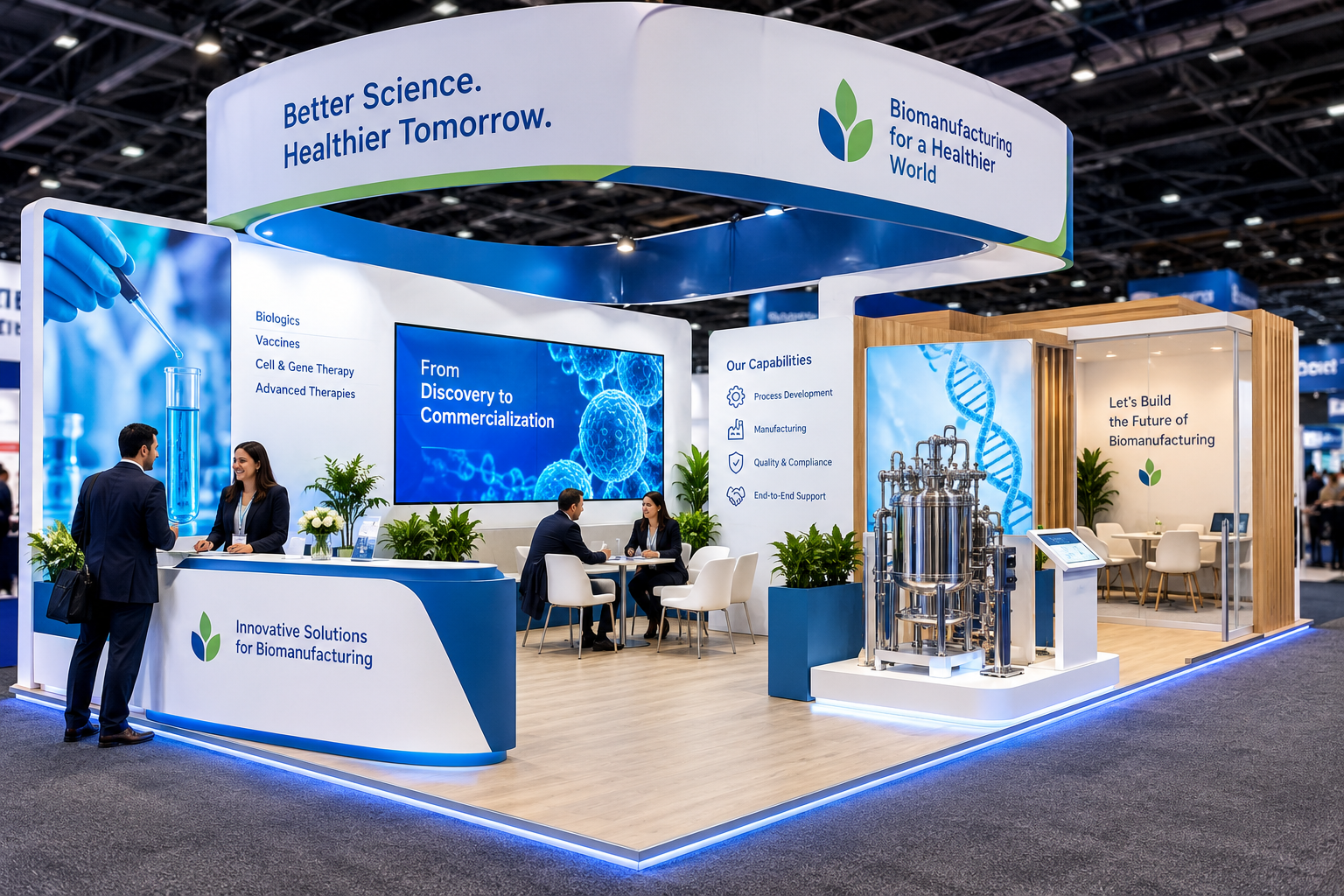
Trade shows in the biomanufacturing sector bring together companies, researchers, engineers, manufacturers, technology providers, and business professionals. With many exhibitors competing for attention, having a visually attractive space is only one part of successful exhibition planning. A booth should also communicate complex solutions clearly, encourage conversations, and make it easy for visitors to explore relevant technologies. Well-planned Biomanufacturing display booths can combine branding, demonstrations, technology, meeting areas, and educational content to create a useful visitor experience.
Why Booth Design Matters in Biomanufacturing
Biomanufacturing is a highly technical industry. Companies may need to showcase equipment, software, production systems, laboratory technologies, processing solutions, or specialized services.
Explaining these offerings inside a busy exhibition hall can be challenging.
A thoughtfully designed booth gives exhibitors an opportunity to simplify complex information without losing its technical value. It can provide different levels of information, allowing visitors to begin with a simple overview and then explore more detailed content.
The booth can also provide a professional environment for conversations with potential customers and industry partners.
1. Clear Brand Visibility
The first essential feature is recognizable branding.
Visitors should be able to identify the company from the exhibition aisle. The company name and logo should be visible without requiring visitors to enter the booth.
Branding can be incorporated into:
Back walls
Hanging signs
Reception counters
Digital screens
Product displays
Meeting areas
The visual identity should remain consistent throughout the booth.
However, excessive branding can create visual clutter. A professional booth generally benefits from a clear hierarchy where the company name and main message receive the most attention.
2. A Strong Main Message
Visitors should understand what the company does within a few seconds.
A concise headline can communicate the primary offering.
Instead of using multiple complicated statements, exhibitors can choose one central message and support it with smaller sections explaining products, applications, and technologies.
The main message should be relevant to the exhibition audience.
For example, a company presenting bioprocessing technology can use a headline that immediately identifies its area of expertise and then use visuals to explain the technology.
3. An Open Booth Layout
A booth should feel accessible from the aisle.
Open entrances can make it easier for visitors to walk into the space. Furniture and large displays should not create unnecessary barriers.
For larger booths, different zones can be established without making the layout feel crowded.
Possible zones include:
Product demonstrations
Interactive technology
Technical information
Presentations
Casual conversations
Private meetings
Storage
The layout should support natural movement between these areas.
4. Product Demonstration Areas
Demonstrations can be particularly useful when exhibiting technical products.
A physical demonstration allows visitors to see how a product works rather than simply reading about it.
Demonstration areas should be visible and easy to approach.
If a product is too large to bring to the exhibition, companies can use a smaller model, component, digital simulation, or video demonstration.
The goal is to make the technology understandable and relevant.
5. Interactive Technology
Interactive technology can encourage visitors to spend more time exploring a booth.
Touchscreens can allow visitors to select products or applications. Digital models can explain equipment components. Animated process diagrams can show manufacturing workflows.
Interactive displays should provide useful information rather than simply playing promotional content.
The visitor should be able to control the experience or explore topics according to their interests.
6. Effective Technical Graphics
Technical graphics can help explain complicated concepts.
Instead of filling booth walls with paragraphs, companies can use:
Process diagrams
Infographics
Flowcharts
Product illustrations
Application graphics
Technical animations
Comparison graphics
These elements can communicate information quickly.
A well-designed process graphic can show how a technology fits into a larger manufacturing workflow, helping visitors understand its practical application.
7. Comfortable Meeting Areas
Trade shows are important networking environments.
Visitors may want to discuss product requirements, technical challenges, partnerships, or future projects.
A booth should therefore include appropriate spaces for conversations.
Small open tables can support quick discussions, while private meeting rooms can accommodate longer conversations.
Meeting areas should be comfortable but should not dominate the entire booth.
8. Strategic Lighting
Lighting can highlight important areas of the booth.
Focused lighting can draw attention to products and demonstrations.
Backlighting can emphasize graphics and brand messages.
Ambient lighting can create a comfortable environment for meetings.
Lighting should also be coordinated with digital screens to prevent reflections.
A professional lighting plan can make products and graphics easier to see throughout the event.
9. Organized Information
Visitors may request different types of information.
Some may only want a quick overview, while others may ask for technical specifications or detailed documentation.
The booth can use a combination of physical and digital resources.
Printed brochures can provide essential information, while QR codes can connect visitors to:
Technical documents
Product pages
Case studies
Videos
Application guides
Contact forms
This approach keeps the physical booth organized while still providing access to detailed information.
10. Knowledgeable Booth Staff
The people working inside the booth are one of its most important components.
Staff should understand the products and be able to explain technical concepts clearly.
They should also be able to identify visitor needs.
A simple conversation can begin with questions about the visitor's role or interests. Once staff understand what the visitor is looking for, they can introduce the most relevant solution.
Technical experts should be available for detailed questions whenever possible.
Designing for Different Visitor Interests
Not every exhibition visitor will have the same priorities.
A researcher may want to understand technical performance. An engineer may be interested in system integration. A manufacturing manager may focus on workflow and implementation. A business decision-maker may want to understand commercial applications.
The booth should therefore provide layered information.
A strong headline can provide the initial message. Product graphics can provide additional context. Demonstrations and technical representatives can provide deeper information.
This structure allows different visitors to engage at their own level.
Use Real-World Applications
Applications often provide more context than product features alone.
A company can show how its technology fits into actual biomanufacturing workflows.
Case studies can demonstrate how a particular challenge was addressed. Process diagrams can show where equipment or software fits into production.
Application-focused displays can help visitors understand how a solution may relate to their own work.
Create an Educational Experience
A trade show booth can also function as a learning environment.
Short presentations, technical demonstrations, expert discussions, and interactive displays can help visitors learn about emerging technologies.
Scheduled sessions can encourage visitors to return to the booth.
The content should be relevant to the exhibition audience and presented in a format that is easy to follow in a busy environment.
Keep the Booth Visually Balanced
A professional booth needs a balance between information and open space.
Too much text can make the space difficult to understand.
Too many displays can make it difficult for visitors to focus.
Too much empty space, however, may leave the booth without enough useful information.
A balanced design gives each important element enough room to stand out.
Include Hidden Storage
Storage is an often-overlooked aspect of booth planning.
Exhibition materials, staff belongings, packaging, brochures, and equipment accessories need to be stored somewhere.
Integrated cabinets and counters can keep these items hidden.
This allows the booth to remain organized throughout the event.
Think About Sustainability
Companies can also consider sustainable booth solutions.
Reusable structures and modular components can potentially be used across multiple exhibitions.
Digital brochures and online resources can reduce the amount of printed material.
Durable graphics and reusable furniture can also support longer-term exhibition planning.
The specific materials should be selected according to event requirements and the company's objectives.
Plan Installation Carefully
A successful booth design also needs to be practical to build.
Exhibitors should consider installation schedules, venue rules, electrical requirements, structural limitations, shipping, storage, and dismantling.
Technical products may require additional handling or demonstration requirements.
Working with an experienced booth builder can help coordinate these details before the exhibition begins.
Measure the Results
After the event, exhibitors can review how effectively the booth supported their goals.
Useful measurements can include:
Qualified leads
Product demonstrations
Technical discussions
Scheduled meetings
Information requests
QR-code interactions
Follow-up opportunities
Staff feedback can also provide useful insight into which booth elements attracted the most attention.
Selecting the Right Exhibition Partner
A booth builder can help translate an exhibition strategy into a physical environment.
When comparing potential partners, companies can review their experience with technical and life sciences exhibitions, custom design capabilities, construction methods, graphics, technology integration, project management, installation, and dismantling services.
The right partner should be able to balance visual design with practical requirements.
This is particularly important for companies presenting complex technologies where accuracy and clarity are essential.
Conclusion
High-impact exhibition spaces require more than attractive graphics. Effective Biomanufacturing display booths combine clear branding, concise messaging, open layouts, demonstrations, interactive technology, technical graphics, comfortable meeting spaces, strategic lighting, organized information, and knowledgeable staff. Together, these elements can create an exhibition environment that makes complex technologies easier to understand while encouraging meaningful professional conversations.
For exhibitors preparing for BioProcess International Conference & Exhibition 2026, early planning can help coordinate booth design, technical displays, graphics, logistics, and visitor engagement. Companies can evaluate their exhibition objectives first and then select a booth-building approach that supports those goals. To explore suitable options for the event, exhibitors can review Biomanufacturing display booths while planning their participation.