
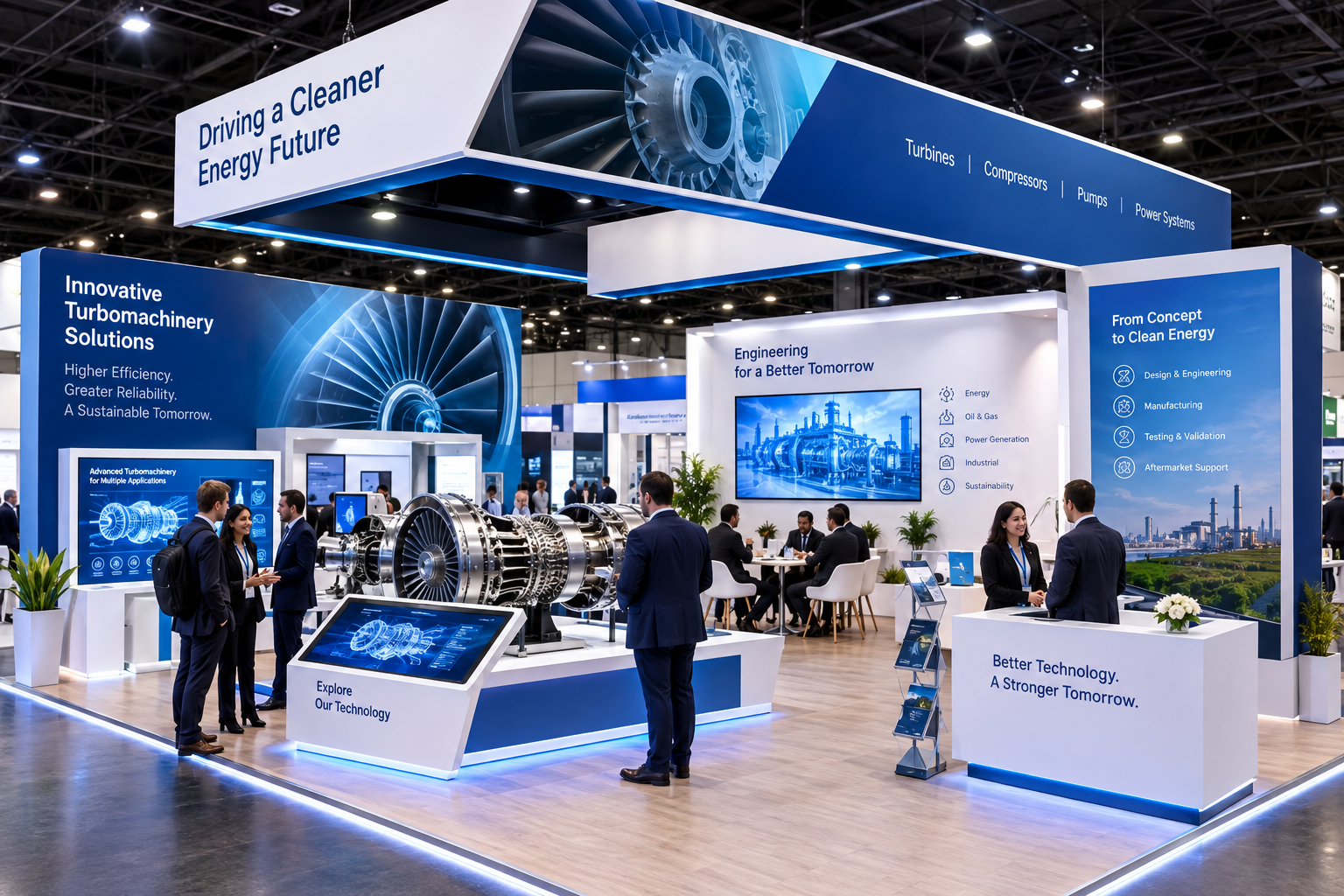
Turbomachinery Display Booths: Common Design Mistakes and How to Avoid Them
Trade shows give turbomachinery companies an opportunity to present complex engineering solutions, demonstrate products, meet industry professionals, and build valuable business relationships. However, having a booth at an exhibition does not automatically guarantee visitor engagement. The booth needs to communicate the company's expertise clearly while making it easy for visitors to explore products and start conversations. Well-planned Turbomachinery display booths can create this experience, but poor planning can make even a technically strong brand difficult to notice.
Turbomachinery exhibitions often involve sophisticated equipment, technical specifications, digital demonstrations, product models, and specialized audiences. Because there is so much information to communicate, exhibitors can easily make design decisions that create clutter, confusion, or poor visitor flow.
Understanding common mistakes before beginning the booth design process can help companies create a more organized, professional, and engaging exhibition environment.
Why Booth Design Mistakes Matter
Visitors at technical trade shows often move quickly between exhibitors. They may have a list of companies they want to meet, scheduled appointments, or specific products they want to investigate.
That means exhibitors have limited time to make a positive first impression.
A poorly planned booth may result in:
-
Low visitor engagement
-
Confusing product communication
-
Weak brand visibility
-
Difficult navigation
-
Poor-quality conversations
-
Limited product demonstrations
-
Missed lead opportunities
The good news is that many of these problems can be avoided during the planning stage.
1. Trying to Display Too Much Information
One of the most common mistakes is attempting to communicate everything at once.
Turbomachinery companies may have dozens of products, technical specifications, services, applications, and capabilities. Trying to place all of this information on booth walls can create an overwhelming environment.
Visitors may struggle to identify the most important message.
How to Avoid It
Prioritize the information.
Start with three questions:
-
What should visitors understand first?
-
Which products are most important at this event?
-
What information should encourage a conversation?
Use concise headlines, strong visuals, diagrams, and short descriptions. Detailed technical information can be provided through digital content, brochures, QR codes, or one-to-one discussions.
2. Weak or Hidden Branding
A booth may contain excellent products but still fail to attract visitors if the company name is difficult to see.
Branding should be visible from multiple directions.
How to Avoid It
Use:
-
Elevated signage
-
Large logos
-
Illuminated brand elements
-
Clear entrance graphics
-
Consistent brand colors
Visitors should be able to identify the company before they enter the booth.
3. Creating a Booth That Looks Like a Warehouse
Industrial products are naturally functional, but the booth should not simply look like a storage area for equipment.
Large machinery components placed without a visual structure can make the space feel crowded and difficult to navigate.
How to Avoid It
Create dedicated product zones.
Use platforms, lighting, signage, and graphics to give each important product its own visual context.
A product should look intentionally displayed rather than simply placed inside the booth.
4. Ignoring Visitor Flow
Another common problem is poor layout planning.
If furniture, displays, counters, and machinery models block the entrance or create narrow paths, visitors may avoid entering.
How to Avoid It
Create an open and intuitive visitor journey.
A practical flow might be:
Entrance → Brand Message → Product Display → Demonstration → Discussion → Lead Capture
Keep major pathways open and avoid unnecessary physical barriers.
5. Using Too Much Text
Technical exhibitors often rely heavily on written information.
While technical details are important, visitors may not stop to read long paragraphs on booth walls.
How to Avoid It
Convert information into visual formats.
Use:
-
Diagrams
-
Icons
-
Charts
-
Product photography
-
Infographics
-
Short headlines
-
Key statistics
A visitor should understand the main idea quickly.
Detailed explanations can happen during conversations with booth representatives.
6. Poorly Designed Product Displays
A product can be technically impressive but visually ineffective if it is positioned incorrectly.
For example, a small component placed on a low table may be difficult to see from the aisle.
How to Avoid It
Consider:
-
Product height
-
Viewing distance
-
Lighting
-
Visitor access
-
Surrounding graphics
-
Product importance
Important components can be elevated or placed within illuminated display cases.
Large equipment can become a central visual feature, while smaller components can be grouped into focused product stations.
7. Neglecting Lighting
Lighting is sometimes treated as an afterthought.
However, exhibition halls can be visually busy and brightly illuminated. A booth with poor lighting may blend into the surrounding environment.
How to Avoid It
Use multiple lighting layers.
For example:
General Lighting: Provides overall visibility.
Accent Lighting: Highlights products.
Graphic Lighting: Makes important branding visible.
Meeting Lighting: Creates a comfortable environment for discussions.
The objective is not maximum brightness. It is controlled visibility.
8. Overusing Technology
Digital screens, touchscreens, interactive displays, and augmented reality can make an exhibition booth engaging.
But technology should not be used simply because it is available.
Too many screens can distract visitors from physical products and make the booth feel unnecessarily complicated.
How to Avoid It
Choose technology based on communication needs.
Use digital tools when they help explain something that physical displays cannot easily communicate.
For example, a 3D visualization may be useful for showing internal turbine components, while a physical product sample may be more effective for demonstrating material quality.
9. Making the Booth Too Closed
Private meeting rooms can be useful, especially for B2B discussions.
However, too many enclosed areas can make a booth appear inaccessible.
Visitors may not know whether they are welcome to enter.
How to Avoid It
Balance open and private spaces.
Use open seating for casual conversations and semi-private or enclosed areas for detailed meetings.
The booth should remain visually connected to the exhibition aisle.
10. Forgetting Comfortable Seating
Technical conversations can last longer than expected.
Visitors may want to discuss product specifications, engineering requirements, project timelines, or procurement considerations.
Without comfortable seating, important conversations may be cut short.
How to Avoid It
Provide a combination of:
-
Consultation tables
-
Comfortable chairs
-
Small meeting areas
-
Semi-private seating
Furniture should support conversation without taking over the booth.
11. Poor Storage Planning
Trade show booths can become cluttered quickly.
Brochures, packaging, personal belongings, technical documents, and promotional items can end up in visible areas.
This can make a professional booth look disorganized.
How to Avoid It
Include storage from the beginning.
Options include:
-
Built-in cabinets
-
Lockable counters
-
Hidden shelving
-
Under-counter storage
-
Back-wall cabinets
Storage should be accessible to staff while remaining visually concealed from visitors.
12. Ignoring the Viewing Distance
A graphic that looks excellent from two feet away may be unreadable from twenty feet away.
Visitors need to recognize the main message before approaching the booth.
How to Avoid It
Create two levels of communication.
Distance Communication
Use:
-
Large logos
-
Short headlines
-
Bold imagery
-
Major product visuals
Close Communication
Use:
-
Specifications
-
Detailed diagrams
-
Product features
-
QR codes
-
Technical documentation
This allows the booth to communicate effectively at different distances.
13. Poorly Positioned Screens
Screens can become difficult to use when they are positioned at awkward heights or angles.
Visitors may have to stand directly in front of them, blocking other people from viewing the content.
How to Avoid It
Position screens based on expected visitor behavior.
Large displays should be visible from the aisle, while interactive screens should be placed where users can comfortably stand without disrupting traffic.
Also consider glare and surrounding lighting.
14. Using Generic Graphics
Generic industrial images may not effectively communicate what a turbomachinery company actually does.
A generic factory photograph does little to explain a specialized engineering solution.
How to Avoid It
Use graphics that directly support the company's products and applications.
Consider:
-
Real product photography
-
Technical illustrations
-
Engineering diagrams
-
Application environments
-
Product cutaways
-
Installation images
-
Performance visualizations
Relevant imagery creates stronger connections between the brand and its technology.
15. Ignoring the Target Audience
Not every visitor has the same information needs.
An engineer may want technical specifications, while a procurement manager may be more interested in reliability, service, cost considerations, and implementation.
How to Avoid It
Design content for multiple visitor types.
For example:
Engineers: Technical specifications and system details
Executives: Business value and strategic benefits
Procurement Teams: Product options and support capabilities
Operators: Performance, maintenance, and usability
This creates a more useful experience for different audiences.
16. Failing to Plan Demonstration Areas
A product demonstration often requires space for visitors and booth staff.
If the demonstration area is too small, people may block pathways or crowd around the display.
How to Avoid It
Reserve sufficient space for:
-
Equipment
-
Demonstration staff
-
Visitors
-
Screens
-
Supporting graphics
The demonstration should be visible from outside the booth while still allowing enough room for interaction.
17. Poor Coordination Between Graphics and Products
Another common mistake is designing graphics independently from physical displays.
This can result in a product sitting beside unrelated information.
How to Avoid It
Pair products with supporting content.
For example:
Physical Compressor Model + Component Diagram + Application Graphic + Digital Demonstration
This creates a complete story.
The product attracts attention, the graphic explains it, and the digital content provides deeper information.
18. Forgetting About Lead Capture
Some exhibitors focus so heavily on booth appearance that they forget what happens after the visitor leaves.
A beautiful booth does not automatically create useful business opportunities.
How to Avoid It
Integrate lead capture into the visitor journey.
Use:
-
QR codes
-
Digital forms
-
Product inquiry forms
-
Meeting booking tools
-
Business card collection
-
Follow-up preference fields
Keep the process quick and simple.
19. Not Preparing Staff for the Booth Design
Even an excellent booth can underperform if staff members do not know how to use the space effectively.
Employees may gather around one area, sit behind counters, or spend too much time talking among themselves.
How to Avoid It
Prepare the team before the event.
Staff should understand:
-
Key booth messages
-
Product demonstrations
-
Visitor qualification
-
Lead capture
-
Meeting procedures
-
Technical questions
-
Follow-up processes
The booth and staff should work as one system.
20. Choosing Appearance Over Functionality
A visually impressive booth can attract attention, but appearance alone does not guarantee a useful visitor experience.
If visitors cannot easily access products, find information, speak with staff, or move through the space, the design has missed its purpose.
How to Avoid It
Evaluate every design decision according to function.
Ask:
Does this element help visitors understand, explore, interact, or connect?
If the answer is no, consider whether it needs to be included.
How to Create a Better Turbomachinery Booth
Avoiding mistakes begins with a structured planning process.
Step 1: Define the Exhibition Objective
Determine whether the primary goal is:
-
Product launch
-
Lead generation
-
Brand awareness
-
Technical education
-
Distributor recruitment
-
Customer meetings
-
New business development
The objective should influence the entire booth design.
Step 2: Identify Key Products
Select the products or technologies that deserve the most attention.
Avoid trying to give every product equal space.
Step 3: Create a Visitor Journey
Design the booth around how visitors will enter, explore, interact, and leave.
Step 4: Build a Visual Hierarchy
Make the most important information the easiest to see.
Step 5: Add Supporting Technology
Use digital tools only where they improve understanding.
Step 6: Design for Conversations
Provide appropriate spaces for quick discussions and private meetings.
Step 7: Plan Lead Capture
Decide how visitor information will be collected before the show begins.
Step 8: Review the Booth From the Visitor's Perspective
Ask someone unfamiliar with the product to walk through the design.
Can they identify the company?
Can they understand what it offers?
Can they find the main products?
Can they tell where to speak with someone?
If these questions are difficult to answer, the design may need refinement.
How the Right Booth Builder Can Help
A specialized booth builder can help transform technical requirements into a practical exhibition environment.
When selecting a booth partner, exhibitors should review:
-
Experience with engineering exhibitions
-
Previous turbomachinery projects
-
Custom booth design capabilities
-
Technical understanding
-
3D visualization services
-
Lighting expertise
-
Graphic production
-
Installation support
-
Project management
-
Modular solutions
The right partner should understand that technical exhibition design involves more than creating an attractive structure. The booth needs to communicate products, support demonstrations, facilitate conversations, and handle the practical demands of a busy event.
Final Checklist Before the Exhibition
Before approving the final booth design, review these areas:
Branding
-
Is the company name visible from the aisle?
-
Is the main message easy to understand?
Products
-
Are important products easy to find?
-
Are displays positioned at comfortable viewing heights?
Graphics
-
Are graphics readable from different distances?
-
Is technical information presented clearly?
Lighting
-
Are key products properly illuminated?
-
Is there excessive glare?
Visitor Flow
-
Are entrances open?
-
Are pathways clear?
Meetings
-
Is there enough seating?
-
Are private discussions possible?
Technology
-
Are screens useful?
-
Are demonstrations easy to operate?
Storage
-
Is there enough hidden storage?
Lead Generation
-
Can visitor information be captured efficiently?
A final review can identify small problems before they become major issues during the event.
Conclusion
Designing an effective turbomachinery exhibition booth requires careful attention to both technical communication and visitor experience. Common mistakes such as excessive text, poor lighting, weak branding, crowded layouts, insufficient storage, and unnecessary technology can reduce the effectiveness of an otherwise strong exhibition presence.
Successful Turbomachinery display booths balance visual appeal with functionality. They make products easy to discover, technical information easier to understand, demonstrations easier to experience, and business conversations easier to conduct.
By defining clear objectives, prioritizing important products, designing a logical visitor journey, and working with an experienced booth-building partner, turbomachinery companies can avoid common design problems and create an exhibition environment that supports meaningful engagement and long-term business opportunities.


