

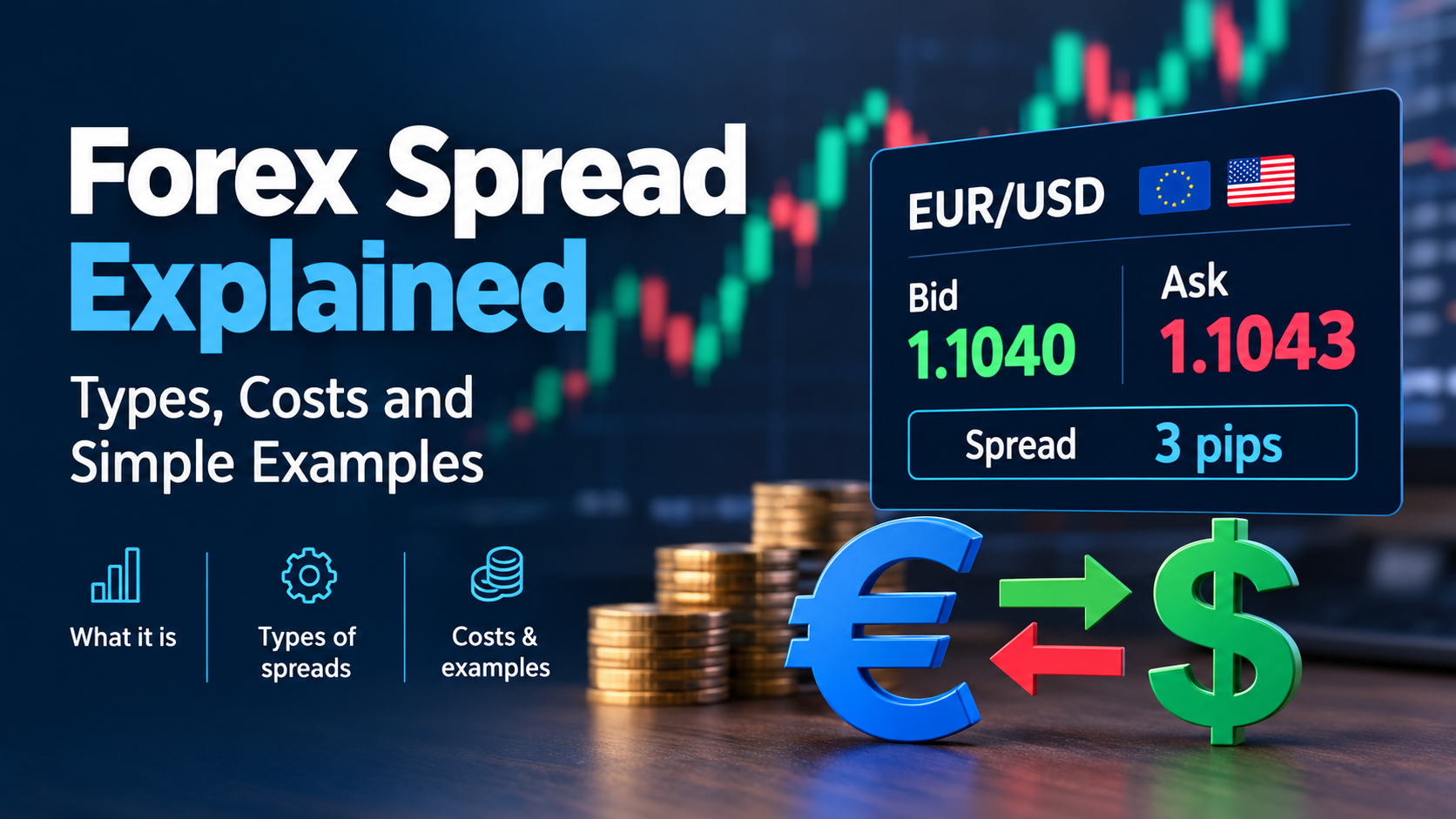
Forex Spread Explained: Types, Costs and Simple Examples
Every forex trade involves two prices: the price at which you can buy and the price at which you can sell. The difference between these two prices is called the forex spread.
Although a spread may appear to be only a small number on a trading platform, it can have a meaningful impact on trading costs. This is particularly true for short-term traders, strategies with tight stop-losses, and anyone who places a large number of trades.
Understanding how forex spreads work can help you estimate the cost of a trade before entering the market. It also explains why a newly opened position may immediately show a small loss.
What Is a Forex Spread?
A standard forex quote contains two prices: the bid and the ask.
The bid price is the price at which you can sell a currency pair, while the ask price is the price at which you can buy it. The difference between the two is known as the bid-ask spread or simply the forex spread.
For example:
|
EUR/USD Quote |
Price |
|
Bid |
1.1040 |
|
Ask |
1.1043 |
|
Spread |
3 pips |
In this example, the spread is 3 pips.
If you buy EUR/USD at 1.1043, the market generally needs to move far enough to overcome that three-pip difference before the trade reaches break-even, assuming there are no other trading costs.
If you're new to currency markets, a guide on what’s forex trading can provide more background on currency pairs, pricing, and how trades are executed.
Why Does the Forex Spread Matter?
The spread is an important part of the cost of opening a forex position.
Imagine two traders enter the same currency pair. One receives a one-pip spread, while the other pays a four-pip spread. The second trader starts the trade at a greater disadvantage because the market must move farther before the position reaches break-even.
Spreads can be especially important when:
-
The profit target is relatively small.
-
You place trades frequently.
-
Your stop-loss is tight.
-
Market volatility is elevated.
-
You trade less-liquid currency pairs.
A difference of only a few pips may seem insignificant on one trade, but those costs can add up considerably when a strategy generates many transactions.
What Are the Main Types of Forex Spreads?
Forex brokers generally offer pricing through several common structures. The three most widely discussed are fixed spreads, variable spreads, and raw spreads with commission.
Fixed Spread
A fixed spread remains at a predetermined level under normal market conditions.
One advantage is that trading costs can be easier to estimate because the bid-ask difference does not continually change. However, fixed spreads are not necessarily guaranteed under every market condition. Brokers may adjust their pricing during periods of extreme volatility or unusual market activity.
Variable Spread
A variable spread changes according to market conditions.
When liquidity is high and trading activity is strong, spreads can become narrower. During periods of low liquidity or sudden volatility, they may widen.
This is particularly relevant when trading highly volatile forex pairs, where market conditions can change rapidly.
Raw Spread With Commission
Some brokers offer raw-spread accounts, where the quoted spread can be extremely low. Instead of relying primarily on the spread to generate revenue, the broker charges a separate commission.
However, a very low advertised spread does not automatically mean the account is cheaper. Traders should compare the total cost of trading, including both the spread and commission.
Why Does the Bid-Ask Spread Widen?
Forex spreads are affected by factors such as liquidity, trading activity, volatility, and market uncertainty.
Spreads can widen during events such as:
-
Central-bank interest-rate announcements
-
Inflation reports
-
Employment data releases
-
Major political developments
-
Sudden market shocks
-
Market opening and closing periods
-
Low-volume trading sessions
For example, EUR/USD is normally one of the more liquid currency pairs, but its spread can still widen significantly around major economic announcements.
If you use EUR/USD trading signals, it is therefore important to check the actual bid and ask prices before entering a position rather than relying solely on a suggested entry price.
How Can Traders Reduce the Impact of Spread Costs?
Traders cannot determine the market spread themselves, but they can take steps to manage its impact.
Check the Current Spread Before Entering
Do not assume that a currency pair will have the same spread throughout the day. Check the live bid and ask prices before placing an order.
Compare the Total Cost of Trading
When comparing brokers or account types, look beyond the advertised spread. Consider:
-
Spreads
-
Commissions
-
Overnight or swap charges
-
Other applicable trading fees
A broker offering a very tight spread may not necessarily have the lowest overall cost.
Avoid Poor Liquidity When Possible
Spreads can become wider when trading activity and liquidity decline. Depending on your strategy, avoiding particularly thin market conditions may help reduce transaction costs.
Consider the Spread Relative to Your Target
The size of the spread matters in relation to your expected profit.
For example, a three-pip spread is much more significant when your target is only 10 pips than when your target is 100 pips.
Use Appropriate Position Sizing
Trading costs should be considered alongside your overall risk management plan. Position size, stop-loss placement, and risk-to-reward ratios should all be evaluated before entering a trade.
Our guide to forex signal risk management provides additional information on how these factors can work together.
Is a Yield Spread the Same as a Forex Spread?
No. Although both terms use the word "spread," they refer to different concepts.
A yield spread generally refers to the difference between the yields of two debt instruments, such as government bonds with different maturities.
A forex spread, on the other hand, is the difference between the bid and ask prices of a currency pair.
Yield differences can influence currency markets because changing interest-rate expectations may affect capital flows and currency demand. However, a yield spread is not the transaction spread displayed on a forex trading platform.
How Do You Calculate a Forex Spread?
Calculating a forex spread is straightforward:
Ask Price − Bid Price = Spread
For example:
-
EUR/USD bid: 1.0874
-
EUR/USD ask: 1.0876
-
Difference: 0.0002
-
Spread: 2 pips
For most major currency pairs, a difference of 0.0001 represents one pip.
However, pip conventions can differ for currency pairs involving the Japanese yen, so traders should always check how their broker quotes and calculates pip values.
A Simple Example of Forex Spread Cost
Suppose EUR/USD is quoted at:
-
Bid: 1.1000
-
Ask: 1.1003
The spread is 3 pips.
If you open a buy position, you enter at the ask price of 1.1003. If the position were immediately closed, you would normally sell at the bid price of 1.1000.
That three-pip difference is the initial spread cost, before considering commissions, swaps, or other applicable charges.
This is why a position can appear slightly negative immediately after it is opened—even when the market has barely moved.
Final Thoughts
The forex spread may be only a few pips, but it can have a noticeable effect on trading performance, particularly for short-term and high-frequency strategies.
Understanding the bid and ask, knowing how to calculate the spread, and monitoring how spreads change under different market conditions can help traders better estimate their trading costs.
Before opening a position, consider not only the potential profit but also the spread, commissions, overnight charges, liquidity, and overall risk.


