
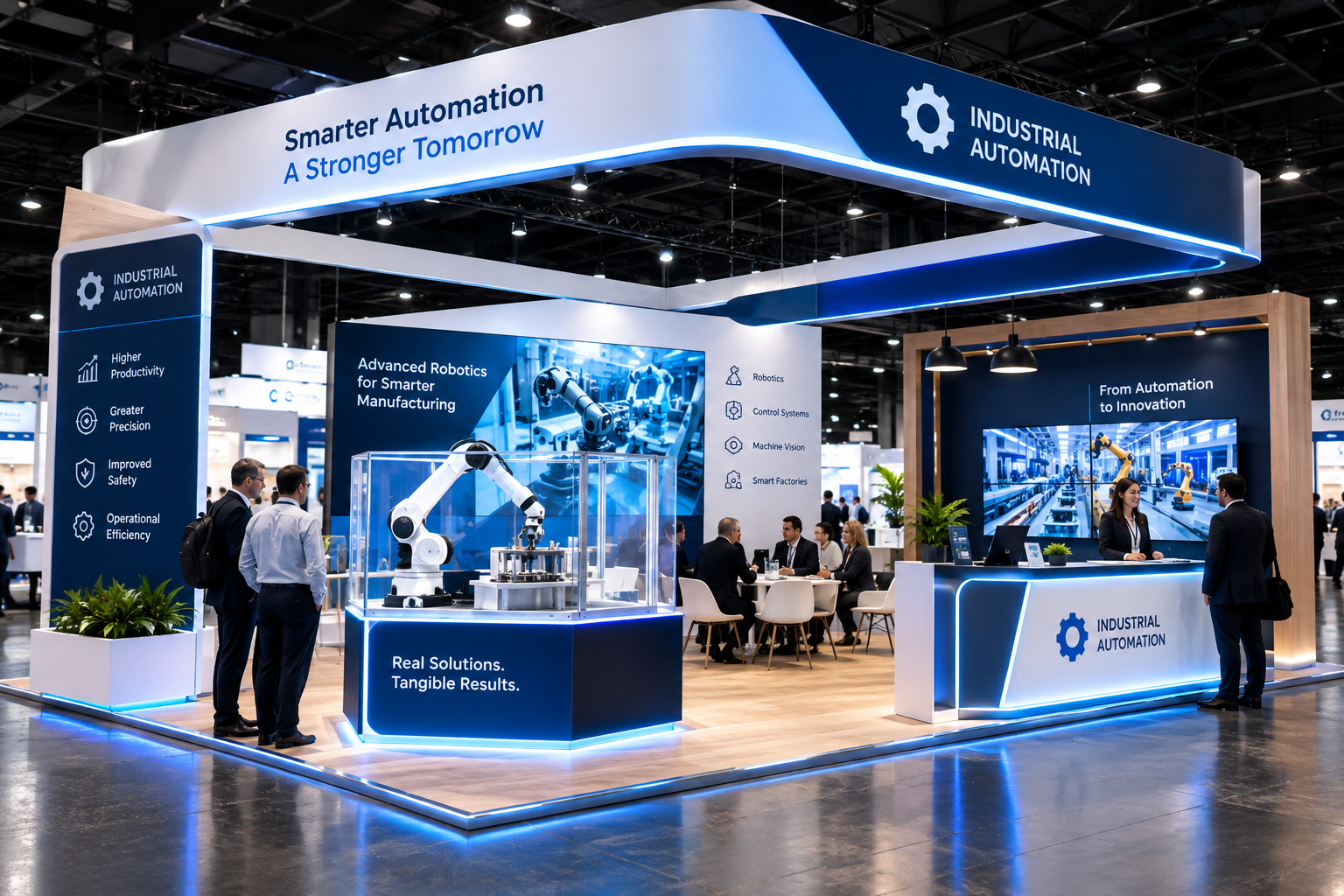
How Industrial Automation Booth Contractors Create High-Impact Trade Show Exhibits

Industrial automation companies compete in a highly technical marketplace where demonstrating technology clearly can be just as important as developing it. At major manufacturing exhibitions, visitors want to understand how automation solutions can improve productivity, precision, safety, and operational efficiency. This is where experienced Industrial automation booth contractors can make a significant difference. Rather than simply creating an attractive display, professional booth contractors develop exhibition environments that communicate complex automation technologies in an engaging and accessible way. From robotics and control systems to smart manufacturing platforms and connected machinery, a well-designed booth can transform technical capabilities into memorable visitor experiences.
Why Trade Show Exhibits Matter for Industrial Automation Brands
Trade shows remain important platforms for industrial automation companies because they bring manufacturers, engineers, distributors, technology providers, and decision-makers together in one location.
Unlike digital marketing, exhibitions allow prospects to interact directly with products and demonstrations. Visitors can see robotic systems operate, examine components, speak with technical representatives, and understand applications in real-world environments.
For industrial automation brands, the booth therefore becomes more than a marketing space. It acts as a physical demonstration center.
A successful exhibit should help visitors quickly answer questions such as:
- What does the company offer?
- Which industries does it serve?
- How does its technology solve operational challenges?
- What makes its solution different?
- Can the technology integrate with existing systems?
- What business results can customers expect?
The booth design should make these answers easy to discover.
Understanding the Needs of Industrial Automation Exhibitors
Industrial automation exhibits often involve sophisticated equipment and technical information. A conventional booth design may not provide enough space or structure for demonstrations.
Companies may need areas for:
- Robotic demonstrations
- Machinery displays
- Control panels
- Interactive touchscreens
- Product samples
- Technical presentations
- Video demonstrations
- Customer meetings
- Product consultations
- Lead-generation activities
Industrial automation booth contractors must understand these requirements before developing the exhibit concept.
The booth needs to accommodate technology while maintaining visitor flow and visual clarity.
Creating a Strong Booth Concept
The first step in creating a high-impact exhibit is developing a clear concept.
A booth should have a central message rather than attempting to communicate every product or service simultaneously. When visitors approach the exhibit, they should immediately understand what the company specializes in.
For example, an automation company could position its booth around:
Smart Manufacturing
Industrial Robotics
Factory Automation
Connected Production
Digital Transformation
The visual identity, demonstrations, graphics, and meeting areas can then support that central theme.
A strong concept creates consistency throughout the exhibit.
Designing Around Product Demonstrations
Industrial automation is inherently visual. Visitors often understand automation technology better when they can see it operating.
Consequently, product demonstrations should be considered during the booth design process rather than added as an afterthought.
A robotic arm performing a programmed task, for example, can attract attention from across an exhibition hall. Similarly, a live demonstration of automated inspection, material handling, machine vision, or process control can give visitors a practical understanding of the technology.
The booth layout should provide sufficient space around demonstrations while maintaining visitor safety and accessibility.
Making Complex Technology Easy to Understand
One of the biggest challenges for automation companies is explaining complex technology to visitors with different levels of technical knowledge.
An engineer may want detailed specifications, while a business executive may be more interested in productivity and return on investment.
A successful booth can address both audiences through layered communication.
Level One: The Main Message
Large graphics can communicate the primary value proposition.
Level Two: Product Information
Screens and signage can provide more detailed information about individual solutions.
Level Three: Technical Interaction
Technical representatives can explain specifications, integration requirements, software capabilities, and applications.
This approach prevents the booth from becoming overloaded with technical text.
Strategic Use of Technology
Technology can enhance an industrial automation exhibit when it serves a clear purpose.
Interactive displays can allow visitors to explore:
- Production workflows
- Automation processes
- Product configurations
- Machine capabilities
- Industry applications
- System integrations
- Performance data
Touchscreens can also help sales teams personalize demonstrations.
For example, a visitor from the automotive sector could explore automation applications relevant to automotive manufacturing, while a food-processing professional could see solutions applicable to packaging or material handling.
Incorporating Large Digital Displays
Large LED screens and high-resolution displays can help communicate technical concepts from a distance.
Instead of using screens simply for promotional videos, companies can use them to explain processes visually.
Animated graphics can show how components interact within an automated production line. Videos can demonstrate equipment operating in facilities that cannot be recreated on the show floor.
This makes digital content particularly valuable when the company's machinery is too large, complex, or expensive to transport.
Designing for Visitor Flow
An attractive booth can still perform poorly if its layout creates congestion.
Visitor movement should be considered from the moment someone sees the booth from the aisle.
A well-planned exhibit typically includes:
- An attention-grabbing front area
- Clear product demonstration zones
- Interactive engagement points
- Comfortable consultation areas
- Storage and operational spaces
- Clearly defined staff areas
Open layouts can make the booth feel more inviting.
At the same time, demonstration equipment should be positioned so visitors can observe it without obstructing major pathways.
Creating an Engaging First Impression
Exhibition halls are crowded with competing brands. Visitors may pass hundreds of booths during a single event.
The exhibit therefore needs strong visual communication.
Industrial automation companies can create an immediate impression through:
- Large-scale branding
- Strategic lighting
- Dynamic digital content
- Distinctive architecture
- Demonstration machinery
- Clean product displays
- High-quality graphics
However, visual impact should always support the company's brand and message.
A booth that is visually impressive but difficult to understand may not generate meaningful engagement.
The Importance of Lighting
Lighting is sometimes overlooked in industrial exhibition design.
Proper lighting can direct attention toward important products and demonstrations. It can also create visual separation between different areas of the booth.
For example, focused lighting can highlight a robotic system, while softer lighting can make a meeting area more comfortable.
Backlit graphics and illuminated branding can also improve visibility from across a large exhibition hall.
Building Dedicated Meeting Areas
Industrial automation purchases often involve complex sales cycles.
A visitor may need to discuss technical requirements, production volumes, integration challenges, pricing, or implementation timelines.
For this reason, an exhibit should include private or semi-private meeting areas where conversations can continue away from the main traffic flow.
Meeting spaces should be comfortable without occupying so much of the booth that they reduce product visibility.
The ideal balance allows the booth to remain active and welcoming while providing appropriate areas for deeper business discussions.
Using Graphics to Support the Sales Message
Exhibition graphics should communicate quickly.
Instead of filling walls with paragraphs of technical information, companies can use visual storytelling.
Graphics might communicate:
Problem → Automation Solution → Business Outcome
For example:
Manual inspection → Automated machine vision → Faster and more consistent quality control
This format allows visitors to understand the business value of the technology without reading extensive technical material.
Demonstrating Industry Applications
Industrial automation solutions can often serve multiple industries.
Rather than displaying only product specifications, exhibitors can demonstrate practical applications.
Industry-specific messaging might focus on:
- Automotive manufacturing
- Aerospace production
- Electronics manufacturing
- Food and beverage
- Pharmaceuticals
- Logistics
- Packaging
- Metal fabrication
- Energy
- General manufacturing
Application-focused displays can help visitors recognize how a solution could fit into their own operations.
Integrating Branding With Technical Design
Industrial brands sometimes face a challenge when combining corporate branding with highly technical equipment.
The solution is not to hide the machinery behind excessive graphics.
Instead, the booth should use architecture, flooring, lighting, signage, and graphics to create a consistent environment around the technology.
The equipment remains the centerpiece while the surrounding design reinforces the company's identity.
This creates a professional and cohesive presentation.
Safety Should Be Part of the Design
Industrial automation demonstrations may involve moving machinery, robotics, electrical equipment, or other operational systems.
Safety should therefore be incorporated into booth planning from the beginning.
Depending on the demonstration, exhibitors may need:
- Safety barriers
- Clearly marked boundaries
- Appropriate spacing
- Controlled access
- Safety signage
- Emergency considerations
- Proper equipment positioning
Professional exhibit planning should account for venue requirements and applicable regulations.
Supporting Lead Generation
The ultimate objective of many trade show exhibits is to create meaningful business opportunities.
A booth should make it easy for visitors to take the next step.
Lead-generation methods can include:
- QR codes
- Digital forms
- Product consultation requests
- Demonstration bookings
- Meeting scheduling
- Downloadable technical resources
- Contact forms
Lead collection should be simple and relevant.
Visitors should not have to complete a lengthy process merely to request additional information.
Designing for Different Visitor Personas
Not every trade show visitor has the same priorities.
A plant manager may focus on efficiency.
An engineer may want technical specifications.
A procurement professional may evaluate cost and implementation.
A company executive may focus on strategic business outcomes.
A flexible exhibit can provide different engagement paths for each audience.
Interactive displays can provide technical depth, while headline graphics communicate high-level business benefits.
Choosing the Right Booth Contractor
Selecting the right contractor is an important part of exhibition planning.
Companies should evaluate contractors based on more than visual portfolio quality.
Important considerations include:
- Experience with technology-focused exhibits
- Understanding of industrial environments
- Demonstration planning capabilities
- Project management
- Graphic production
- Installation services
- Dismantling support
- Technology integration
- Safety planning
- Ability to meet exhibition deadlines
A contractor should also understand the objectives of the exhibiting company.
The best exhibit is not necessarily the largest one. It is the one that supports the company's goals most effectively.
Planning for IMTS and Manufacturing Exhibitions
Manufacturing exhibitions attract audiences with strong technical expertise. Events such as IMTS provide opportunities for automation companies to present machinery, software, robotics, components, and manufacturing technologies.
The competitive environment makes preparation particularly important.
Companies should begin planning early enough to finalize:
- Booth objectives
- Exhibit size
- Product demonstrations
- Graphics
- Technology
- Logistics
- Staff requirements
- Meeting schedules
- Lead-generation systems
Early planning reduces last-minute decisions and provides greater opportunity to refine the visitor experience.
Measuring Trade Show Performance
A high-impact booth should also support measurable business objectives.
Companies can evaluate performance through metrics such as:
- Qualified leads
- Product demonstrations
- Meetings held
- New contacts
- Follow-up requests
- Sales opportunities
- Engagement with interactive content
- Post-event conversions
These metrics help companies understand whether the exhibit generated meaningful business value.
The results can also inform future booth improvements.
How Design Influences Brand Perception
A trade show booth communicates something about the company before a sales representative says a word.
A well-organized, modern, technically capable exhibit can reinforce perceptions of innovation and professionalism.
For an industrial automation company, this is particularly important because customers are often evaluating technology providers for long-term partnerships.
The exhibit should therefore reflect qualities that the company wants customers to associate with its brand, such as reliability, precision, innovation, efficiency, and technical expertise.
The Value of Professional Exhibit Planning
Creating an effective industrial automation exhibit requires coordination between branding, architecture, technology, logistics, safety, and marketing.
Professional contractors can bring these elements together into one cohesive environment.
Instead of treating the booth as a collection of graphics and equipment, they can approach it as a complete visitor experience.
This can help companies attract attention, explain complex products, facilitate business conversations, and create stronger connections with prospective customers.
Preparing for Future Trade Show Success
Exhibition strategies should evolve after every event.
Companies can review which demonstrations attracted the most attention, which graphics generated questions, which areas remained underused, and which conversations resulted in qualified opportunities.
This information can guide future booth designs.
A successful exhibit is therefore not a one-time project. It can become part of a broader trade show marketing strategy that improves over time.
Conclusion
Industrial automation companies operate in an industry where technology, precision, and innovation are central to business success. A professionally designed exhibition environment can translate those qualities into a physical experience that visitors can see, understand, and interact with. From product demonstrations and interactive technology to strategic graphics, visitor flow, meeting spaces, and safety considerations, every element should contribute to a clear purpose. Working with experienced Industrial automation booth contractors can help exhibitors develop trade show environments that present complex solutions effectively while creating valuable opportunities for engagement and business development.


