
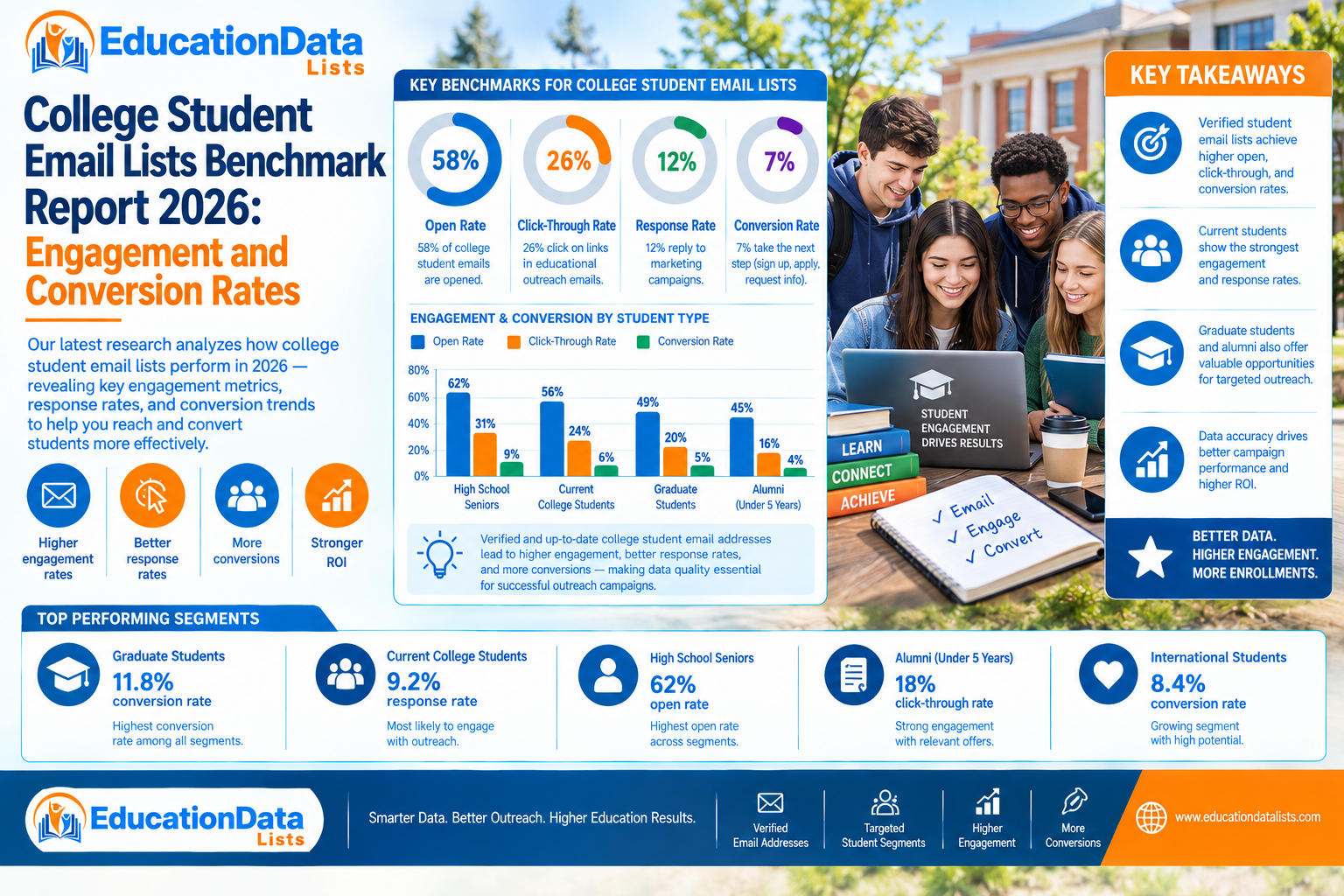
College Student Email Lists Benchmark Report 2026: Engagement and Conversion Rates | EducationDataLists

Introduction
The U.S. higher-education market represents a substantial addressable audience for education marketers: NCES reports 13.95 million undergraduate full-time-equivalent students across Title IV institutions in 2024–25. Yet reaching students through email is not simply a volume exercise. MailerLite's 2025 benchmark, based on more than 3.6 million campaigns, found that higher-education emails generated a 2.15% median click rate, 9.15% click-to-open rate, and 43.98% open rate.
For marketers evaluating College Student Email Lists, these figures provide useful external benchmarks—but they are not universal conversion targets. Student communication preferences, message relevance, timing, data quality, consent, and the specific conversion objective all influence results. This 2026 benchmark report examines the latest evidence and explains how marketers can turn student email data into measurable engagement and conversion without confusing list size with campaign performance.
How Large Is the College Student Email Market in 2026?
The potential audience is substantial, but it is also highly segmented.
NCES's Integrated Postsecondary Education Data System reports 16.79 million 12-month full-time-equivalent students at Title IV institutions in 2024–25, including approximately 13.95 million undergraduate FTE students and 2.33 million graduate students.
The 2023–24 IPEDS data similarly recorded more than 21.6 million unduplicated undergraduate students over the 12-month period, illustrating why headcount and full-time-equivalent enrollment should not be treated as interchangeable measures.
For marketers, this distinction matters.
A College Student Email Database should not be evaluated solely by the number of records it contains. A database can become substantially more useful when records are segmented by factors such as:
-
Institution
-
Undergraduate or graduate status
-
Academic program
-
Location
-
Enrollment status
-
Student interests
-
Graduation timeframe
-
Relevant engagement history
A 100,000-record audience with poor segmentation can be less valuable than a much smaller audience that closely matches a campaign's objective.
What Are the 2026 Higher-Education Email Engagement Benchmarks?
The strongest current public benchmark comes from MailerLite's 2025 dataset, which covers more than 3.6 million campaigns from 181,000 approved accounts between December 2024 and November 2025.
For higher education, MailerLite reports:
| Metric | Higher Education Benchmark |
|---|---|
| Open rate | 43.98% |
| Click rate | 2.15% |
| Click-to-open rate | 9.15% |
| Unsubscribe rate | 0.10% |
The overall benchmark across all industries was a 43.46% open rate, 2.09% click rate, 6.81% click-to-open rate, and 0.22% unsubscribe rate.
Higher education therefore showed a slightly higher click rate and substantially higher click-to-open rate than the overall dataset.
However, marketers should not interpret the 43.98% open rate as a precise measure of human attention. MailerLite notes that Apple Mail Privacy Protection can inflate open measurements, making click rate a more reliable indicator of engagement.
Which metric should marketers prioritize?
For campaigns using College Student Email Lists, click rate is generally more actionable than open rate because a click represents an observable interaction with campaign content.
A useful hierarchy is:
Delivered → Clicked → Completed desired action → Converted
The final two stages are where campaign economics become meaningful.
What Do Students Actually Want From College Emails?
Student communication research provides an important counterpoint to raw email benchmarks: students may value email while simultaneously becoming more selective about what they engage with.
SchoolFinder Group's 2026 Prospective Student Communication Survey, based on more than 1,800 students who requested information through its platform in 2025, found that email-only was the preferred communication channel for 52.9% of respondents. Text messages were preferred by 32.5%, social media by 31.6%, and physical mail by 29.4%.
The survey also found that students ranked useful, relevant content as the most important quality in an email from a school. Relevance ranked second, followed by response speed, mobile/desktop presentation, subject line, graphics, and personalization.
This is an important distinction.
Email remains a preferred channel, but that does not mean students want more generic email.
What does this mean for a College Student Mailing List?
It suggests that list segmentation should be connected to the reason a student is receiving the message.
For example, different campaigns might target:
-
Prospective applicants
-
Current undergraduate students
-
Graduate students
-
International students
-
Students nearing graduation
-
Students interested in specific programs
-
Students who registered for an event
-
Students who previously engaged with content
The objective should be to make the message relevant to the student's current information need.
How Frequently Do Students Want to Hear From Colleges?
Frequency is another important variable.
SchoolFinder Group's 2026 research indicates that students increasingly favor selective communication rather than constant messaging. The survey found that 44.7% of students open to text communication preferred receiving texts only when the school had something important to share.
The same research found that email remains the dominant channel preference, but students also increasingly consider SMS, social media, and other channels.
This points toward a broader principle for student email marketing:
The goal is not maximum frequency; it is maximum relevance per message.
A campaign calendar should therefore distinguish between important transactional or deadline-driven communications and promotional messages.
Is There a Standard Conversion Rate for College Student Email Lists?
No reliable public benchmark currently establishes a universal conversion rate for College Student Email Lists.
This is an important limitation because “conversion” can mean very different things in higher education and student marketing.
Examples include:
-
Application started
-
Application completed
-
Event registration
-
Campus visit
-
Webinar registration
-
Scholarship inquiry
-
Course enrollment
-
Information request
-
Content download
-
Donation
-
Product purchase
-
Subscription
-
Career-service registration
A 2% click rate can produce very different business outcomes depending on the landing page and conversion objective.
For example, a campaign generating 2,000 clicks from 100,000 delivered messages may appear successful at the email level. But if only 20 people complete the desired action, the conversion rate from delivered email is 0.02%.
That is why marketers should report stage-specific conversion rates rather than claiming that an email list has one universal conversion rate.
How Should Student Email Conversion Be Measured?
A 2026 student-email measurement framework can be divided into four stages.
1. Delivery rate
This measures whether the email was accepted by the receiving mail system.
2. Engagement rate
Track:
-
Click rate
-
Click-to-open rate
-
Replies
-
Landing-page visits
-
Unsubscribes
3. Conversion rate
Define one specific action, such as:
Conversions ÷ unique clicks × 100
For campaigns where delivery-level conversion is more meaningful:
Conversions ÷ delivered emails × 100
Both can be useful, but they answer different questions.
4. Downstream value
For commercial campaigns, continue measurement through:
-
Qualified leads
-
Applications
-
Enrollments
-
Purchases
-
Revenue
-
Customer acquisition cost
-
Return on marketing investment
This prevents a high-click campaign from being incorrectly classified as a high-performing campaign when the downstream action rate is weak.
Why Does Email Deliverability Matter for College Student Campaigns?
Even a highly targeted database cannot generate engagement if messages fail to reach the inbox.
Validity's 2026 Email Deliverability Benchmark Report found a global inbox placement rate of 87.2% in 2025. For the education sector specifically, inbox placement was 87.6%, with 7.9% of messages placed in spam and 4.5% classified as missing.
This means deliverability deserves its own KPI.
A marketer sending 100,000 emails cannot assume that 100,000 people actually had the opportunity to see the message.
The practical funnel is closer to:
Database → Delivered → Inbox → Opened → Clicked → Converted
Losses can occur at every stage.
How Fast Does Student Email Data Become Outdated?
Professional and consumer contact information changes over time, making database maintenance essential.
ZeroBounce's 2026 Email List Decay Report analyzed more than 11 billion email addresses processed during 2025 and found that at least 23% of email-list data decayed within one year. ZeroBounce also reported that more than 9% of the email addresses it checked in 2025 were catch-all addresses, which can be difficult to validate reliably.
This is a cross-industry benchmark—not a claim that 23% of college-student addresses become invalid every year.
Nevertheless, it demonstrates why a College Student Email Database needs ongoing maintenance.
Students may:
-
Change institutions
-
Graduate
-
Leave a program
-
Lose access to institutional accounts
-
Change status
-
Use personal addresses for different activities
-
Become inactive
A static database therefore becomes less reliable over time.
What Are the Privacy Considerations for College Student Email Data?
Student email marketing requires careful attention to the distinction between publicly available information, institutional directory information, and protected education records.
The U.S. Department of Education's Student Privacy Policy Office explains that FERPA allows institutions to disclose appropriately designated directory information without prior consent, provided the institution has given required public notice and the eligible student has not opted out.
However, that does not mean that every student record can automatically be used for marketing.
FERPA's rules depend on the institution's policies, the type of information involved, the purpose of disclosure, and applicable exceptions. The Department of Education's current 2026 guidance continues to emphasize these distinctions.
Marketers should therefore verify the lawful basis and permitted use of student data rather than assuming that possession of an email address automatically creates marketing permission.
What Does Recent Student Research Say About Email Effectiveness?
A 2025 peer-reviewed study examined email communication among 5,539 doctoral students in a randomized factorial experiment. The researchers specifically investigated how communication emails affected web-survey response rates, representativeness, and response bias.
The value of this study is methodological: it demonstrates that email communication design can be experimentally tested rather than evaluated only through observational metrics.
For marketers, the lesson is to test variables such as:
-
Subject line
-
Message length
-
Sender identity
-
Call-to-action
-
Timing
-
Follow-up sequence
-
Content relevance
Rather than assuming one format works for every student audience, organizations can run controlled experiments and measure incremental performance.
How Should College Student Mailing Lists Be Segmented?
A strong segmentation model combines demographic, academic, behavioral, and lifecycle variables.
Academic segmentation
Examples include:
-
Undergraduate vs. graduate
-
Major or field
-
Year of study
-
Institution type
-
Program
Lifecycle segmentation
Consider:
-
Prospective student
-
Newly admitted student
-
Enrolled student
-
Near-graduation student
-
Alumni
Behavioral segmentation
Use available first-party engagement such as:
-
Previous clicks
-
Event attendance
-
Content downloads
-
Website visits
-
Application activity
-
Prior responses
Geographic segmentation
Location can also influence messaging, particularly for regional programs, campus events, and location-specific opportunities.
The goal is to avoid treating millions of students as one homogeneous audience.
What Should Marketers Do With a College Student Email List in 2026?
1. Use click rate as a core engagement KPI
The higher-education benchmark of 2.15% provides a useful external reference point, while individual campaigns should be evaluated against their own historical performance.
2. Define conversion before launching the campaign
Decide whether success means an application, registration, purchase, download, enrollment, or another measurable action.
3. Segment aggressively but responsibly
Use academic, institutional, lifecycle, and first-party behavioral attributes to make communications more relevant.
4. Refresh and validate the data
ZeroBounce's 23% annual decay finding reinforces the need for ongoing list hygiene.
5. Respect student privacy and communication preferences
Do not assume that an available email address equals unrestricted marketing permission. Review institutional policies, applicable privacy requirements, consent status, and suppression requests before activating a campaign.
EducationDataLists can serve as a resource when marketers need education-focused contact data, but database providers and campaign owners should distinguish between data availability, verification, and permission to communicate.
2026 College Student Email Benchmark Scorecard
For practical campaign management, marketers can use the following scorecard:
| KPI | 2026 Reference |
|---|---|
| Higher education open rate | 43.98% |
| Higher education click rate | 2.15% |
| Higher education CTOR | 9.15% |
| Higher education unsubscribe rate | 0.10% |
| Global inbox placement | 87.2% |
| Education-sector inbox placement | 87.6% |
| Education-sector spam placement | 7.9% |
| Education-sector missing rate | 4.5% |
| Annual list decay benchmark | At least 23% |
The figures come from different datasets and should not be combined into a single performance model. MailerLite measures email campaign engagement, Validity measures deliverability, and ZeroBounce measures email-data quality. Each answers a different question.
Conclusion
The 2026 benchmark evidence shows that college-student email marketing should be evaluated as a complete funnel rather than through list size or open rate alone. Higher education recorded a 2.15% median click rate and 9.15% click-to-open rate in MailerLite's 2025 dataset, while Validity reported 87.6% inbox placement for the education sector. At the same time, ZeroBounce's latest research found that at least 23% of email-list data decays within a year.
For marketers using College Student Email Lists, the strongest 2026 strategy is therefore built around accurate data, relevant segmentation, responsible communication, strong deliverability, and clearly defined conversion events. There is no universal student-email conversion rate—and that is precisely why organizations should benchmark their own campaigns against credible industry references while continuously testing what produces measurable downstream results.
Frequently Asked Questions
What is the 2026 benchmark for college student email engagement?
There is no single benchmark specifically for third-party college-student lists. MailerLite's 2025 higher-education dataset reports a 43.98% open rate, 2.15% click rate, and 9.15% click-to-open rate, which provides a useful directional benchmark.
What is a good conversion rate for College Student Email Lists?
There is no reliable universal conversion benchmark because conversion objectives vary widely. An application, event registration, purchase, download, and enrollment are fundamentally different conversion events, so marketers should define and benchmark each conversion separately.
How large is the U.S. college student market?
NCES reports approximately 13.95 million undergraduate full-time-equivalent students and 16.79 million total 12-month FTE students at Title IV institutions in 2024–25. These figures describe enrollment, not the number of unique email addresses available for marketing.
Do college students still prefer email?
Yes. SchoolFinder Group's 2026 prospective-student survey found that 52.9% of respondents selected email-only as their preferred communication channel, making email the leading option in that survey. The research also found that students place high importance on useful content and relevance.
How often should a College Student Email Database be updated?
There is no universal refresh interval, but ongoing maintenance is important. ZeroBounce's 2026 research found that at least 23% of email-list data decayed within one year across the data it analyzed, supporting regular validation and suppression of outdated records.
Is open rate still a reliable student-email KPI?
Open rate is useful as a directional trend but should not be treated as the sole measure of engagement. MailerLite notes that Apple Mail Privacy Protection can inflate opens, making click rate a more dependable engagement indicator.
What click rate should marketers target for college-student campaigns?
The 2025 MailerLite benchmark for higher education was 2.15%, but this should be used as a comparison point rather than a guaranteed target. Campaign purpose, audience quality, message relevance, CTA design, and sending context can all materially affect click performance.
Can student email addresses be used for marketing?
Not automatically. FERPA permits certain appropriately designated directory information to be disclosed under specific conditions, but institutions' policies, opt-outs, consent requirements, the purpose of use, and other applicable laws must be considered. Marketers should verify the permitted use of student data before sending promotional communications.
What is the most important metric for a college student email campaign?
The most useful KPI depends on the campaign objective, but marketers should ultimately prioritize the conversion that represents business or program value. Clicks and replies can diagnose engagement, while applications, registrations, enrollments, purchases, or qualified leads provide stronger evidence of downstream effectiveness.


