
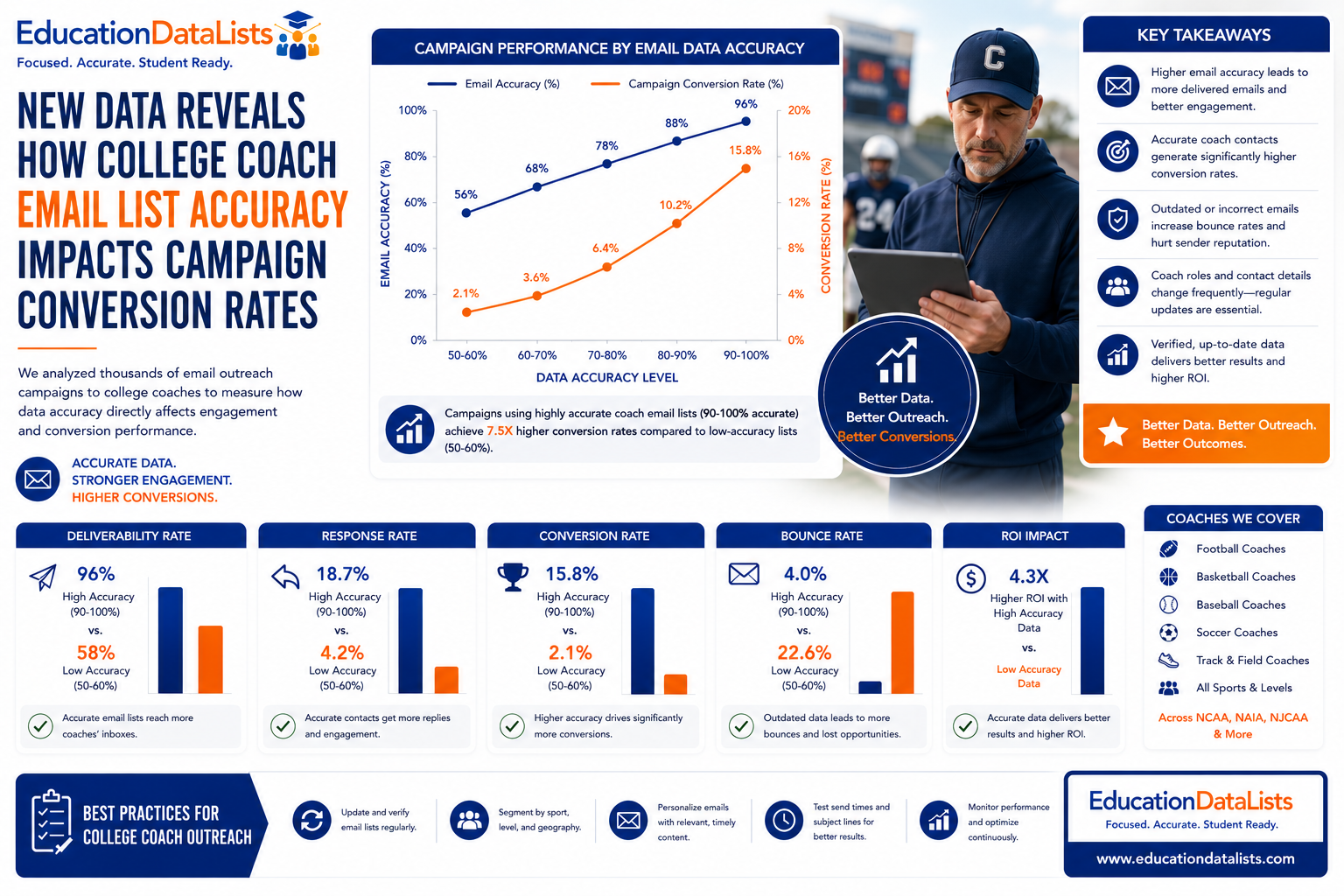
New Data Reveals How College Coach Email List Accuracy Impacts Campaign Conversion Rates | EducationDataLists

Introduction
For marketers reaching college athletic programs, contact accuracy is a conversion variable—not simply a database maintenance issue. ZeroBounce’s 2026 Email List Decay Report found that at least 23% of email-list data degraded within one year, after analyzing more than 11 billion email addresses processed during 2025.
That benchmark is particularly relevant to college athletics, where programs span more than 1,000 NCAA institutions and coaching staffs operate across hundreds of sports and programs. The NCAA reported 1,075 active member institutions across Divisions I, II and III as of September 2025.
This study examines how contact accuracy can affect deliverability, engagement and conversion when marketers use a College Coach Email List, why coaching data requires ongoing maintenance, and which practices can produce more reliable outreach results.
Why College Coach Contact Accuracy Matters
A campaign can have excellent creative and targeting but still underperform if messages are sent to outdated, incorrect or inactive addresses.
Validity's State of CRM Data Management in 2025 provides a broader B2B warning: 76% of respondents said less than half of their organization's CRM data was accurate and complete, while 37% said their organizations lost revenue because of poor data quality. The study surveyed 602 CRM users and stakeholders across the U.S., U.K. and Australia.
For college athletics outreach, inaccurate records can create several problems:
-
Messages bounce because a coach has changed institutions.
-
Emails reach a former assistant rather than the current decision-maker.
-
Job titles and responsibilities become outdated.
-
Duplicate records inflate the apparent size of a campaign.
-
Generic departmental addresses may replace more relevant individual contacts.
-
Poor-quality addresses can undermine deliverability.
The key lesson is that list size is not the same as usable reach. A smaller, current audience can produce more meaningful opportunities than a larger database containing stale contacts.
College Athletics Is a Large and Changing Contact Environment
The potential audience for college athletics outreach is substantial. NCAA data shows 1,082 active institutions when the association's September 2025 membership breakdown includes reclassifying institutions, with 361 Division I, 292 Division II and 422 Division III active members.
The scale of athletic activity is equally significant. During the 2024–25 academic year, NCAA schools sponsored 19,928 championship-sport teams, while 554,298 student-athletes participated in NCAA championship sports.
That creates a broad B2B audience for companies selling products and services to athletics departments—from technology and recruiting solutions to training, equipment, facilities, media and professional services.
However, the breadth of the market also increases the importance of segmentation. A campaign aimed at every college coach is unlikely to be as relevant as one organized by:
-
Sport
-
NCAA division
-
School size
-
Conference
-
Geographic region
-
Coaching role
-
Recruiting responsibility
-
Athletics department function
A well-maintained College Coach Email Database should therefore be treated as a dynamic targeting asset rather than a static spreadsheet.
What Does the Latest Email Benchmark Data Tell Us?
General email benchmarks reinforce the importance of measuring the entire campaign funnel rather than focusing exclusively on opens.
MailerLite's 2025 benchmark dataset analyzed more than 3.6 million campaigns from 181,000 accounts between December 2024 and November 2025. Across industries, the median click rate was 2.09%, while the median click-to-open rate was 6.81%.
These figures should not be interpreted as a specific benchmark for college coaches. Instead, they provide a useful reference point for understanding campaign behavior.
For a College Coach Email List campaign, marketers should evaluate:
-
Delivery rate — Did the message reach the intended mailbox?
-
Bounce rate — How many addresses were invalid?
-
Engagement — Did recipients interact with the message?
-
Response rate — Did prospects initiate a conversation?
-
Conversion rate — Did engagement lead to a meeting, inquiry, demo or other desired action?
This distinction matters because a low conversion rate may originate much earlier in the funnel. If a significant portion of the audience is outdated, the campaign may be losing opportunities before recipients even see the message.
Data Decay Can Quietly Reduce Campaign Reach
ZeroBounce's latest research offers one of the clearest current indicators of the problem. Its 2026 report analyzed more than 11 billion email addresses verified during 2025 and found that at least 23% of email-list data degraded within a year. The company also identified more than 2.6 billion invalid addresses during 2025.
The 23% figure should not be applied mechanically to every College Coach Email List. It is a cross-industry benchmark, not a measurement of college athletic contacts specifically.
But it demonstrates why annual—or preferably ongoing—verification matters.
Consider a hypothetical database containing 10,000 contacts. Applying the 23% industry decay benchmark purely as an illustration would mean approximately 2,300 records could become problematic over a year. That is not a prediction of college-coach-specific decay; it simply shows how quickly a static database can lose usable coverage.
For marketers, the implication is straightforward: campaign performance should be evaluated against the current number of deliverable, relevant contacts, not the original database size.
Why Coaching Roles Make Accuracy Especially Important
College athletics is not a single job category. A program can include head coaches, assistant coaches, recruiting coordinators, sport-specific staff, strength and conditioning personnel and other athletics professionals.
The NCAA itself maintains demographic data covering coaches and administrators across divisions, sports and roles, with national data updated in September 2025.
That role diversity makes job-title accuracy particularly important.
For example, a vendor selling recruiting software may want to prioritize recruiting-focused personnel. A sports-equipment company may need head coaches and equipment-related decision-makers. A compliance solution may be more relevant to athletics administrators.
A College Coach Mailing List that identifies role and sport can therefore support more precise segmentation than a database containing only names and email addresses.
Accuracy Affects More Than Deliverability
Poor contact data can also affect the quality of campaign reporting.
Suppose a campaign reaches 5,000 records but 15% are duplicates or outdated. The reported audience size may look healthy, while the actual reachable audience is substantially smaller.
This can distort:
-
Open-rate calculations
-
Click-through performance
-
Response-rate analysis
-
Cost per lead
-
Cost per acquisition
-
Sales-team productivity
-
Campaign-to-campaign comparisons
Validity's 2025 research found that organizations lose an average of 16 sales deals per quarter because of poor-quality data, illustrating that data problems can extend beyond marketing metrics into revenue performance.
For education and athletics marketers, this suggests that data quality should be treated as part of revenue operations rather than merely a marketing hygiene task.
How Accurate Data Can Improve Conversion Potential
Accuracy alone does not guarantee conversions. Offer quality, timing, messaging, brand recognition and relevance remain important.
However, accurate contact data removes a major source of wasted outreach.
A stronger campaign workflow combines:
Accurate contact → Relevant segmentation → Personalized message → Appropriate offer → Follow-up → Conversion tracking
For example, instead of sending one message to every coach, marketers can create separate campaigns for:
-
Division I head coaches
-
Division II recruiting staff
-
Division III programs
-
Specific sports
-
Regional programs
-
Athletics administrators
This approach makes personalization more meaningful because the message is based on verified professional context rather than superficial personalization such as inserting a first name.
Practical Strategies for Improving College Coach Campaign Performance
1. Verify contacts before major campaigns
Do not assume an old College Coach Email List remains accurate. Validate addresses before sending large campaigns and remove invalid or risky records.
2. Track role and institutional changes
Coaching positions can change, so monitor job titles, schools and program affiliations. A contact who changes institutions may still be valuable—but only if the record is updated.
3. Segment by sport and division
The NCAA's 2025–26 membership includes 361 Division I, 292 Division II and 422 Division III active institutions, demonstrating why a single message can be too broad.
Segmenting by division and sport can make outreach more relevant.
4. Measure downstream conversion
Do not judge list quality using open rates alone. Track replies, qualified conversations, meetings, opportunities and revenue contribution.
5. Refresh the database continuously
ZeroBounce's 23% annual decay benchmark shows why periodic verification is necessary. A quarterly or campaign-based refresh can help reduce the risk of repeatedly contacting outdated records.
How EducationDataLists Fits Into the Process
For marketers that need structured education-sector prospecting data, EducationDataLists can be used as a resource for building targeted outreach audiences. The important principle is not simply acquiring more records; it is maintaining relevant, usable contact information and combining it with segmentation and responsible email practices.
A College Coach Email Database becomes more valuable when marketers can identify the right institution, role, sport and contact—and then use that information to deliver a message with genuine relevance.
Conclusion
The latest data points to a clear conclusion: contact accuracy is foundational to email campaign performance. ZeroBounce's 2026 research indicates that at least 23% of email-list data can degrade over a year, while Validity's 2025 research shows that poor CRM data can create measurable revenue consequences.
College athletics adds another layer of complexity because thousands of teams operate across more than 1,000 NCAA institutions and coaching roles can vary by sport and program.
For marketers, the path forward is not simply to increase database size. It is to verify, segment, refresh and measure. Organizations that treat their College Coach Email List as a continuously maintained marketing asset will be better positioned to turn outreach into meaningful conversations and measurable conversions.
Frequently Asked Questions
1. How often should a College Coach Email List be updated?
There is no universal update interval because coaching and institutional changes vary. However, ZeroBounce's finding that at least 23% of email-list data degraded within one year provides a strong case for regular verification rather than relying on annual database snapshots.
2. Does a larger College Coach Email List produce higher conversion rates?
Not necessarily. A larger database can increase potential reach, but outdated, duplicated or irrelevant records can reduce campaign efficiency. Quality, segmentation and relevance are generally more useful performance levers than raw contact volume.
3. What information should a college coach contact record contain?
Useful fields can include name, professional email, coaching role, institution, sport, division, conference and location. Additional fields can be valuable when they are accurate, relevant and obtained and used in accordance with applicable privacy and email-marketing requirements.
4. How does inaccurate data affect email campaigns?
Incorrect addresses can generate bounces and reduce the number of legitimate prospects reached. Poor CRM data can also distort campaign reporting; Validity found that 37% of surveyed organizations reported losing revenue directly because of poor data quality.
5. Should marketers segment a College Coach Mailing List by NCAA division?
Yes, when division is relevant to the offer. NCAA Division I, II and III programs differ in institutional scale, athletic structures and operating models, so division-based segmentation can help marketers create more appropriate messaging.
6. What is the most important metric for measuring list quality?
There is no single metric. Bounce rate and deliverability help evaluate address validity, while response, qualified-lead and conversion rates show whether the contacts are commercially relevant.
7. Can accurate data guarantee better conversion rates?
No. Accurate data improves the foundation of a campaign but cannot guarantee conversion. Messaging, offer quality, timing, sender reputation, segmentation and follow-up also influence results.


