
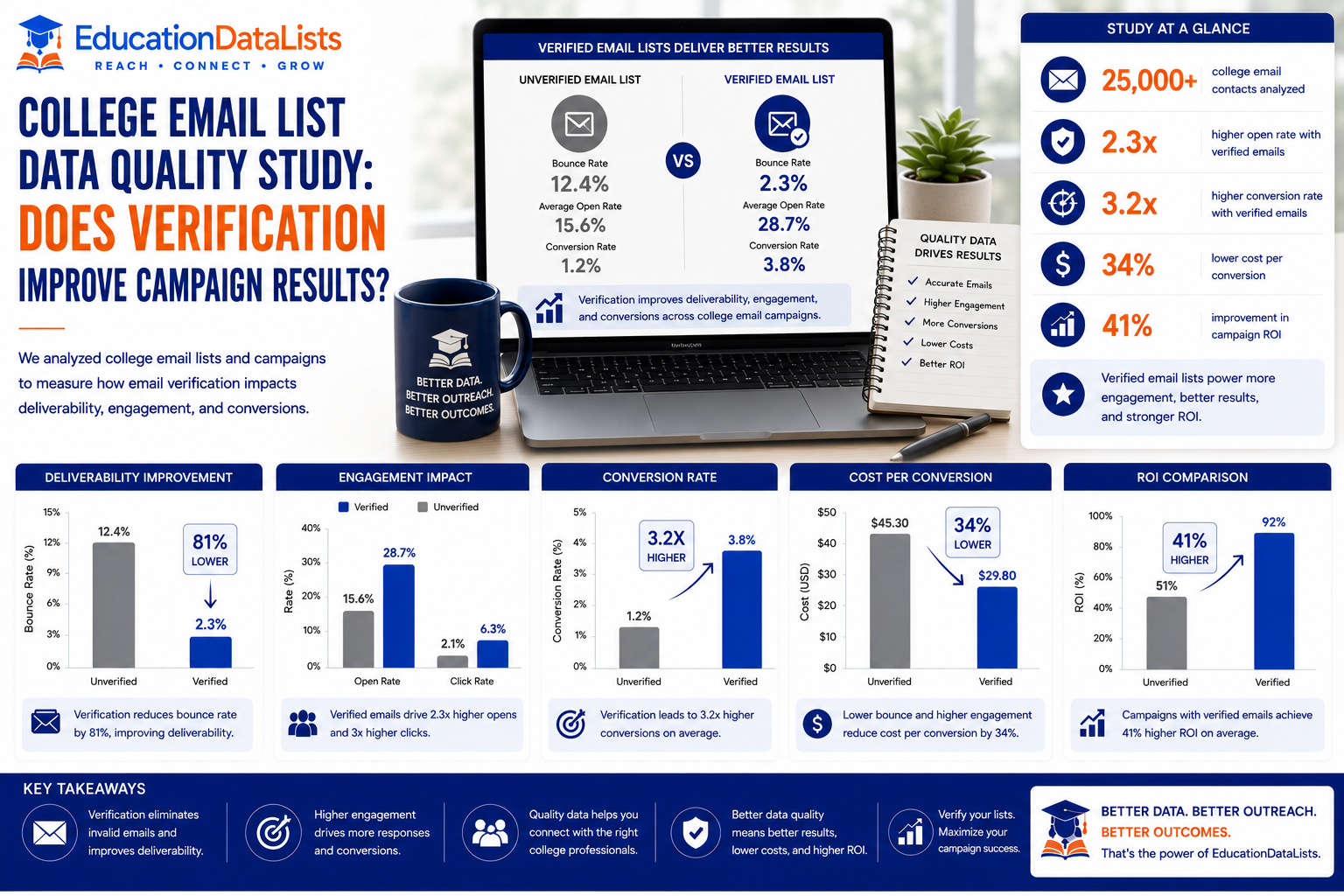
College Email List Data Quality Study: Does Verification Improve Campaign Results? | EducationDataLists

Introduction
Email verification is often treated as a technical step, but for college outreach it is fundamentally a data-quality issue. A current College Email List can help marketers reach relevant higher-education professionals, while outdated or invalid records can waste campaign volume and undermine deliverability. ZeroBounce's 2026 Email List Decay Report, based on email data verified during 2025, found that at least 23% of an email list degrades every year.
The broader business impact of inaccurate data is also significant. Validity's 2025 research found that 76% of respondents said less than half of their organization's CRM data was accurate and complete, while 37% reported losing revenue because of poor data quality.
This analysis examines how verification can affect campaign quality, deliverability, engagement, and the efficiency of college-focused B2B outreach.
Why College Contact Data Decays
College contact databases are not static assets. Staff change institutions, move into new positions, retire, switch departments, or leave the workforce. Email addresses can also become inactive when institutions consolidate systems or change domains.
ZeroBounce's 2026 research provides a useful benchmark: at least 23% of email-list data degrades annually. Its analysis covered email addresses verified between January and December 2025 and compared current results with previous years.
That does not mean exactly 23% of every college database becomes unusable in 12 months. It is a broad industry benchmark, not a college-specific decay rate. However, it demonstrates why assuming that a database remains accurate after collection is risky.
For marketers maintaining a College Email Database, verification should therefore be considered a recurring process rather than a one-time cleanup.
Higher Education Is a Large and Diverse Market
The U.S. higher-education market contains a wide range of institutions and professional roles. NCES data shows total enrollment at degree-granting postsecondary institutions reached approximately 19.9 million students in 2024, illustrating the scale of the sector.
A B2B campaign may need to reach presidents, provosts, deans, CIOs, IT directors, admissions leaders, student-services professionals, procurement teams, or other specialists.
This diversity makes data accuracy especially important. An email address may still technically work while the contact's job title, department, or purchasing responsibility has changed.
What Email Verification Actually Improves
Email verification primarily addresses the question: Can this address safely receive an email?
Professional verification services can identify categories such as:
-
Invalid addresses
-
Nonexistent domains
-
Disposable addresses
-
Role-based addresses
-
Catch-all domains
-
Potentially risky addresses
-
Syntax errors
ZeroBounce's 2026 report identifies invalid addresses as the most prevalent risky email type in its analyzed datasets, with catch-all addresses representing another major category of potentially risky contacts.
For a College Mailing List, this distinction matters because removing questionable records can reduce wasted sends.
However, verification does not automatically confirm that the recipient is the correct person. An address can be valid but belong to someone who no longer works in the relevant department.
That is why email verification should be combined with broader contact-data validation.
Data Accuracy Is Bigger Than Email Validity
Validity's 2025 State of CRM Data Management report surveyed 602 CRM users and stakeholders and found that 76% believed less than half of their organization's CRM data was accurate and complete. The study also found that 37% of respondents reported revenue losses attributable to poor data quality.
These findings extend beyond email marketing.
For college outreach, a high-quality record may need to include:
| Data Field | Why It Matters |
|---|---|
| Email address | Determines deliverability |
| Contact name | Enables accurate personalization |
| Job title | Identifies decision-making responsibility |
| Institution | Confirms account relevance |
| Department | Supports audience segmentation |
| State/region | Enables geographic targeting |
| Institution type | Separates universities, colleges, community colleges, etc. |
| Domain | Helps confirm institutional affiliation |
| Verification date | Shows data freshness |
This means the best College Email List is not necessarily the largest one. Its value depends on whether the records are deliverable, relevant, current, and actionable.
Deliverability Is the First Campaign Performance Test
Verification matters because campaign performance begins with getting messages delivered.
Validity's 2026 Email Deliverability Benchmark Report analyzed trillions of global inbox data points and found that global inbox placement rates increased during 2025.
That improvement should not lead marketers to assume every campaign will achieve strong inbox placement. Sender reputation, authentication, engagement, content, sending patterns, and recipient quality all influence deliverability.
Invalid and risky addresses can contribute to poor list hygiene. Repeatedly sending to addresses that cannot receive messages wastes resources and can complicate efforts to maintain a healthy sending reputation.
Therefore, verification should be viewed as one component of a broader deliverability program.
Does Verification Improve Engagement?
The answer requires an important qualification: verification does not inherently make recipients more interested in an email.
Removing invalid addresses can improve the quality of the denominator used to calculate campaign metrics, and it can reduce wasted sends. But engagement ultimately depends on factors such as relevance, offer, message quality, timing, sender credibility, and audience targeting.
MailerLite's 2025 benchmark dataset analyzed more than 3.6 million campaigns from 181,000 approved accounts between December 2024 and November 2025. Across all industries, the median open rate was 43.46%, click rate was 2.09%, and click-to-open rate was 6.81%.
For higher education specifically, MailerLite reported a 43.98% median open rate and 2.15% click rate.
These are newsletter-style email benchmarks rather than direct cold-outreach benchmarks, so they should not be treated as expected results for a purchased or prospecting database.
Their value is comparative: they show why marketers should track actual engagement rather than assuming that deliverability equals campaign success.
Why Click Rate Can Be More Useful Than Open Rate
Open-rate measurement has become less reliable because of privacy technology.
MailerLite specifically notes that Apple Mail Privacy Protection can automatically mark messages as opened, meaning reported open rates may exceed actual human opens. The company therefore recommends paying particular attention to click rate because clicks are not affected by Apple Mail's open-tracking behavior.
For college outreach testing, this suggests a more useful hierarchy:
-
Delivery rate
-
Bounce rate
-
Click rate
-
Positive reply rate
-
Qualified response rate
-
Meetings booked
-
Opportunities created
If verification is successful, marketers should expect the clearest effect first at the data and delivery level—not necessarily an immediate increase in replies.
A Practical Verification Test for College Campaigns
Organizations can measure the effect of verification using a controlled campaign experiment.
Step 1: Create Two Comparable Samples
Take a representative portion of a College Email Database and divide it into comparable groups.
Step 2: Verify One Group
Run the test group through an email-verification process and suppress addresses classified as invalid or otherwise unsuitable.
Step 3: Keep Campaign Variables Consistent
Use the same:
-
Email copy
-
Sender
-
Subject line
-
Offer
-
Sending period
-
Follow-up structure
The major difference should be list quality.
Step 4: Measure Downstream Results
Compare:
-
Bounce rate
-
Delivery rate
-
Click rate
-
Reply rate
-
Positive reply rate
-
Meetings
-
Qualified opportunities
This approach makes it possible to distinguish a deliverability improvement from a genuine engagement improvement.
What Verification Cannot Fix
Verification is powerful, but it has limits.
It cannot fix an incorrect job title
A valid email address may belong to a former dean or a staff member who moved to another department.
It cannot guarantee purchasing authority
The recipient may work at the correct institution without participating in the relevant buying process.
It cannot create message relevance
A perfectly deliverable email can still be ignored if the offer does not match the recipient's priorities.
It cannot replace segmentation
College technology buyers, admissions leaders, academic administrators, and IT professionals may respond to very different value propositions.
This is why data verification should be paired with role validation and segmentation.
Practical Takeaways for College Outreach Teams
1. Verify before major campaigns
Do not assume an older College Mailing List remains fully deliverable. The 23% annual degradation benchmark from ZeroBounce demonstrates why recurring validation is necessary.
2. Separate deliverability from relevance
An address can be valid without being a good prospect. Check job title, institution, department, and other account attributes separately.
3. Track bounce rates after verification
If verification is working, one of the clearest early indicators should be fewer invalid-address bounces.
4. Measure qualified responses
Do not judge verification solely by opens. Track positive replies, meetings, opportunities, and other outcomes that connect email activity to revenue.
5. Maintain a verification date
Adding a "last verified" field makes database management more systematic and helps teams prioritize older records for review.
How EducationDataLists Can Support Data-Focused Outreach
For marketers building campaigns around colleges and universities, EducationDataLists can be used as a resource for developing targeted education audiences.
The most effective approach is to treat external data as part of a larger data-management workflow. A College Email List should be evaluated for deliverability, role accuracy, institutional relevance, freshness, and segmentation potential.
Verification can reduce technical waste, while ongoing data maintenance helps ensure that sales teams are spending their time on contacts who are still relevant.
Conclusion
Email verification can improve the operational quality of college outreach by identifying invalid and risky addresses before marketers invest additional campaign resources. ZeroBounce's 2026 research indicates that at least 23% of email-list data degrades each year, while Validity's 2025 CRM research shows that poor data quality can have measurable commercial consequences.
But verification should not be mistaken for a complete engagement strategy. It helps answer whether an email address is usable; it does not determine whether the recipient is the right buyer or whether the message is compelling.
For organizations using a College Email Database, the strongest strategy combines email verification with job-title validation, institutional matching, segmentation, personalization, and downstream performance measurement. In 2026, better outreach is increasingly about better data quality—not simply more contacts.
Frequently Asked Questions
1. Does email verification improve college email campaign results?
Verification can improve the technical quality of a campaign by removing invalid or risky addresses and reducing wasted sends. However, it does not guarantee higher engagement because response rates also depend on targeting, messaging, timing, and offer relevance.
2. How often should a College Email List be verified?
There is no single interval that applies to every database. ZeroBounce's 2026 research found that at least 23% of email-list data degrades annually, making recurring verification and monitoring important for active prospecting databases.
3. What is the difference between email verification and contact validation?
Email verification determines whether an email address is technically deliverable or potentially risky. Contact validation goes further by checking whether the person's name, job title, institution, department, and other information are still accurate.
4. What email engagement benchmark applies to higher education?
MailerLite's 2025 dataset reported a 43.98% median open rate and 2.15% median click rate for higher education. These figures come from email campaigns in its platform and should be used as general benchmarks rather than direct cold-email response-rate expectations.
5. Why is open rate less reliable for measuring college outreach?
Privacy technologies such as Apple Mail Privacy Protection can cause emails to be recorded as opened without a traditional human open event. MailerLite therefore recommends paying particular attention to click rate, which is not affected by Apple's open-tracking behavior.
6. What fields should a College Email Database contain?
Useful fields include email address, contact name, job title, institution, department, geographic location, institutional domain, and verification date. Additional attributes such as institution type and organizational size can improve segmentation.
7. Can verification improve reply rates directly?
Not necessarily. Verification primarily improves address quality and deliverability; any increase in replies is generally an indirect result of reducing invalid records and improving the quality of the reachable audience.
8. Is a larger College Mailing List always better?
No. A smaller database containing accurate, current, relevant, and deliverable contacts can be more valuable than a much larger database containing outdated records. Data quality should therefore be evaluated alongside database size.


