
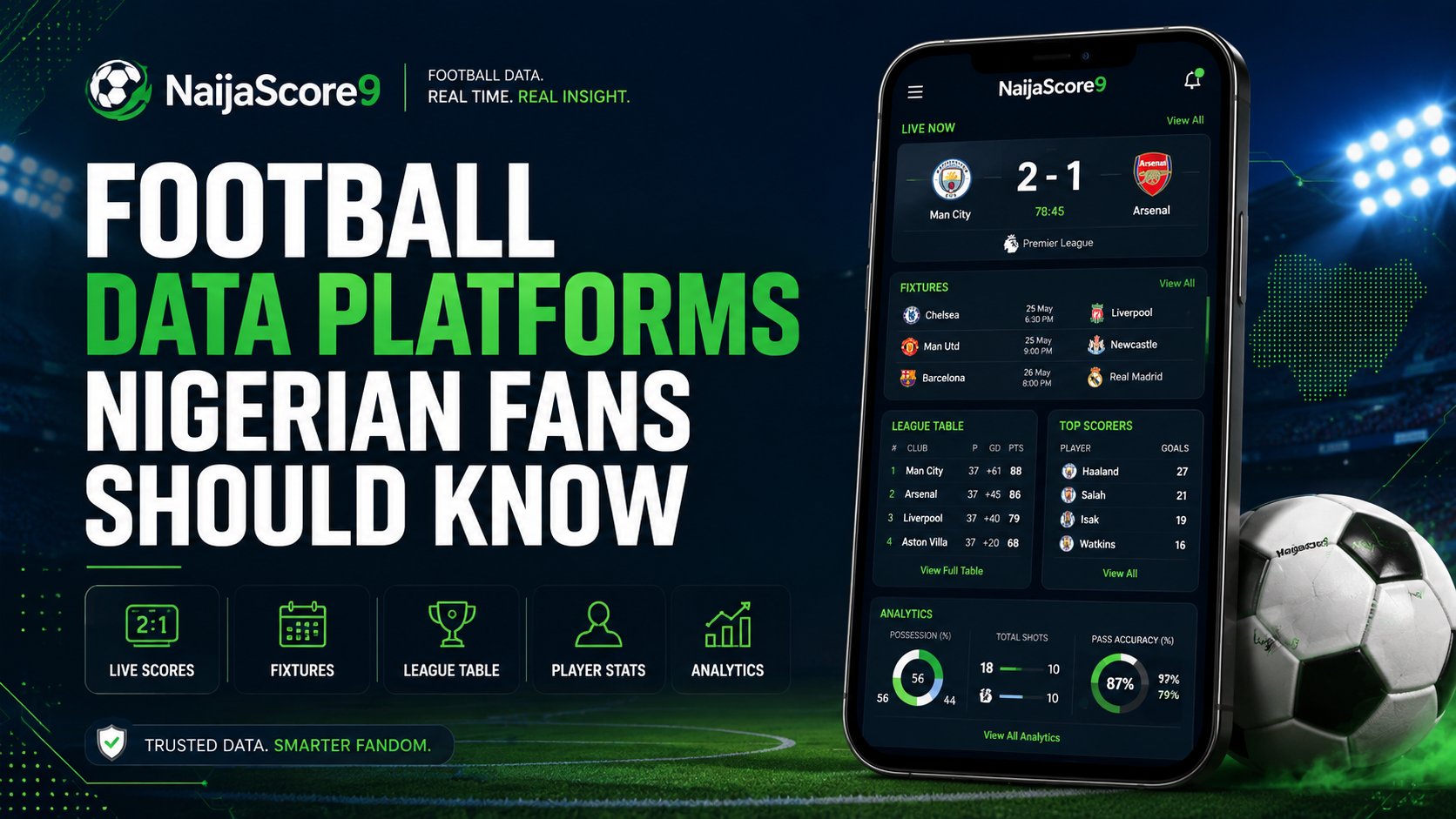
Football Data Platforms Nigerian Fans Should Know

Following football properly now involves much more than knowing the score at full-time.
A fan may want to check today's fixtures in the morning, follow several matches during the afternoon, review league positions after the games and research probabilities for tomorrow's fixtures later in the evening.
That is where football data platforms become useful.
Different platforms organise different parts of the game. Some are designed primarily for live scores, others specialise in statistics, while prediction platforms analyse available football data to estimate possible outcomes before kick-off.
For Nigerian football fans following competitions such as the Premier League, UEFA Champions League, Europa League, La Liga, Serie A and major international tournaments, understanding these different platform types can make football research much more efficient.
The important question is not simply:
Which football platform has the most data?
It is:
Which platform provides the information I need, and can I interpret that information correctly?
What Counts as a Football Data Platform?
A football data platform is a website or service that organises information about matches, teams, players or competitions.
Depending on its purpose, it might provide:
-
today's football matches;
-
upcoming fixtures;
-
live scores;
-
completed results;
-
league tables;
-
team form;
-
goals scored and conceded;
-
home and away records;
-
player statistics;
-
line-ups;
-
match events;
-
football predictions;
-
probability estimates;
-
football odds.
Not every platform needs to provide all of these.
A specialist live-score service can still be extremely useful without offering detailed predictions. Likewise, a football prediction website may focus primarily on pre-match analysis rather than minute-by-minute match tracking.
Understanding the purpose of the platform is therefore the first step.
Live Score Platforms: Best for Following Matches as They Happen
Live score platforms are designed around one question:
What is happening right now?
They are particularly useful when several matches are taking place simultaneously.
A Nigerian fan may be following Arsenal in the Premier League while also checking Barcelona in La Liga and AC Milan in Serie A. Opening a separate search for every match quickly becomes inconvenient.
A good live football platform can organise those fixtures together.
Useful live information may include:
-
current score;
-
match minute;
-
goal events;
-
yellow and red cards;
-
substitutions;
-
starting line-ups;
-
match status.
For live data, freshness matters.
Information that is excellent five minutes later may be poor live information. The platform therefore needs to update quickly and display the most important details clearly.
Fixture Platforms Help Fans See the Football Calendar
Fixtures are one of the simplest types of football data, but they can be surprisingly valuable.
A fixture platform can answer:
-
Which teams play today?
-
What time is the match?
-
When does Liverpool play next?
-
Which Champions League games are scheduled this week?
-
What fixtures are coming tomorrow?
The schedule also provides analytical context.
Suppose one team has played three matches in eight days while its opponent has enjoyed a full week without a competitive game.
That does not tell you who will win.
But it may affect:
-
player recovery;
-
squad rotation;
-
preparation time;
-
team selection.
Good football analysis often begins with simply understanding the schedule.
Results Platforms Help Put Current Form Into Context
Football fans frequently use the last five results to judge a team.
For example:
W – W – D – W – W
looks strong.
But results alone can create a misleading impression.
Ask who the team played.
Five positive results against lower-ranked opposition may not tell you how the team will perform against one of the strongest clubs in the league.
When reviewing past results, look at:
-
opponent quality;
-
match venue;
-
goals scored;
-
goals conceded;
-
margin of victory;
-
competition.
A result is a fact.
What the result means for the next fixture requires interpretation.
League Tables Show More Than Position
League standings provide the broader competitive picture.
A useful league table normally contains:
-
matches played;
-
wins;
-
draws;
-
losses;
-
goals scored;
-
goals conceded;
-
goal difference;
-
points.
Table position helps explain where a team stands across the entire season.
But it should not be used on its own to predict the next match.
A sixth-placed team could currently be one of the league's strongest-performing sides.
A second-placed club may be struggling after injuries or a difficult run of fixtures.
The table explains the season to date.
Recent football data explains what has been happening more recently.
Both can matter.
Team Statistics Platforms Provide Deeper Context
The final result does not always reflect the quality of a performance.
Imagine two teams both win 2-1.
Team A creates 18 shots and controls most of the game.
Team B scores from two of its only meaningful opportunities while spending most of the match defending.
The scoreline is identical.
The performance is not.
Statistics platforms may help by providing information such as:
-
shots;
-
shots on target;
-
possession;
-
corners;
-
goals scored;
-
goals conceded;
-
clean sheets;
-
home form;
-
away form.
The objective should not be to collect every available number.
It should be to identify which data helps explain how a team is actually performing.
Player Data Can Change How Team Numbers Should Be Read
Team averages assume a reasonably normal squad.
That assumption may no longer hold if important players are unavailable.
Suppose a club has scored regularly throughout the season.
Then its leading striker, who has contributed heavily to that output, is ruled out.
The historical team average remains correct.
But it may no longer describe today's attacking strength as accurately.
Player information can therefore add an important layer of context.
Useful data may include:
-
appearances;
-
starts;
-
minutes;
-
goals;
-
assists;
-
cards;
-
recent involvement.
Before an important fixture, knowing who produced the team's numbers can be just as useful as knowing the numbers themselves.
Prediction Platforms Use Data to Look Forward
Traditional football data records things that have already happened.
Prediction platforms attempt something different: they use available information to estimate what may happen next.
For example, a match could be assessed as:
Home Win: 50%
Draw: 29%
Away Win: 21%
The home team is the most likely individual outcome.
However, a 50% prediction should never be interpreted as certainty.
Half of the probability is still assigned elsewhere.
For fans interested in this type of analysis, a dedicated prediction platform such as NaijaScore9 can be used to review available match probabilities alongside wider football research.
The useful question is not:
“What result is guaranteed?”
It is:
“How does the available information assess the relative likelihood of the possible outcomes?”
That is a much more realistic way to use a prediction site.
Football Odds Are Another Form of Data
Odds are usually associated with betting, but they also communicate information about probability.
Suppose an outcome is priced at:
2.00
The approximate implied probability is:
50%
At:
1.50 → about 66.7%
2.50 → about 40%
4.00 → about 25%
This means football odds can be compared with prediction probabilities.
Imagine a model estimates:
Home Win: 58%
while the available bookmaker price implies approximately:
50%
That difference may be worth investigating.
It does not prove that the model is more accurate than the market.
It simply shows that two assessments are not identical.
Different Platforms Should Answer Different Questions
Trying to use every football platform in the same way creates confusion.
A better approach is to match the source to the question.
If you want to know:
“What is the score?”
use live-match data.
If your question is:
“When does this club play next?”
use fixture data.
For:
“How has this team performed?”
look at results and statistics.
And when the question becomes:
“What outcome appears more likely before kick-off?”
a prediction platform becomes more relevant.
This simple distinction helps prevent raw statistics, predictions and live information from being mixed together unnecessarily.
Data Quality Matters More Than Data Quantity
A football page displaying 100 statistics is not automatically better than one showing 15 relevant figures.
Football data becomes useful when it is:
-
current;
-
clearly labelled;
-
relevant to the match;
-
easy to understand.
Too many numbers can create false confidence.
For example, knowing that a team has averaged 1.8 goals over an entire season may be less useful than knowing that it averages only 0.8 goals away—and today's fixture is away.
Relevant information beats impressive-looking volume.
Nigerian Fans Should Consider Competition Coverage
Many Nigerian football supporters follow several leagues rather than one competition exclusively.
Useful coverage may include:
-
English Premier League;
-
UEFA Champions League;
-
UEFA Europa League;
-
Spanish La Liga;
-
Italian Serie A;
-
German Bundesliga;
-
French Ligue 1;
-
African competitions;
-
international football.
A football platform may be excellent but still unsuitable for a particular fan if it does not cover the competitions they regularly follow.
Coverage should match the user's actual interests.
Always Separate Home and Away Performance
Venue-specific data deserves special attention.
Suppose a team has scored 32 league goals.
Looking deeper reveals:
Home: 24 goals
Away: 8 goals
The overall total gives the impression of a strong attack.
The away record tells a different story.
The same principle applies to:
-
victories;
-
clean sheets;
-
goals conceded;
-
BTTS frequency;
-
total goals.
When researching an upcoming match, use data that resembles the circumstances of that fixture as closely as possible.
Do Not Give Old Head-to-Head Data Too Much Weight
Historical meetings are easy to find and easy to understand.
They can also be overused.
A match played several seasons ago may involve completely different:
-
players;
-
managers;
-
tactical systems;
-
squad quality.
Recent head-to-head information can be useful supporting evidence.
Older meetings are better treated as historical context than as a major prediction factor.
Today's teams should usually matter more than yesterday's rivalry statistics.
Historical Data Is Not the Same as a Prediction
Consider these two statements:
Team A scored in seven of its previous eight away matches.
and:
Team A has a 63% estimated probability of scoring today.
The first is historical data.
The second is a forecast.
The forecast may use historical data as an input, but it includes additional assumptions about today's fixture.
This distinction is essential.
Past performance can inform probability.
It cannot guarantee repetition.
A Practical Way to Combine Football Platforms
Fans do not need to jump randomly between dozens of statistics.
A structured routine works better.
Before Matchday
Check the upcoming fixture and schedule.
Then Review Performance
Look at recent results, standings and home/away form.
Add Squad Context
Check important player availability where possible.
Examine Predictions
Review how the fixture is being assessed in probability terms.
Compare Market Information
If relevant, look at football odds and their implied probabilities.
Each platform now performs a specific role.
That makes the information easier to interpret.
Where NaijaScore9 Fits
NaijaScore9 is primarily useful for fans researching football predictions, odds, betting information and market-related analysis.
Rather than functioning solely as a live-score service, the platform can form part of the pre-match research stage.
A user may examine a fixture, review prediction probabilities and then explore additional information about football markets and odds.
The important principle remains the same:
Predictions provide estimates.
Odds provide prices.
Neither provides certainty.
Football Data Improves Understanding, Not Certainty
No football database can tell you everything that will happen after kick-off.
Unexpected events remain part of the game:
-
injuries;
-
red cards;
-
penalties;
-
individual mistakes;
-
exceptional saves;
-
missed chances.
A team can statistically dominate a match and still lose.
That does not make football data useless.
It simply defines its proper role.
Data helps describe teams, identify patterns and estimate probabilities.
It does not remove uncertainty from sport.
Final Thoughts
Football data platforms give Nigerian fans different ways to understand and follow the game.
Live score services are designed for what is happening now. Fixture platforms organise upcoming matches. Results, standings and team statistics provide historical and seasonal context, while player data can explain changes in team strength.
Prediction platforms take those ideas further by attempting to estimate future outcomes, while football odds provide another view of how probabilities are being priced.
The most effective approach is not to find the platform displaying the greatest amount of information.
It is to know what question you are asking and which type of data can answer it.
For Nigerian football fans, combining reliable football information with sensible context can provide a much clearer understanding of a match—without mistaking data, predictions or market prices for guarantees.


