

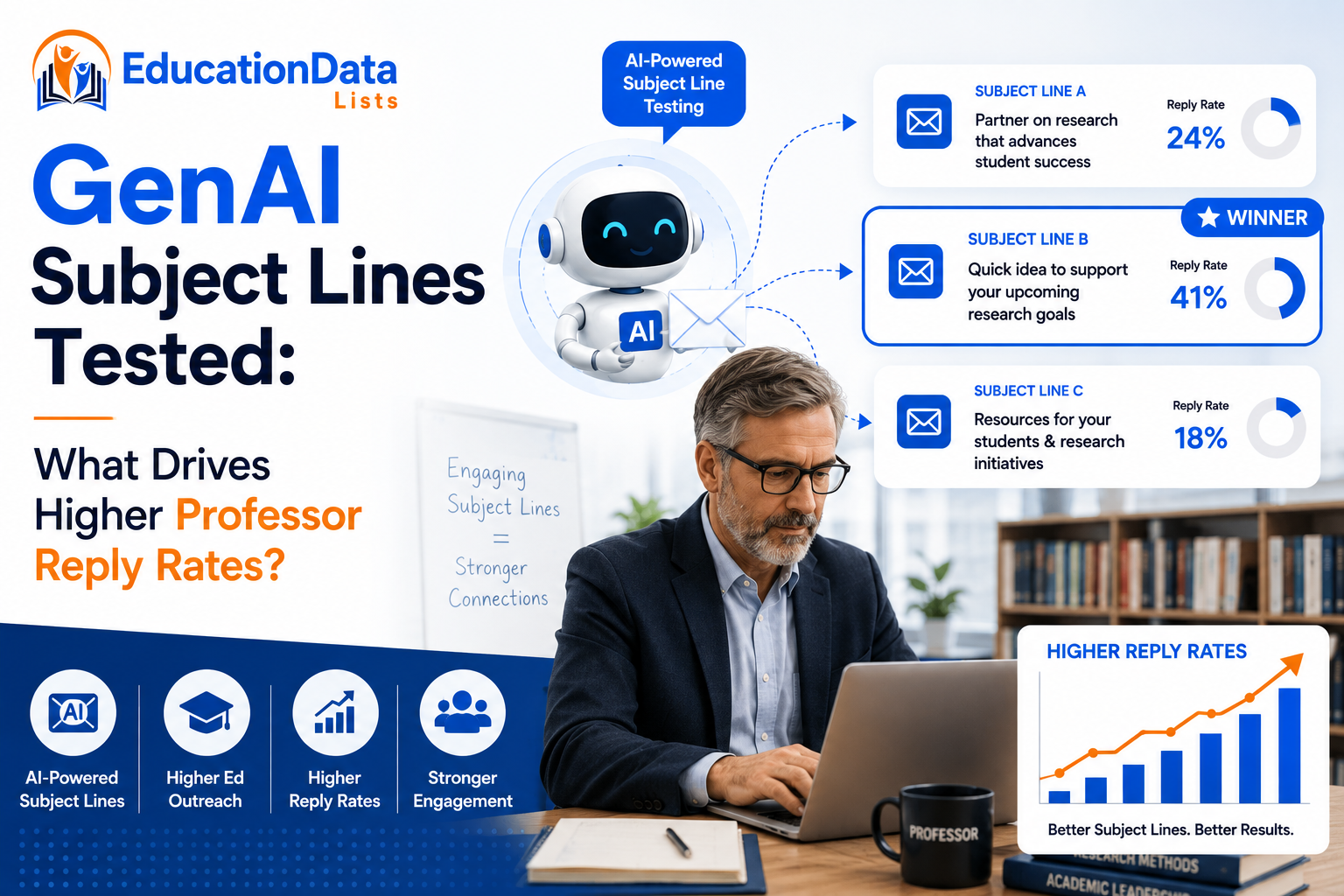
GenAI Subject Lines Tested: What Drives Higher Professor Reply Rates? | EducationDataLists

Introduction
Generative AI can produce dozens of email subject lines in seconds, but speed does not guarantee stronger engagement from professors. Current evidence suggests that AI performs best when it is connected to audience data and real A/B-test results—not when marketers simply ask an LLM to “write a compelling subject line.” A large 2025 GetResponse analysis, for example, found that AI-generated emails did not consistently outperform manually created messages in the education sector: AI-generated education emails recorded a 31.81% open rate versus 44.61% for emails created from scratch. However, AI-generated education messages produced a higher click-to-open rate, 31.27% versus 19.21%. (GetResponse)
This distinction matters for marketers using a Professor Email List. The strongest subject line is not necessarily the one that generates the most opens; it is the one that earns attention while accurately setting up a relevant conversation.
Research note: No recent public study located for this article isolates professor reply rates by AI-generated subject line versus human-written subject line. Therefore, this article does not invent a professor-specific reply-rate percentage. Instead, it combines current education email benchmarks, AI-email experiments, faculty research, and large-scale marketing studies to identify the factors most likely to influence response quality.
What Does the Latest Evidence Say About AI-Generated Email Copy?
The evidence favors testing AI rather than assuming AI always wins.
GetResponse analyzed customer email performance to compare messages created with its AI tools against messages created manually. Its overall benchmark showed an average open rate of 26.8%, while results varied substantially by industry. In education, AI-generated emails achieved a 31.81% open rate, compared with 44.61% for manually created emails. (GetResponse)
However, the picture changed further down the engagement funnel.
Education emails generated with AI achieved a 9.95% click-through rate, compared with 8.57% for manually written emails. Their click-to-open rates were also higher: 31.27% versus 19.21%. (GetResponse)
That creates an important lesson for a Professor Mailing List campaign:
A subject line that gets fewer opens can still produce stronger engagement among the people who do open.
Marketers should therefore avoid optimizing solely for open rate.
Why Open Rate Alone Is a Weak Proxy for Professor Replies
Open rate measures attention, while reply rate measures willingness to continue a conversation.
MailerLite's 2025 benchmark analyzed more than 3.6 million campaigns from 181,000 approved accounts covering December 2024 through November 2025. Across all industries, the median open rate was 43.46%, click rate was 2.09%, and click-to-open rate was 6.81%. (MailerLite)
For higher education specifically, MailerLite reported:
-
43.98% median open rate
-
2.15% median click rate
-
9.15% median click-to-open rate
-
0.10% median unsubscribe rate (MailerLite)
These are useful benchmarks for educational email campaigns, but they are not cold-email reply-rate benchmarks for professors.
That distinction is critical.
A professor who subscribed to an institution's newsletter has a fundamentally different relationship with the sender than a professor receiving an unsolicited vendor email.
For a Professor Email Database, marketers should therefore track a hierarchy of outcomes:
-
Delivery
-
Opens, where useful
-
Clicks
-
Positive replies
-
Qualified replies
-
Meetings or calls
-
Opportunities or conversions
The farther down this funnel the measurement goes, the more commercially meaningful it becomes.
Which AI Subject-Line Approaches Are Most Promising?
1. Specificity beats generic cleverness
The most useful AI subject lines are grounded in a specific audience problem.
Compare:
"A New Approach to Higher Education"
with:
"Reducing grading time in large-enrollment courses"
The second subject establishes a clearer reason for a professor to pay attention.
This principle becomes especially important when an AI system is generating subject lines at scale. Without detailed audience context, generative models tend to produce plausible but interchangeable marketing language.
Salesforce's 2026 State of Marketing research illustrates the broader problem. Among 4,450 marketing decision-makers, 75% said they had adopted AI, yet 84% said they still run generic campaigns. Meanwhile, 78% said they need more personalized content than they can currently produce. (Salesforce)
AI is therefore solving a content-production problem faster than it is necessarily solving a relevance problem.
2. Audience context improves AI output
AI-generated copy becomes more useful when the prompt contains meaningful audience information.
For a professor campaign, useful inputs might include:
-
Academic discipline
-
Institution type
-
Faculty role
-
Research area
-
Teaching responsibility
-
Relevant technology or workflow
-
Campaign objective
-
Previous engagement
A Professor Email List segmented by discipline can therefore support much more relevant AI generation than a generic faculty database.
A subject line for a computer science professor should not necessarily resemble one written for a history professor. Even when the product is identical, the problem framing can differ.
What Does Current Faculty Research Say About AI Attitudes?
Professors are not a uniformly enthusiastic AI audience, so AI-related messaging requires particular care.
College Board's February 2026 research surveyed more than 3,000 U.S. college faculty. It found that 77% said they had used AI in their professional role, but sentiment remained mixed: 45% reported an overall negative view of AI use in higher education, compared with 34% reporting a positive view. (College Board Newsroom)
The same research found that 72% of faculty faced at least minor challenges managing student AI use, while only 21% felt very confident guiding AI use in their classrooms. (College Board Newsroom)
This has a direct implication for AI-generated subject lines.
A subject such as:
"How AI can transform your classroom"
may attract some recipients but alienate others because it assumes a positive attitude toward AI.
A more neutral approach might be:
"A practical framework for evaluating classroom AI"
The difference is subtle but important. The second subject acknowledges the professor's need to evaluate rather than presuming adoption.
Does Discipline Change the Best Subject-Line Strategy?
Yes. Current faculty research shows meaningful differences by academic discipline.
College Board found that faculty in writing-intensive areas such as English, history, and humanities reported greater concerns about student AI use and academic integrity. Faculty in STEM and business disciplines were more likely to report using AI professionally and viewing it more positively. (College Board Newsroom)
The Digital Education Council's 2025 Global AI Faculty Survey gathered 1,681 responses from faculty at 52 institutions across 28 countries, demonstrating the scale of faculty interest in AI adoption, preparedness, and institutional guidance. (Digital Education Council)
For marketers, this supports discipline-level segmentation.
A Professor Mailing List campaign could test different subject-line angles such as:
| Faculty segment | Potential subject-line angle |
|---|---|
| STEM | Efficiency, research, technical capability |
| Business | Application, outcomes, productivity |
| Humanities | Critical thinking, evidence, academic integrity |
| Social sciences | Research methodology, analysis, teaching |
| Health sciences | Accuracy, workflow, evidence |
| Arts | Creativity, instructional application |
These are testing hypotheses—not guaranteed winners.
The objective is to discover which framing produces the highest qualified response rate within each segment.
What Does Research Say About AI + A/B Testing?
AI becomes substantially more valuable when it learns from experimental outcomes.
A large field experiment described in research by Angelopoulos, Lee, and Misra evaluated AI-assisted email marketing across 36 campaigns and 283 million impressions. Their A/B-test-aligned model produced subject lines with 33% higher click-through rates than unassisted human experts. Importantly, the study also found that simply using a much larger general-purpose language model did not produce the same improvement. (SSRN)
The finding is highly relevant to professor outreach.
The lesson is not:
"AI writes better subject lines than humans."
It is:
AI connected to experimental evidence can outperform intuition-based copywriting.
For a Professor Email Database, marketers can apply the same principle by maintaining a structured record of:
-
Subject-line version
-
Faculty segment
-
Send date
-
Open behavior
-
Reply behavior
-
Positive/negative response
-
Meeting conversion
Over time, those results can become a proprietary training signal for future campaigns.
Which Subject-Line Variables Should Marketers Test?
The best test program changes one meaningful variable at a time.
Test 1: Problem vs. benefit
A: "A faster way to manage course materials"
B: "Cut course-material preparation time"
Test 2: Specificity vs. broad appeal
A: "New research technology for faculty"
B: "Research workflow tools for behavioral-science faculty"
Test 3: Question vs. statement
A: "How are you handling AI-assisted assessment?"
B: "A practical approach to AI-assisted assessment"
Test 4: Curiosity vs. clarity
A: "One change reshaping faculty workflows"
B: "A new approach to faculty workflow automation"
Test 5: Neutral vs. promotional
A: "Faculty perspectives on classroom AI"
B: "See our new AI solution for faculty"
The important point is to test these patterns with actual professors rather than assuming that a general email-marketing rule applies to academic audiences.
Should AI Personalize the Professor's Name?
Name personalization should be tested, but deeper contextual relevance is generally more meaningful than a first-name token alone.
A subject such as:
"John, a question about your research"
may look personalized while still being generic.
A subject referencing a legitimate professional context can provide substantially more information:
"A question about your faculty research workflow"
However, marketers should never insert unsupported research interests, publications, institutional initiatives, or other personal details simply because an AI model predicts that they might be relevant.
The more sophisticated the personalization, the more important data accuracy becomes.
Why Data Quality Determines AI Subject-Line Performance
AI cannot compensate for inaccurate audience data.
Salesforce's 2026 research found that 98% of marketers encounter barriers to personalization, with data problems among the most common obstacles. It also reported that high-performing marketers were 2.8 times more likely to use customer data to create relevant experiences and 2.4 times more likely to have unified data sources. (Salesforce)
That makes the quality of a Professor Email List strategically important.
Before asking AI to personalize subject lines, marketers should verify:
-
Current institution
-
Faculty position
-
Academic discipline
-
Professional email
-
Relevant department
-
Geographic location
-
Previous engagement
An AI-generated subject line sent to the wrong professor is not personalization—it is inaccurate targeting at scale.
How Should Marketers Measure Professor Reply Rates?
Use positive-reply rate as the primary conversation metric, while retaining downstream conversion metrics.
A useful framework is:
Positive Reply Rate = Positive Replies ÷ Delivered Emails × 100
Then track:
Qualified Reply Rate = Qualified Replies ÷ Delivered Emails × 100
And:
Meeting Rate = Meetings ÷ Delivered Emails × 100
This prevents an AI subject line from being declared a winner simply because it generated more opens.
For example, a subject-line variant that increases opens but produces irrelevant or negative replies should not necessarily replace a lower-open-rate variant that generates more qualified conversations.
How Should a GenAI Subject-Line Test Be Designed?
A robust professor campaign could follow this structure:
Step 1: Create a homogeneous audience
Segment professors by discipline, role, institution type, or another meaningful attribute.
Step 2: Randomize the audience
Split comparable recipients between control and test groups.
Step 3: Change only the subject line
Keep the email body, offer, sender, timing, and audience criteria consistent.
Step 4: Generate several AI variants
Ask AI to produce alternatives using explicit audience context and constraints.
Step 5: Human-review every version
Remove exaggerated claims, awkward personalization, unsupported assumptions, and overly promotional language.
Step 6: Measure downstream behavior
Compare positive replies, qualified replies, clicks, meetings, and unsubscribes—not just opens.
Step 7: Feed results into the next test
The winning patterns should become evidence for future campaigns.
5 Actionable Takeaways for 2026
1. Don't assume AI automatically beats human copy
GetResponse's education-sector results show why: manually created messages had higher open rates, while AI-generated messages had stronger click-to-open performance. (GetResponse)
2. Optimize for replies, not opens
For B2B professor outreach, a qualified conversation is more valuable than an inflated open-rate improvement.
3. Segment by discipline
Faculty attitudes toward AI differ substantially across academic fields, making one universal subject-line strategy unlikely to be optimal. (College Board Newsroom)
4. Give AI real audience context
Feed the model accurate information about the professor segment, campaign objective, problem, and value proposition.
5. Build a learning system
The most valuable AI workflow is not "generate 20 subject lines." It is generate → test → measure → learn → generate again.
How EducationDataLists Can Support Professor Outreach
EducationDataLists can serve as a resource for marketers that need a targeted Professor Email List for education-focused B2B campaigns.
The strategic value comes from combining targeted contact data with verification, segmentation, responsible personalization, and controlled testing. A Professor Email Database should be treated as an evolving campaign asset—not simply a static collection of email addresses.
The practical workflow is:
Identify → Verify → Segment → Generate → Test → Measure → Refresh
That process gives marketers the foundation needed to evaluate whether GenAI is actually improving engagement with faculty audiences.
Conclusion
The evidence from 2025–2026 does not support a simple conclusion that AI-generated subject lines always outperform human-written alternatives. GetResponse's education data shows a more nuanced result: AI-generated emails produced lower open rates than manually created messages but stronger click-to-open performance. (GetResponse) Large-scale research also indicates that AI becomes more powerful when connected to A/B-test data rather than used as a standalone copy generator. (SSRN)
For marketers using a Professor Email List, the winning strategy is therefore not "more AI." It is better experimentation powered by AI. Segment faculty carefully, give models accurate context, test specific messaging hypotheses, and judge winners by qualified replies and downstream outcomes. As faculty attitudes toward AI continue to evolve, marketers that continually test rather than assume will be best positioned to earn meaningful academic engagement.
Frequently Asked Questions
Do AI-generated subject lines get more replies from professors?
There is not currently a sufficiently broad public benchmark showing that AI-generated subject lines consistently produce higher professor reply rates. Available email research shows mixed results across industries, making controlled testing against a human-written control essential. (GetResponse)
What is the best subject line for a Professor Email List?
There is no universal winner. The strongest approach is to test subject lines built around specific problems, benefits, questions, or discipline-specific context and determine which produces the highest qualified response rate among the target professor segment.
Should marketers use AI to write emails to professors?
Yes, provided AI is used as an assistance and experimentation tool rather than an autonomous source of facts. Faculty research shows that attitudes toward AI vary considerably, so messages should be accurate, context-aware, and reviewed by a human before deployment. (College Board Newsroom)
What email engagement benchmark applies to higher education?
MailerLite's 2025 data reports a 43.98% median open rate, 2.15% click rate, and 9.15% click-to-open rate for higher education. These are email-marketing benchmarks rather than cold-email professor reply rates, so they should be used for directional comparison rather than as guaranteed performance targets. (MailerLite)
Should a Professor Mailing List be segmented by academic discipline?
Yes. Current College Board research found meaningful differences in faculty attitudes and AI usage by discipline, with writing-intensive fields generally reporting greater concerns and STEM/business faculty more likely to use AI professionally. (College Board Newsroom)
Is open rate the best metric for testing AI subject lines?
No. Open rates are useful for evaluating attention, but they should not be the sole success metric. Clicks, positive replies, qualified replies, meetings, and conversions provide stronger evidence of whether a subject line is producing meaningful engagement.
How large should an A/B test be?
There is no single appropriate sample size because statistical power depends on baseline performance, expected lift, audience size, and the metric being tested. For smaller professor audiences, marketers should avoid declaring a winner from tiny differences and instead run repeated tests across comparable segments.
What information should a Professor Email Database contain?
At minimum, useful records should include a professional email address, professor's name, institution, academic role, discipline or department, and a method or date for verifying the information. Additional segmentation and engagement fields can improve personalization when they are accurate and appropriately sourced.
Can AI personalization improve professor outreach?
AI can make personalized content easier to produce at scale, but the quality of personalization depends heavily on underlying data. Salesforce's 2026 research found that 98% of marketers encounter personalization barriers and identified data problems as a major obstacle. (Salesforce)
Why should marketers test AI-generated and human-written subject lines?
Testing prevents assumptions from becoming campaign strategy. Research on AI-assisted email experimentation found that models aligned with actual A/B-test outcomes can produce substantially better results than unassisted human approaches, demonstrating the value of combining human judgment with empirical feedback. (SSRN)


