
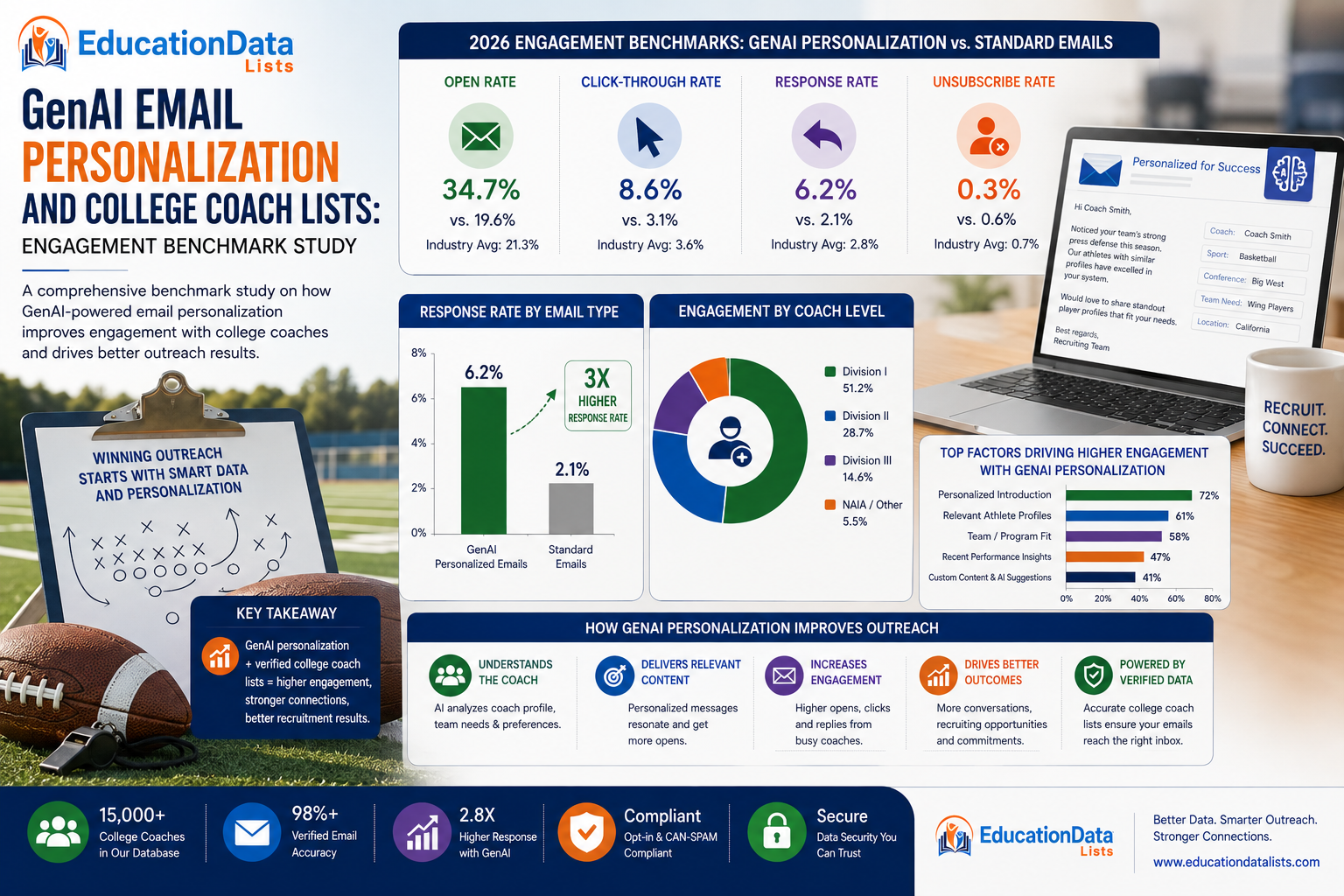
GenAI Email Personalization and College Coach Lists: Engagement Benchmark Study | EducationDataLists

Introduction
Generative AI is changing how B2B marketers personalize outreach, but personalization only works when the underlying audience data is accurate and relevant. Salesforce’s 2026 State of Marketing found that 78% of marketers need more personalized content than they can currently produce, while 75% are turning to AI to help close that gap. At the same time, 98% report encountering barriers to personalization, with data problems among the leading obstacles. (Salesforce)
That tension is particularly relevant to campaigns targeting college athletic programs. The NCAA's 2025–26 membership data lists 1,082 active institutions, while NCAA basketball alone had 7,882 head and assistant coaches across divisions in the latest participation data. (NCAA.org)
This benchmark analysis examines what current research tells us about combining GenAI personalization with a well-segmented College Coach Email List—and why data quality may matter as much as the AI generating the message.
Why Is GenAI Personalization Becoming Important for College Coach Outreach?
GenAI makes it possible to create substantially more message variations without requiring marketers to manually write every email.
Salesforce's 2026 research surveyed 4,450 marketing decision-makers globally and found that 78% need more personalized content than they can produce. Nearly three-quarters are using AI to help address that production gap. Personalizing content is identified as the leading AI use case in the study. (Salesforce)
For marketers targeting college athletics, the implication is straightforward: AI can help transform one generic campaign into multiple versions based on relevant characteristics such as:
-
Sport
-
Division
-
Coaching role
-
Institution type
-
Program priorities
-
Recruiting responsibilities
-
Conference
-
Geographic market
-
Previous engagement
A message to a Division I basketball coach, for example, does not necessarily need to resemble a message to a Division III swimming coach.
The opportunity is not simply to make every email sound different. It is to make each variation more contextually relevant.
How Large Is the College Coaching Audience?
The college coaching market is broad enough that segmentation can become a meaningful competitive advantage.
The NCAA reports 1,082 active institutions for the 2025–26 membership year: 361 Division I, 292 Division II, and 422 Division III institutions, plus seven institutions reclassifying. (NCAA.org)
Basketball provides an especially clear illustration of the potential audience. NCAA data published in March 2025 counted 7,882 head and assistant basketball coaches across divisions based on the latest available participation data. (NCAA.org)
These figures should not be interpreted as the size of the entire market for a College Coach Email List. They demonstrate something more important: college athletics is highly fragmented by sport, division, institution, and role.
That fragmentation creates an opportunity for targeted outreach.
A broad College Coach Mailing List can provide reach, but segmentation determines whether GenAI has enough context to create genuinely relevant communication.
Does Better Data Make AI Personalization More Effective?
Yes—but current research suggests that AI cannot compensate for poor underlying data.
Salesforce found that 98% of marketers encounter barriers to personalization, and data-related issues are among the primary obstacles. High-performing marketers are also 2.8 times more likely to use customer data to create relevant experiences and 2.4 times more likely to have unified their data sources. (Salesforce)
This creates a critical distinction:
AI can scale personalization, but it cannot reliably manufacture accurate recipient context.
If a College Coach Email List identifies someone as a head coach when that person has moved to another program, AI can produce a beautifully personalized email that is still wrong.
Similarly, if the database lacks sport, institution, or role information, the AI may have little reliable context from which to create meaningful personalization.
For this reason, the quality of a College Coach Contact List should be assessed not only by email deliverability but also by the depth and freshness of the fields available for personalization.
What Does the Latest Research Say About Personalization and Engagement?
Current research supports personalization as a meaningful marketing strategy, but it does not justify assuming that AI-generated personalization automatically produces higher response rates.
HubSpot's 2025 State of Marketing research found that 86% of marketers said their customers receive a somewhat or very personalized experience, and 94% said personalized customer experiences affect company sales. However, only 65% said they have high-quality data about their target demographic. (HubSpot Blog)
That gap is significant.
It suggests marketers recognize the commercial importance of personalization while simultaneously struggling to obtain the data needed to execute it consistently.
For college coach campaigns, this means a strong personalization strategy should begin with the audience record rather than the AI prompt.
A useful workflow is:
Accurate contact → relevant attributes → audience segment → AI-assisted message → human review → controlled test → response analysis
AI becomes the content-production layer, not the data-quality layer.
How Should a College Coach Email List Be Segmented for GenAI?
The best segmentation strategy depends on the campaign objective, but several variables are particularly useful for athletics outreach.
Segment by sport
Football, basketball, baseball, soccer, swimming, volleyball, track and field, and other programs operate in different competitive environments.
A vendor selling athletic equipment, recruiting technology, performance software, or training services can therefore create more relevant messaging by sport.
Segment by coaching role
Head coaches, assistant coaches, coordinators, recruiting personnel, and other athletics staff can have different responsibilities.
A message intended for a program decision-maker should not automatically be sent to every coaching contact.
Segment by NCAA division
Division I, Division II, and Division III have different institutional structures and athletic models. The NCAA itself describes Division I as having the largest schools and budgets, Division II as balancing athletics and academics, and Division III as taking an academics-first approach. (NCAA.org)
That makes division a useful personalization variable when the product or offer has different value propositions across institutions.
Segment by institution or conference
Conference affiliation and institutional characteristics can add another layer of contextual relevance.
The NCAA reported 140 conference memberships in its 2025–26 membership breakdown, illustrating the complexity of the college athletics ecosystem. (NCAA.org)
Can AI Personalization Improve Engagement Without Becoming Generic?
AI personalization can fail when marketers confuse surface-level customization with relevance.
Adding a coach's name, school, or sport does not necessarily create a personalized message. Modern recipients can recognize formulaic AI-generated copy quickly.
Salesforce's 2026 research found that 84% of marketers still sometimes run generic campaigns, despite widespread AI adoption. It also found that 83% of marketers say customers increasingly expect two-way conversations with brands. (Salesforce)
The lesson is important for college athletics outreach:
Personalization should change the substance of the message—not merely the greeting.
For example:
Weak personalization
Hi Coach [Name], we help athletic programs improve performance.
Stronger contextual personalization
Your program's emphasis on [relevant area] makes [specific solution] potentially useful for reducing [specific problem]. We recently worked with programs facing a similar challenge around [relevant issue].
The second version requires reliable contextual information.
What About Deliverability?
Personalization does not replace email infrastructure and sender-reputation fundamentals.
Google's current Gmail sender requirements state that senders must authenticate email and maintain spam rates below 0.3%, while Google recommends keeping spam rates below 0.10% whenever possible. For senders exceeding 5,000 messages per day to Gmail accounts, SPF, DKIM, and DMARC authentication are required, along with one-click unsubscribe for marketing messages. (Google Support)
Google also announced that it began ramping up enforcement on non-compliant traffic in November 2025, including temporary and permanent rejections. (Google Support)
This makes contact quality especially important.
A highly personalized message still cannot generate a response if it is sent to an invalid address or contributes to poor sender reputation.
For a College Coach Contact List, marketers should therefore evaluate:
-
Email validity
-
Domain quality
-
Role accuracy
-
Current institution
-
Suppression status
-
Engagement history
-
Bounce patterns
How Should Marketers Measure a GenAI College Coach Campaign?
Open rates alone are increasingly insufficient.
Google explicitly states that it does not track open rates and cannot verify the accuracy of third-party open-rate measurements. (Google Support)
Instead, marketers should build a measurement framework around actions that matter to the campaign.
Recommended benchmark metrics
| Metric | What it reveals |
|---|---|
| Delivery rate | Whether contacts are reachable |
| Bounce rate | Database and address quality |
| Click rate | Initial content engagement |
| Reply rate | Direct recipient interest |
| Positive reply rate | Quality of engagement |
| Meeting/demo rate | Commercial intent |
| Conversion rate | Business outcome |
| Revenue per campaign | Financial impact |
A useful experiment would compare:
Control: Standard outreach to a defined coach segment.
Test: GenAI-assisted personalized outreach to a comparable segment.
The two groups should be matched as closely as possible for sport, division, role, list quality, send timing, and offer.
That is far more informative than comparing two unrelated campaigns.
What Does Recent AI Research Say About Personalization?
Emerging 2026 research also provides an important warning: AI-generated personalization is not automatically superior simply because AI generated it.
A 2026 academic benchmark called SDR-Bench evaluated personalization across 6,279 customer-success stories spanning 22 industries and approximately 200 enterprises. The researchers reported a consistent personalization plateau and found that, in one Fortune 100 technology cohort, no tested model statistically separated successful from unsuccessful outreach. (arXiv)
Another 2026 field experiment involving 121 employees across six companies and 16,880 emails found that AI-assisted rewriting affected the emotional tone of professional emails but did not directly change open rates, reply rates, or response times. (arXiv)
These findings are highly relevant to college coach outreach.
They suggest that marketers should not publish an assumption such as "GenAI increases response rates by X%" unless they have conducted a controlled test on their own audience.
The evidence supports testing AI personalization, not blindly assuming it works.
Where Does EducationDataLists Fit?
For campaigns targeting collegiate athletics professionals, EducationDataLists can be used as a resource for building a targeted College Coach Email List and organizing contacts around relevant audience attributes.
The strategic objective should remain data quality rather than database volume.
Marketers can use a College Coach Mailing List as the starting point, then validate records, segment contacts, define campaign-specific audiences, and use GenAI to develop message variations based on verified context.
That combination is more defensible than using AI to generate large volumes of superficially personalized emails.
5 Actionable Takeaways for Marketers
1. Build the data model before the AI workflow
Determine which fields the AI actually needs—sport, role, school, division, conference, geography, or other relevant attributes.
2. Personalize around business context
Use AI to explain why an offer is relevant to a particular coach or program rather than simply inserting names and school names.
3. Test AI against a control group
Do not treat personalization as successful until it produces measurable improvement against a comparable standard-outreach group.
4. Protect deliverability
Maintain authentication, monitor spam rates, remove invalid contacts, and respect unsubscribe requirements. Google's current requirements make these fundamentals increasingly important. (Google Support)
5. Optimize for responses, not vanity metrics
A campaign with a modest open rate but strong positive replies can be more valuable than one with many opens and little downstream activity.
Conclusion
The 2026 evidence points to a more nuanced conclusion than "AI personalization always performs better." Marketers clearly want more personalization: Salesforce reports that 78% need more personalized content than they can produce, and 75% are turning to AI to scale it. Yet the same research shows that data problems remain a major obstacle. (Salesforce)
For college athletics outreach, the strongest opportunity is therefore the combination of accurate contact data, meaningful segmentation, AI-assisted content, and controlled measurement.
A well-structured College Coach Email List gives GenAI the context required to produce more relevant messages. But the real benchmark should be incremental business performance—positive replies, qualified conversations, meetings, and conversions—not simply the number of personalized emails sent.
Frequently Asked Questions
What is a College Coach Email List?
A College Coach Email List is a collection of professional contact records for coaching personnel at colleges and universities. Depending on the database, records may include information such as coach name, role, sport, institution, division, and professional email address.
Does GenAI personalization increase college coach email response rates?
There is not currently a credible universal statistic proving that GenAI personalization produces a specific response-rate increase among college coaches. Emerging 2026 research shows that AI personalization can have measurable effects in some contexts, but results vary and controlled testing remains essential. (arXiv)
How should a College Coach Contact List be segmented?
Useful segmentation variables include sport, coaching role, NCAA division, institution, conference, geography, and campaign relevance. The right variables depend on what the marketer is offering.
How many college coaches are there?
There is no single current figure covering every collegiate sport and institution. For scale, NCAA data reported 7,882 head and assistant basketball coaches across divisions based on the latest participation data, while the NCAA reported 1,082 active institutions for 2025–26. (NCAA.org)
What email metrics should be used to benchmark coach outreach?
Marketers should monitor delivery rate, bounce rate, click rate, reply rate, positive reply rate, meetings, conversions, and revenue. Open rates can be useful directionally, but Google says it does not track open rates and cannot verify third-party open-rate measurements. (Google Support)
Is a larger College Coach Mailing List always better?
No. A larger database can increase potential reach, but inaccurate or poorly segmented contacts can reduce campaign efficiency and make performance harder to interpret. A smaller, relevant, well-maintained audience can provide a stronger foundation for personalized outreach.
What makes AI personalization effective?
AI personalization is most useful when it has reliable contextual data and a clearly defined campaign objective. Salesforce's 2026 research reinforces this point: data quality and disconnected information remain major barriers to personalization, even as AI adoption expands. (Salesforce)


