
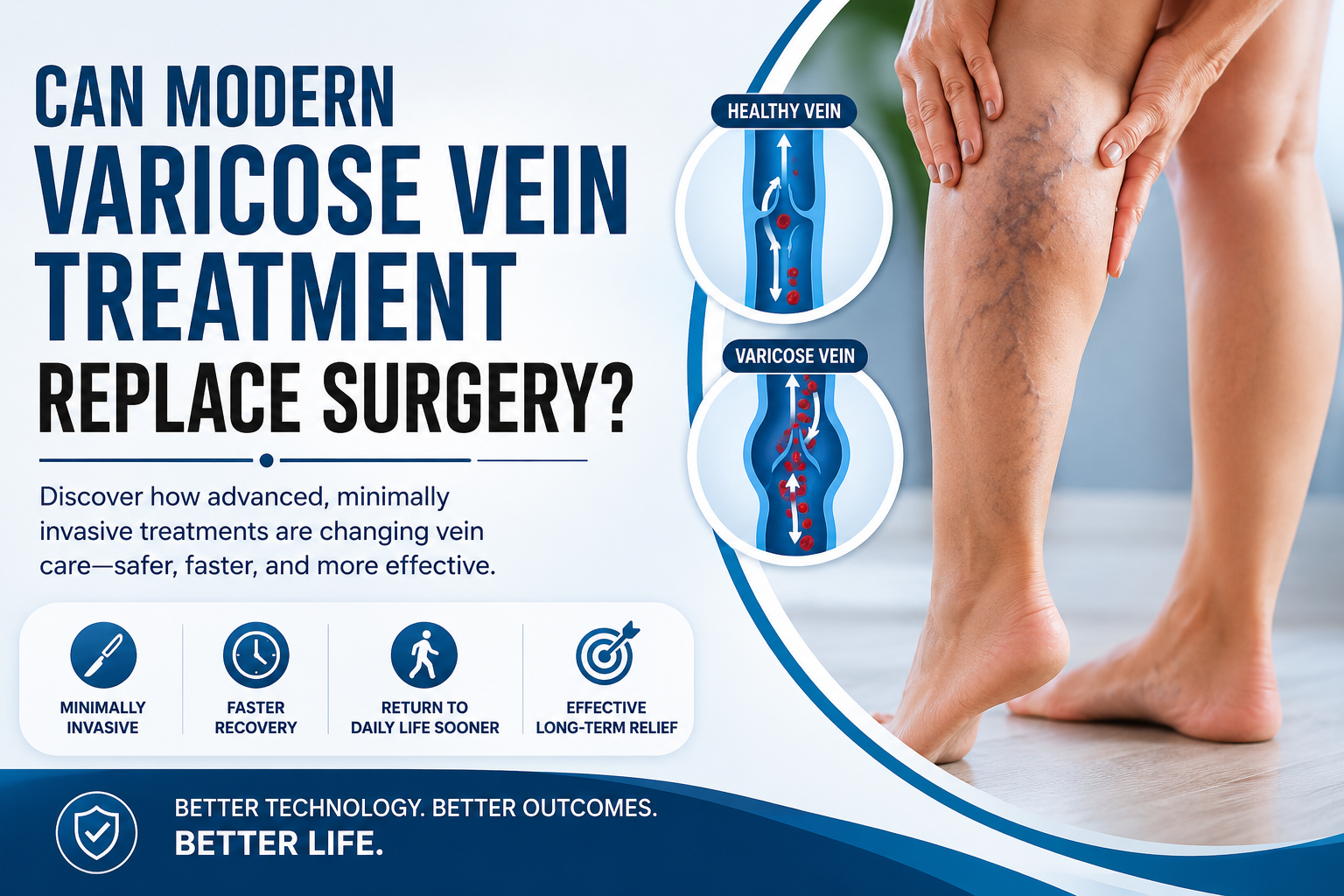
Can Modern Varicose Vein Treatment Replace Surgery?

Yes, modern varicose vein treatment has replaced traditional surgery for many patients with symptomatic vein disease. Advances in minimally invasive procedures now allow doctors to treat damaged veins without the large incisions once required for vein stripping surgery. Today, treatments such as Endovenous Laser Ablation (EVLA), Radiofrequency Ablation (RFA), Venaseal, and Foam Sclerotherapy are commonly recommended because they target the underlying circulation problem while offering shorter recovery times and less disruption to daily life.
Many people still believe surgery is the only way to treat varicose veins. While surgery remains appropriate in selected situations, it is no longer the first option for many patients. Modern imaging and minimally invasive technology have changed the way vein disease is managed. Understanding how varicose veins treatment has evolved helps explain why surgery is needed far less often than it was in the past.
How Was Varicose Vein Disease Treated in the Past?
For many years, vein stripping surgery was the standard treatment for symptomatic varicose veins.
The procedure involved removing the diseased vein through surgical incisions.
Although effective, surgery generally required:
-
Larger incisions
-
More tissue disruption
-
Longer recovery
-
More postoperative discomfort
As medical technology advanced, doctors began developing treatments that could close diseased veins without removing them.
This shift has significantly changed modern vein care.
Why Have Minimally Invasive Treatments Become More Common?
Modern treatments focus on correcting abnormal blood flow instead of surgically removing the vein.
The body naturally redirects blood through healthier veins after the diseased vein is closed.
According to the National Institute for Health and Care Excellence (NICE), endothermal ablation techniques are commonly recommended as first-line treatment for suitable patients with symptomatic varicose veins.
Because these procedures require only a small puncture rather than surgical incisions, recovery is often faster.
What Is Endovenous Laser Ablation (EVLA)?
EVLA is one of the most widely used minimally invasive treatments.
A thin laser fibre is inserted into the affected vein using ultrasound guidance.
Laser energy heats the vein wall, causing it to seal closed.
Once the vein is closed:
-
Blood naturally flows through healthier veins.
-
Venous pressure decreases.
-
Symptoms gradually improve.
Many patients return to normal daily activities relatively quickly after treatment.
How Does Radiofrequency Ablation Work?
Radiofrequency Ablation (RFA) works in a similar way.
Instead of laser energy, controlled radiofrequency heat is used to close the diseased vein.
The objective remains the same:
-
Eliminate abnormal blood flow.
-
Improve circulation.
-
Reduce symptoms.
-
Avoid traditional surgery.
According to the Society for Vascular Surgery, both EVLA and RFA are established minimally invasive treatments for chronic venous disease.
What Is Venaseal?
Venaseal is another minimally invasive option.
Rather than using heat, this procedure uses a specially designed medical adhesive to seal the affected vein.
Because thermal energy is not used, the procedure follows a different treatment approach while still restoring healthier venous circulation.
Whether Venaseal is appropriate depends on:
-
Vein anatomy
-
Ultrasound findings
-
Individual patient characteristics
Not every patient is a candidate for every treatment.
Is Foam Sclerotherapy Still Used?
Yes.
Foam Sclerotherapy remains an important treatment option.
A specially prepared foam solution is injected into the affected vein, causing the vein walls to collapse and gradually be absorbed by the body.
Doctors commonly recommend Foam Sclerotherapy for:
-
Smaller varicose veins
-
Residual veins after other procedures
-
Selected patients based on ultrasound findings
The most suitable treatment depends on the individual pattern of vein disease.
Does Every Patient Still Need Surgery?
No.
Many patients can now be successfully treated without traditional surgery.
However, surgery may still be considered in certain situations when minimally invasive techniques are not the most appropriate option.
Doctors evaluate:
-
Ultrasound findings
-
Vein anatomy
-
Symptom severity
-
Previous treatments
-
Overall health
The decision is based on achieving the safest and most effective long-term outcome.
How Do Doctors Decide Which Treatment Is Best?
The appearance of the veins alone is not enough.
Doctors perform a duplex ultrasound to determine:
-
Which veins are damaged
-
Where blood is flowing backward
-
The severity of venous reflux
-
Which treatment offers the best outcome
Personalized treatment planning ensures that the procedure matches the patient's specific vein anatomy and symptoms.
What Are the Benefits of Modern Treatment?
Compared with traditional surgery, minimally invasive procedures often provide:
-
Smaller puncture sites
-
Less tissue disruption
-
Faster recovery
-
Earlier return to daily activities
-
Effective treatment of venous reflux
The goal is not simply improving appearance but restoring healthier blood circulation while minimizing recovery time.
Conclusion
Modern varicose vein treatment has transformed the way chronic venous disease is managed. For many patients, minimally invasive procedures such as EVLA, RFA, Venaseal, and Foam Sclerotherapy can effectively treat the underlying circulation problem without the need for traditional vein stripping surgery. Although surgery still has a role in selected cases, it is no longer the routine treatment it once was.
The encouraging news is that modern imaging allows doctors to choose the most appropriate treatment based on each patient's individual vein anatomy and symptoms. Early evaluation provides more options and helps address vein disease before long-term complications develop. Those interested in learning more about minimally invasive vein care can consult the best doctor for varicose veins in jaipur to understand which treatment approach may be most suitable.
Frequently Asked Questions
Has modern treatment replaced varicose vein surgery?
For many patients, yes. Minimally invasive procedures are now commonly recommended instead of traditional vein stripping surgery.
Is laser treatment considered surgery?
Endovenous Laser Ablation is a minimally invasive procedure rather than traditional open surgery.
Can everyone avoid surgery for varicose veins?
Not always. The most appropriate treatment depends on ultrasound findings, vein anatomy, symptoms, and overall health.
How do doctors decide between different treatments?
Doctors use duplex ultrasound, symptom assessment, and vein anatomy to recommend the most suitable treatment for each patient.
Are minimally invasive treatments effective?
Yes. Modern minimally invasive procedures are widely used to treat symptomatic varicose veins and restore healthier blood flow while reducing recovery time.


