
Circuit Breaker Keeps Tripping? Here's What It's Actually Telling You

Most people don't think about their electrical panel until something stops working. The lights go dark, half the kitchen loses power, you walk over, flip the switch back, and move on with your day. Do that once and it's nothing. Do it three times in a week, and it's a different story.
A circuit breaker is a safety device first. Its only job is cutting power before something on that line gets dangerous. When it trips, it isn't malfunctioning. It's working.
What actually causes a breaker to trip
Three things cause most repeat trips.
An overloaded circuit is the simplest one. Too many appliances pulling power off the same line at once, and the breaker hits its limit and shuts down. A 20-amp circuit breaker can only carry so much before it cuts out, and that's by design, not a flaw.
A short circuit is more serious. Somewhere in the wiring, a hot wire is making contact with a neutral wire it shouldn't be touching, and that creates a sudden spike the breaker has to stop. If you smell something off or notice scorch marks near an outlet, this is probably what's happening, and it's worth calling an electrician near you rather than guessing.
A ground fault works similarly, except the hot wire is touching a grounded surface instead, a damp wall, a metal box, or water. That's why kitchens and bathrooms are required to have GFCI protection.
If your breaker trips the moment you reset it, with nothing even plugged in, stop resetting it. That's not an overload. Something in the wiring is actively wrong, and forcing it back on repeatedly just adds heat to a problem that's already there.
Resetting a breaker the right way
Most people reset a tripped breaker wrong, then wonder why it trips again immediately.
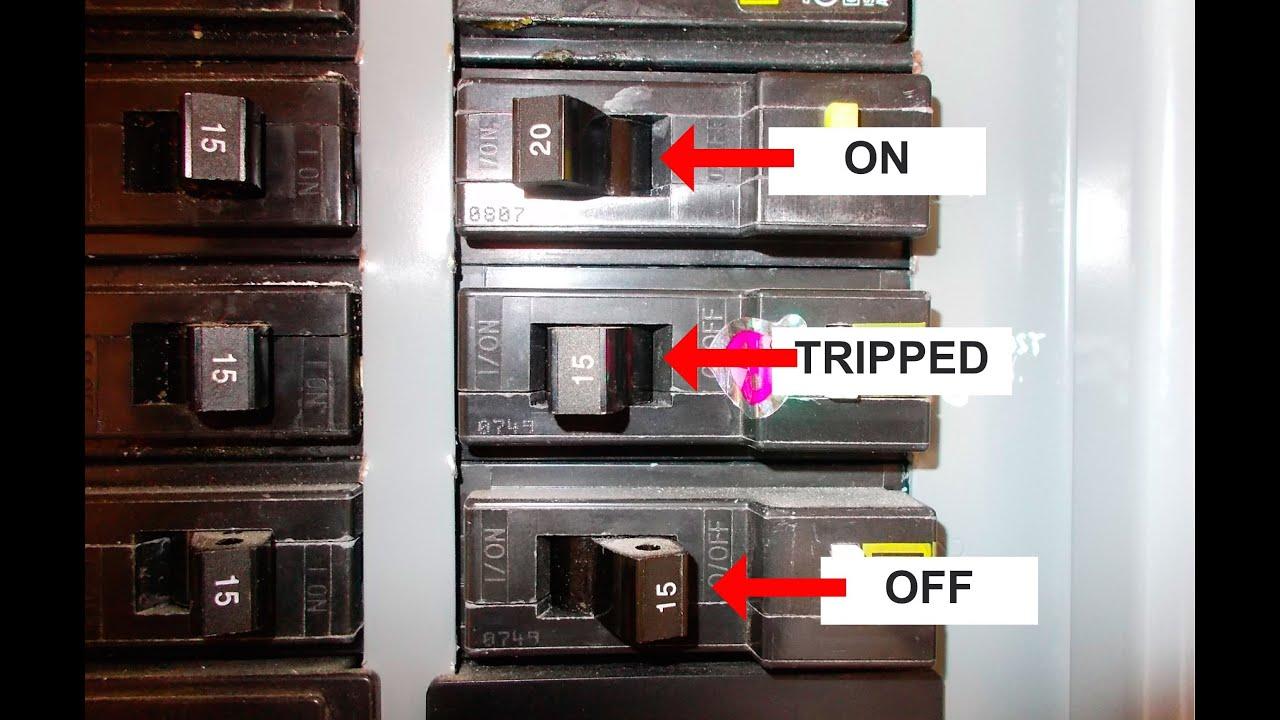
First, unplug whatever's on that circuit. Don't reset it with the load still attached. Open the panel and find the breaker sitting in the middle position, not fully off, not fully on.
Push it all the way to off first. Then push it on. You should feel it click into place. Going straight from the middle to on, skipping the off step, is the most common mistake, and it's also why people assume their breaker is faulty when it isn't.
If it holds, bring appliances back one at a time. If it trips again with nothing connected, the problem is in the wiring itself, not whatever you had plugged in.
Matching the breaker to the circuit
Amperage is just how much current a line can safely carry, nothing more complicated than that.
A 20-amp circuit breaker covers most bedrooms and living spaces. Kitchens usually need a 30-amp breaker for bigger countertop appliances. Air conditioners, electric dryers, and water heaters tend to call for a 40-amp breaker. Electric ranges and EV chargers often need 60 amps or more.
Putting a 60 amp breaker on wiring rated for 20 amps doesn't make the circuit safer. It does the opposite. The breaker won't trip when it should, and that's how house fires start. Always match the breaker to the wire gauge, not to whatever appliance you're trying to run.
Fuse box or circuit breaker panel?
Older homes, especially anything built before the 1960s or 70s, sometimes still run on fuses instead of breakers.
The difference is simple. A fuse blows once and gets thrown away. A breaker trips and resets. Both do the same basic job, but a modern circuit breaker panel is more convenient and usually has better safety features built in. If your house still has a fuse box, it's worth getting a quote on upgrading. Older systems weren't built for how much power a modern home actually draws, and some insurers have started asking about it during renewals.
Does the brand of breaker actually matter?
In most cases, yes, especially once you're dealing with higher loads.
ABB breakers have a solid reputation across both industrial and residential setups. Siemens sits in the same tier. The Siemens 20-amp arc fault breaker in particular is built to catch arc faults, which standard breakers usually miss entirely, and arc faults are a real cause of house fires.
For bigger jobs, like a main panel feed or a subpanel connection, a Siemens 100 amp breaker is a common choice. Arc fault protection is also becoming code-required in more places, so if your panel is older, there's a decent chance it doesn't have any.
Should you replace a breaker yourself?
Probably not, and here's why. The main lugs at the top of a panel stay energized even when the main breaker is off. That's still live, dangerous voltage, no matter what you've switched off. People get hurt assuming the whole panel is dead when it isn't.
Buying the correct replacement breaker yourself before an electrician shows up is fine, and it can actually save time on the visit. Gobreaker carries the full range, so you're not stuck waiting on a special order. But the actual swap inside a live panel is where you want a licensed electrician handling it, not a weekend project.
What is a circuit breaker finder, and do you need one?
If your panel isn't labeled, and a lot of older ones aren't, a breaker finder is genuinely worth having.
It's two pieces. One plugs into the outlet you're trying to identify; the other scans the panel until it picks up a match. It beats the old method of flipping breakers one at a time while someone yells from another room. They're inexpensive, and the first time you actually need one, it pays for itself.
The bottom line
A breaker that keeps tripping isn't being difficult. It's telling you something: an overload, a short, a ground fault, or just a breaker that's worn out after enough years on the job. Ignoring it doesn't make the cause go away. It just delays whatever happens next.
Whether you need a 20 amp breaker for a bedroom circuit, a 40 amp breaker for an AC unit, or a Siemens 100 amp breaker for a main feed, Gobreaker stocks the parts. Get the right one before the electrician arrives, and let them handle the install.
FAQs
Why does my breaker keep tripping with nothing plugged in?
That usually points to a wiring fault somewhere in the line itself, either a short or a ground fault. It's worth calling an electrician rather than continuing to reset it.
How do I know if I need a 30-amp or 60-amp breaker?
Match it to the wire gauge already running that circuit. Your electrician can confirm the rating, or it may be printed on the wire's insulation.
Can I replace a circuit breaker myself?
Technically yes in some areas, but the main bus bars inside the panel stay live even with the main breaker off. Most people are better off hiring a licensed electrician for the actual installation.
What makes the Siemens 20-amp arc fault breaker different from a standard one?
It's built to detect arc faults, a leading cause of electrical fires, that ordinary breakers don't catch.
How long does a circuit breaker actually last? Most decent breakers last 25 to 40 years under normal use. Repeated tripping wears them out faster than that.
What's the real difference between a fuse and a circuit breaker?
A fuse burns out and has to be replaced every time. A breaker trips and resets, which is more convenient and generally considered safer for modern household loads.
When is it time to upgrade the whole panel?
If it's over 25 years old, still runs on fuses, or trips often enough that it's become a routine annoyance, it's worth having an electrician look at a full upgrade.


