
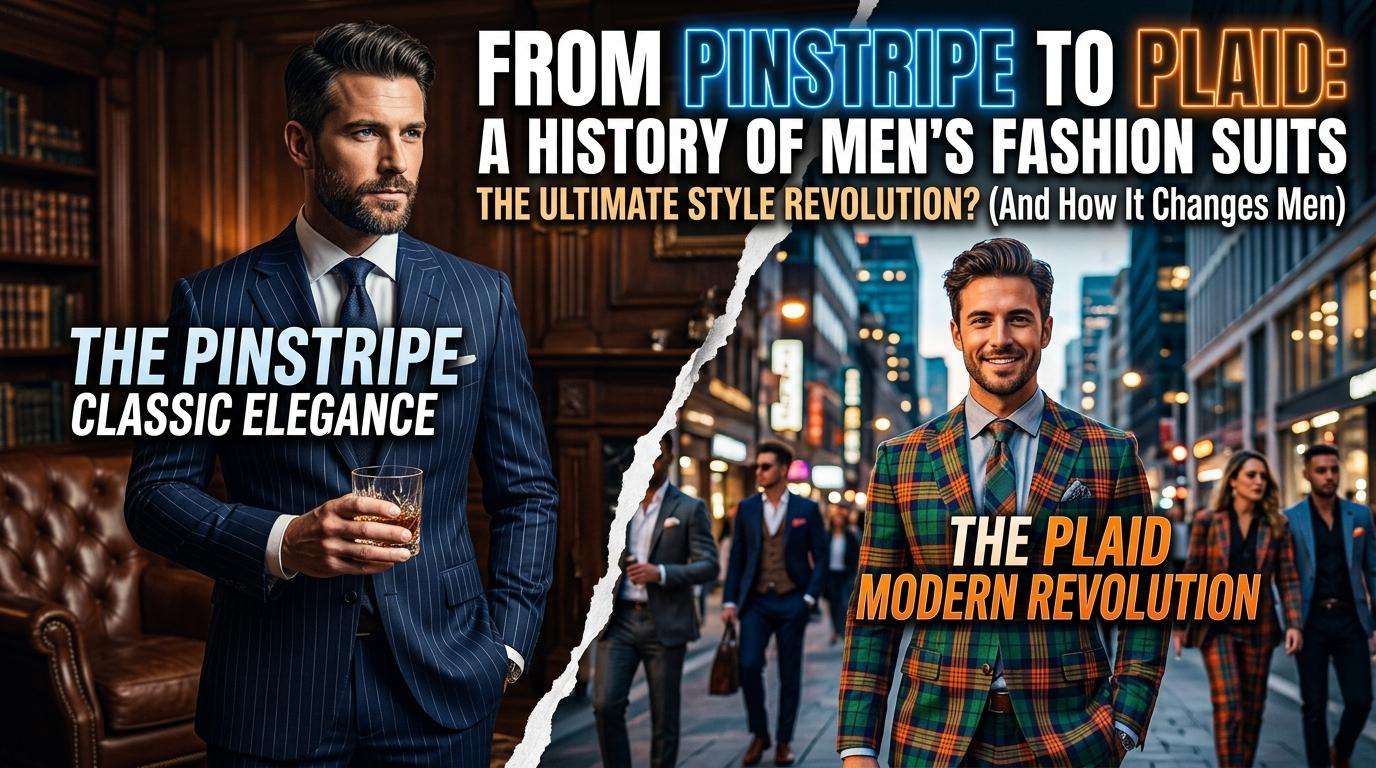
From Pinstripe to Plaid: A History of Men's Fashion Suits
Threads Through Time: The Fascinating Evolution of Men's Fashion Suits
The suit is the most enduring garment in the history of men's fashion. It has survived world wars, cultural revolutions, the rise and fall of countless trends, and repeated declarations of its own death and it has emerged from each of those challenges not just intact but often stronger and more relevant than before. Understanding how the suit evolved from its origins to its current form isn't just an exercise in fashion history it's a window into how society itself has changed, what men have valued at different moments in history, and how clothing communicates power, identity, and culture.
This is the story of the suit: where it came from, how it changed, and why it still matters in 2025.
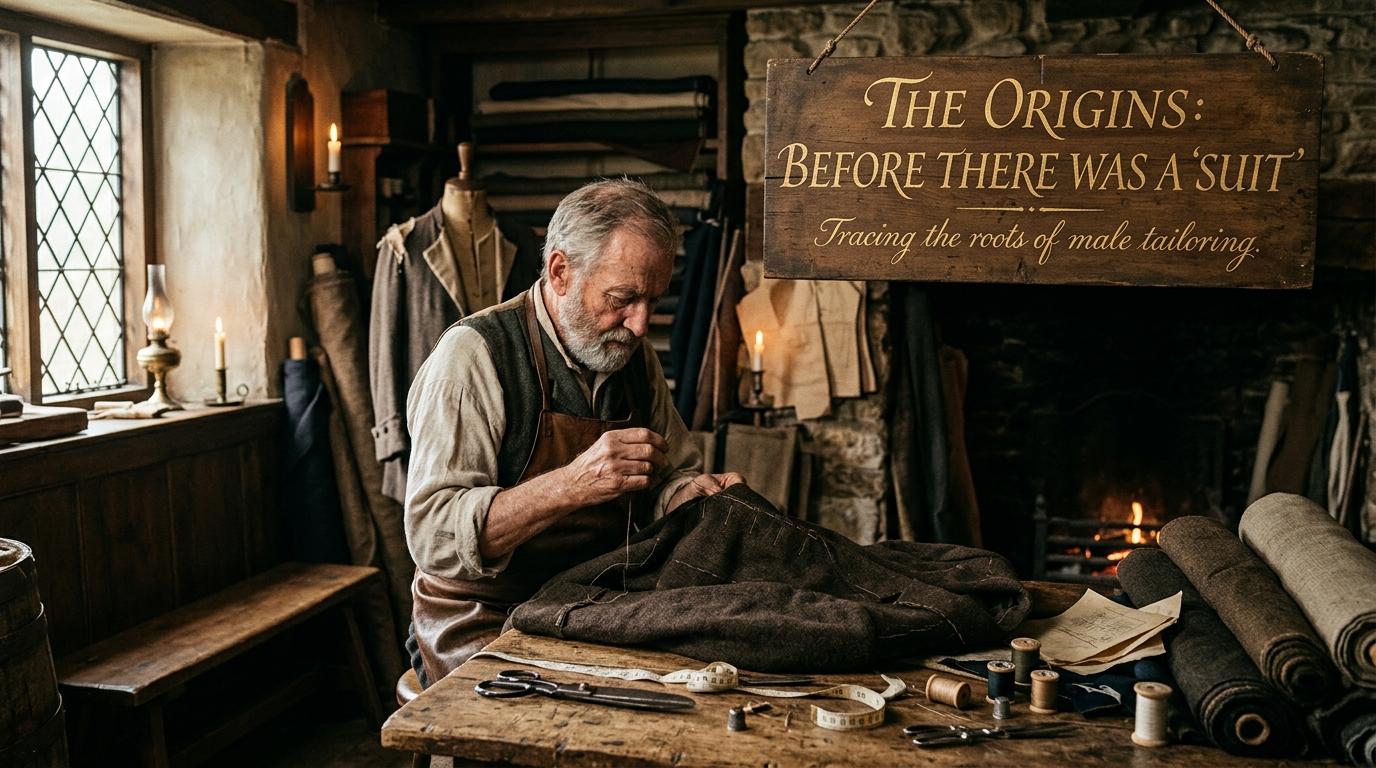
The Origins: Before There Was a "Suit"
The concept of a coordinated set of garments for men jacket, trousers, and waistcoat made from matching fabric didn't appear fully formed. It evolved gradually from the 17th century court fashions of Europe, where the "justaucorps," a long knee-length coat, was worn with matching breeches and waistcoat by aristocratic men at the French and English courts.
By the late 18th century, the influence of the British country gentleman was reshaping men's fashion. The tailcoat cut away in front to allow freedom of movement for riding replaced the long justaucorps in fashionable circles. This garment, worn with waistcoat and knee breeches, is recognizable as an ancestor of the modern suit even if its silhouette seems theatrical by today's standards.
The real revolution came in the early 19th century, when the lounge suit the direct predecessor of the modern business suit began to emerge as a more casual alternative to formal tailcoats. It was originally considered too informal for serious occasions. Within decades, it would become the defining garment of the modern man.
The Victorian Era: Formality, Restraint, and the Birth of the Business Suit
The Victorian period cemented the suit as the respectable uniform of professional men. Dark wool in navy, charcoal, and black dominated. The silhouette was structured and formal high buttoning jackets, stiff collars, and waistcoats worn as standard. The idea that a respectable man should dress with sober restraint was deeply embedded in Victorian values, and mens fashion suits of this era reflect that cultural moment precisely.
The frock coat and the morning coat were the formal standards for daytime wear among the upper and middle classes. The lounge suit continued to gain respectability as an option for less formal occasions, and by the end of the 19th century, it had established itself as a legitimate garment for professional men rather than simply casual wear.
Fabrics in this era were heavy thick wool broadcloths and tweeds that provided warmth and durability but little in the way of lightness or comfort. Patterns began to appear: subtle stripes, windowpane checks, and the early versions of the pinstripe that would become one of the most iconic patterns in men's suit history.
The Edwardian Era and the Early 20th Century: Elegance Reaches Its Peak
The Edwardian period roughly 1900 to 1910 is often considered the golden age of tailoring. Savile Row in London reached the height of its influence during this period, dressing royalty, aristocracy, and the aspirational middle classes in suits of extraordinary craft and refinement. The silhouette was elegant and sculptural nipped waists, structured chests, and carefully shaped shoulders created a silhouette that emphasized masculine elegance without excess.
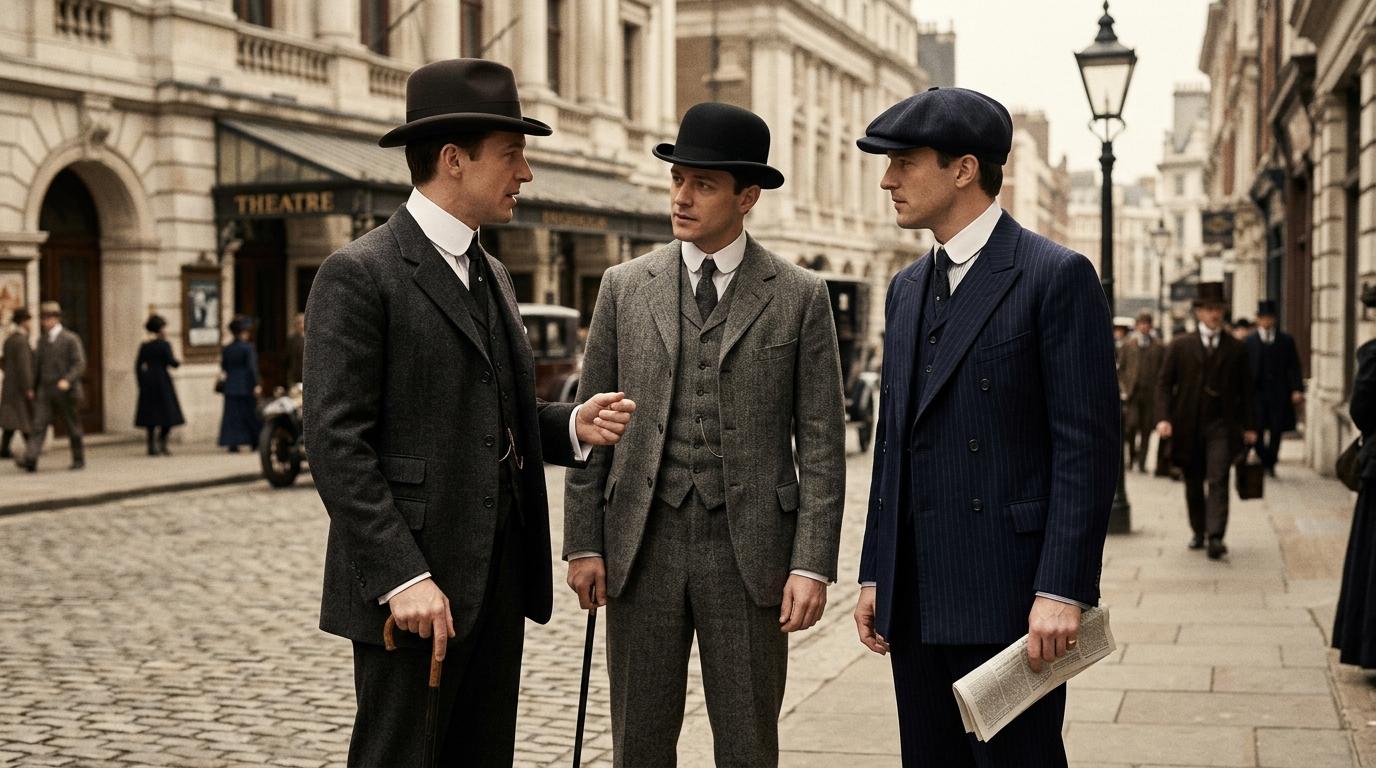
The pinstripe suit emerged as a symbol of financial authority during this period. Worn by bankers, lawyers, and businessmen in the City of London and on Wall Street, the pinstripe communicated seriousness, credibility, and economic power. It was functional dress code signaling made manifest in fabric and thread and it has maintained that association across more than a century of mens fashion suits history.
The 1920s and 1930s: Hollywood, Jazz, and the Suit as Cultural Symbol
The period between the two world wars produced some of the most distinctive and influential suit styles in history. The 1920s brought broader shoulders, wider lapels, and a relaxation of Victorian stiffness. The suit became associated not just with professional respectability but with style, personality, and cultural aspiration.
Hollywood's golden age played a decisive role. Film stars like Cary Grant, Fred Astaire, and Gary Cooper appeared on screen in impeccably tailored suits that millions of American men wanted to emulate. The suit became aspirational in a new way not just a professional uniform but a symbol of elegance and sophistication that any man might achieve.
It was also during this period that the Zoot suit emerged from African American and Latino communities, primarily in urban centers like Harlem, Los Angeles, and Chicago. The Zoot suit characterized by its dramatically oversized jacket with wide, padded shoulders, extremely wide peak lapels, and high-waisted, wide-legged trousers that tapered sharply at the ankle was a radical departure from the conventional suit silhouette. It was deliberately excessive, a theatrical rejection of mainstream restraint that communicated cultural pride, individuality, and defiance. The Zoot suit became so culturally charged that it was literally outlawed in some cities during World War II, when its extravagant use of fabric was framed as unpatriotic in the context of wartime rationing. The Zoot suit riots of 1943 in Los Angeles were a flashpoint of racial and cultural tension that revealed how powerfully clothing can function as political statement.
The Post-War Era: The Grey Flannel Suit and Corporate Conformity
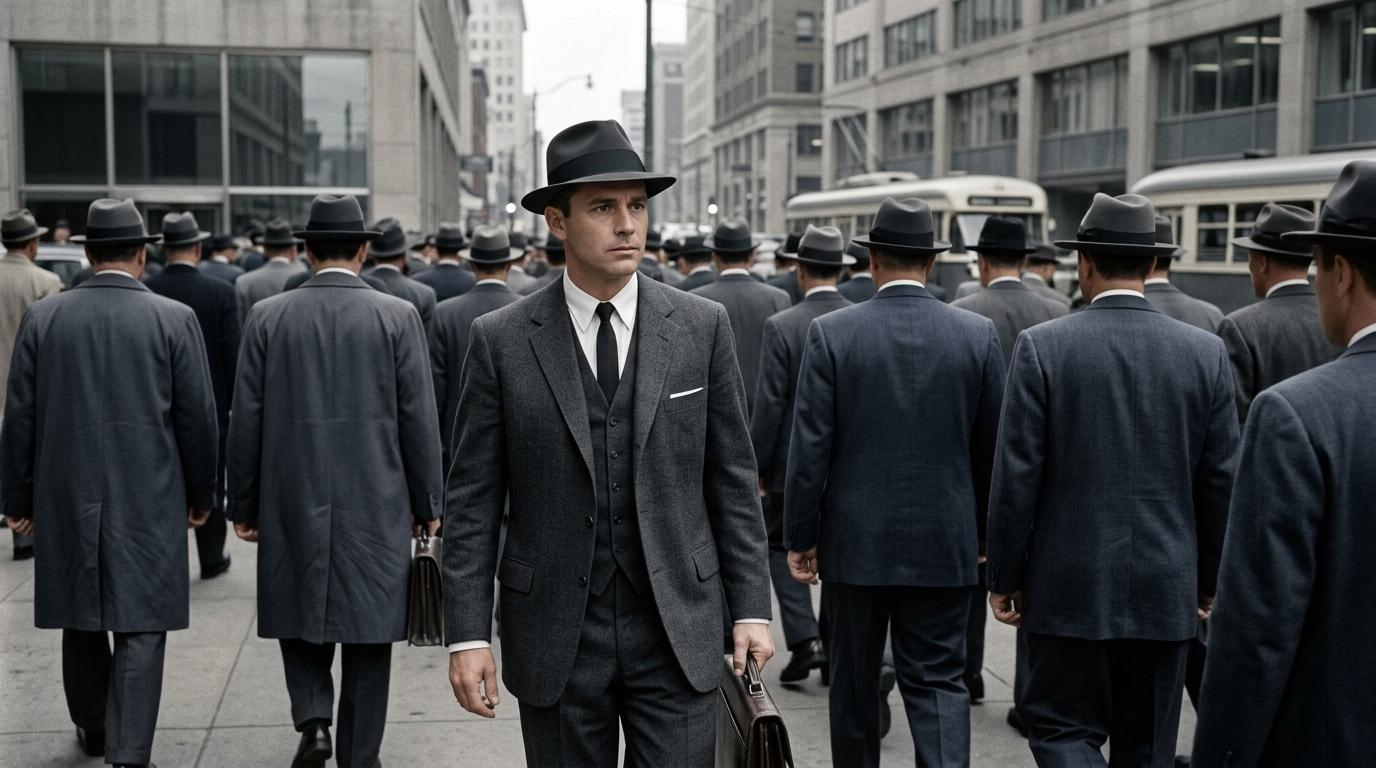
The post-World War II period produced one of the most culturally significant suit moments in history. The gray flannel suit became the uniform of corporate America the visual symbol of the conformist, organization-man culture that dominated professional life in the 1950s. Slim, conservative, and deliberately unremarkable, the gray flannel suit represented the subordination of individual expression to collective professional identity.
The novel and film "The Man in the Gray Flannel Suit" captured this cultural moment perfectly, using the garment as a metaphor for the pressures and compromises of postwar American professional life. This was the suit as constraint rather than expression powerful in its cultural reach, sobering in what it revealed about the relationship between clothing and social conformity.
The 1960s and 1970s: Rebellion, Revolution, and the Mod Suit
The 1960s blew the conservative suit aesthetic apart. The Mod movement in Britain centered in London's Carnaby Street and influenced by designers like Pierre Cardin and Hardy Amies produced slim, often collarless suits in bold colors and unconventional patterns. The Beatles wore Mod suits that appeared on television screens and magazine covers around the world, instantly making this new aesthetic globally visible.
Lapels widened dramatically through the late 1960s and into the 1970s, reaching almost comical proportions by the mid-decade. Plaid suits bold, pattern-heavy, and unapologetically visible became fashionable in a way that would have been unthinkable in the conservative 1950s. The suit was being reclaimed as a vehicle for personal expression rather than corporate uniformity.
The Power Suit Era: The 1980s and Dominant Masculinity
The 1980s produced the power suit broad shoulders, strong structure, bold colors, and an aggressive silhouette that communicated ambition and dominance. This was the era of Wall Street excess, and mens fashion suits of the period reflected the cultural values of that moment with remarkable precision. Double-breasted suits returned with authority. Pinstripes came back bolder. The suit became a vehicle for projecting power in a decade that celebrated power above almost all other values.
The 1990s Through the 2000s: Minimalism, Casualization, and Survival
The 1990s brought a reaction against 1980s excess. Suits became slimmer, simpler, and more restrained. At the same time, the rise of Silicon Valley casual culture began to genuinely threaten the suit's dominance in professional environments for the first time. Tech entrepreneurs deliberately rejected suits as a symbol of the old corporate order, and as their cultural influence grew, the suit's position as the default professional uniform became genuinely contested.
The suit survived this challenge by adapting becoming more casual in its styling, more flexible in its application, and more varied in its interpretation.
The Modern Era: The Suit Reimagined for Individual Expression
Today, the men's fashion suit exists in a state of extraordinary diversity. Slim and trim cuts coexist with wider, more relaxed silhouettes. Heritage patterns like plaid, windowpane, and pinstripe continue to appear alongside bold solid colors and unconventional fabrics. The suit has been reclaimed by streetwear culture, absorbed into athleisure aesthetics, and deconstructed by avant-garde designers and through all of it, its essential character remains intact.
The suit in 2025 is whatever the man wearing it needs it to be professional armor, personal statement, cultural reference, or artistic canvas. That flexibility is exactly what has kept it relevant across four centuries of men's fashion.
MensUSA: Where Suit History Meets Modern Excellence
For men who appreciate the rich history of mens fashion suits and want to wear that heritage with contemporary confidence, MensUSA offers a collection that honors the craft while embracing the present. From classic pinstripe and windowpane suiting to bold modern colors and custom suits for men that bring the bespoke tradition to accessible price points, MensUSA gives every man the tools to write his own chapter in the long, extraordinary story of the suit.


