
Test Match Rain Delay Calculator: Predict Remaining Overs & Session Times

Why Test Cricket Has No DLS and Why That Matters
Every cricket fan knows about the Duckworth-Lewis-Stern (DLS) method, but DLS only applies to limited-overs cricket ODIs and T20s. In Test cricket, there is no revised target, no resource percentage, no mathematical rebalancing. When rain arrives in a Test match, both sides simply lose the same irreplaceable asset: time.
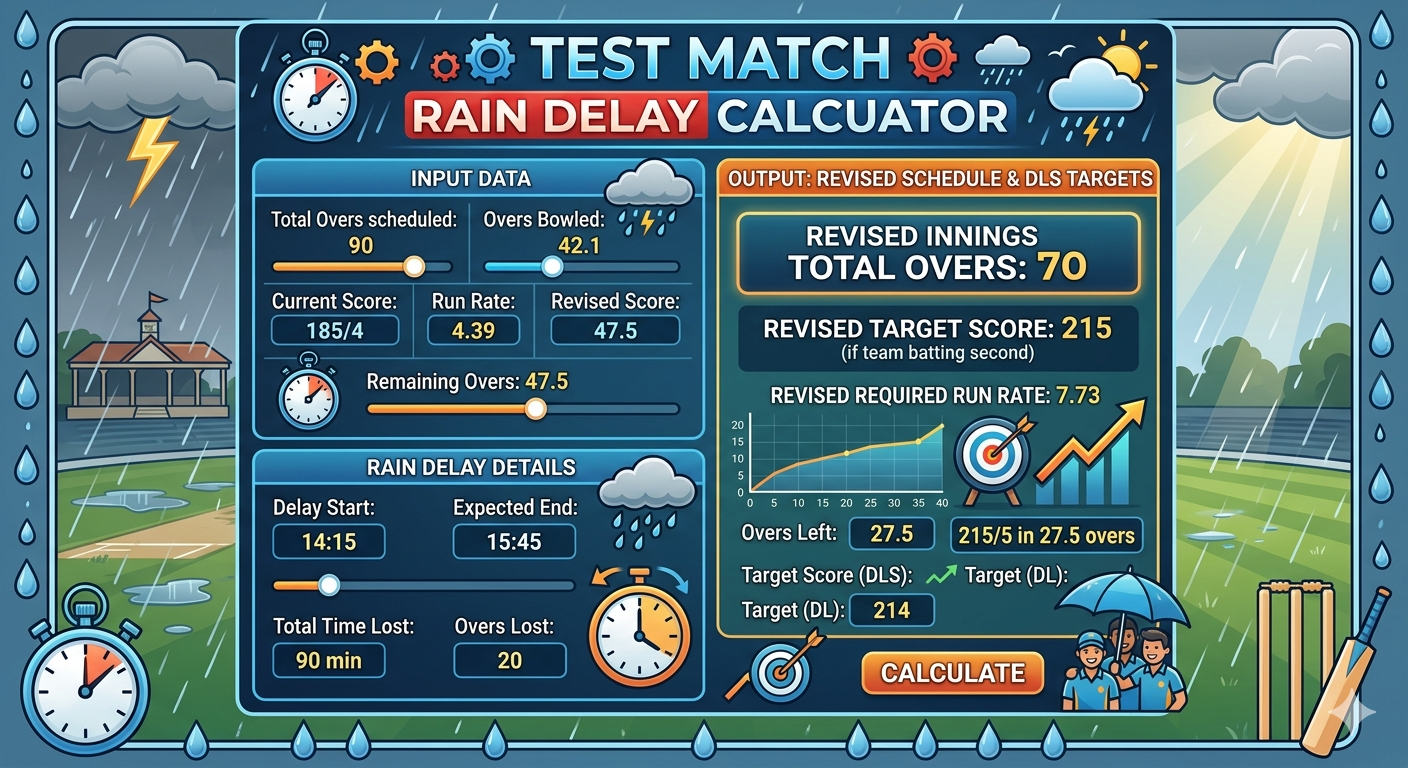
This is what makes a test match rain delay calculator fundamentally different from its ODI equivalent. The calculation is deceptively simple how many overs can be bowled in the time remaining yet the strategic implications ripple across batting orders, declaration timing, WTC points, and series outcomes.
How the Test Match Rain Delay Rules Actually Work
Before you use any calculator, you need to understand the official ICC framework. The ICC Men's Test Match Playing Conditions (last updated June 2025) govern every aspect of weather interruptions. Here is the complete step-by-step protocol:
Umpires Assess the Conditions
When rain begins, or when light deteriorates below safe playing conditions, the on-field umpires take the players off the field. Both conditions rain and bad light are treated separately under the Laws. Rain stops play when it is heavy enough to endanger player safety or render the outfield slippery. Bad light is assessed by the umpires independent of rain.
The Outfield Must Be Safe Not Just Dry
This is the rule that most fans misunderstand. Play does not resume the moment rain stops. The outfield must be assessed as safe for fielding meaning no standing water, no dangerous slippery patches, and no risk of injury from diving or changing direction. In damp English or New Zealand conditions, this assessment alone can add 20 to 45 minutes to an already lengthy delay.
The 15-Overs-Per-Hour Formula
ICC playing conditions set the standard over rate at 15 overs per hour. This is the key figure in every test match rain delay calculator. If rain costs one hour of play, approximately 15 overs are lost. Two hours of rain costs around 30 overs. That is roughly one full session of Test cricket, gone permanently from the match.
The 30-Minute Extension Rule
ICC rules permit play to be extended by up to 30 minutes beyond the scheduled close of play on any given day but only to recover overs lost to bad weather. This extension cannot be used to manufacture more favourable conditions for one side; it is strictly compensatory. On Day 5, this extension becomes one of the most contested moments in cricket.
Minimum 15 Overs in the Final Hour
In the final session of the fifth day, a minimum of 15 overs must be bowled regardless of the scheduled close time. This rule exists specifically to prevent teams from bowling slowly to run down the clock in rain-shortened scenarios. Failure to maintain over rate carries ICC penalty points and WTC point deductions.
Overs Lost by Rain Duration Quick Reference Guide
Use this table as your instant reference for any live Test match. The figures assume the ICC standard rate of 15 overs per hour and apply to all formats of Test cricket including the World Test Championship.
| Rain Duration | Overs Lost (Est.) | Sessions Lost | Effect on Day |
|---|---|---|---|
| 30 minutes | 7–8 overs | Less than 1 | Minor. Day still largely complete. |
| 1 hour | ~15 overs | Half a session | Moderate. Extension may recover 10–12 overs. |
| 2 hours | ~30 overs | 1 full session | Significant. Draw risk rises sharply on Days 4–5. |
| 3 hours | ~45 overs | 1.5 sessions | Severe. Only one session of cricket likely on the day. |
| 4+ hours / Full day | 75–90 overs | Full day lost | Match effectively lost. Result almost impossible from Day 4. |
Rain Risk by Test Venue 2025–26 WTC Cycle
Not every Test match ground carries the same rain risk. The current World Test Championship cycle (2025–2027) includes venues with dramatically different weather profiles. Here is an expert breakdown:
May–Oct Winter (dry)
| Venue / Country | Peak Wet Season | Avg Days Rain (Test Month) | Delay Risk |
|---|---|---|---|
| Lord's / Edgbaston, England | Year-round | 10–14 days | Very High |
| Basin Reserve, New Zealand | Oct–Apr | 10–13 days | High |
| Mirpur / Sylhet, Bangladesh | 12–18 days | High | |
| Galle / SSC, Sri Lanka | May–Aug | 12–16 days | Medium |
| Kensington / Sabina, West Indies | Jun–Nov | 10–14 days | Medium |
| MCG / SCG, Australia | Dec–Feb | 5–8 days | Low |
| Eden Gardens / Wankhede, India | Outside monsoon | 2–5 days | Low |
| Newlands / SuperSport, South Africa | 2–4 days | Low |
Rain Delays and the World Test Championship
The WTC 2025–2027 cycle has introduced a sharper points system that makes rain delays more consequential than ever before. Under the current ICC structure, a match result carries the following WTC points allocation:
ICC World Test Championship Points Rain Draw Implications
- Win: 12 points to the victorious side, 0 to the losing side.
- Draw (including rain-affected draws): 4 points to each side.
- Tie: 6 points each.
- Over-rate deduction: 1 point deducted per over behind the required rate at the end of a match rain sessions are factored into the allowances, but slow bowling is not excused.
- Abandoned match (no balls bowled): 4 points shared, same as a draw, to prevent weather from penalising either side entirely.
This means a single full day of rain at Lord's in a closely contested Ashes Test — a scenario that occurs with alarming regularity can swing the WTC points table by up to 8 points in a context where the qualification margin for the final might be just 10 to 15 percentage points. Rain, under the WTC system, is not just a weather event. It is a points event.
Expert Pro Tips for Fans, Analysts and Bettors
The "Overs Available" Formula
For any live rain delay situation: multiply remaining playing hours by 15 (ICC over rate). Subtract 10–20 overs for outfield drying time on a wet day. The result is a realistic estimate of overs still available in the match. Example: 4 hours left on Day 5, minus 1 hour drying time = 3 hours = ~45 overs.
The Drying Time Variable Nobody Calculates
The single largest content gap in competitor articles is outfield drying time. After rain stops, add 20–40 minutes for a light shower on a prepared ground, 45–70 minutes for a sustained downpour, and up to 120 minutes in venues with poor drainage (notably Mirpur, Sylhet, and many Caribbean grounds). This variable alone is the difference between a result and a draw.
Declaration Timing After Rain
Captains must recalibrate declarations using the exact overs-remaining figure, not intuition. A captain who declares with 60 overs left on a dry Day 5 may need to revisit that number entirely if rain has reduced the effective overs to 35. The test match rain delay calculator exists precisely to help make that recalibration rapidly and accurately.
Bad Light Is Not Rain Track It Separately
Competitors consistently conflate rain delays and bad-light delays. They are separate laws. Bad light can only be offered to batsmen (they can choose to stay on) under Law 2.5 but ICC playing conditions override this in certain circumstances. Bad-light delays are typically shorter than rain delays but can stack consecutively on overcast days in England, New Zealand, and the West Indies.
Use Radar, Not Just Forecasts
Weather forecast apps give probability, not timing. For live Test match delay estimation, use a rain radar tool (Ventusky, Windy, or the BBC Weather radar for England Tests) to track the actual storm cell moving toward the ground. The difference between a 30-minute shower and a 3-hour system is almost always visible on radar 90 minutes before it arrives.
Famous Rain-Hit Tests That Changed Cricket History
The 1939 Timeless Test Rain Ends the Longest Match
The South Africa vs England match in Durban ran for ten scheduled playing days. England, chasing 696, were 654 for 5 and needed just 42 more runs for victory. Rain on Day 9 had already cost a full day. With England needing their boat to depart Durban, the match was abandoned as a draw. It remains the only Test in history where rain literally ended the match by forcing the touring side's departure.
Headingley 2019 Rain Gifted England a Winning Platform
Heavy overnight rain ahead of the final session on Day 4 left Australia unable to bowl on a sticky pitch the following morning. Ben Stokes's remarkable 135 not out, combined with the rain-affected pitch conditions, delivered one of Test cricket's greatest escapes. Weather had shaped every tactical decision from declaration to bowling lineup.
The 2021 Manchester Test Abandonment
The fourth India vs England Test was called off before it started due to COVID-related concerns but the rain at Emirates Old Trafford during that period highlighted exactly how vulnerable Manchester remains as a Test venue, with an average of over 12 rain days during August alone.
📌 Key Takeaways Cite-Worthy Insights
- The test match rain delay calculator is built on one foundational number:15 overs per hourunder ICC playing conditions. Every estimate flows from this figure.
- Outfield drying time after rain is the most underestimated variable in any rain delay calculation it typically adds 20 to 120 minutes beyond the rain stoppage itself.
- Test cricket uses no DLS method. Rain in a Test match costs overs permanently, with no mathematical compensation or revised target.
- The ICC allows a maximum 30-minute daily extension to recover rain-lost overs. On Day 5, this extension can be the difference between a result and a draw.
- Under the WTC 2025–2027 points system, a rain-enforced draw distributes 4 points each identical to any other draw. Qualification margins can swing by 8 WTC points from a single rain-affected Test.
- England, New Zealand, Bangladesh, and the West Indies host the world's most rain-vulnerable Test venues, based on average rainy-day frequency during scheduled Test windows.
- "Rain in a Test match is not just a weather event it is a points event, a tactics event, and a declaration event. Understand the overs math, and you understand the match."
Conclusion: Master the Maths, Master the Match
The test match rain delay calculator is a deceptively simple tool built on a genuinely complex web of ICC rules, venue-specific drainage rates, outfield drying variables, WTC points implications, and tactical decision-making under uncertainty.
The core formula is straightforward: overs remaining = (hours of play left × 15) minus drying time allowance. But applying that formula intelligently factoring in the day of match, the venue's drainage history, the current result position, and the WTC points at stake — is what separates casual spectators from genuine analysts of the game.


