
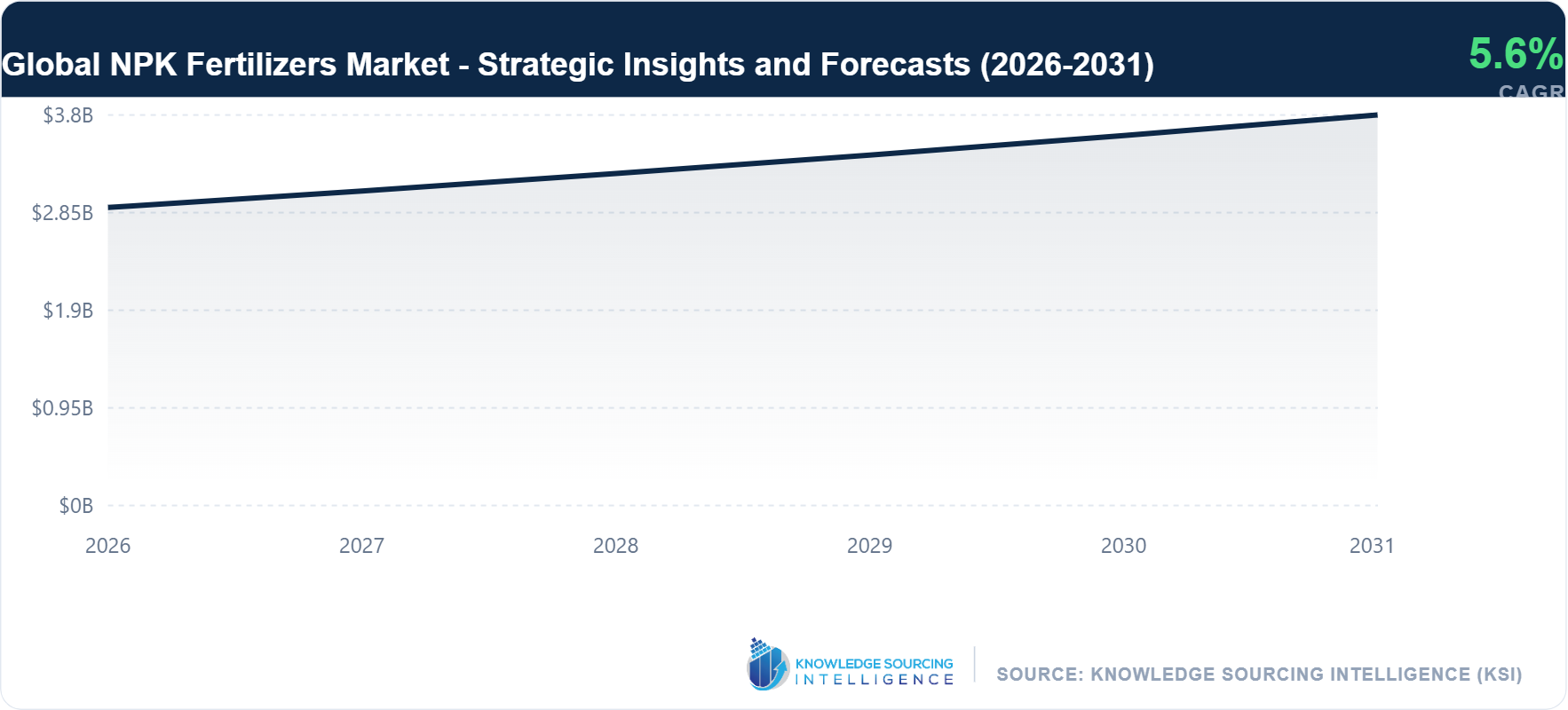
NPK Fertilizers Market to Reach USD 3.8 Billion by 2031, Driven by Rising Demand for Sustainable Agriculture

Noida, India — April 6, 2026 — The NPK fertilizers market is witnessing steady expansion as modern agriculture increasingly depends on balanced nutrient solutions to improve crop productivity. According to a recent study by Knowledge Sourcing Intelligence (KSI), the market is projected to grow from USD 2.9 billion in 2026 to USD 3.8 billion by 2031, registering a compound annual growth rate (CAGR) of 5.6% over the forecast period.
Market Overview
NPK fertilizers—comprising nitrogen (N), phosphorus (P), and potassium (K)—form the backbone of modern crop nutrition strategies. These three macronutrients are essential for plant growth, supporting everything from root development to flowering and disease resistance. As agricultural systems transition toward higher efficiency and sustainability, NPK blends are evolving from standardized formulations to more targeted, crop-specific solutions.
The increasing global population and the need to maximize agricultural output on limited arable land are reinforcing the role of NPK fertilizers as a critical input in food production systems.
Key Growth Drivers
Rising Food Demand and Agricultural Intensification
Growing pressure on global food supply chains is pushing farmers to adopt nutrient-efficient fertilizers that ensure consistent yields. NPK fertilizers offer a balanced nutrient mix, making them indispensable in intensive farming practices.
Shift Toward Precision Agriculture
The market is benefiting from the adoption of precision farming techniques, where fertilizers are applied in controlled quantities to minimize waste and maximize output. Liquid and water-soluble NPK variants are gaining traction due to their compatibility with fertigation systems and advanced irrigation methods.
Innovation in Fertilizer Formulations
Manufacturers are investing in enhanced formulations such as controlled-release fertilizers and micronutrient-enriched blends. These innovations not only improve nutrient-use efficiency but also address environmental concerns associated with excessive fertilizer use.
Market Segmentation Insights
The NPK fertilizers market is segmented across multiple dimensions, including type, crop application, and formulation. Complex NPK fertilizers—offering a combination of nutrients in a single product—continue to dominate due to their efficiency and convenience in large-scale farming.
By crop type, cereals and grains account for a significant share, while fruits and vegetables represent a faster-growing segment, supported by increasing demand for high-value horticulture crops.
Regional Outlook
Asia-Pacific leads the global market, supported by strong agricultural output in countries such as India and China. Government initiatives promoting fertilizer usage and food security programs are further accelerating regional demand. At the same time, developed markets are focusing on sustainable fertilizer solutions and precision agriculture technologies.
Challenges and Market Constraints
Despite strong growth prospects, the market faces several headwinds. Fluctuating raw material prices, environmental regulations, and the emergence of organic and bio-based alternatives may impact adoption rates in certain regions. Additionally, the need for regulatory compliance and sustainable practices is increasing operational complexity for manufacturers.
Competitive Landscape
The NPK fertilizers market is characterized by a mix of global agribusiness giants and regional producers. Companies are competing through product innovation, strategic partnerships, and expansion into emerging markets. Increasing emphasis on sustainability and efficiency is shaping competitive strategies across the value chain.
Conclusion
The NPK fertilizers market is entering a phase of transformation, where efficiency, sustainability, and customization are becoming central to growth. As agricultural systems evolve to meet global food demand, NPK fertilizers will remain a cornerstone of crop nutrition—supported by technological advancements and shifting farming practices.
About Knowledge Sourcing Intelligence (KSI)
Knowledge Sourcing Intelligence (KSI) is a leading provider of market research and strategic insights, offering comprehensive reports across industries. KSI delivers data-driven analysis to help organizations navigate evolving market landscapes and identify growth opportunities.


